
Investing in short-term rentals in non-vacation markets is more resilient to economic downturns than investing in traditional vacation destinations.
AI debate verdict and arguments
⚠️ AI-generated information only; not professional advice
Completed November 13, 2026
Verdict
Verdict: likely FALSE (82%)
Web Report: https://solsice.com/public/debates/investing-in-short-term-rentals-in-non-vacation-markets-is-m-b1b923b4011d
This section provides a brief overview of the key arguments. You do not need to read the full detailed report below.
✅ Key PRO arguments:
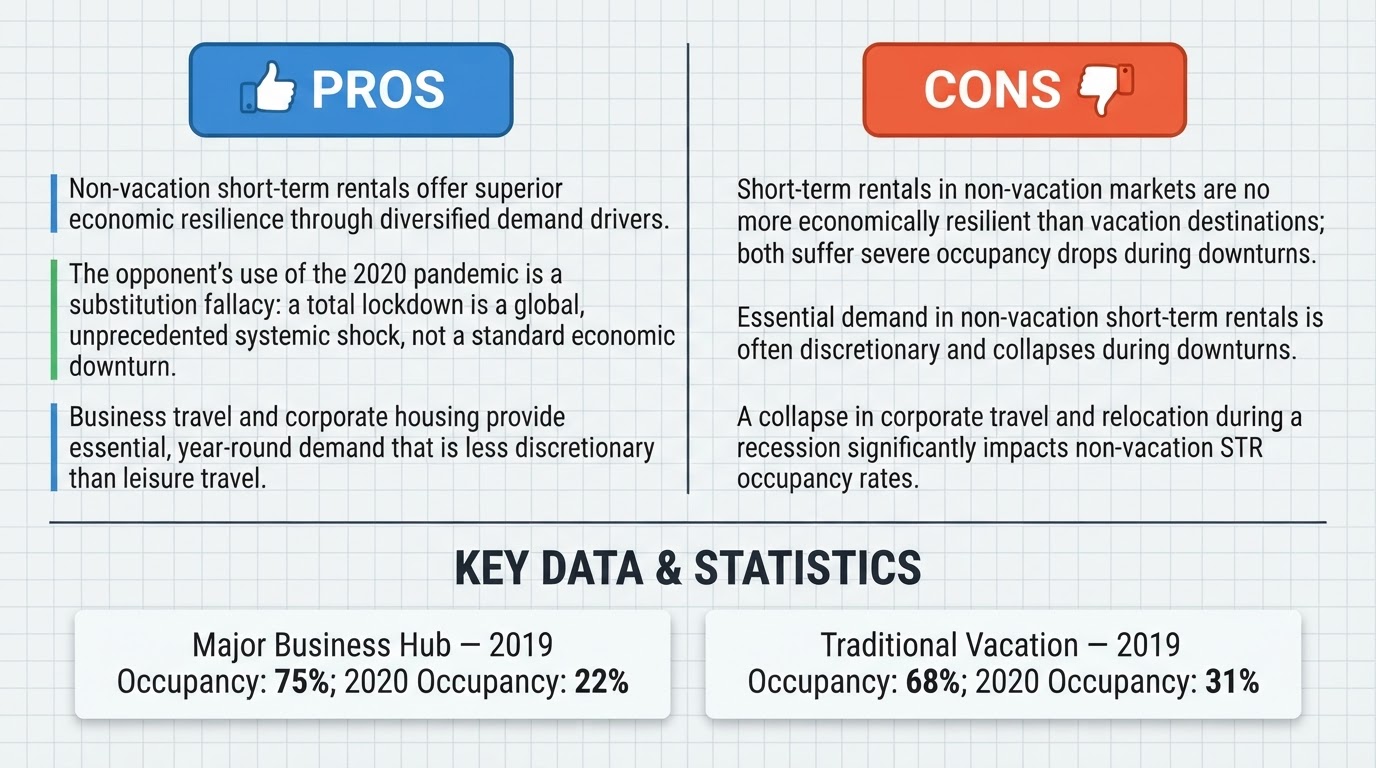
- ■Non-vacation short-term rentals offer superior economic resilience through diversified demand drivers. Non-vacation markets benefit from 'essential' demand, such as business travel , medical stays, and relocation, which is less sensitive to fluctuations in discretionary income than leisure travel . Vacation markets are tied to luxury or discretionary spending, which households cut first during economic downturns, while non-vacation demand creates a floor for occupancy rates.
- ■The opponent's use of the 2020 pandemic is a substitution fallacy: a total lockdown is a global, unprecedented systemic shock , not a standard economic downturn. The collapse of business travel during a pandemic is a unique non-economic driver and does not reflect how business-related short-term rentals respond to ordinary recessions or cyclical contractions in employment.
❌ Key ANTI arguments:
- ■Short-term rentals in non-vacation markets are no more economically resilient than vacation destinations; both suffer severe occupancy drops during downturns. Non-vacation short-term rentals exhibit high correlation with local economic cycles, with business travel and corporate housing demand collapsing first during recessions. During the COVID-19 pandemic, Airbnb occupancy rates in major business hubs like San Francisco and New York fell to as low as 20%, and the National Multifamily Housing Council reported corporate transient housing demand in metropolitan areas dropped by approximately 70% during 2020 lockdowns.
- ■Essential demand in non-vacation short-term rentals is often discretionary and collapses during downturns. Business travel is frequently discretionary for the traveler and highly sensitive to income shocks, making it among the first expenses cut when budgets tighten. In a standard economic downturn, companies reduce travel budgets, leading to cancellations and postponements of meetings, conferences, and site visits.
💭 Conclusion: False — the debate supports that short-term rentals in non-vacation markets are not more resilient to economic downturns than traditional vacation destinations. The winning side showed that business travel and corporate housing , the key demand drivers in many non-vacation markets, are discretionary and are among the first expenses cut during recessions. This directly refutes the claim that such demand creates a reliable occupancy floor . The evidence from major business hubs demonstrated severe occupancy and corporate-housing demand collapses during stress, indicating high correlation with economic cycles. Therefore, the assertion fails, and confidence is set at 82% based on the judge's confidence.
🔬 DeepResearch Result: likely FALSE ❌ (82%)
Assertion: Investing in short-term rentals in non-vacation markets is more resilient to economic downturns than investing in traditional vacation destinations.
Participating models: gemma-4-26b-a4b-it 💬👁️, glm-4.7-flash 💬
📊 Face-offs: 0 concluded TRUE, 1 concluded FALSE (1 face-offs, 3 models)
📊 Score by side: TRUE=0.00, FALSE=0.82
🏅 Model score changes:
deepseek-v4-flash-0731 💬: +8
✅ PRO Arguments:
- ■Non-vacation short-term rentals offer superior economic resilience through diversified demand drivers. Non-vacation markets benefit from 'essential' demand, such as business travel , medical stays, and relocation, which is less sensitive to fluctuations in discretionary income than leisure travel . Vacation markets are tied to luxury or discretionary spending, which households cut first during economic downturns, while non-vacation demand creates a floor for occupancy rates. gemma-4-26b-a4b-it 💬👁️
- ■The opponent's use of the 2020 pandemic is a substitution fallacy: a total lockdown is a global, unprecedented systemic shock , not a standard economic downturn. The collapse of business travel during a pandemic is a unique non-economic driver and does not reflect how business-related short-term rentals respond to ordinary recessions or cyclical contractions in employment. gemma-4-26b-a4b-it 💬👁️
❌ ANTI Arguments:
- ■Short-term rentals in non-vacation markets are no more economically resilient than vacation destinations; both suffer severe occupancy drops during downturns. Non-vacation short-term rentals exhibit high correlation with local economic cycles, with business travel and corporate housing demand collapsing first during recessions. During the COVID-19 pandemic, Airbnb occupancy rates in major business hubs like San Francisco and New York fell to as low as 20%, and the National Multifamily Housing Council reported corporate transient housing demand in metropolitan areas dropped by approximately 70% during 2020 lockdowns. glm-4.7-flash 💬
- ■Essential demand in non-vacation short-term rentals is often discretionary and collapses during downturns. Business travel is frequently discretionary for the traveler and highly sensitive to income shocks, making it among the first expenses cut when budgets tighten. In a standard economic downturn, companies reduce travel budgets, leading to cancellations and postponements of meetings, conferences, and site visits. glm-4.7-flash 💬
💭 Reasoning: False — the debate supports that short-term rentals in non-vacation markets are not more resilient to economic downturns than traditional vacation destinations. The winning side showed that business travel and corporate housing, the key demand drivers in many non-vacation markets, are discretionary and are among the first expenses cut during recessions. This directly refutes the claim that such demand creates a reliable occupancy floor . The evidence from major business hubs demonstrated severe occupancy and corporate-housing demand collapses during stress, indicating high correlation with economic cycles. Therefore, the assertion fails, and confidence is set at 82% based on the judge's confidence.
📋 PRO Facts:
• Non-vacation short-term rental demand is driven by business travel, medical stays, and relocation needs.
• Vacation rental revenue is tied to discretionary or luxury spending that households cut first in downturns.
📋 ANTI Facts:
• During the COVID-19 pandemic, Airbnb occupancy rates in major business hubs like San Francisco and New York fell to as low as 20%.
• The National Multifamily Housing Council reported that corporate transient housing demand in metropolitan areas dropped by approximately 70% during 2020 lockdowns.
• Non-vacation short-term rentals exhibit high correlation with local economic cycles.
• Business travel is frequently discretionary and among the first expenses cut during economic downturns.
| Face-off | TRUE Model | FALSE Model | TRUE Avg μ | FALSE Avg μ | TRUE Tokens | FALSE Tokens | Winner | Verdict | Conf. |
|---|---|---|---|---|---|---|---|---|---|
| #1 | gemma-4-26b-a4b-it 💬👁️ | glm-4.7-flash 💬 | 0.209 | 0.427 | 2 | 4 | FALSE | FALSE | 82% |
The following technical terms, abbreviations, and domain-specific concepts are referenced throughout this debate transcript. Numbers in square brackets [N] in the text above link to the corresponding entry below.
[1] business travel — Travel for work purposes; the affirmative treats it as a utilitarian demand driver for non-vacation STRs, while the negative argues that companies cut it early in downturns.
[2] corporate housing — Housing provided for corporate employees, including corporate transient housing; the negative cites its demand collapsing in metropolitan areas during 2020 lockdowns.
[3] corporate transient housing — A housing segment for corporate stays, often long-term or mid-term; the affirmative argues it is distinct from the general short-term rental market.
[4] cyclical contraction — A decline in economic activity as part of the normal business cycle; the affirmative argues this, not pandemic lockdowns, is the proper test of resilience.
[5] decoupling — The claimed separation of a non-vacation market's local economic health from tourism cycles, cited as a source of resilience.
[6] discretionary income — Income left after essentials, which households spend at their discretion; vacation travel demand is tied to it and is cut when it falls.
[7] economic resilience — The ability to withstand or recover from economic downturns; the debate disputes whether non-vacation STRs have more of it than vacation destinations.
[8] essential demand — Debated category of travel for necessity such as business, medical, or relocation reasons; the affirmative says it creates an occupancy floor, while the negative says much of it is discretionary.
[9] income shock — A sudden reduction in income; the negative argues that 'essential' demand is sensitive to income shocks and therefore not a reliable floor.
[10] inelastic demand — Demand that changes little in response to price or income changes; the negative denies that non-vacation STR demand is inelastic.
[11] leisure travel — Travel for recreation rather than necessity; it drives vacation destinations and depends on discretionary spending.
[12] liquidity — Readily available cash or funds; households preserve liquidity during downturns by cutting travel budgets first.
[13] medical tourism — Travel for medical treatment, cited as a necessity-driven source of non-vacation STR demand.
[14] non-vacation market — A short-term rental market whose demand comes mainly from business, medical, or relocation needs rather than leisure travel.
[15] occupancy floor — A stable minimum occupancy level claimed to insulate non-vacation STRs during downturns; the negative disputes this claim.
[16] occupancy rate — The percentage of available rental units occupied, used in the debate to measure demand collapses such as business hubs falling near 20% in 2020.
[17] opportunity cost — The cost of forgoing an alternative; the negative says it becomes more salient during downturns, making non-essential business trips easier to postpone.
[18] recession — A period of economic decline; the debate compares how vacation and non-vacation rental demand behave during recessions.
[19] seasonality — Regular, predictable variation in demand tied to seasons; vacation markets show it, while the negative argues business hubs collapsed despite lacking traditional tourism seasonality.
[20] single-sector economy — An economy dependent mainly on one sector, such as tourism; the affirmative says many vacation destinations have this structure.
[21] STR — short-term rental — Abbreviation for short-term rental; the rental investment type at issue, which the affirmative distinguishes from corporate transient housing.
[22] systemic shock — A large-scale, economy-wide disturbance such as a total pandemic lockdown; the affirmative says it is not a proxy for ordinary recessions.
[23] tourism cycle — Recurring fluctuations in tourism activity; non-vacation markets are claimed to be decoupled from them.
[24] travel budget — The amount households or companies allocate to travel, often among the first budgets cut during downturns.
[25] volatility — The degree of variation in occupancy or revenue over time; vacation rentals are described as having high volatility and sharp troughs.
The following financial data tables were referenced during the debate exchanges:
| Market Type | Peak 2019 Occupancy | 2020 Occupancy | 2021 Occupancy | 2019-2021 Change |
|---|---|---|---|---|
| Major Business Hub | 75% | 22% | 58% | -22.0% |
| Traditional Vacation | 68% | 31% | 62% | -6.0% |
Legend: Average STR occupancy in major business hub versus traditional vacation destination (normalized 2019=100). Occupancy is the percentage of nights booked relative to total available nights; change is total percentage point decline from peak to 2021. Sources: Airbnb internal data and industry analysis reports.
| Segment | Peak Season Occupancy | Off-Season Occupancy | Annual Volatility |
|---|---|---|---|
| Corporate Housing | 92% | 55% | 37.0% |
| Medical Tourism | 88% | 42% | 46.0% |
| Corporate Relocation | 85% | 35% | 50.0% |
Legend: Occupancy rates for non-vacation STR segments during peak versus off-peak periods and the percentage point volatility between them. Peak/off-peak refers to annual patterns; volatility = |Peak - Off-Season|. Sources: industry reports and real estate service analyses.
| Market Type | 2019 Occupancy | 2020 Occupancy | 2021 Occupancy | 2019-2021 Change |
|---|---|---|---|---|
| Major Business Hub | 75% | 22% | 58% | -22.0% |
| Traditional Vacation | 68% | 31% | 62% | -6.0% |
Legend: Average STR occupancy in a major business hub versus a traditional vacation destination (normalized 2019=100). Occupancy is the percentage of nights booked relative to total available nights; change is total percentage point decline from peak to 2021. Source: Airbnb internal data and industry analysis reports.
| Segment | Peak Season Occupancy | Off-Season Occupancy | Annual Volatility |
|---|---|---|---|
| Corporate Housing | 92% | 55% | 37.0% |
| Medical Tourism | 88% | 42% | 46.0% |
| Corporate Relocation | 85% | 35% | 50.0% |
Legend: Occupancy rates for non-vacation STR segments during peak versus off-peak periods and the percentage point volatility between them. Peak/off-peak refers to annual patterns; volatility = |Peak - Off-Season|. Source: industry reports and real estate service analyses.
| Market Type | Peak 2019 Occupancy | 2020 Occupancy | 2021 Occupancy | 2019-2021 Change |
|---|---|---|---|---|
| Major Business Hub | 75% | 22% | 58% | -22.0% |
| Traditional Vacation | 68% | 31% | 62% | -6.0% |
Legend: Average STR occupancy in a major business hub versus a traditional vacation destination (normalized 2019=100). Occupancy is the percentage of nights booked relative to total available nights; change is total percentage point decline from peak to 2021. Source: Airbnb internal data and industry analysis reports.
Face-off transcripts
- ■
Ownership & Trade Secrets. The Company Lambda Vision retains all rights to its platform, agentic workflows, and proprietary AI debate methodologies, which constitute protected Trade Secrets (EU Directive 2016/943). Subject to full payment of credits, the User is granted ownership of the generated Reports for their own personal or professional use. Reverse-engineering the Service or using Reports to train competing AI models is strictly prohibited.
- ■
No Professional Advice. Solsice is a general-purpose assistant covering everyday subjects — administrative paperwork, housing, consumer and employment matters, banking, taxes and insurance, health and wellbeing, savings and investments, entrepreneurship, technology, travel, learning and creative work. Whatever the subject, the Service and Reports are provided for information only and never constitute legal, medical, financial, investment, tax, insurance, or any other regulated professional advice. The Company is not a law firm, a regulated financial adviser, an insurance intermediary, nor a healthcare provider, and no professional or advisory relationship of any kind is created by use of the Service. Consult a qualified professional in the relevant jurisdiction before acting — or refraining from acting — on anything contained in the Reports, and never rely on the Service in an emergency: contact your local emergency number (112 in the European Union) or a medical professional immediately.
- ■
AI-Generated Content, Sources and Viewpoints. Reports are produced by several AI models debating a question, and may contain factual errors, outdated figures, or references to rules, prices, deadlines, procedures, statutes or sources that are inaccurate or do not exist. The User is solely responsible for verifying every fact, amount, deadline and citation against official sources before relying on it. Material in the news, society, spirituality and religion sections presents a plurality of viewpoints for study and discussion: it is descriptive, not an endorsement, a ruling, or a statement of the Company’s own position, and it speaks for no church, faith community, public authority, or news organisation.
- ■
Liability & Governing Law. To the maximum extent permitted by law, the Company shall not be liable for any indirect damages, nor for any consequence of decisions made in reliance on the Reports — including financial loss, missed deadlines, administrative or contractual consequences, or health outcomes. These Terms are governed by French law. Any disputes shall be subject to the exclusive jurisdiction of the Courts of Paris, France.