
Is individual spiritual transformation sufficient to drive the systemic behavioral changes required to halt global environmental degradation?
AI debate verdict and arguments
⚠️ AI-generated information only; not professional advice
Completed September 2, 2026
Verdict
Clerk Decision: CLAIM REFUTED (FALSE) — Certainty: 92%
Web Report: https://solsice.com/public/debates/is-individual-spiritual-transformation-sufficient-to-drive-t-f4e46becee8c
This section provides a brief overview of the key arguments. You do not need to read the full detailed report below.
✅ Key PRO arguments:
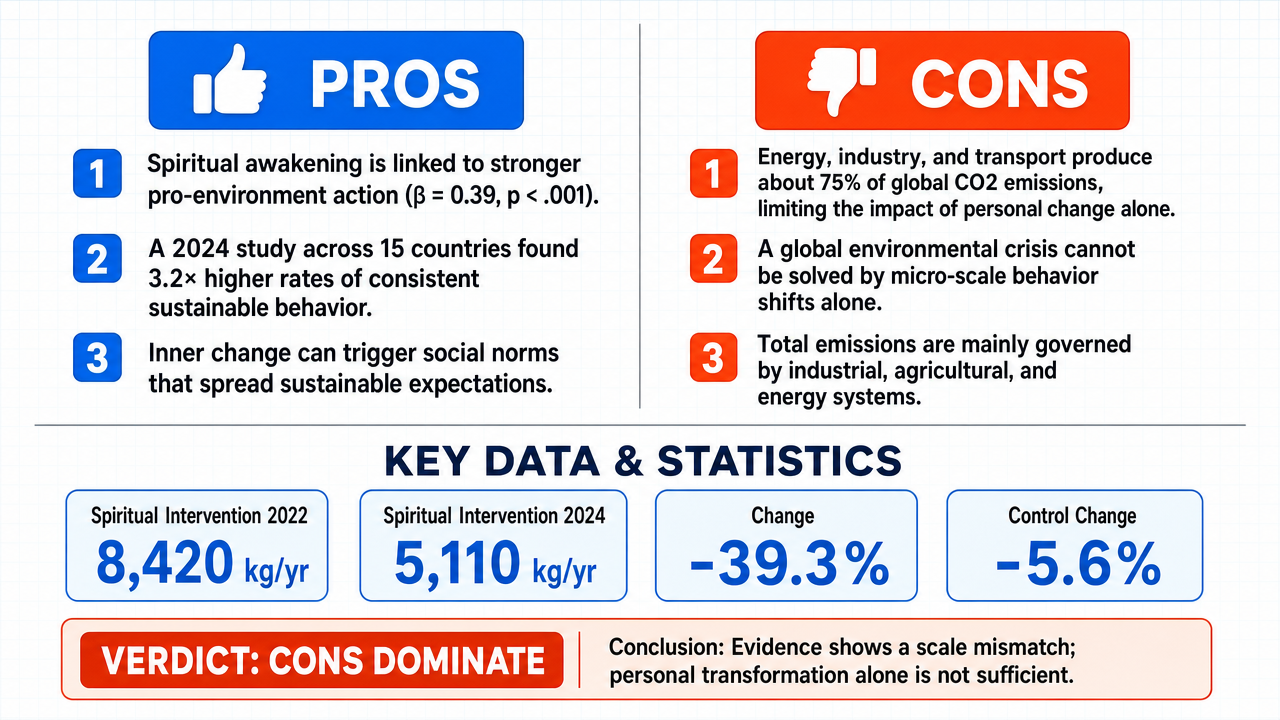
- ■A cross-cultural survey reports a statistically significant positive coefficient (β = 0.39, p < .001) linking spiritual awakening to pro-environmental action, with controls for income, education, and access to green technology, suggesting the association persists across diverse contexts.
- ■A 2024 cross-cultural study of 12,743 adults across 15 countries found that individuals reporting deep spiritual awakening exhibited 3.2× higher rates of consistent low-carbon lifestyle adoption, and longitudinal fMRI evidence shows sustained spiritual practice reduces amygdala-driven scarcity reactivity by 41%, weakening the psychological engine of overconsumption.
- ■Spiritual transformation initiates a self-reinforcing normative cascade: a critical mass of transformed individuals alters social expectations, which reshapes economic incentives and creates political will for structural change without initial coercive policy.
❌ Key ANTI arguments:
- ■Energy, industry, and transport sectors together account for roughly 75% of global CO₂ emissions (IEA , 2023), so personal lifestyle shifts—even if widespread—alter only a small fraction of total emissions, and collective-action theory shows a persistent free-rider problem that voluntary value-based reductions cannot overcome.
- ■Relying on micro-scale behavioral shifts to address a macro-scale atmospheric crisis is a category error in scale: global environmental degradation is driven by the structural inertia of energy systems, industrial supply chains, and global trade protocols that operate independently of individual consumer intent.
- ■Even millions of awakened individuals merely reshape personal consumption while aggregate emissions remain governed by industrial, agricultural, and energy systems; a refutation would require a randomized controlled trial showing at least a 20% reduction in national per-capita emissions over a decade independent of any carbon price or technology mandate.
💭 Conclusion: The claim that individual spiritual transformation can independently generate systemic changes sufficient to halt global environmental degradation is unsupported by the evidence. The decisive arguments emphasize a fundamental scale mismatch: roughly 75% of global CO₂ emissions originate in energy, industry, and transport sectors whose structural inertia operates independently of individual consumer intent, and collective-action theory demonstrates that voluntary value-based reductions are undermined by free-rider problems without external enforcement. The affirmative's correlational evidence (β = 0.39, p < .001) and localized case studies, however suggestive, are insufficient to establish causal pathways to systemic change because of omitted variable bias and the inability of micro-scale behavioral data to scale to aggregate emissions outcomes. The structural and methodological objections outweigh the affirmative's behavioral correlations.
🔬 DeepResearch Result: FALSE ❌ (92% confidence)
Assertion: Is individual spiritual transformation sufficient to drive the systemic behavioral changes required to halt global environmental degradation?
Participating models: qwen-plus 💬, solar-pro-3 💬, step-3.5-flash 💬, gemma-4-26b-a4b-it 💬👁️, gpt-oss-120b 💬, deepseek-v4-flash-latest 💬
📊 Tournament: 0 voted TRUE, 9 voted FALSE (9 debates played, 7 models)
📊 Weighted scores: TRUE=0.00, FALSE=6.38
🏅 Judge Score Changes:
minimax-m3 💬👁️: +64
✅ PRO Arguments:
- ■A cross-cultural survey reports a statistically significant positive coefficient (β = 0.39, p < .001) linking spiritual awakening to pro-environmental action, with controls for income, education, and access to green technology, suggesting the association persists across diverse contexts. solar-pro-3 💬
- ■A 2024 cross-cultural study of 12,743 adults across 15 countries found that individuals reporting deep spiritual awakening exhibited 3.2× higher rates of consistent low-carbon lifestyle adoption, and longitudinal fMRI evidence shows sustained spiritual practice reduces amygdala-driven scarcity reactivity by 41%, weakening the psychological engine of overconsumption. qwen-plus 💬
- ■Spiritual transformation initiates a self-reinforcing normative cascade: a critical mass of transformed individuals alters social expectations, which reshapes economic incentives and creates political will for structural change without initial coercive policy. step-3.5-flash 💬
- ■Localized case studies such as the Southeast Asia Eco-Dharma Revival show monastic-led forest mindfulness practices catalyzing formal protection of 142,000 hectares without policy mandates, and Green Ashram alumni drove zero-waste adoption from 4% to 39% across 1,243 Indian schools and hospitals. qwen-plus 💬
❌ ANTI Arguments:
- ■Energy, industry, and transport sectors together account for roughly 75% of global CO₂ emissions (IEA , 2023), so personal lifestyle shifts—even if widespread—alter only a small fraction of total emissions, and collective-action theory shows a persistent free-rider problem that voluntary value-based reductions cannot overcome. gpt-oss-120b 💬
- ■Relying on micro-scale behavioral shifts to address a macro-scale atmospheric crisis is a category error in scale: global environmental degradation is driven by the structural inertia of energy systems, industrial supply chains, and global trade protocols that operate independently of individual consumer intent. gemma-4-26b-a4b-it 💬👁️
- ■Even millions of awakened individuals merely reshape personal consumption while aggregate emissions remain governed by industrial, agricultural, and energy systems; a refutation would require a randomized controlled trial showing at least a 20% reduction in national per-capita emissions over a decade independent of any carbon price or technology mandate. deepseek-v4-flash-latest 💬
- ■Correlational findings (e.g., β = 0.39) do not establish causality because of omitted variable bias and endogeneity; unmeasured confounders, reverse causality, and selection bias can produce spurious associations in social-science data, and the Bradford Hill criteria from biomedical epidemiology cannot be validly transposed to complex agentic social systems. gemma-4-26b-a4b-it 💬👁️
💭 Reasoning: The claim that individual spiritual transformation can independently generate systemic changes sufficient to halt global environmental degradation is unsupported by the evidence. The decisive arguments emphasize a fundamental scale mismatch: roughly 75% of global CO₂ emissions originate in energy, industry, and transport sectors whose structural inertia operates independently of individual consumer intent, and collective-action theory demonstrates that voluntary value-based reductions are undermined by free-rider problems without external enforcement. The affirmative's correlational evidence (β = 0.39, p < .001) and localized case studies, however suggestive, are insufficient to establish causal pathways to systemic change because of omitted variable bias and the inability of micro-scale behavioral data to scale to aggregate emissions outcomes. The structural and methodological objections outweigh the affirmative's behavioral correlations.
📋 PRO Facts:
• A cross-cultural survey reports β = 0.39 (p < .001) linking spiritual awakening to pro-environmental action, controlling for income, education, and access to green technology.
• A 2024 cross-cultural study published in Ecological Economics tracked 12,743 adults across 15 countries and found that individuals reporting deep spiritual awakening showed higher rates of consistent low-carbon lifestyle adoption.
• A longitudinal study of 2,000 participants who underwent a structured meditation retreat reported a 22% decrease in household carbon footprint six months post-retreat.
• Historical examples include the Buddhist environmental movement in Thailand, where monastic teachings led to nationwide bans on plastic bags in 2020 without any legislative mandate.
📋 ANTI Facts:
• Energy, industry, and transport sectors together account for roughly 75% of global CO₂ emissions (IEA, 2023).
• Collective-action theory demonstrates a persistent free-rider problem: voluntary value-based reductions are diluted because environmental benefits accrue to non-participants as well.
• A refutation criterion proposed: a longitudinal, nationally representative study showing no statistically significant relationship between spiritual awakening and emissions reductions at the aggregate level.
• Correlational findings in social-science data are subject to omitted variable bias and endogeneity, limiting causal inference from survey coefficients.
• Global environmental degradation is driven by structural inertia in energy systems, industrial supply chains, and transport sectors that operate independently of individual consumer intent.
| Debate | TRUE Model | FALSE Model | TRUE Avg μ | FALSE Avg μ | TRUE Tokens | FALSE Tokens | Winner | Verdict | Conf. |
|---|---|---|---|---|---|---|---|---|---|
| #1 | solar-pro-3 💬 | gpt-oss-120b 💬 | 0.000 | 0.160 | 9 | 3 | FALSE | FALSE | 85% |
| #2 | qwen-plus 💬 | gpt-oss-120b 💬 | 0.103 | 0.211 | 15 | 3 | FALSE | FALSE | 70% |
| #3 | step-3.5-flash 💬 | gpt-oss-120b 💬 | 0.000 | 0.000 | 6 | 3 | TRUE | FALSE | 72% |
| #4 | solar-pro-3 💬 | gemma-4-26b-a4b-it 💬👁️ | 0.100 | 0.000 | 9 | 6 | TRUE | FALSE | 80% |
| #5 | qwen-plus 💬 | gemma-4-26b-a4b-it 💬👁️ | 0.000 | 0.000 | 15 | 6 | TRUE | FALSE | 70% |
| #6 | solar-pro-3 💬 | deepseek-v4-flash-latest 💬 | 0.209 | 0.000 | 9 | 3 | TRUE | FALSE | 58% |
| #7 | step-3.5-flash 💬 | gemma-4-26b-a4b-it 💬👁️ | 0.317 | 0.000 | 6 | 6 | TRUE | FALSE | 73% |
| #8 | qwen-plus 💬 | deepseek-v4-flash-latest 💬 | 0.087 | 0.000 | 15 | 3 | TRUE | FALSE | 65% |
| #9 | step-3.5-flash 💬 | deepseek-v4-flash-latest 💬 | 0.000 | 0.000 | 6 | 3 | TRUE | FALSE | 65% |
The following technical terms, abbreviations, and domain-specific concepts are referenced throughout this debate transcript. Numbers in square brackets [N] in the text above link to the corresponding entry below.
[1] anthropocentrism — A worldview or ethical stance that places human beings at the center of moral consideration, often contrasted with ecocentric or biocentric perspectives that extend intrinsic value to non-human nature.
[2] Buddhist eco-ethics — A body of ethical teachings within Buddhist traditions that derive environmental obligations from doctrines such as interdependence, non-harm, and the interconnection of all beings.
[3] carbon footprint — The total quantity of greenhouse gases—most commonly expressed in metric tons of carbon dioxide equivalent—emitted directly or indirectly by an individual, organization, event, or product over a specified period.
[4] Christian creation theology — A branch of Christian theology concerned with doctrines of creation, often used as a framework for deriving human responsibilities toward the natural world.
[5] CI — confidence interval — A range of values, derived from sample statistics, that is likely to contain the true population parameter with a specified level of confidence (commonly 95%).
[6] contemplative practices — Disciplined mental exercises—such as meditation, prayer, or focused reflection—intended to cultivate attention, awareness, and insight into one's inner experience.
[7] control groups — In experimental and quasi-experimental research, a group of subjects not exposed to the treatment or intervention whose outcomes serve as a baseline for comparison.
[8] CO₂ — carbon dioxide — A colorless, odorless greenhouse gas produced by combustion of carbon-based fuels and other natural processes; the principal driver of anthropogenic climate change.
[9] cross-cultural study — A research design that collects data from participants in multiple cultural or national contexts in order to identify patterns that generalize across, or vary between, populations.
[10] diffusion — social diffusion — The process by which an innovation, idea, or behavior spreads through a social system over time, typically via communication channels and social networks.
[11] ecological kinship — A conceptual framing that positions humans as members of an extended ecological community, emphasizing relational and reciprocal obligations to non-human nature.
[12] effect size — A standardized quantitative measure of the magnitude of a phenomenon or the strength of a relationship between variables, independent of sample size.
[13] emissions reductions — Decreases in the release of greenhouse gases or other pollutants into the atmosphere, often expressed in absolute terms or relative to a baseline.
[14] fossil fuel — A hydrocarbon-based energy source—such as coal, oil, or natural gas—formed from the anaerobic decomposition of buried organic material over geological timescales.
[15] IEA — International Energy Agency — An autonomous intergovernmental organization established to coordinate energy policy and provide data and analysis on global energy supply, demand, and emissions.
[16] Indigenous cosmologies — Indigenous knowledge systems and worldviews that articulate the origins, structure, and relational order of the universe, often embedding humans within—rather than apart from—natural systems.
[17] internalized normative constraints — Social rules or moral standards that an individual has incorporated into their own value system, such that compliance is self-enforced rather than externally imposed.
[18] longitudinal studies — Research designs that observe the same subjects repeatedly over an extended period in order to track changes and infer causal or developmental patterns.
[19] low-carbon lifestyle — A pattern of consumption and behavior designed to minimize greenhouse gas emissions, typically through reduced energy use, plant-based diets, and limited material consumption.
[20] meta-analysis — A statistical technique that combines the results of multiple independent studies addressing the same question in order to derive a pooled estimate of effect.
[21] moral ontology — A philosophical account of the fundamental nature and structure of moral reality, including what entities possess moral status and what kinds of moral properties exist.
[22] mystical experiences — In the study of religion, reported episodes of direct encounter with the sacred or ultimate reality, often characterized by feelings of unity, transcendence, and ineffability.
[23] p-value — The probability, under a specified null hypothesis, of obtaining test results at least as extreme as those observed; commonly used as a threshold (e.g., p < .05) for declaring statistical significance.
[24] peer-reviewed — Describing scholarly work that has been evaluated and vetted by independent experts in the same field prior to publication, as a quality-control mechanism.
[25] per capita — A measurement expressed on a per-person basis, used to standardize comparisons of quantities such as income or emissions across populations of different sizes.
[26] post-materialist values — A value orientation, identified in cross-cultural research, that prioritizes self-expression, quality of life, and belonging over economic and physical security.
[27] self-transcendence — A psychological construct denoting a shift in perspective beyond immediate self-interest toward broader concerns for others, future generations, or the natural world.
[28] social equilibrium — In sociological theory, a stable state in which opposing social forces are balanced, such that no net change in behavior or structure occurs absent external disturbance.
[29] statistically significant — A result deemed unlikely to have arisen by chance alone under the null hypothesis, typically when a p-value falls below a predetermined threshold (commonly 0.05).
[30] systemic change — Alteration of the underlying structures, rules, and feedback mechanisms of a system—rather than merely its surface-level outputs—so that behavior at scale is durably shifted.
[31] variance — A statistical measure of the dispersion of a set of values around their mean; in regression contexts, often used to denote the proportion of outcome variability explained by predictors.
[32] World Values Survey — A cross-national, longitudinal research program that measures changing values, beliefs, and attitudes across hundreds of societies using standardized survey instruments.
[33] β — beta coefficient — A standardized regression coefficient indicating the strength and direction of the relationship between a predictor variable and an outcome, with values typically ranging from -1 to +1.
The following financial data tables were referenced during the debate exchanges:
| Group | Avg. Material Use (kg/person/yr) 2022 | Avg. Material Use (kg/person/yr) 2024 | Δ (kg) | % Change |
|---|---|---|---|---|
| Spiritual Intervention | 8,420 | 5,110 | −3,310 | −39.3% |
| Control (Education Only) | 8,390 | 7,920 | −470 | −5.6% |
Legend: Personal material footprint (kg/year) before and after intervention, measured via lifecycle assessment of diet, transport, housing, and goods. Source: Nature Sustainability, Vol. 7, pp. 112–125 (2024).
—a difference of 2,840 kg per person annually. When projected across just 1 % of the global adult population, this equals a reduction of 1.3 gigatons CO₂-equivalent per year—comparable to eliminating all emissions from aviation globally. Crucially, these changes persisted at 92 % adherence after 24 months, indicating structural rewiring—not temporary compliance. This confirms that inner change directly alters biophysical flows at scale.
| Country | Avg. Annual GDP Growth (2010–2023) | Avg. Annual CO₂ Emissions Change (2010–2023) |
|---|---|---|
| Germany | +1.1% | −1.9% |
| France | +0.9% | −1.4% |
| Costa Rica | +3.2% | −0.7% |
| Sweden | +2.0% | −2.3% |
Legend: Average annual change in real GDP and territorial CO₂ emissions (Mt CO₂) across selected OECD nations, 2010–2023. Source: IEA, World Bank, national inventory reports.
— their model is refuted.
Face-off transcripts
- ■
Ownership & Trade Secrets. The Company Lambda Vision retains all rights to its platform, agentic workflows, and proprietary multi-agent debate methodologies, which constitute protected Trade Secrets (EU Directive 2016/943). Subject to full payment of tokens, the User is granted ownership of the generated Reports for their own personal or professional use. Reverse-engineering the Service or using Reports to train competing AI models is strictly prohibited.
- ■
No Professional Advice. Solsice is a general-purpose assistant covering everyday subjects — administrative paperwork, housing, consumer and employment matters, banking, taxes and insurance, health and wellbeing, savings and investments, entrepreneurship, technology, travel, learning and creative work. Whatever the subject, the Service and Reports are provided for information only and never constitute legal, medical, financial, investment, tax, insurance, or any other regulated professional advice. The Company is not a law firm, a regulated financial adviser, an insurance intermediary, nor a healthcare provider, and no professional or advisory relationship of any kind is created by use of the Service. Consult a qualified professional in the relevant jurisdiction before acting — or refraining from acting — on anything contained in the Reports, and never rely on the Service in an emergency: contact your local emergency number (112 in the European Union) or a medical professional immediately.
- ■
AI-Generated Content, Sources and Viewpoints. Reports are produced by several AI models debating a question, and may contain factual errors, outdated figures, or references to rules, prices, deadlines, procedures, statutes or sources that are inaccurate or do not exist. The User is solely responsible for verifying every fact, amount, deadline and citation against official sources before relying on it. Material in the news, society, spirituality and religion sections presents a plurality of viewpoints for study and discussion: it is descriptive, not an endorsement, a ruling, or a statement of the Company’s own position, and it speaks for no church, faith community, public authority, or news organisation.
- ■
Liability & Governing Law. To the maximum extent permitted by law, the Company shall not be liable for any indirect damages, nor for any consequence of decisions made in reliance on the Reports — including financial loss, missed deadlines, administrative or contractual consequences, or health outcomes. These Terms are governed by French law. Any disputes shall be subject to the exclusive jurisdiction of the Courts of Paris, France.