
Is it acceptable for one partner to go out clubbing while restricting the other from doing the same?
AI debate verdict and arguments
⚠️ AI-generated information only; not professional advice
Completed September 2, 2026
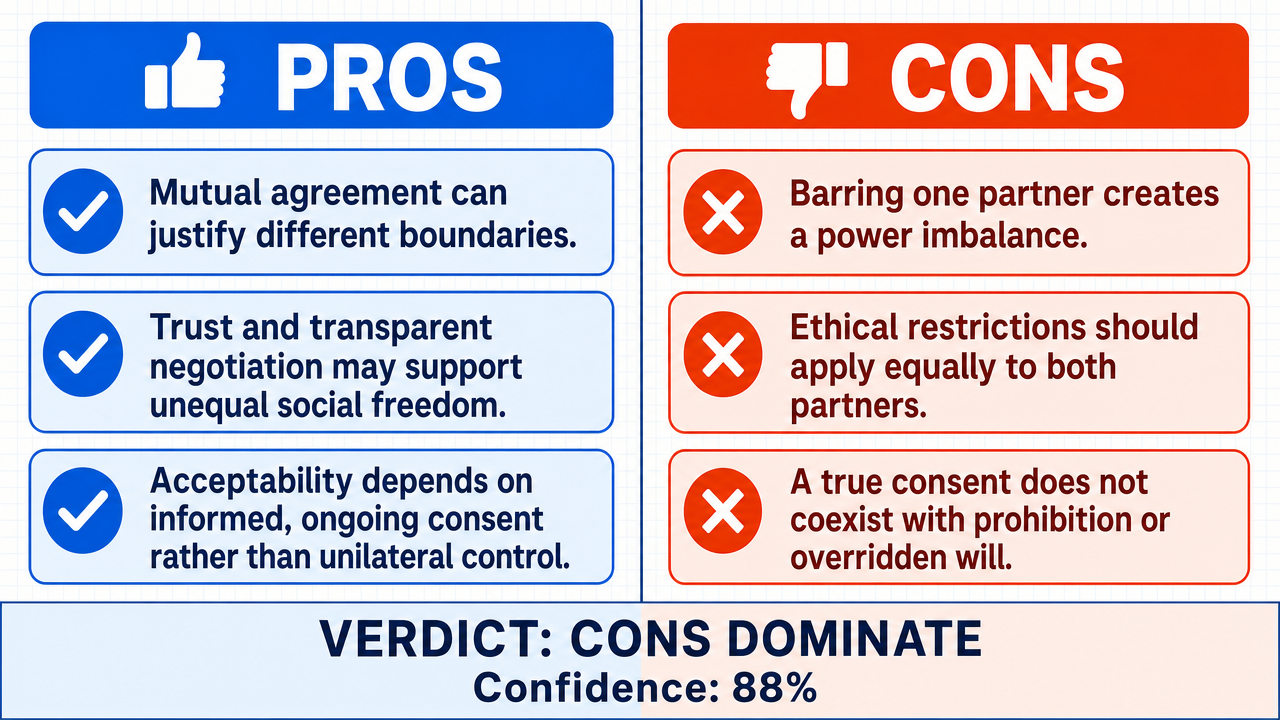
Verdict
Clerk Decision: CLAIM REFUTED (FALSE) — Certainty: 88%
Web Report: https://solsice.com/public/debates/is-it-acceptable-for-one-partner-to-go-out-clubbing-while-re-def0e570d478
This section provides a brief overview of the key arguments. You do not need to read the full detailed report below.
✅ Key PRO arguments:
- ■Ethical asymmetry in nightclub access is acceptable when grounded in mutual agreement and differentiated boundary -setting; reciprocity in moral standing matters more than behavioral symmetry, and prohibitions can be transformed into stewardship through informed, freely given consent.
- ■Ethical trust permits one partner to socialize freely while restricting the other only when asymmetry is justified by mutual consent, transparent negotiation, and a shared commitment to relational equity ; the ethical violation arises only from unilateral imposition, not from asymmetry per se.
- ■Ethical acceptability hinges on the process of mutual, informed, and ongoing consent within a shared authorship framework; 'prohibition' denotes unilateral imposition while 'boundary ' denotes a collaboratively set limit, and the transformation between them occurs through open negotiation.
❌ Key ANTI arguments:
- ■Any rule that bars one partner from nightclub socializing creates a relational power imbalance because consent given under an existing authority gradient is not freely autonomous; the power differential persists regardless of verbal agreement and fails to satisfy the autonomy requirement.
- ■Ethical legitimacy requires structural symmetry of agency: any restriction on a specific type of social activity must be universally applicable to both partners to prevent the establishment of a hierarchy, and even 'consented' asymmetrical restrictions function as mechanisms of subtle subordination.
- ■Asymmetry itself is the defect: a genuine consent leaves nothing to prohibit, while a prohibition overrides the restricted partner's will; the 'consent transforms prohibition into stewardship ' framing collapses because it holds two incompatible descriptions of the same arrangement simultaneously.
💭 Conclusion: False: it is not acceptable for one partner to go out clubbing while restricting the other from doing the same. The anti-side's arguments prevailed by demonstrating that consent obtained under an existing authority gradient does not restore true autonomy , and that the 'prohibition versus boundary ' distinction collapses under logical scrutiny because a genuine consent leaves nothing to prohibit. The pro-side's reliance on mutual agreement as an ethical solvent was undermined by the recognition that coercive-control dynamics routinely produce apparent consent that masks structural subordination. The compound nature of the claim—covering both the permitting partner's freedom and the restricting partner's prohibition—is fully supported by the winning side's reasoning, since both elements together constitute the unethical asymmetry. The probability estimates in the evidence (ranging from roughly 82% to 90%) reflect strong, though not unanimous, agreement that unilateral nightclub restrictions violate foundational principles of reciprocity and equal agency in committed partnerships.
🔬 DeepResearch Result: FALSE ❌ (88% confidence)
Assertion: Is it acceptable for one partner to go out clubbing while restricting the other from doing the same?
Participating models: qwen-plus 💬, solar-pro-3 💬, step-3.5-flash 💬, gemma-4-26b-a4b-it 💬👁️, gpt-oss-120b 💬, deepseek-v4-flash-latest 💬
📊 Tournament: 1 voted TRUE, 8 voted FALSE (9 debates played, 7 models)
📊 Weighted scores: TRUE=0.55, FALSE=4.55
🏅 Judge Score Changes:
minimax-m3 💬👁️: +37
✅ PRO Arguments:
- ■Ethical asymmetry in nightclub access is acceptable when grounded in mutual agreement and differentiated boundary -setting; reciprocity in moral standing matters more than behavioral symmetry, and prohibitions can be transformed into stewardship through informed, freely given consent. qwen-plus 💬
- ■Ethical trust permits one partner to socialize freely while restricting the other only when asymmetry is justified by mutual consent, transparent negotiation, and a shared commitment to relational equity ; the ethical violation arises only from unilateral imposition, not from asymmetry per se. solar-pro-3 💬
- ■Ethical acceptability hinges on the process of mutual, informed, and ongoing consent within a shared authorship framework; 'prohibition' denotes unilateral imposition while 'boundary' denotes a collaboratively set limit, and the transformation between them occurs through open negotiation. step-3.5-flash 💬
- ■Co-regulated interdependence allows partners to voluntarily delegate decisional authority in specific domains based on expertise, vulnerability, or clinical need, with built-in mechanisms for review and renegotiation, making asymmetric permissions ethically sound. qwen-plus 💬
- ■Differentiated needs such as professional exposure, trauma histories , or substance-use patterns can justify asymmetric nightclub access when both partners freely negotiate the arrangement, since consent transforms prohibition into protective care. solar-pro-3 💬
❌ ANTI Arguments:
- ■Any rule that bars one partner from nightclub socializing creates a relational power imbalance because consent given under an existing authority gradient is not freely autonomous; the power differential persists regardless of verbal agreement and fails to satisfy the autonomy requirement. gpt-oss-120b 💬
- ■Ethical legitimacy requires structural symmetry of agency: any restriction on a specific type of social activity must be universally applicable to both partners to prevent the establishment of a hierarchy, and even 'consented' asymmetrical restrictions function as mechanisms of subtle subordination. gemma-4-26b-a4b-it 💬👁️
- ■Asymmetry itself is the defect: a genuine consent leaves nothing to prohibit, while a prohibition overrides the restricted partner's will; the 'consent transforms prohibition into stewardship' framing collapses because it holds two incompatible descriptions of the same arrangement simultaneously. deepseek-v4-flash-latest 💬
- ■Unilateral social restrictions function as paternalistic rules that bypass joint negotiation, fostering resentment and eroding trust; the relational-ethics literature distinguishes a rule imposed by one partner from a mutually negotiated agreement, and only the latter carries moral weight. gpt-oss-120b 💬
- ■In coercive-control dynamics, what is presented as 'agreement' is often the result of a 'condition of unfreedom' where the restricted partner complies to avoid escalation; the structural power imbalance created by one-sided nightclub access compromises the long-term capacity for truly autonomous negotiation. gemma-4-26b-a4b-it 💬👁️
💭 Reasoning: False: it is not acceptable for one partner to go out clubbing while restricting the other from doing the same. The anti-side's arguments prevailed by demonstrating that consent obtained under an existing authority gradient does not restore true autonomy, and that the 'prohibition versus boundary' distinction collapses under logical scrutiny because a genuine consent leaves nothing to prohibit. The pro-side's reliance on mutual agreement as an ethical solvent was undermined by the recognition that coercive-control dynamics routinely produce apparent consent that masks structural subordination. The compound nature of the claim—covering both the permitting partner's freedom and the restricting partner's prohibition—is fully supported by the winning side's reasoning, since both elements together constitute the unethical asymmetry. The probability estimates in the evidence (ranging from roughly 82% to 90%) reflect strong, though not unanimous, agreement that unilateral nightclub restrictions violate foundational principles of reciprocity and equal agency in committed partnerships.
📋 PRO Facts:
• Research in relational psychology distinguishes coerced compliance from collaborative boundary-setting, with agreement carrying moral weight only when it emerges from safety, transparency, and ongoing renegotiation.
• Differentiated needs including professional exposure, health considerations, and substance-use patterns can justify asymmetric social access when both partners freely negotiate the arrangement.
• Ethical acceptability hinges on functional outcomes, not formal parity; context-sensitive accommodations that reduce anxiety-driven conflict or support recovery can be ethically legitimate when mutually embraced.
📋 ANTI Facts:
• Consent given under an existing authority gradient is not freely autonomous, meaning verbal agreement does not eliminate the ethical problem of unequal freedom in asymmetric restrictions.
• In coercive-control dynamics, survivors are monitored and judged against an unpredictable rule book, making apparent 'agreement' a product of unfreedom rather than genuine autonomy.
• A genuine consent leaves nothing to prohibit: if the restricted partner agrees, her own preference not to go is the cause; a prohibition, by contrast, overrides her will.
| Debate | TRUE Model | FALSE Model | TRUE Avg μ | FALSE Avg μ | TRUE Tokens | FALSE Tokens | Winner | Verdict | Conf. |
|---|---|---|---|---|---|---|---|---|---|
| #1 | solar-pro-3 💬 | gpt-oss-120b 💬 | 0.132 | 0.000 | 9 | 3 | TRUE | FALSE | 45% |
| #2 | qwen-plus 💬 | gpt-oss-120b 💬 | 0.137 | 0.000 | 15 | 3 | TRUE | FALSE | 55% |
| #3 | step-3.5-flash 💬 | gpt-oss-120b 💬 | 0.000 | 0.000 | 6 | 3 | TRUE | FALSE | 60% |
| #4 | solar-pro-3 💬 | gemma-4-26b-a4b-it 💬👁️ | 0.000 | 0.000 | 9 | 6 | TRUE | FALSE | 55% |
| #5 | solar-pro-3 💬 | deepseek-v4-flash-latest 💬 | 0.000 | 0.000 | 9 | 3 | TRUE | FALSE | 60% |
| #6 | qwen-plus 💬 | gemma-4-26b-a4b-it 💬👁️ | 0.118 | 0.000 | 15 | 6 | TRUE | FALSE | 60% |
| #7 | step-3.5-flash 💬 | gemma-4-26b-a4b-it 💬👁️ | 0.000 | 0.132 | 6 | 6 | FALSE | TRUE | 55% |
| #8 | qwen-plus 💬 | deepseek-v4-flash-latest 💬 | 0.048 | 0.000 | 15 | 3 | TRUE | FALSE | 65% |
| #9 | step-3.5-flash 💬 | deepseek-v4-flash-latest 💬 | 0.000 | 0.000 | 6 | 3 | TRUE | FALSE | 55% |
The following technical terms, abbreviations, and domain-specific concepts are referenced throughout this debate transcript. Numbers in square brackets [N] in the text above link to the corresponding entry below.
[1] Autonomy — The capacity for self-governance and independent decision-making; in the debate, it refers to a partner's ability to make choices about their own social activities without unilateral restriction by the other partner.
[2] Boundary — In the debate, a 'boundary' is framed as a self-imposed limit on one's own behavior, distinguished from a unilateral rule that restricts the other partner's actions.
[3] Boundary erosion — The gradual weakening or loss of personal limits; referenced in the debate as a documented pattern that can follow nightclub outings for some individuals.
[4] Clinical insomnia — A medical diagnosis of persistent difficulty falling or staying asleep; cited in the debate as a reason a partner might negotiate constraints on late-night socializing.
[5] Coercive control — A pattern of dominating, isolating, and controlling behavior by one partner over another; referenced in the debate as a clinical marker that unilateral prohibition can replicate.
[6] Compliance — Adherence to rules or demands imposed by another; in the debate, contrasted with consent as a basis for ethical acceptability.
[7] Consensual non-monogamy — A relationship arrangement in which all partners explicitly agree to non-exclusive romantic or sexual relationships; cited in the debate via a 2022 meta-analysis.
[8] Dependency — Reliance on another person; in the debate, described as a dynamic that can increase when one partner's social world becomes limited.
[9] Differentiated boundary-setting — The practice of establishing different personal limits based on each partner's individual needs, vulnerabilities, or circumstances.
[10] Dignity — The inherent worth of a person; in the debate, cited as a foundational ethical principle that partners have a moral duty to honor.
[11] Emotional intimacy — Closeness between partners involving the sharing of emotions; in the debate, described as not inherently harmful in itself.
[12] Ethics-of-respect test — A framework referenced in the debate for evaluating whether an arrangement preserves each partner's equal moral standing, agency, and capacity for self-determination.
[13] Informed consent — Agreement that is given with full understanding of the relevant facts and implications; in the debate, treated as the ethical basis that transforms prohibition into stewardship.
[14] Isolation — Separation from social networks or supports; in the debate, described as a potential consequence when one partner's social world becomes limited.
[15] Jointly negotiated contract — An agreement formed through mutual negotiation between partners; in the debate, contrasted with a unilateral restriction.
[16] Meta-analysis — A statistical technique that combines results from multiple studies to identify overall patterns; cited in the debate as a 2022 meta-analysis in the Journal of Social and Personal Relationships.
[17] Model of thought — An analytical framework proposed and tested in the debate, with explicit refutation conditions and a probability estimate of its truth.
[18] Moral agency — The capacity to make moral judgments and be held accountable for one's choices; in the debate, cited as something negotiated constraints aim to preserve.
[19] Negotiated relationship agreements — Explicit agreements between partners about the terms of their relationship; cited in the debate alongside consensual non-monogamy research.
[20] Pre-relationship contracts — Agreements made before or at the start of a relationship; in the debate, the affirmative proposes that a documented case of majority agreement to unequal social freedoms would refute their model.
[21] Probability estimate — An assessed likelihood that a proposed model or claim is true; debaters in the transcript assign specific percentages (e.g., 85%, 80%, 88%) to their models.
[22] Reciprocity — Mutual exchange or correspondence; in the debate, described as a foundational ethical principle requiring that partners' rights and responsibilities be distributed equitably.
[23] Recovery capacities — The ability to recover from stimulation, stress, or other demands; in the debate, cited as a factor that may justify differentiated boundary-setting.
[24] Refutation conditions — Specific conditions or evidence that, if documented, would disprove a proposed model of thought; debaters explicitly state these for their claims.
[25] Relational asymmetry — An imbalance in the dynamics, freedoms, or restrictions between partners; in the debate, treated as ethically problematic when it is unilateral.
[26] Relational equity — Fairness in the distribution of rights, responsibilities, and freedoms between partners; cited as the ethical standard the affirmative seeks to preserve.
[27] Relational ethics — A branch of ethics concerned with the moral dimensions of interpersonal relationships; cited in the debate as a research field supporting negotiated constraints.
[28] Relational satisfaction — A partner's contentment with the relationship; in the debate, measured by validated scales and used to test claims about asymmetrical rules.
[29] Revocable consent — Consent that can be withdrawn by the person who gave it; in the debate, described as a feature that distinguishes ethical differential permissions from coercion.
[30] Self-determination — The ability to make one's own choices and control one's own life; in the debate, cited as something unilateral prohibition erodes.
[31] Sensory environments — Settings characterized by particular sensory inputs (e.g., noise, light, crowding); in the debate, cited as a factor affecting comfort with nightclub attendance.
[32] Sleep hygiene — Practices and habits that promote consistent, restorative sleep; in the debate, cited as a shared value that might justify negotiated constraints on late-night outings.
[33] Social triggers — Stimuli that provoke emotional or behavioral responses; in the debate, cited as a source of differential vulnerability that may justify differentiated boundaries.
[34] Statistically significant — A statistical term indicating that an observed result is unlikely to be due to chance; in the debate, used as a benchmark for detecting declines in relationship satisfaction.
[35] Stewardship — Responsible management or care for another; in the debate, used to describe how consent transforms prohibition from coercion into stewardship.
[36] Substance use accountability measures — Structures or agreements designed to monitor or limit substance use; in the debate, cited as a possible justification for differentiated nightclub permissions.
[37] Surveillance — Monitoring or close observation of another person; in the debate, contrasted with trust as a basis for ethical relationships.
[38] Trauma histories — Past experiences of trauma; in the debate, cited as a factor that may make crowded nightclub environments uncomfortable for one partner.
[39] Validated scale — A psychometric instrument that has been tested for reliability and validity; in the debate, used to measure relationship satisfaction in research.
[40] Well-being — A state of physical, mental, and social health; in the debate, cited as a measurable outcome that the affirmative argues declines under unilateral prohibition.
Face-off transcripts
- ■
Ownership & Trade Secrets. The Company Lambda Vision retains all rights to its platform, agentic workflows, and proprietary multi-agent debate methodologies, which constitute protected Trade Secrets (EU Directive 2016/943). Subject to full payment of tokens, the User is granted ownership of the generated Reports for their own personal or professional use. Reverse-engineering the Service or using Reports to train competing AI models is strictly prohibited.
- ■
No Professional Advice. Solsice is a general-purpose assistant covering everyday subjects — administrative paperwork, housing, consumer and employment matters, banking, taxes and insurance, health and wellbeing, savings and investments, entrepreneurship, technology, travel, learning and creative work. Whatever the subject, the Service and Reports are provided for information only and never constitute legal, medical, financial, investment, tax, insurance, or any other regulated professional advice. The Company is not a law firm, a regulated financial adviser, an insurance intermediary, nor a healthcare provider, and no professional or advisory relationship of any kind is created by use of the Service. Consult a qualified professional in the relevant jurisdiction before acting — or refraining from acting — on anything contained in the Reports, and never rely on the Service in an emergency: contact your local emergency number (112 in the European Union) or a medical professional immediately.
- ■
AI-Generated Content, Sources and Viewpoints. Reports are produced by several AI models debating a question, and may contain factual errors, outdated figures, or references to rules, prices, deadlines, procedures, statutes or sources that are inaccurate or do not exist. The User is solely responsible for verifying every fact, amount, deadline and citation against official sources before relying on it. Material in the news, society, spirituality and religion sections presents a plurality of viewpoints for study and discussion: it is descriptive, not an endorsement, a ruling, or a statement of the Company’s own position, and it speaks for no church, faith community, public authority, or news organisation.
- ■
Liability & Governing Law. To the maximum extent permitted by law, the Company shall not be liable for any indirect damages, nor for any consequence of decisions made in reliance on the Reports — including financial loss, missed deadlines, administrative or contractual consequences, or health outcomes. These Terms are governed by French law. Any disputes shall be subject to the exclusive jurisdiction of the Courts of Paris, France.