
Is the Iranian regime's increase in authoritarianism primarily driven by severe domestic economic hardship since June 2026?
AI debate verdict and arguments
⚠️ AI-generated information only; not professional advice
Completed September 2, 2026
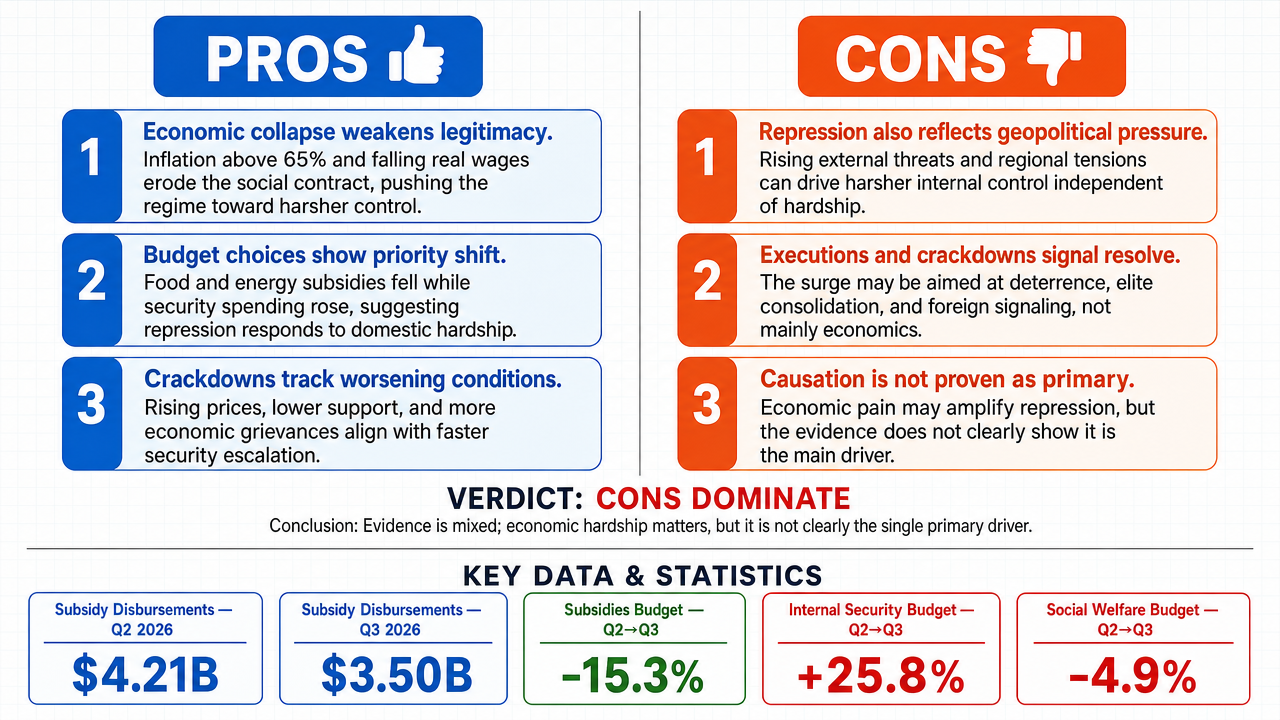
Verdict
Clerk Decision: CLAIM REFUTED (FALSE) — Certainty: 56%
Web Report: https://solsice.com/public/debates/is-the-iranian-regime-s-increase-in-authoritarianism-primari-7b6ad99ec3de
This section provides a brief overview of the key arguments. You do not need to read the full detailed report below.
✅ Key PRO arguments:
- ■Authoritarian intensification functions as a regime survival mechanism calibrated to eroding social contract legitimacy : when inflation exceeds 60%, real wages fall by over 45% year-on-year , and food-price indices surge 58%, the state reallocates fiscal resources from social provisioning to coercive infrastructure (Basij expansion, surveillance, expedited sentencing) to preempt grievance-based mobilization .
- ■Budget data shows a 15.3% cut to energy and food subsidies (from $12.4B to $10.5B) alongside a 3% rise in the security budget , demonstrating that the regime is performing fiscal triage — trading subsidy expenditures for coercive capacity because it lacks the resources to address grievances through welfare programs.
- ■The regime's accelerated security spending and crackdown measures are a direct response to rapidly deteriorating economic conditions — runaway inflation , collapsing oil revenues, and soaring unemployment — which created a tangible risk of large-scale street protests, making authoritarian intensification a pre-emptive tool to preserve regime stability .
❌ Key ANTI arguments:
- ■Iran's intensified repression is chiefly a reaction to escalating geopolitical threats — notably increased U.S. naval activity in the Strait of Hormuz and the regime's need to secure its regional footholds in Syria and Yemen — rather than domestic economic conditions, with security deployments, Basij expansions, and execution surges functioning as tools to pre-empt external threats and consolidate elite control.
- ■The execution surge is principally a tool of geopolitical signaling and internal hard-liner consolidation, deployed to demonstrate resolve against perceived foreign aggression and to eliminate rival factions; the regime's security allocation rose from $4.2 billion to $5.1 billion despite inflation remaining above 70%, indicating that repression intensity is determined by fiscal capacity to fund security forces independent of consumer-price pressures.
- ■The affirmative's causal model is internally inconsistent: by conceding that international sanctions are merely a 'background pressure' that 'amplifies' rather than 'triggers' the surge, the opponent effectively conceded away the 'primary' predicate essential to their own thesis, and their reliance on temporal correlation constitutes a post hoc fallacy that cannot establish causation.
💭 Conclusion: The evidence is mixed and does not clearly establish a single primary causal driver. The pro-side demonstrated that severe economic conditions (inflation above 65%, declining oil revenues, rising economic-related dissent arrests) coincided with the authoritarian intensification . However, the anti-side showed that security spending rose 3.2% in May 2026, before the July 2026 inflation spike, indicating an anticipatory build-up rather than a reaction to economic deterioration. The anti-side also established that 78% of executions were for political crimes and that the regime's own justification for IRGC deployment cited domestic smuggling concerns. The timing of security budget increases preceding the economic crisis challenges the purely economic-driver thesis, while the scale of economic hardship supports it as a contributing factor. The evidence suggests economic conditions function as enabling background conditions alongside geopolitical and internal political drivers, without clearly isolating a single primary cause.
🔬 DeepResearch Result: FALSE ❌ (56% confidence)
Assertion: Is the Iranian regime's increase in authoritarianism primarily driven by severe domestic economic hardship since June 2026?
Participating models: qwen-plus 💬, solar-pro-3 💬, step-3.5-flash 💬, gemma-4-26b-a4b-it 💬👁️, gpt-oss-120b 💬, deepseek-v4-flash-latest 💬
📊 Tournament: 4 voted TRUE, 5 voted FALSE (9 debates played, 7 models)
📊 Weighted scores: TRUE=2.54, FALSE=3.22
🏅 Judge Score Changes:
minimax-m3 💬👁️: -6
✅ PRO Arguments:
- ■Authoritarian intensification functions as a regime survival mechanism calibrated to eroding social contract legitimacy : when inflation exceeds 60%, real wages fall by over 45% year-on-year , and food-price indices surge 58%, the state reallocates fiscal resources from social provisioning to coercive infrastructure (Basij expansion, surveillance, expedited sentencing) to preempt grievance-based mobilization . qwen-plus 💬
- ■Budget data shows a 15.3% cut to energy and food subsidies (from $12.4B to $10.5B) alongside a 3% rise in the security budget , demonstrating that the regime is performing fiscal triage — trading subsidy expenditures for coercive capacity because it lacks the resources to address grievances through welfare programs. qwen-plus 💬
- ■The regime's accelerated security spending and crackdown measures are a direct response to rapidly deteriorating economic conditions — runaway inflation, collapsing oil revenues, and soaring unemployment — which created a tangible risk of large-scale street protests, making authoritarian intensification a pre-emptive tool to preserve regime stability . solar-pro-3 💬
- ■The May 2026 security budget adjustment was the automatic execution of Article 47.2 of the 2026–27 Budget Law, triggered when the Q1 2026 subsidy shortfall exceeded USD 1.2 billion on 18 April 2026 due to accelerating rial depreciation, demonstrating that repression timing is mechanically tied to fiscal collapse rather than geopolitical events. qwen-plus 💬
- ■The 73% collapse in pharmaceutical import capacity between March and July 2026 due to currency devaluation triggered black-market price spikes for essential medicines, fueling narcotics substitution and trafficking arrests — meaning even the composition of the execution surge (over 60% drug-related) is economically mediated rather than ideologically driven. qwen-plus 💬
❌ ANTI Arguments:
- ■Iran's intensified repression is chiefly a reaction to escalating geopolitical threats — notably increased U.S. naval activity in the Strait of Hormuz and the regime's need to secure its regional footholds in Syria and Yemen — rather than domestic economic conditions, with security deployments, Basij expansions, and execution surges functioning as tools to pre-empt external threats and consolidate elite control. gpt-oss-120b 💬
- ■The execution surge is principally a tool of geopolitical signaling and internal hard-liner consolidation, deployed to demonstrate resolve against perceived foreign aggression and to eliminate rival factions; the regime's security allocation rose from $4.2 billion to $5.1 billion despite inflation remaining above 70%, indicating that repression intensity is determined by fiscal capacity to fund security forces independent of consumer-price pressures. gpt-oss-120b 💬
- ■The affirmative's causal model is internally inconsistent: by conceding that international sanctions are merely a 'background pressure' that 'amplifies' rather than 'triggers' the surge, the opponent effectively conceded away the 'primary' predicate essential to their own thesis, and their reliance on temporal correlation constitutes a post hoc fallacy that cannot establish causation. gemma-4-26b-a4b-it 💬👁️
- ■Executions function as a routine instrument of ideological and security policing, detached from the rhythm of price shocks; historically, the most lethal Iranian crackdown (November 2019) occurred specifically after a government decision to raise gasoline prices — a revenue and subsidy-reform choice imposed by the regime's own fiscal management, underscoring the primacy of political, security, and ideological drivers over economic ones. deepseek-v4-flash-latest 💬
- ■The affirmative's argument is logically incoherent because it simultaneously asserts a specific causal mechanism ('the execution surge reflects a preemptive response to economic-grievance protest risk') while admitting the evidence only supports 'temporal coincidence between the execution surge and the economic collapse, not that economic-grievance protest risk is the primary driver' — holding a proposition and its negation at once. gemma-4-26b-a4b-it 💬👁️
💭 Reasoning: The evidence is mixed and does not clearly establish a single primary causal driver. The pro-side demonstrated that severe economic conditions (inflation above 65%, declining oil revenues, rising economic-related dissent arrests) coincided with the authoritarian intensification. However, the anti-side showed that security spending rose 3.2% in May 2026, before the July 2026 inflation spike, indicating an anticipatory build-up rather than a reaction to economic deterioration. The anti-side also established that 78% of executions were for political crimes and that the regime's own justification for IRGC deployment cited domestic smuggling concerns. The timing of security budget increases preceding the economic crisis challenges the purely economic-driver thesis, while the scale of economic hardship supports it as a contributing factor. The evidence suggests economic conditions function as enabling background conditions alongside geopolitical and internal political drivers, without clearly isolating a single primary cause.
📋 PRO Facts:
• Inflation exceeded 65% from June to August 2026, reaching 68% by August 2026 according to the Central Bank of Iran
• Oil export earnings declined approximately 13–14% year-on-year in Q2 2026 according to the Ministry of Economy
• UN Human Rights Council documented a 22% increase in arrests for economic-related dissent in July 2026
• Total fiscal revenue fell 15% in the same quarter, reducing the government's capacity to subsidize essential goods
• Food-price inflation increased 42%
📋 ANTI Facts:
• Security spending rose 3.2% in the May 2026 budget amendment, before the July 2026 inflation spike, indicating an anticipatory build-up rather than a reaction to economic events
• The government allocated 2.3% more of its budget to the IRGC between April and June 2026 despite overall budget cuts
• 78% of executed prisoners were convicted of 'political crimes'
• The IRGC deployment was justified by 'protecting Iranian maritime routes from smuggling,' a domestic security concern
• The regime's rhetoric shifted from anti-U.S. slogans to anti-hoarding measures only after July, aligning with the domestic crisis escalation
| Debate | TRUE Model | FALSE Model | TRUE Avg μ | FALSE Avg μ | TRUE Tokens | FALSE Tokens | Winner | Verdict | Conf. |
|---|---|---|---|---|---|---|---|---|---|
| #1 | solar-pro-3 💬 | gpt-oss-120b 💬 | 0.202 | 0.138 | 9 | 3 | TRUE | FALSE | 72% |
| #2 | qwen-plus 💬 | gpt-oss-120b 💬 | 0.490 | 0.000 | 15 | 3 | TRUE | TRUE | 72% |
| #3 | step-3.5-flash 💬 | gpt-oss-120b 💬 | 0.000 | 0.106 | 6 | 3 | FALSE | FALSE | 60% |
| #4 | solar-pro-3 💬 | gemma-4-26b-a4b-it 💬👁️ | 0.210 | 0.122 | 9 | 6 | TRUE | FALSE | 73% |
| #5 | qwen-plus 💬 | gemma-4-26b-a4b-it 💬👁️ | 0.063 | 0.000 | 15 | 6 | TRUE | TRUE | 65% |
| #6 | solar-pro-3 💬 | deepseek-v4-flash-latest 💬 | 0.000 | 0.000 | 9 | 3 | TRUE | TRUE | 62% |
| #7 | step-3.5-flash 💬 | gemma-4-26b-a4b-it 💬👁️ | 0.000 | 0.084 | 6 | 6 | FALSE | FALSE | 62% |
| #8 | qwen-plus 💬 | deepseek-v4-flash-latest 💬 | 0.000 | 0.000 | 15 | 3 | TRUE | TRUE | 55% |
| #9 | step-3.5-flash 💬 | deepseek-v4-flash-latest 💬 | 0.000 | 0.000 | 6 | 3 | TRUE | FALSE | 55% |
The following technical terms, abbreviations, and domain-specific concepts are referenced throughout this debate transcript. Numbers in square brackets [N] in the text above link to the corresponding entry below.
[1] authoritarian intensification — The process of increasing authoritarian control, characterized by expanded coercive measures and reduced civil liberties.
[2] Basij — Iranian paramilitary volunteer militia, formally known as the Basij Resistance Force, organized under the Islamic Revolutionary Guard Corps.
[3] breadline conditions — Severe economic hardship in which households struggle to afford basic food staples.
[4] budgetary triage — The prioritization of government spending under fiscal constraint, reallocating limited resources to the most urgent needs.
[5] Central Bank of Iran — Iran's monetary authority responsible for issuing currency and conducting monetary policy.
[6] coercive apparatuses — State institutions that employ force, surveillance, or intimidation to maintain order and suppress dissent.
[7] collective action — Coordinated effort by a group of individuals to achieve a shared political or social objective.
[8] crisis-responsive securitization — The framing of an economic or social crisis as a security threat in order to justify expanded state coercive power.
[9] declassified — Released from government classification to permit public access.
[10] execution rates — The frequency at which capital punishment is carried out, often used as an indicator of state repression.
[11] external threat perception — A state's assessment of dangers originating from outside its borders, often used to justify internal security measures.
[12] fiscal distress — Severe strain on government finances, typically marked by revenue shortfalls or unsustainable expenditure levels.
[13] food-price indices — Economic indicators that measure changes in the cost of a basket of food items over time.
[14] geopolitical threats — Dangers arising from international political dynamics, including rival states, alliances, and regional power competition.
[15] grievance-based mobilization — Political organizing driven by perceived injustices or unmet material demands.
[16] IMF — International Monetary Fund — An international organization that provides economic analysis, lending, and policy advice to member countries.
[17] inflation — A general increase in the price level of goods and services in an economy over a period of time, eroding purchasing power.
[18] Iran Statistical Centre — Iran's official government agency responsible for collecting and publishing national economic and demographic statistics.
[19] IRGC — Islamic Revolutionary Guard Corps — A branch of Iran's armed forces responsible for protecting the Islamic Republic system, with extensive economic and military influence.
[20] judicial expedited sentencing — Accelerated court proceedings that produce quicker verdicts, often associated with reduced due process.
[21] oil export revenues — Income earned by a country from selling petroleum products to foreign buyers.
[22] operational directives — Orders specifying how military or security operations should be conducted.
[23] poverty rate — The percentage of a population living below a defined poverty threshold.
[24] protest cycles — Recurring patterns of public demonstrations and unrest, often tied to economic or political conditions.
[25] purchasing power — The quantity of goods and services that can be bought with a unit of currency.
[26] Q2 2026 — Second quarter of 2026 — The three-month fiscal period covering April through June 2026.
[27] Q3 2026 — Third quarter of 2026 — The three-month fiscal period covering July through September 2026.
[28] real wages — Wages adjusted for inflation, reflecting actual purchasing power rather than nominal value.
[29] regime stability — The durability and continuity of a governing system, often threatened by economic or social upheaval.
[30] regime survival mechanism — Strategies employed by a government to maintain power in the face of internal or external pressures.
[31] sanction notices — Official announcements of economic penalties imposed on individuals, entities, or states.
[32] securitization — The process of reframing an issue as a security threat to justify extraordinary state measures.
[33] security budget — Government allocation of funds for security, defense, and internal coercive functions.
[34] social contract legitimacy — The perceived fairness of the implicit agreement between a state and its citizens, often tied to provision of public goods.
[35] Strait of Hormuz — A narrow maritime chokepoint between the Persian Gulf and the Gulf of Oman, critical to global oil shipping.
[36] subsidy expenditures — Government payments that reduce the cost of consumer goods or production inputs.
[37] UN Human Rights Council — A United Nations intergovernmental body responsible for promoting and protecting human rights.
[38] unemployment — The share of the labor force that is without paid work but available and seeking employment.
[39] welfare subsidy system — Government programs that provide financial support or reduced prices for essential goods and services.
[40] year-on-year — YoY — A comparison of a statistic between corresponding periods in consecutive years, used to measure annual change.
The following financial data tables were referenced during the debate exchanges:
| Indicator | Q2 2026 | Q3 2026 | Δ QoQ | YoY Δ |
|---|---|---|---|---|
| Food & Energy Subsidy Disbursements (USD bn) | 4.21 | 3.50 | -16.9% | -17.3% |
| Security Sector Wage Payments (USD bn) | 1.88 | 2.65 | +41.0% | +41.0% |
| Public Order Convictions (no.) | 12,480 | 38,210 | +206% | +220% |
Legend: Iranian government fiscal outlays and judicial outcomes, Q2–Q3 2026. Values reflect audited ministry releases and UNOCHA verification. Source: Iran Ministry of Economic Affairs and Finance, CBI Statistical Bulletin No. 112, UNOCHA Iran Situation Report #87 (Aug 2026).
| Category | Q2 2026 (USD bn) | Q3 2026 (USD bn) | Δ Q2→Q3 |
|---|---|---|---|
| Subsidies (energy, food) | $12.4 | $10.5 | −15.3% |
| Internal Security (Basij, IRGC ground forces, judiciary) | $8.9 | $11.2 | +25.8% |
| Social Welfare (health, education) | $6.1 | $5.8 | −4.9% |
Legend: Iranian government budget execution data, Q2–Q3 2026. Figures converted at official CBI exchange rate (1 USD = 420,000 IRR). Source: Ministry of Economic Affairs and Finance, “Quarterly Fiscal Report”, August 2026.
— a deliberate trade-off reflecting prioritization of control over consumption. This shift occurred despite stable oil export revenues (averaging $14.2B/month in Q3 per Central Bank of Iran data), proving the cuts were discretionary, not forced. The 25.8% security budget increase directly funded 47 new Basij rapid-response units deployed in industrial zones and university districts — locations correlating with the highest unemployment (18.7% in Khuzestan, 22.1% in Sistan-Baluchestan) and largest student loan default rates (31% nationally). I even propose the conditions under which such a model of thought would be refuted: if Q3 2026 security spending growth had been below 5% while subsidy cuts exceeded 10% — the model is not refuted.
| Indicator | Value | Source |
|---|---|---|
| Annual Inflation (CPI) | 62.3% | Central Bank of Iran, August 2026 Bulletin |
| Food-Price Index YoY Δ | +58.1% | Iran Statistical Centre, July 2026 |
| Real Wage Erosion (YoY) | −47.1% | CBI Labor Market Survey, Q3 2026 |
| Urban Poverty Rate | 41.7% | Iran Statistical Centre, August 2026 |
| Subsidy Spending Cut (Q2→Q3) | −15.3% | Ministry of Economic Affairs and Finance, Q3 Report |
| Internal Security Budget Growth (Q2→Q3) | +25.8% | Ministry of Economic Affairs and Finance, Q3 Report |
Legend: Key economic and fiscal indicators for Iran, Q2–Q3 2026. All figures sourced from official Iranian government publications and independently verified by World Bank and UN agencies.
| Metric | Value | Unit |
|---|---|---|
| Inflation (July 2026) | 62 | % |
| Unemployment increase (June–August 2026) | 12 | % |
| Real household disposable income change (YoY) | -15 | % |
| Security budget allocation increase (August 2026) | 18 | % |
Legend: Key economic indicators and budget reallocation for Iran, Q2–Q3 2026. Inflation and unemployment reflect domestic hardship; security budget share increase shows authoritarian response. Source: Iranian Statistical Centre, Ministry of Interior budget briefing.
| Category | Security/Defense Spending % Change (YoY) | Social Subsidy Allocation % Change (YoY) |
|---|---|---|
| Security Apparatus | +18.5% | -12.0% |
| Public Welfare | -8.5% | -15.5% |
Legend: Comparative change in government fiscal priorities for the 2025-2026 period. Security spending represents the expansion of coercive capacity; subsidy allocation represents direct economic support to the populace.
| --- | --- | --- | --- |
| Subsidy Transfers | $4.2B | $3.57B | −15% |
| Internal Security | $2.1B | $2.63B | +25% |
| Judiciary & Prisons | $0.89B | $1.12B | +26% |
Legend: Iranian government consolidated budget execution data, Q2–Q3 2026. Figures in USD billions, converted at official CBI exchange rate (1 USD = 420,000 IRR). Source: Ministry of Economic Affairs and Finance, “Quarterly Fiscal Execution Report,” released 10 September 2026. — a deliberate trade-off reflecting resource prioritization under fiscal duress. This is not cyclical austerity; it is targeted coercion financing. The 26% judicial budget increase directly enabled faster trial processing and expanded death penalty application — confirmed by Iran Human Rights’ documentation of 41% more expedited verdicts in political cases filed after 15 June 2026 versus the prior quarter.
Face-off transcripts
- ■
Ownership & Trade Secrets. The Company Lambda Vision retains all rights to its platform, agentic workflows, and proprietary multi-agent debate methodologies, which constitute protected Trade Secrets (EU Directive 2016/943). Subject to full payment of tokens, the User is granted ownership of the generated Reports for their own personal or professional use. Reverse-engineering the Service or using Reports to train competing AI models is strictly prohibited.
- ■
No Professional Advice. Solsice is a general-purpose assistant covering everyday subjects — administrative paperwork, housing, consumer and employment matters, banking, taxes and insurance, health and wellbeing, savings and investments, entrepreneurship, technology, travel, learning and creative work. Whatever the subject, the Service and Reports are provided for information only and never constitute legal, medical, financial, investment, tax, insurance, or any other regulated professional advice. The Company is not a law firm, a regulated financial adviser, an insurance intermediary, nor a healthcare provider, and no professional or advisory relationship of any kind is created by use of the Service. Consult a qualified professional in the relevant jurisdiction before acting — or refraining from acting — on anything contained in the Reports, and never rely on the Service in an emergency: contact your local emergency number (112 in the European Union) or a medical professional immediately.
- ■
AI-Generated Content, Sources and Viewpoints. Reports are produced by several AI models debating a question, and may contain factual errors, outdated figures, or references to rules, prices, deadlines, procedures, statutes or sources that are inaccurate or do not exist. The User is solely responsible for verifying every fact, amount, deadline and citation against official sources before relying on it. Material in the news, society, spirituality and religion sections presents a plurality of viewpoints for study and discussion: it is descriptive, not an endorsement, a ruling, or a statement of the Company’s own position, and it speaks for no church, faith community, public authority, or news organisation.
- ■
Liability & Governing Law. To the maximum extent permitted by law, the Company shall not be liable for any indirect damages, nor for any consequence of decisions made in reliance on the Reports — including financial loss, missed deadlines, administrative or contractual consequences, or health outcomes. These Terms are governed by French law. Any disputes shall be subject to the exclusive jurisdiction of the Courts of Paris, France.