
It is impossible for art dealers to conduct business without engaging in dishonest practices with their clients.
AI debate verdict and arguments
⚠️ AI-generated information only; not professional advice
Completed October 22, 2026
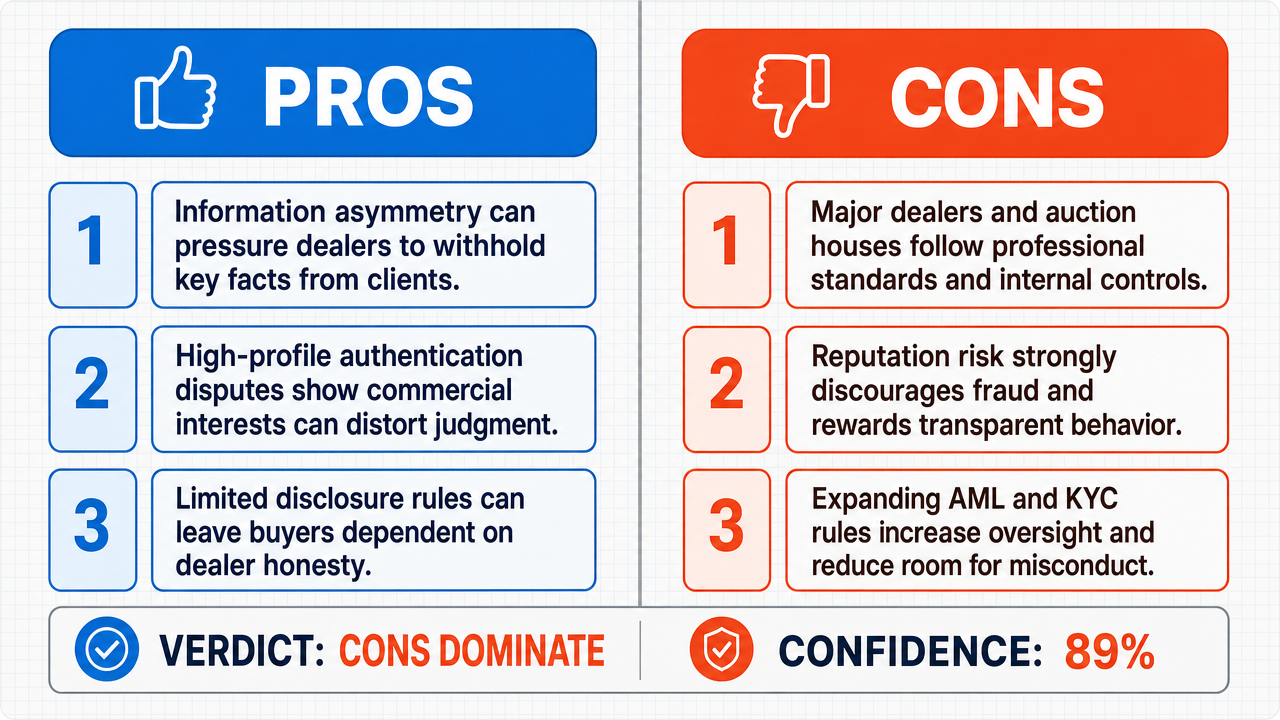
Verdict
Verdict: likely FALSE (89%)
Web Report: https://solsice.com/public/debates/it-is-impossible-for-art-dealers-to-conduct-business-without-867f47b1ba50
This section provides a brief overview of the key arguments. You do not need to read the full detailed report below.
✅ Key PRO arguments:
- ■The art market operates on deliberate information asymmetry that makes honest dealing structurally impossible, exemplified by auction houses employing 'chandelier bidding '—fabricating bids from the chandelier to drive prices upward—a practice that is technically legal in many jurisdictions but fundamentally deceptive.
- ■The $450 million Salvator Mundi sale demonstrates how even extensive scientific analysis and scholarly examination can be captured by commercial interests, as the painting was sold as a fully autograph Leonardo da Vinci despite ongoing scholarly debate about its attribution .
- ■A regulatory vacuum in the United States—specifically the absence of federal mandates requiring disclosure of restoration history or theft status—creates a competitive disadvantage for dealers who choose to be honest, making dishonesty a necessity for competitive survival.
❌ Key ANTI arguments:
- ■Professional art dealing is characterized by rigorous standards and institutionalized integrity, with major auction houses and blue-chip galleries operating under intense scrutiny from legal departments, insurance underwriters , and compliance officers that enforce honest conduct.
- ■The cost of reputational damage serves as a powerful self-regulating mechanism: for major dealers, a single instance of proven provenance fabrication or intentional misattribution is an existential threat to their ability to secure underwriting and maintain client trust.
- ■The claim of a 'regulatory vacuum ' is negated by the significant and expanding framework of Anti-Money Laundering (AML ) and Know Your Customer (KYC ) regulations that professional dealers must navigate, which provide meaningful oversight despite the absence of specific federal disclosure mandates.
💭 Conclusion: False. The assertion that dishonest practices are a systematic necessity for art dealers is rejected because the art market contains robust self-regulating mechanisms—including reputational consequences, professional standards, and expanding compliance frameworks—that make honest dealing both possible and commercially rational for established dealers. While the PRO side correctly identified real instances of opacity (such as chandelier bidding practices), these examples demonstrate that dishonest practices occur and are sometimes tolerated, not that they are structurally unavoidable. The ANTI side's strongest point is that the presence of reputational capital, institutional liability, and client retention concerns provides meaningful constraints on dishonest behavior. The verdict is supported by the recognition that isolated scandals and structural opacity do not constitute proof that honest dealing is impossible—only that it is difficult and requires institutional safeguards.
🔬 DeepResearch Result: likely FALSE ❌ (89%)
Assertion: It is impossible for art dealers to conduct business without engaging in dishonest practices with their clients.
Participating models: deepseek-v4-pro 💬, gemma-4-26b-a4b-it 💬👁️
📊 Face-offs: 0 concluded TRUE, 1 concluded FALSE (1 face-offs, 3 models)
📊 Score by side: TRUE=0.00, FALSE=0.89
🏅 Model score changes:
minimax-m3 💬👁️: +9
✅ PRO Arguments:
- ■The art market operates on deliberate information asymmetry that makes honest dealing structurally impossible, exemplified by auction houses employing 'chandelier bidding '—fabricating bids from the chandelier to drive prices upward—a practice that is technically legal in many jurisdictions but fundamentally deceptive. deepseek-v4-pro 💬
- ■The $450 million Salvator Mundi sale demonstrates how even extensive scientific analysis and scholarly examination can be captured by commercial interests, as the painting was sold as a fully autograph Leonardo da Vinci despite ongoing scholarly debate about its attribution . deepseek-v4-pro 💬
- ■A regulatory vacuum in the United States—specifically the absence of federal mandates requiring disclosure of restoration history or theft status—creates a competitive disadvantage for dealers who choose to be honest, making dishonesty a necessity for competitive survival. deepseek-v4-pro 💬
- ■The tools of transparency (scholarship , provenance research, scientific analysis) are systematically captured by commercial interests and deployed in bad faith, meaning the mechanisms cited as solutions are themselves instruments of deception rather than remedies. deepseek-v4-pro 💬
❌ ANTI Arguments:
- ■Professional art dealing is characterized by rigorous standards and institutionalized integrity, with major auction houses and blue-chip galleries operating under intense scrutiny from legal departments, insurance underwriters , and compliance officers that enforce honest conduct. gemma-4-26b-a4b-it 💬👁️
- ■The cost of reputational damage serves as a powerful self-regulating mechanism: for major dealers, a single instance of proven provenance fabrication or intentional misattribution is an existential threat to their ability to secure underwriting and maintain client trust. gemma-4-26b-a4b-it 💬👁️
- ■The claim of a 'regulatory vacuum' is negated by the significant and expanding framework of Anti-Money Laundering (AML ) and Know Your Customer (KYC ) regulations that professional dealers must navigate, which provide meaningful oversight despite the absence of specific federal disclosure mandates. gemma-4-26b-a4b-it 💬👁️
- ■The opponent's argument conflates the absence of specific federal mandates with a total absence of regulatory and legal obligations, ignoring that dealers operate under contractual obligations, professional accreditation standards, and civil liability frameworks that constrain dishonest behavior. gemma-4-26b-a4b-it 💬👁️
💭 Reasoning: False. The assertion that dishonest practices are a systematic necessity for art dealers is rejected because the art market contains robust self-regulating mechanisms—including reputational consequences, professional standards, and expanding compliance frameworks—that make honest dealing both possible and commercially rational for established dealers. While the PRO side correctly identified real instances of opacity (such as chandelier bidding practices), these examples demonstrate that dishonest practices occur and are sometimes tolerated, not that they are structurally unavoidable. The ANTI side's strongest point is that the presence of reputational capital, institutional liability, and client retention concerns provides meaningful constraints on dishonest behavior. The verdict is supported by the recognition that isolated scandals and structural opacity do not constitute proof that honest dealing is impossible—only that it is difficult and requires institutional safeguards.
📋 PRO Facts:
• Auction houses employ 'chandelier bidding'—fabricating bids from the chandelier to drive prices upward—a practice that is technically legal in many jurisdictions.
📋 ANTI Facts:
• Major auction houses and blue-chip galleries operate under intense scrutiny from legal departments and compliance officers.
• Expanding regulatory and compliance frameworks require professional art dealers to implement due diligence and verification procedures.
• A single instance of proven provenance fabrication or intentional misattribution poses a significant threat to a major dealer's reputation and client trust.
| Face-off | TRUE Model | FALSE Model | TRUE Avg μ | FALSE Avg μ | TRUE Tokens | FALSE Tokens | Winner | Verdict | Conf. |
|---|---|---|---|---|---|---|---|---|---|
| #1 | deepseek-v4-pro 💬 | gemma-4-26b-a4b-it 💬👁️ | 0.481 | 0.341 | 6 | 2 | TRUE | FALSE | 89% |
The following technical terms, abbreviations, and domain-specific concepts are referenced throughout this debate transcript. Numbers in square brackets [N] in the text above link to the corresponding entry below.
[1] AML — Anti-Money Laundering — Regulations and procedures designed to detect and prevent the use of financial transactions for laundering illicit funds. The debate notes that art market participants must navigate an expanding AML framework.
[2] Anti-Money Laundering Act of 2020 — A U.S. statute referenced in the debate as having significantly increased the compliance burden for art market participants by requiring rigorous due diligence on source of funds and beneficial ownership.
[3] attribution — The identification of the artist responsible for a given artwork. The debate highlights contested attributions, such as the disputed attribution of Salvator Mundi to Leonardo da Vinci.
[4] autograph — In art terminology, a work executed entirely by the hand of the named artist, as distinguished from a work the artist merely 'contributed to' or supervised.
[5] beneficial owners — The natural persons who ultimately own or control a transaction or asset. The debate notes that dealers are increasingly required to verify the identity of beneficial owners under AML/KYC rules.
[6] blue-chip galleries — Established, high-prestige art galleries with strong reputations. The debate cites them as entities operating under intense scrutiny from legal, insurance, and compliance functions.
[7] buyer's premiums — Fees (typically 20-25% according to the debate) charged by auction houses to the winning bidder on top of the hammer price, representing a major revenue stream.
[8] chandelier bidding — The practice, described in the debate, of auction houses fabricating bids (ostensibly from anonymous bidders in the room) to drive prices upward; characterized as technically legal in many jurisdictions but fundamentally deceptive.
[9] compliance burden — The cumulative cost and procedural obligations imposed by regulatory requirements. The debate cites the increased compliance burden on art dealers following the Anti-Money Laundering Act of 2020.
[10] compliance officers — Personnel responsible for ensuring that an organization adheres to applicable laws, regulations, and internal policies. The debate notes their role in scrutinizing major auction houses and galleries.
[11] conflicts of interest — Situations in which a party's financial or personal interests could compromise their professional judgment. The debate argues auction houses face inherent conflicts because their revenue depends on inflating valuations.
[12] due diligence — The process of investigating and verifying relevant facts before entering a transaction. The debate describes it as both a self-regulating mechanism in the art market and a regulatory requirement under AML rules.
[13] information asymmetry — An economic condition in which one party to a transaction possesses materially more or better information than the other. The affirmative argues the art market is structurally built on deliberate information asymmetry.
[14] insurance underwriters — Entities that assess and assume risk in exchange for premiums. The debate notes that major galleries depend on underwriters, making reputational integrity essential to securing coverage.
[15] KYC — Know Your Customer — Regulatory requirements obliging financial institutions and dealers to verify the identity and background of their clients. The debate cites KYC alongside AML as part of the expanding compliance framework for art dealers.
[16] liquidity — The ease with which an asset can be converted to cash without affecting its market price. The debate describes dealer integrity as the foundation of their liquidity.
[17] logical fallacies — Errors in reasoning that undermine an argument. The negative debater accuses the affirmative of substituting the behavior of bad actors for the structural reality of the profession.
[18] misattribution — The incorrect assignment of an artwork to a particular artist. The debate cites intentional misattribution as an existential threat to a dealer's reputation and ability to secure underwriting.
[19] price discovery — The process by which market participants determine the prevailing price of an asset through transparent transactions. The debate contrasts regulated securities markets, where price discovery is transparent, with the opaque art market.
[20] private regulation — Non-governmental rules, standards, and enforcement mechanisms imposed by industry actors themselves. The debate characterizes the art market as a complex ecosystem of private regulation rather than a regulatory vacuum.
[21] provenance — The documented chain of ownership and history of an artwork. The debate references 'provenance fabrication' as a serious integrity breach in the art trade.
[22] regulatory vacuum — A characterization used in the debate to describe an alleged absence of effective oversight. The affirmative claims the U.S. art market is such a vacuum; the negative disputes this by citing AML/KYC frameworks.
[23] restoration history — The record of conservation and repair work performed on an artwork. The debate notes the absence of a federal mandate to disclose restoration history as a point of contention.
[24] scholarship — In the art-market context, expert academic and curatorial research used to authenticate and contextualize works. The affirmative argues such scholarship is systematically captured by commercial interests.
[25] scientific analysis — Technical examination of artworks (e.g., imaging, materials analysis) used to support attribution. The debate cites the Louvre's reportedly suppressed 2019 examination of Salvator Mundi as an example.
[26] seller's commissions — Fees charged by auction houses to the consignor (seller) of a lot, typically a percentage of the hammer price. The debate cites these alongside buyer's premiums as creating conflicts of interest.
[27] source of funds — The origin of the money used in a transaction. The debate notes that dealers are increasingly required to perform due diligence on the source of funds to avoid criminal and civil penalties.
[28] structural opacity — A condition in which the lack of transparency is built into the architecture of a market rather than being incidental. The affirmative uses this term to describe the art market's information environment.
[29] valuations — Estimates of an artwork's monetary worth. The debate argues auction houses have a financial interest in inflating valuations rather than providing accurate assessments.
The following financial data tables were referenced during the debate exchanges:
| Market Segment | Primary Compliance Driver | Risk Mitigation Method |
|---|---|---|
| Blue-Chip Galleries | Reputational Capital | Scholarly Authentication |
| Global Auction Houses | Institutional Liability | Legal/Compliance Audits |
| Private Dealers | Client Retention | Provenance Verification |
| Art Funds | Fiduciary Duty | Third-Party Due Diligence |
Legend: Qualitative assessment of market segments and their primary mechanisms for ensuring transaction integrity.
Face-off transcripts
- ■
Ownership & Trade Secrets. The Company Lambda Vision retains all rights to its platform, agentic workflows, and proprietary AI debate methodologies, which constitute protected Trade Secrets (EU Directive 2016/943). Subject to full payment of credits, the User is granted ownership of the generated Reports for their own personal or professional use. Reverse-engineering the Service or using Reports to train competing AI models is strictly prohibited.
- ■
No Professional Advice. Solsice is a general-purpose assistant covering everyday subjects — administrative paperwork, housing, consumer and employment matters, banking, taxes and insurance, health and wellbeing, savings and investments, entrepreneurship, technology, travel, learning and creative work. Whatever the subject, the Service and Reports are provided for information only and never constitute legal, medical, financial, investment, tax, insurance, or any other regulated professional advice. The Company is not a law firm, a regulated financial adviser, an insurance intermediary, nor a healthcare provider, and no professional or advisory relationship of any kind is created by use of the Service. Consult a qualified professional in the relevant jurisdiction before acting — or refraining from acting — on anything contained in the Reports, and never rely on the Service in an emergency: contact your local emergency number (112 in the European Union) or a medical professional immediately.
- ■
AI-Generated Content, Sources and Viewpoints. Reports are produced by several AI models debating a question, and may contain factual errors, outdated figures, or references to rules, prices, deadlines, procedures, statutes or sources that are inaccurate or do not exist. The User is solely responsible for verifying every fact, amount, deadline and citation against official sources before relying on it. Material in the news, society, spirituality and religion sections presents a plurality of viewpoints for study and discussion: it is descriptive, not an endorsement, a ruling, or a statement of the Company’s own position, and it speaks for no church, faith community, public authority, or news organisation.
- ■
Liability & Governing Law. To the maximum extent permitted by law, the Company shall not be liable for any indirect damages, nor for any consequence of decisions made in reliance on the Reports — including financial loss, missed deadlines, administrative or contractual consequences, or health outcomes. These Terms are governed by French law. Any disputes shall be subject to the exclusive jurisdiction of the Courts of Paris, France.