
It is significantly easier to secure funding and launch projects for animal protection than for humanitarian aid in impoverished rural areas of Romania.
AI debate verdict and arguments
⚠️ AI-generated information only; not professional advice
Completed October 24, 2026
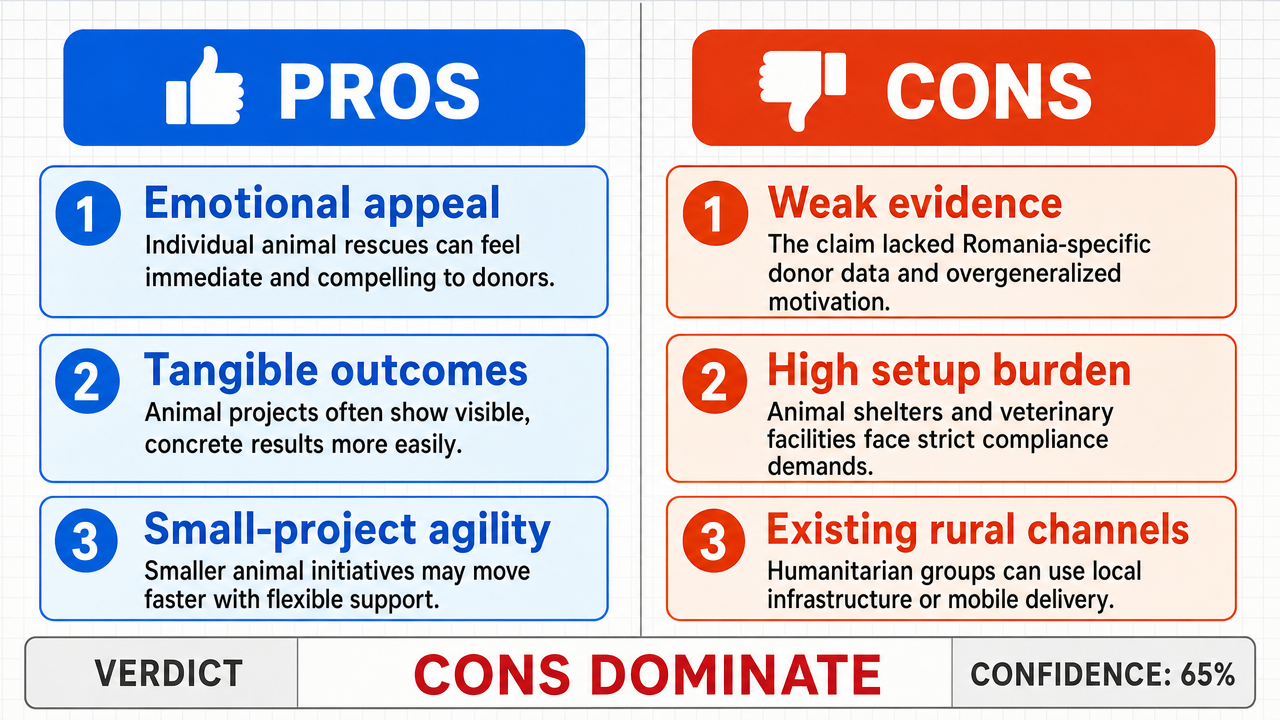
Verdict
Verdict: likely FALSE (65%)
Web Report: https://solsice.com/public/debates/it-is-significantly-easier-to-secure-funding-and-launch-proj-90fc2562c693
This section provides a brief overview of the key arguments. You do not need to read the full detailed report below.
✅ Key PRO arguments:
- ■Animal-protection campaigns benefit from emotional salience and the perceived immediacy of rescuing individual dogs, cats, and other animals, which can lower the psychological barrier to small donations and crowdfunding .
- ■Animal-protection projects often present donors with discrete and tangible outcomes, whereas rural humanitarian aid must address interconnected problems such as poverty, deficient infrastructure, and long-term healthcare needs whose results are less visible.
- ■The size of the funding pool does not by itself determine how easy a project is to fund or launch; smaller, flexible animal-protection initiatives may still have lower organizational and entry barriers than complex systemic interventions.
❌ Key ANTI arguments:
- ■The affirmative generalized about donor psychology and the perceived futility of humanitarian work without providing Romanian-specific donor data, and it did not demonstrate that the flexibility of animal-protection projects actually makes funding easier.
- ■Romania's animal-welfare regulatory framework, including Law 205/2004, imposes demanding shelter and veterinary-facility standards , making the establishment of compliant animal-protection projects comparatively costly and time-consuming.
- ■Rural humanitarian organizations can use existing public infrastructure, including local councils and orphanages, or deploy mobile units , reducing the need to construct specialized facilities before delivering assistance.
💭 Conclusion: False, although confidence is limited because the assertion combines two distinct issues—securing funding and launching projects—and the tournament included only one debate. The strongest anti case is that animal protection often requires purpose-built shelters and veterinary facilities under Romania's animal-welfare framework, making project setup comparatively difficult. Rural humanitarian organizations can instead work through existing local councils, orphanages, and mobile units , while access to EU structural funds offers a more stable funding route than relying primarily on animal-welfare micro-donations . The pro side plausibly identified emotional appeal and visible, tangible outcomes as advantages for animal campaigns, but it supplied no Romanian-specific donor evidence and did not overcome the regulatory and infrastructure barriers. Accordingly, the debate rejects the compound assertion, but with moderate rather than decisive confidence.
🔬 DeepResearch Result: likely FALSE ❌ (65%)
Assertion: It is significantly easier to secure funding and launch projects for animal protection than for humanitarian aid in impoverished rural areas of Romania.
Participating models: gemma-4-26b-a4b-it 💬👁️, glm-4.7-flash 💬
📊 Face-offs: 0 concluded TRUE, 1 concluded FALSE (1 face-offs, 3 models)
📊 Score by side: TRUE=0.00, FALSE=0.68
🏅 Model score changes:
minimax-m3 💬👁️: +7
✅ PRO Arguments:
- ■Animal-protection campaigns benefit from emotional salience and the perceived immediacy of rescuing individual dogs, cats, and other animals, which can lower the psychological barrier to small donations and crowdfunding . gemma-4-26b-a4b-it 💬👁️
- ■Animal-protection projects often present donors with discrete and tangible outcomes, whereas rural humanitarian aid must address interconnected problems such as poverty, deficient infrastructure, and long-term healthcare needs whose results are less visible. gemma-4-26b-a4b-it 💬👁️
- ■The size of the funding pool does not by itself determine how easy a project is to fund or launch; smaller, flexible animal-protection initiatives may still have lower organizational and entry barriers than complex systemic interventions. gemma-4-26b-a4b-it 💬👁️
❌ ANTI Arguments:
- ■The affirmative generalized about donor psychology and the perceived futility of humanitarian work without providing Romanian-specific donor data, and it did not demonstrate that the flexibility of animal-protection projects actually makes funding easier. glm-4.7-flash 💬
- ■Romania's animal-welfare regulatory framework, including Law 205/2004, imposes demanding shelter and veterinary-facility standards , making the establishment of compliant animal-protection projects comparatively costly and time-consuming. glm-4.7-flash 💬
- ■Rural humanitarian organizations can use existing public infrastructure, including local councils and orphanages, or deploy mobile units , reducing the need to construct specialized facilities before delivering assistance. glm-4.7-flash 💬
- ■Humanitarian aid can draw on major and comparatively stable EU structural funding, while animal-protection organizations may depend more heavily on volatile micro-donations ; this gives rural humanitarian projects a funding advantage independent of their broader scope. glm-4.7-flash 💬
💭 Reasoning: False, although confidence is limited because the assertion combines two distinct issues—securing funding and launching projects—and the tournament included only one debate. The strongest anti case is that animal protection often requires purpose-built shelters and veterinary facilities under Romania's animal-welfare framework, making project setup comparatively difficult. Rural humanitarian organizations can instead work through existing local councils, orphanages, and mobile units, while access to EU structural funds offers a more stable funding route than relying primarily on animal-welfare micro-donations. The pro side plausibly identified emotional appeal and visible, tangible outcomes as advantages for animal campaigns, but it supplied no Romanian-specific donor evidence and did not overcome the regulatory and infrastructure barriers. Accordingly, the debate rejects the compound assertion, but with moderate rather than decisive confidence.
📋 PRO Facts:
• The pro case emphasized that rescuing individual animals provides donors with visible and emotionally engaging outcomes.
• Animal-protection initiatives can attract micro-donations and crowdfunding through the perceived immediacy of animal rescue.
• Rural humanitarian aid was described as addressing complex, long-term problems involving poverty, infrastructure, and healthcare.
• The affirmative did not present Romanian-specific donor data demonstrating a measurable advantage in funding ease.
📋 ANTI Facts:
• Romanian Law 205/2004 was cited as requiring specific standards for animal shelters and veterinary facilities.
• Rural humanitarian projects can use existing local councils, orphanages, and mobile service units rather than constructing specialized facilities.
• EU structural funds were identified as a major and comparatively stable funding source for humanitarian aid.
• The anti side argued that the affirmative did not establish that project flexibility translates into easier access to funding.
| Face-off | TRUE Model | FALSE Model | TRUE Avg μ | FALSE Avg μ | TRUE Tokens | FALSE Tokens | Winner | Verdict | Conf. |
|---|---|---|---|---|---|---|---|---|---|
| #1 | gemma-4-26b-a4b-it 💬👁️ | glm-4.7-flash 💬 | 0.188 | 0.379 | 4 | 4 | FALSE | FALSE | 68% |
The following technical terms, abbreviations, and domain-specific concepts are referenced throughout this debate transcript. Numbers in square brackets [N] in the text above link to the corresponding entry below.
[1] administrative and strategic vetting — Review processes used to assess initiatives before funding. The Affirmative says animal-protection projects require less vetting than large-scale social interventions.
[2] administrative burden — The procedural, paperwork, and organizational demands involved in obtaining approval or funding. The debate presents it as a significant obstacle to rural humanitarian projects and EU-fund applications.
[3] animal protection — Projects intended to protect animals, including shelter and individual rescue work for dogs and cats. Their funding accessibility is contrasted with that of rural humanitarian aid.
[4] animal welfare — The protection and treatment of animals, discussed in relation to shelter standards, veterinary oversight, and regulatory compliance.
[5] animal welfare protocols — Procedures governing animal welfare that, according to the Negative, shelters must follow as part of the applicable animal-protection framework.
[6] application processes — Formal procedures for seeking funding, described by the Affirmative as exhaustive, lengthy, and demanding when applying for EU structural funds.
[7] category error — A reasoning error in which one measure is substituted for another. The Affirmative labels the emphasis on capital volume a category error because the proposition concerns ease of access rather than budget size.
[8] compliance — Adherence to funding, facility, inspection, and animal-welfare requirements. It is presented as burdensome for both EU-fund applicants and animal-shelter projects.
[9] compliance costs — The financial expense of meeting regulatory requirements, cited as a reason animal-welfare organizations may struggle to establish compliant shelters.
[10] crowdfunding — Raising funds by soliciting contributions from many supporters, described as a rapid funding channel for animal-protection causes.
[11] cuteness factor — The emotional appeal of cute animals that, in the Affirmative's account, lowers the barrier to micro-donations and crowdfunding.
[12] donor fatigue — Donors' reduced willingness or enthusiasm to continue supporting a cause, invoked to explain possible weakness in funding for large humanitarian problems.
[13] donor psychology — The attitudes and decision patterns of donors, including reactions to emotional appeal and perceived futility. The Negative disputes the claimed Romanian-specific pattern for lack of supporting data.
[14] EU — European Union — The European Union is the institutional context for the structural funds and European Commission guidelines discussed in the debate.
[15] EU structural funds — European Union structural funds — Funding described as a major source for rural development in Romania. The Negative characterizes the associated capital as massive and stable, while the Affirmative emphasizes application, compliance, and coordination burdens.
[16] European Commission guidelines — The funding and application guidance cited by the Affirmative as part of the demanding process for securing EU structural funds.
[17] facility requirements — Physical and operational conditions that shelters must meet under the cited animal-welfare framework, including specified facilities and veterinary oversight.
[18] facility standards — Rules governing the design and operation of animal shelters and veterinary facilities, described as costly and time-consuming to establish.
[19] humanitarian aid — Assistance addressing poverty and service deficiencies, including infrastructure, healthcare, and long-term needs in vulnerable communities.
[20] inspections — Reviews used to determine whether organizations or facilities meet applicable requirements. The Negative says inspections can delay animal-protection project initiation.
[21] institutional coordination — Coordination among institutions during extended funding or project processes, cited as part of the difficulty of securing EU structural funds.
[22] local municipal partnerships — Working relationships with local government that the Negative says can help humanitarian projects access resources.
[23] micro-donations — Small individual contributions used as an accessible funding source for animal protection. The Negative characterizes such funding as volatile, while the Affirmative treats it as low-friction.
[24] mobile units — Portable service units that can deliver assistance without requiring new permanent facilities, cited as reducing the launch barrier for rural humanitarian work.
[25] mobilization of capital — The gathering or deployment of financial resources for projects or causes, discussed when comparing animal-centric funding with funding for large-scale interventions.
[26] NGO — non-governmental organization — An organization operating outside government, referenced through established frameworks that can support humanitarian project delivery.
[27] NGO frameworks — non-governmental organization frameworks — Existing organizational structures for running projects, cited as an advantage for humanitarian aid because they can facilitate access to resources.
[28] perceived futility — The belief that a large social problem cannot be solved, invoked as a possible reason for donor resistance to complex rural humanitarian needs.
[29] physical infrastructure — The facilities and physical systems a project requires. The debate contrasts constructing a compliant animal shelter with using existing councils, orphanages, or mobile units.
[30] psychological barriers — Barriers arising from donor attitudes, such as perceived futility or donor fatigue, invoked to explain differences in funding support.
[31] regulatory and bureaucratic landscape — The combined legal rules, approvals, and administrative processes affecting a project's launch. The parties dispute whether this landscape is more burdensome for animal protection or rural humanitarian aid.
[32] Romanian Law 205/2004 on Animal Welfare — The Romanian animal-welfare law cited by the Negative as requiring shelter facility standards, veterinary oversight, animal-welfare protocols, and related compliance.
[33] rural development — Development initiatives in rural areas, identified as the context for applying EU structural funds in Romania.
[34] rural humanitarian aid — Humanitarian work addressing poverty, infrastructure deficits, and healthcare needs in impoverished rural areas of Romania.
[35] social interventions — Large-scale actions intended to address social problems, described by the Affirmative as requiring extensive administrative and strategic vetting.
[36] structural barriers — System-level obstacles to securing funding or launching projects, including regulation, administration, project scale, and institutional coordination.
[37] structural poverty — Poverty arising from systemic conditions, linked in the debate with infrastructure deficits and long-term healthcare needs in rural Romania.
[38] sustainable project — A project intended to continue operating over time; the Negative argues that infrastructure and compliance needs can offset easy access to micro-donations.
[39] veterinary facilities — Facilities providing veterinary capacity, cited alongside shelters as costly animal-welfare infrastructure that must meet applicable standards.
[40] veterinary oversight — Supervision involving veterinary expertise, cited as one of the shelter standards required under the animal-welfare framework discussed in the debate.
The following financial data tables were referenced during the debate exchanges:
| Project Category | Perceived Ease of Funding | Primary Funding Source | Complexity of Implementation |
|---|---|---|---|
| Animal Protection | High | Crowdfunding / Micro-donations | Low to Moderate |
| Rural Humanitarian Aid | Low | Institutional Grants / State Aid | High |
Legend: Qualitative comparison of project types in the Romanian context based on mobilization speed and administrative requirements.
| Project Type | Primary Funding Mechanism | Average Grant Size | Stability of Funding |
|---|---|---|---|
| Animal Protection | Crowdfunding / Micro-donations | Low (Variable) | Low |
| Rural Humanitarian Aid | EU Structural Funds / State Aid | High (Stable) | High |
Legend: Comparison of funding mechanisms and stability for project types in Romania. Funding size is qualitative; stability indicates the reliability of the funding source over time.
Face-off transcripts
- ■
Ownership & Trade Secrets. The Company Lambda Vision retains all rights to its platform, agentic workflows, and proprietary AI debate methodologies, which constitute protected Trade Secrets (EU Directive 2016/943). Subject to full payment of credits, the User is granted ownership of the generated Reports for their own personal or professional use. Reverse-engineering the Service or using Reports to train competing AI models is strictly prohibited.
- ■
No Professional Advice. Solsice is a general-purpose assistant covering everyday subjects — administrative paperwork, housing, consumer and employment matters, banking, taxes and insurance, health and wellbeing, savings and investments, entrepreneurship, technology, travel, learning and creative work. Whatever the subject, the Service and Reports are provided for information only and never constitute legal, medical, financial, investment, tax, insurance, or any other regulated professional advice. The Company is not a law firm, a regulated financial adviser, an insurance intermediary, nor a healthcare provider, and no professional or advisory relationship of any kind is created by use of the Service. Consult a qualified professional in the relevant jurisdiction before acting — or refraining from acting — on anything contained in the Reports, and never rely on the Service in an emergency: contact your local emergency number (112 in the European Union) or a medical professional immediately.
- ■
AI-Generated Content, Sources and Viewpoints. Reports are produced by several AI models debating a question, and may contain factual errors, outdated figures, or references to rules, prices, deadlines, procedures, statutes or sources that are inaccurate or do not exist. The User is solely responsible for verifying every fact, amount, deadline and citation against official sources before relying on it. Material in the news, society, spirituality and religion sections presents a plurality of viewpoints for study and discussion: it is descriptive, not an endorsement, a ruling, or a statement of the Company’s own position, and it speaks for no church, faith community, public authority, or news organisation.
- ■
Liability & Governing Law. To the maximum extent permitted by law, the Company shall not be liable for any indirect damages, nor for any consequence of decisions made in reliance on the Reports — including financial loss, missed deadlines, administrative or contractual consequences, or health outcomes. These Terms are governed by French law. Any disputes shall be subject to the exclusive jurisdiction of the Courts of Paris, France.