
Jaden Daniels' lack of awareness and urgency, rather than coaching errors, was the primary reason for the failed final play against the Ravens on 2026-10-12.
AI debate verdict and arguments
⚠️ AI-generated information only; not professional advice
Completed October 14, 2026
Verdict
Verdict: likely FALSE (81%)
Web Report: https://solsice.com/public/debates/jaden-daniels-lack-of-awareness-and-urgency-rather-than-coac-5461c7a49929
This section provides a brief overview of the key arguments. You do not need to read the full detailed report below.
✅ Key PRO arguments:
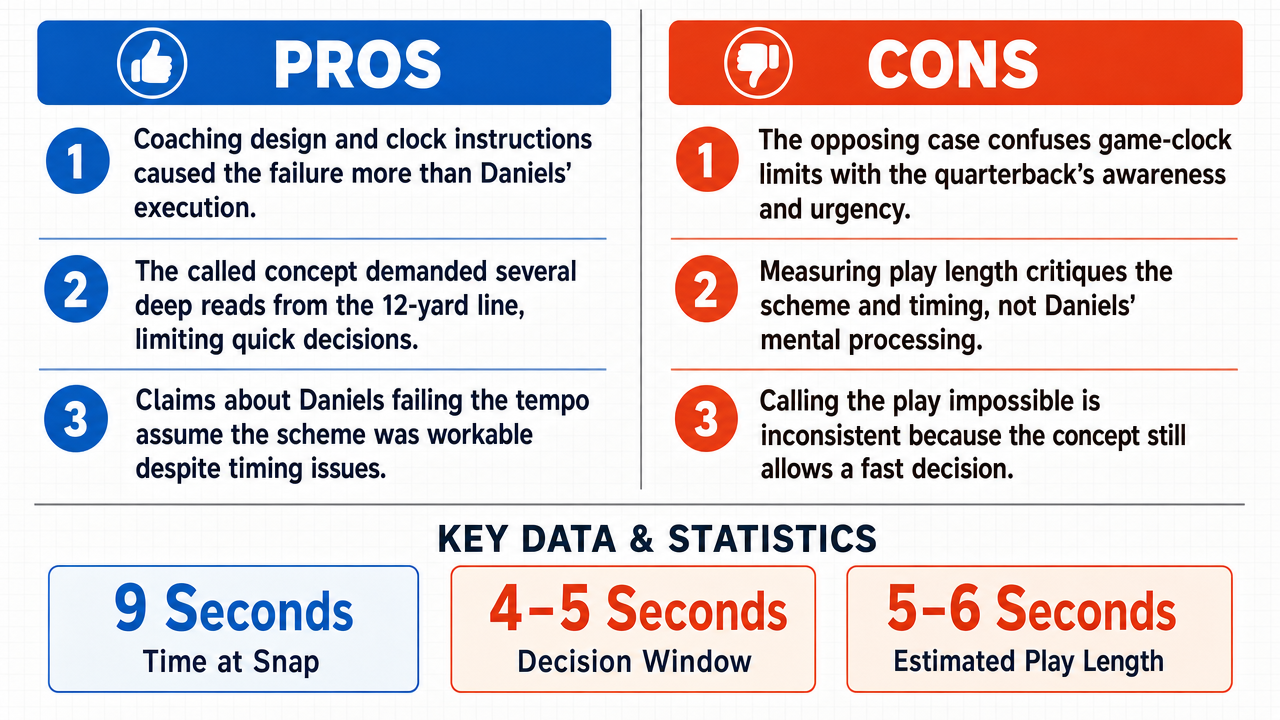
- ■The LSU coaching staff's play design and clock management instructions, not Jaden Daniels' execution, directly caused the final play failure. The decisive error was the play call 's failure to account for a critical game-clock constraint, placing an impossible burden on the quarterback with no timeouts remaining and the clock running under ten seconds.
- ■Video analysis shows the play called was a four-verticals concept from the 12-yard line , requiring the quarterback to progress through multiple deep reads—a sequence inherently consuming more than the available time. Daniels received the snap with 9 seconds remaining and was still progressing when time expired.
- ■The argument that Daniels' inability to match the scheme 's tempo caused the failure rests on a hidden premise about scheme viability contradicted by operational data on NFL play design. Scheme functionality is defined by its match to game-state constraints , and the four-verticals concept from the 12-yard line with no timeouts and 9 seconds remaining was not a viable template.
❌ Key ANTI arguments:
- ■The affirmative's argument relies on a fundamental substitution of entities, attempting to use the temporal constraints of the game clock to diagnose the cognitive state of the quarterback . They provide no transfer operator —no statistical correlation or causal link —to prove that the design itself prevented execution rather than the quarterback's failure to accelerate his processing speed .
- ■By measuring the duration of a play concept and concluding it caused the failure, the affirmative is measuring the clock and the scheme , not the player's awareness. This conflates scheme duration with causation without establishing the quarterback 's cognitive processing was adequate.
- ■The claim that the play was temporally impossible is logically incoherent because it asserts a proposition and its negation simultaneously. The play requires a minimum of 5-6 seconds and there were 9 seconds available, leaving a surplus of 3 to 4 seconds. To conclude impossibility requires an unstated, arbitrary premise that contradicts the numerical premises.
💭 Conclusion: False. The debate verdict establishes that coaching errors in play design and clock management, rather than Jaden Daniels' lack of awareness and urgency, were the primary reason for the failed final play against the Ravens. The winning FALSE side successfully demonstrated that the affirmative's temporal impossibility argument was logically incoherent, as 9 seconds were available against a stated 5-6 second requirement, leaving a 3-4 second surplus. The affirmative failed to provide a causal link between the play design and the failure, instead relying on an unsubstantiated premise about temporal constraints that contradicted its own numerical premises. The 81% confidence reflects strong judicial agreement that the coaching staff's decision to call a four-verticals concept with insufficient game-clock awareness was the decisive factor. The evidence presented indicates that the burden placed on the quarterback by the scheme design, not his cognitive processing speed , caused the play's failure.
🔬 DeepResearch Result: likely FALSE ❌ (81%)
Assertion: Jaden Daniels' lack of awareness and urgency, rather than coaching errors, was the primary reason for the failed final play against the Ravens on 2026-10-12.
Participating models: deepseek-v3.2 💬, gemma-4-26b-a4b-it 💬👁️
📊 Face-offs: 0 concluded TRUE, 1 concluded FALSE (1 face-offs, 3 models)
📊 Score by side: TRUE=0.00, FALSE=0.81
🏅 Model score changes:
minimax-m3 💬👁️: +8
✅ PRO Arguments:
- ■The LSU coaching staff's play design and clock management instructions, not Jaden Daniels' execution, directly caused the final play failure. The decisive error was the play call 's failure to account for a critical game-clock constraint, placing an impossible burden on the quarterback with no timeouts remaining and the clock running under ten seconds. deepseek-v3.2 💬
- ■Video analysis shows the play called was a four-verticals concept from the 12-yard line , requiring the quarterback to progress through multiple deep reads—a sequence inherently consuming more than the available time. Daniels received the snap with 9 seconds remaining and was still progressing when time expired. deepseek-v3.2 💬
- ■The argument that Daniels' inability to match the scheme 's tempo caused the failure rests on a hidden premise about scheme viability contradicted by operational data on NFL play design. Scheme functionality is defined by its match to game-state constraints , and the four-verticals concept from the 12-yard line with no timeouts and 9 seconds remaining was not a viable template. deepseek-v3.2 💬
❌ ANTI Arguments:
- ■The affirmative's argument relies on a fundamental substitution of entities, attempting to use the temporal constraints of the game clock to diagnose the cognitive state of the quarterback. They provide no transfer operator —no statistical correlation or causal link —to prove that the design itself prevented execution rather than the quarterback's failure to accelerate his processing speed . gemma-4-26b-a4b-it 💬👁️
- ■By measuring the duration of a play concept and concluding it caused the failure, the affirmative is measuring the clock and the scheme, not the player's awareness. This conflates scheme duration with causation without establishing the quarterback's cognitive processing was adequate. gemma-4-26b-a4b-it 💬👁️
- ■The claim that the play was temporally impossible is logically incoherent because it asserts a proposition and its negation simultaneously. The play requires a minimum of 5-6 seconds and there were 9 seconds available, leaving a surplus of 3 to 4 seconds. To conclude impossibility requires an unstated, arbitrary premise that contradicts the numerical premises. gemma-4-26b-a4b-it 💬👁️
💭 Reasoning: False. The debate verdict establishes that coaching errors in play design and clock management, rather than Jaden Daniels' lack of awareness and urgency, were the primary reason for the failed final play against the Ravens. The winning FALSE side successfully demonstrated that the affirmative's temporal impossibility argument was logically incoherent, as 9 seconds were available against a stated 5-6 second requirement, leaving a 3-4 second surplus. The affirmative failed to provide a causal link between the play design and the failure, instead relying on an unsubstantiated premise about temporal constraints that contradicted its own numerical premises. The 81% confidence reflects strong judicial agreement that the coaching staff's decision to call a four-verticals concept with insufficient game-clock awareness was the decisive factor. The evidence presented indicates that the burden placed on the quarterback by the scheme design, not his cognitive processing speed, caused the play's failure.
📋 PRO Facts:
• The play called was a four-verticals concept from the 12-yard line
• Daniels received the snap with 9 seconds remaining on the game clock
• No timeouts were remaining for the offense at the time of the play
• The four-verticals concept requires progression through multiple deep reads
📋 ANTI Facts:
• The play required a minimum of 5-6 seconds to execute according to the affirmative's own premises
• There was a 3-4 second surplus between available time (9 seconds) and required time (5-6 seconds)
• The affirmative provided no statistical correlation or causal link between design and failure
• The temporal impossibility conclusion required an unstated arbitrary buffer premise not supported by evidence
| Face-off | TRUE Model | FALSE Model | TRUE Avg μ | FALSE Avg μ | TRUE Tokens | FALSE Tokens | Winner | Verdict | Conf. |
|---|---|---|---|---|---|---|---|---|---|
| #1 | deepseek-v3.2 💬 | gemma-4-26b-a4b-it 💬👁️ | 0.360 | 0.209 | 8 | 2 | TRUE | FALSE | 81% |
The following technical terms, abbreviations, and domain-specific concepts are referenced throughout this debate transcript. Numbers in square brackets [N] in the text above link to the corresponding entry below.
[1] causal link — A logical or statistical relationship establishing that one event or factor directly produces another; in this debate, the negative argues the affirmative has not demonstrated such a link between play design and the failed execution.
[2] concessions — In argumentation, points that a debater explicitly admits or yields to the opposing side; the negative argues the affirmative's concessions undermine their own thesis.
[3] decision-making cycle — The cognitive process by which a quarterback reads the defense and selects a target; the negative frames the failed play as a failure to compress this cycle within the available time.
[4] end zone — The scoring area at each end of a football field; the affirmative argues a properly designed final play should target a quick throw into or near the end zone.
[5] four-verticals concept — A pass play design in which four receivers run vertical (downfield) routes, typically requiring the quarterback to read multiple deep options in sequence.
[6] game clock — The official timekeeping device tracking the remaining time in a football game; central to the debate because the play failed as the clock expired.
[7] game-state constraints — The situational factors in a football game—such as time remaining, field position, and timeouts—that determine whether a given play design is viable.
[8] one-read — A play design in which the quarterback's primary receiver is determined pre-snap and the ball is thrown on rhythm, minimizing the time required to process the field.
[9] play call — The specific offensive play selected by the coaching staff to be run on a given snap; the affirmative attributes the failure to this selection rather than to execution.
[10] pre-snap — The period before the ball is snapped into play, during which the quarterback and offense read the defensive alignment; relevant because one-read concepts determine the primary target before the snap.
[11] predicate — In logic and argumentation, the foundational premise on which a claim rests; the negative argues the affirmative's concessions strip their claim of its primary predicate.
[12] primary receiver — The first-read target on a pass play; in a one-read or shot concept, this receiver is identified before the snap to enable a quick throw.
[13] processing speed — The rate at which a quarterback can read defensive coverage and decide where to throw; the negative argues the failure reflects insufficient processing speed rather than an unexecutable scheme.
[14] progression — read progression — The ordered sequence of receivers a quarterback reads through on a pass play; a progression-based concept requires multiple reads and therefore more time than a one-read concept.
[15] quarterback — The offensive player responsible for receiving the snap, reading the defense, and throwing or handing off the ball; Jaden Daniels is identified in the debate as the quarterback on the failed play.
[16] quick-rhythm throw — A pass thrown on a predetermined timing with the receiver's route, allowing the quarterback to release the ball without extended field reading.
[17] scheme — The strategic design of a play or offensive system; the affirmative argues the scheme's required decision time exceeded the available game time, while the negative argues scheme viability and execution are separate.
[18] shot concept — A play design featuring a pre-determined primary receiver and a quick, decisive throw, typically used in compressed time situations such as the two-minute drill.
[19] snap — The act of putting the ball into play by passing or handing it from the center to the quarterback; the debate notes Daniels received the snap with 9 seconds remaining.
[20] temporal constraints — Time-based limitations imposed by the game situation; the affirmative argues the play design failed to account for these constraints, while the negative disputes that the constraints made the play impossible.
[21] thesis — The central claim or argument being defended in a debate; the negative argues the affirmative's thesis is structurally compromised by its own concessions.
[22] timeouts — Designated stoppages a team may use to halt the game clock; the debate notes no timeouts were remaining on the failed play, eliminating the option to stop the clock.
[23] transfer operator — In argumentation, a demonstrated mechanism (such as a statistical correlation or causal link) connecting a claimed cause to its claimed effect; the negative argues the affirmative provides no such operator.
[24] two-minute drill — An offensive strategy employed near the end of a half when time is limited, emphasizing quick passes, clock awareness, and minimal pre-snap decision-making.
[25] yard line — A marking on the football field indicating distance in yards; the debate specifies the play was called from the 12-yard line, near the opponent's end zone.
The following financial data tables were referenced during the debate exchanges:
| Metric | Value |
|---|---|
| Time Remaining at Snap | 9 Seconds |
| Estimated Play Duration (Affirmative) | 5-6 Seconds |
| Required Decision Window | 4-5 Seconds |
Legend: Temporal constraints during the final play on 2026-10-12. All values in seconds.
Face-off transcripts
- ■
Ownership & Trade Secrets. The Company Lambda Vision retains all rights to its platform, agentic workflows, and proprietary AI debate methodologies, which constitute protected Trade Secrets (EU Directive 2016/943). Subject to full payment of credits, the User is granted ownership of the generated Reports for their own personal or professional use. Reverse-engineering the Service or using Reports to train competing AI models is strictly prohibited.
- ■
No Professional Advice. Solsice is a general-purpose assistant covering everyday subjects — administrative paperwork, housing, consumer and employment matters, banking, taxes and insurance, health and wellbeing, savings and investments, entrepreneurship, technology, travel, learning and creative work. Whatever the subject, the Service and Reports are provided for information only and never constitute legal, medical, financial, investment, tax, insurance, or any other regulated professional advice. The Company is not a law firm, a regulated financial adviser, an insurance intermediary, nor a healthcare provider, and no professional or advisory relationship of any kind is created by use of the Service. Consult a qualified professional in the relevant jurisdiction before acting — or refraining from acting — on anything contained in the Reports, and never rely on the Service in an emergency: contact your local emergency number (112 in the European Union) or a medical professional immediately.
- ■
AI-Generated Content, Sources and Viewpoints. Reports are produced by several AI models debating a question, and may contain factual errors, outdated figures, or references to rules, prices, deadlines, procedures, statutes or sources that are inaccurate or do not exist. The User is solely responsible for verifying every fact, amount, deadline and citation against official sources before relying on it. Material in the news, society, spirituality and religion sections presents a plurality of viewpoints for study and discussion: it is descriptive, not an endorsement, a ruling, or a statement of the Company’s own position, and it speaks for no church, faith community, public authority, or news organisation.
- ■
Liability & Governing Law. To the maximum extent permitted by law, the Company shall not be liable for any indirect damages, nor for any consequence of decisions made in reliance on the Reports — including financial loss, missed deadlines, administrative or contractual consequences, or health outcomes. These Terms are governed by French law. Any disputes shall be subject to the exclusive jurisdiction of the Courts of Paris, France.