
La pratique des bookmakers d'offrir des bonus de bienvenue aux nouveaux joueurs sur les sites de paris sportifs français entraîne finalement une perte financière nette pour les opérateurs.
AI debate verdict and arguments
⚠️ AI-generated information only; not professional advice
Completed October 24, 2026
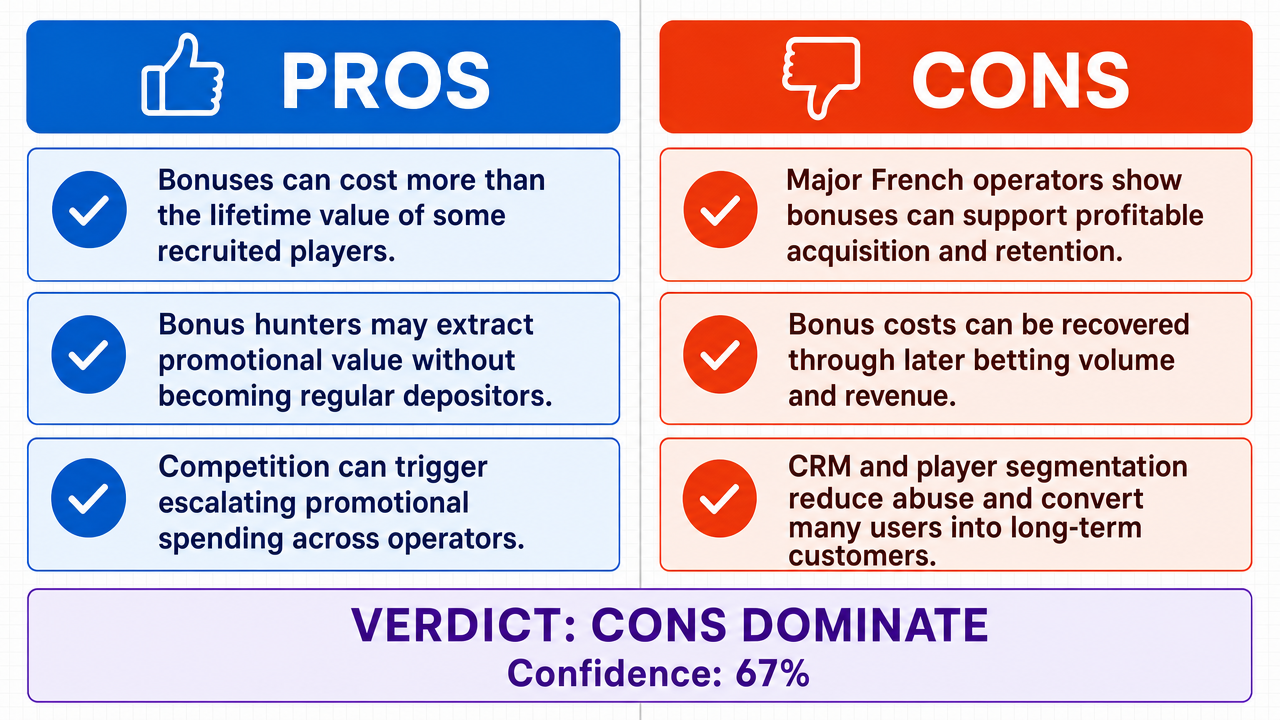
Verdict
Verdict: likely FALSE (67%)
Web Report: https://solsice.com/public/debates/la-pratique-des-bookmakers-d-offrir-des-bonus-de-bienvenue-a-ea85a0bb8fe2
This section provides a brief overview of the key arguments. You do not need to read the full detailed report below.
✅ Key PRO arguments:
- ■Welcome bonuses can raise customer-acquisition costs above the lifetime value of the recruited players, so bonus-seeking cohorts can carry negative expected value and produce a structural net loss for operators.
- ■Bonus hunters who specialize in extracting promotional value without meaningful personal deposits can capture bonus value while generating little ongoing revenue, raising the cost per genuinely profitable player.
- ■In the highly competitive French market regulated by the Autorité Nationale des Jeux, operators are pushed into an arms race of promotional spending in which bonus costs can outpace the returns generated by the promotions.
❌ Key ANTI arguments:
- ■The financial performance of major French operators indicates that welcome bonuses function as an effective customer-acquisition and retention strategy rather than a net-loss driver: PMU , the dominant sports-betting player, reported betting revenue of approximately 2.5 billion euros in 2023 while maintaining strong profitability margins .
- ■The cost of bonuses can be amortized through the volume of bets and the subsequent revenue generated by the acquired player base, so the initial promotional liability is recovered over the customer relationship.
- ■Although a subset of players pursue only bonuses, a larger share can be converted into profitable long-term customers, and operators' strategic segmentation and retention efforts are specifically designed to achieve that conversion.
💭 Conclusion: False is the tournament verdict: the FALSE side won the single debate with 67% judge confidence, arguing that welcome bonuses are a profitable customer-acquisition and retention tool rather than a cause of net financial loss for operators. Its strongest evidence is that PMU , the dominant French sports-betting operator, reported betting revenue of approximately 2.5 billion euros in 2023 while maintaining strong profitability margins linked to high player volume generated through promotional activity. The winning side also argued that bonus outlays are amortized through betting volume and the long-term value of converted players, with segmentation and retention efforts turning a substantial share of sign-ups into profitable customers. The losing side raised plausible concerns about bonus hunters , negative cohort economics , and a promotional arms race , but it did not establish that welcome bonuses specifically cause aggregate net losses, and its reading of PMU's scale as an established-base effect did not carry the judgment. The verdict therefore rejects the assertion that these bonuses ultimately end in net financial loss, although at 67% confidence from only one debate the evidence remains partly inferential rather than a definitive operator-level accounting demonstration.
🔬 DeepResearch Result: likely FALSE ❌ (67%)
Assertion: La pratique des bookmakers d'offrir des bonus de bienvenue aux nouveaux joueurs sur les sites de paris sportifs français entraîne finalement une perte financière nette pour les opérateurs.
Participating models: gemma-4-26b-a4b-it 💬👁️, glm-4.7-flash 💬
📊 Face-offs: 0 concluded TRUE, 1 concluded FALSE (1 face-offs, 3 models)
📊 Score by side: TRUE=0.00, FALSE=0.67
🏅 Model score changes:
minimax-m3 💬👁️: +7
✅ PRO Arguments:
- ■Welcome bonuses can raise customer-acquisition costs above the lifetime value of the recruited players, so bonus-seeking cohorts can carry negative expected value and produce a structural net loss for operators. gemma-4-26b-a4b-it 💬👁️
- ■Bonus hunters who specialize in extracting promotional value without meaningful personal deposits can capture bonus value while generating little ongoing revenue, raising the cost per genuinely profitable player. gemma-4-26b-a4b-it 💬👁️
- ■In the highly competitive French market regulated by the Autorité Nationale des Jeux, operators are pushed into an arms race of promotional spending in which bonus costs can outpace the returns generated by the promotions. gemma-4-26b-a4b-it 💬👁️
- ■The conversion of bonus users into profitable long-term players is often a mathematical illusion, and analysis of cohort-level economics still reveals unamortized acquisition costs and structural losses. gemma-4-26b-a4b-it 💬👁️
- ■PMU 's approximately 2.5 billion euros in 2023 betting revenue reflects market dominance and an established player base rather than proof that new bonus-driven cohorts are profitable, so it cannot validate the promotional strategy. gemma-4-26b-a4b-it 💬👁️
❌ ANTI Arguments:
- ■The financial performance of major French operators indicates that welcome bonuses function as an effective customer-acquisition and retention strategy rather than a net-loss driver: PMU, the dominant sports-betting player, reported betting revenue of approximately 2.5 billion euros in 2023 while maintaining strong profitability margins . glm-4.7-flash 💬
- ■The cost of bonuses can be amortized through the volume of bets and the subsequent revenue generated by the acquired player base, so the initial promotional liability is recovered over the customer relationship. glm-4.7-flash 💬
- ■Although a subset of players pursue only bonuses, a larger share can be converted into profitable long-term customers, and operators' strategic segmentation and retention efforts are specifically designed to achieve that conversion. glm-4.7-flash 💬
- ■Judging promotional mechanics by their initial liability alone, and assuming all bonus users are unprofitable, oversimplifies the cohort economics and ignores the long-term value generated by a significant segment of new players. glm-4.7-flash 💬
- ■Strong operator revenue and profitability margins show that the overall welcome-bonus strategy can be financially sustainable in the French market, contradicting the claim of inherent net loss. glm-4.7-flash 💬
💭 Reasoning: False is the tournament verdict: the FALSE side won the single debate with 67% judge confidence, arguing that welcome bonuses are a profitable customer-acquisition and retention tool rather than a cause of net financial loss for operators. Its strongest evidence is that PMU, the dominant French sports-betting operator, reported betting revenue of approximately 2.5 billion euros in 2023 while maintaining strong profitability margins linked to high player volume generated through promotional activity. The winning side also argued that bonus outlays are amortized through betting volume and the long-term value of converted players, with segmentation and retention efforts turning a substantial share of sign-ups into profitable customers. The losing side raised plausible concerns about bonus hunters, negative cohort economics, and a promotional arms race, but it did not establish that welcome bonuses specifically cause aggregate net losses, and its reading of PMU's scale as an established-base effect did not carry the judgment. The verdict therefore rejects the assertion that these bonuses ultimately end in net financial loss, although at 67% confidence from only one debate the evidence remains partly inferential rather than a definitive operator-level accounting demonstration.
📋 PRO Facts:
• The pro side argued that customer-acquisition costs from welcome bonuses can exceed the lifetime value of bonus-seeking players.
• Bonus hunters who exploit promotional terms without meaningful deposits were described as having negative expected value for operators because the bonus itself creates a mathematical advantage for the player.
• The French market was characterized as highly competitive and regulated by the Autorité Nationale des Jeux, with operators engaged in an arms race of promotional spending.
• The pro side argued that PMU's approximately 2.5 billion euros in 2023 betting revenue reflects market dominance and an established player base rather than the marginal profitability of bonus-driven cohorts.
📋 ANTI Facts:
• PMU reported betting revenue of approximately 2.5 billion euros in 2023.
• PMU maintained strong profitability margins, which the anti side linked to high player volume generated through promotional activities.
• Bonus costs can be offset through the volume of bets and the subsequent revenue generated by the player base.
• Operators apply segmentation and retention strategies aimed at converting a substantial portion of bonus-acquired users into profitable long-term customers.
• Only a subset of players are characterized as being interested exclusively in bonuses, while a larger portion can become profitable long-term customers.
| Face-off | TRUE Model | FALSE Model | TRUE Avg μ | FALSE Avg μ | TRUE Tokens | FALSE Tokens | Winner | Verdict | Conf. |
|---|---|---|---|---|---|---|---|---|---|
| #1 | gemma-4-26b-a4b-it 💬👁️ | glm-4.7-flash 💬 | 0.256 | 0.485 | 4 | 4 | FALSE | FALSE | 67% |
The following technical terms, abbreviations, and domain-specific concepts are referenced throughout this debate transcript. Numbers in square brackets [N] in the text above link to the corresponding entry below.
[1] Active Player Accounts — Accounts counted as active in the French online gambling market. The debate's table reports 2.5 million for 2021 and 3.2 million for 2022.
[2] ANJ — Autorité Nationale des Jeux — The body identified in the debate as regulating the French sports-betting market. The negative side also attributes a 2022 annual report on the French online gambling market to the ANJ.
[3] arms race — A competitive promotional dynamic in which operators increase bonuses and other promotional spending to attract players.
[4] balance sheet — The financial statement position in which the debate says bonus-related liabilities appear.
[5] betting revenue — Revenue generated from betting activity. The negative side cites approximately 2.5 billion euros in 2023 betting revenue for PMU.
[6] bonus hunters — Users who specialize in exploiting promotional terms to extract value without making significant personal deposits.
[7] CAC — cost of acquisition — The cost of acquiring a new player or customer. The affirmative side argues that it remains above the net margin generated by bonus users during their lifecycle.
[8] churn rate — The rate at which players stop being retained; the affirmative side describes it as high among bonus-seeking users.
[9] CLV — Customer Lifetime Value — The total value attributed to a customer over the customer relationship. The negative side argues that some bonus users add personal funds and increase this value.
[10] cohort economics — The financial performance of a group of new bonus-driven players over their lifecycle. The negative side disputes the premise that such cohorts have negative economics.
[11] conversion rate — The proportion of bonus users who transition to personal deposits, real-money wagering, or profitable long-term customers. The debate disputes whether this proportion is high enough to offset acquisition costs.
[12] customer acquisition — The process of attracting new players, in this case through welcome bonuses and promotional spending. Its profitability depends on acquisition cost relative to the value and margin generated by acquired players.
[13] liability — A financial obligation on the operator's balance sheet; matched deposits and risk-free bets are cited as creating direct liabilities.
[14] LTV — lifetime value — The lifetime value attributed to a player, used against acquisition cost when assessing whether bonus users repay the initial promotional outlay.
[15] marginal profitability — Profit specifically attributable to new bonus-driven cohorts rather than to the aggregate revenue of an established player base.
[16] market dominance — A leading position in a market. PMU's dominance and established player base are offered as an alternative to bonus-driven growth when explaining its high revenue.
[17] matched deposits — A welcome-bonus structure cited among the promotional mechanics that, according to the affirmative side, creates a direct operator liability.
[18] mathematical advantage — An operator-favorable edge attributed to the mathematical structure of welcome bonuses. The affirmative side uses this concept to argue that bonus hunters have negative expected value for operators.
[19] negative expected value — An expected outcome below zero for the operator when bonus terms are used by bonus hunters. This is an affirmative-side argument rather than an uncontested finding in the debate.
[20] net financial loss — The condition in which an operator's total costs exceed its revenue. It is the central disputed conclusion: the affirmative side says welcome bonuses cause it, while the negative side says bonus costs are amortized and profitable acquisition and retention result.
[21] net margin — The profit remaining after relevant costs, compared in the affirmative argument with the cost of acquiring bonus users and the margin they generate during their lifecycle.
[22] online gambling market — The French market for online gambling, used as the setting for the ANJ report and active-player-account figures.
[23] player retention — The ability to keep players over time, contrasted with churn among users who pursue only promotional value. The negative side cites strategic segmentation and retention efforts.
[24] player volume — The number of players engaged with an operator or market. The negative side says PMU's high volume and strong margins rely on promotional activities.
[25] PMU — The operator described in the debate as the dominant player in the French sports-betting market and cited for 2023 betting revenue. The affirmative side disputes using its aggregate performance as proof that new bonus cohorts are profitable.
[26] profitability margins — Profit measured relative to revenue; PMU's strong profitability margins are cited as evidence that the overall promotional strategy can be profitable.
[27] promotional mechanics — The rules and structures through which welcome bonuses and related promotions are offered and used. The transcript contrasts their liability and conversion effects with longer-term customer value.
[28] promotional spending — Operator expenditure on bonuses and other promotions to acquire and retain players. It is described as escalating in a competitive arms race.
[29] real-money wagering — Wagering after a player deposits personal funds, contrasted with initial play funded through a welcome bonus.
[30] risk-free bets — A type of welcome bonus cited as part of the mathematical structure that can create a direct operator liability.
[31] sports betting — Betting on sports outcomes through French websites in the scenario. The dispute concerns whether welcome bonuses offered by these operators produce a net loss.
[32] strategic segmentation — Separating or targeting player groups according to their behavior or value as part of acquisition and retention efforts. The negative side presents it as a way to convert some bonus users into loyal customers.
[33] volume of bets — The aggregate amount of wagering activity generated by the player base. The negative side says this volume helps amortize bonus costs.
[34] welcome bonuses — Promotional offers made by bookmakers to new players, including risk-free bets and matched deposits. Their profitability is disputed: one side says they create structural net losses, while the other says they support profitable acquisition and retention.
The following financial data tables were referenced during the debate exchanges:
| Year | Active Player Accounts |
|---|---|
| 2021 | 2.5 million |
| 2022 | 3.2 million |
| Metric | Value |
| --- | --- |
| Gross Gaming Revenue (GGR) | €2.2 billion |
| Player Deposits | €8.2 billion |
Legend: Number of active player accounts in the French online gambling market. Source: ANJ Annual Report 2022.
Legend: Key financial metrics for the French online gambling market in 2022. Source: ANJ Annual Report 2022.
Face-off transcripts
- ■
Ownership & Trade Secrets. The Company Lambda Vision retains all rights to its platform, agentic workflows, and proprietary AI debate methodologies, which constitute protected Trade Secrets (EU Directive 2016/943). Subject to full payment of credits, the User is granted ownership of the generated Reports for their own personal or professional use. Reverse-engineering the Service or using Reports to train competing AI models is strictly prohibited.
- ■
No Professional Advice. Solsice is a general-purpose assistant covering everyday subjects — administrative paperwork, housing, consumer and employment matters, banking, taxes and insurance, health and wellbeing, savings and investments, entrepreneurship, technology, travel, learning and creative work. Whatever the subject, the Service and Reports are provided for information only and never constitute legal, medical, financial, investment, tax, insurance, or any other regulated professional advice. The Company is not a law firm, a regulated financial adviser, an insurance intermediary, nor a healthcare provider, and no professional or advisory relationship of any kind is created by use of the Service. Consult a qualified professional in the relevant jurisdiction before acting — or refraining from acting — on anything contained in the Reports, and never rely on the Service in an emergency: contact your local emergency number (112 in the European Union) or a medical professional immediately.
- ■
AI-Generated Content, Sources and Viewpoints. Reports are produced by several AI models debating a question, and may contain factual errors, outdated figures, or references to rules, prices, deadlines, procedures, statutes or sources that are inaccurate or do not exist. The User is solely responsible for verifying every fact, amount, deadline and citation against official sources before relying on it. Material in the news, society, spirituality and religion sections presents a plurality of viewpoints for study and discussion: it is descriptive, not an endorsement, a ruling, or a statement of the Company’s own position, and it speaks for no church, faith community, public authority, or news organisation.
- ■
Liability & Governing Law. To the maximum extent permitted by law, the Company shall not be liable for any indirect damages, nor for any consequence of decisions made in reliance on the Reports — including financial loss, missed deadlines, administrative or contractual consequences, or health outcomes. These Terms are governed by French law. Any disputes shall be subject to the exclusive jurisdiction of the Courts of Paris, France.