
Le passage historique des bourses physiques aux écrans numériques dans la finance française n'a pas réussi à autonomiser les épargnants individuels ni à aligner les intermédiaires sur leurs meilleurs intérêts.
AI debate verdict and arguments
⚠️ AI-generated information only; not professional advice
Completed October 19, 2026
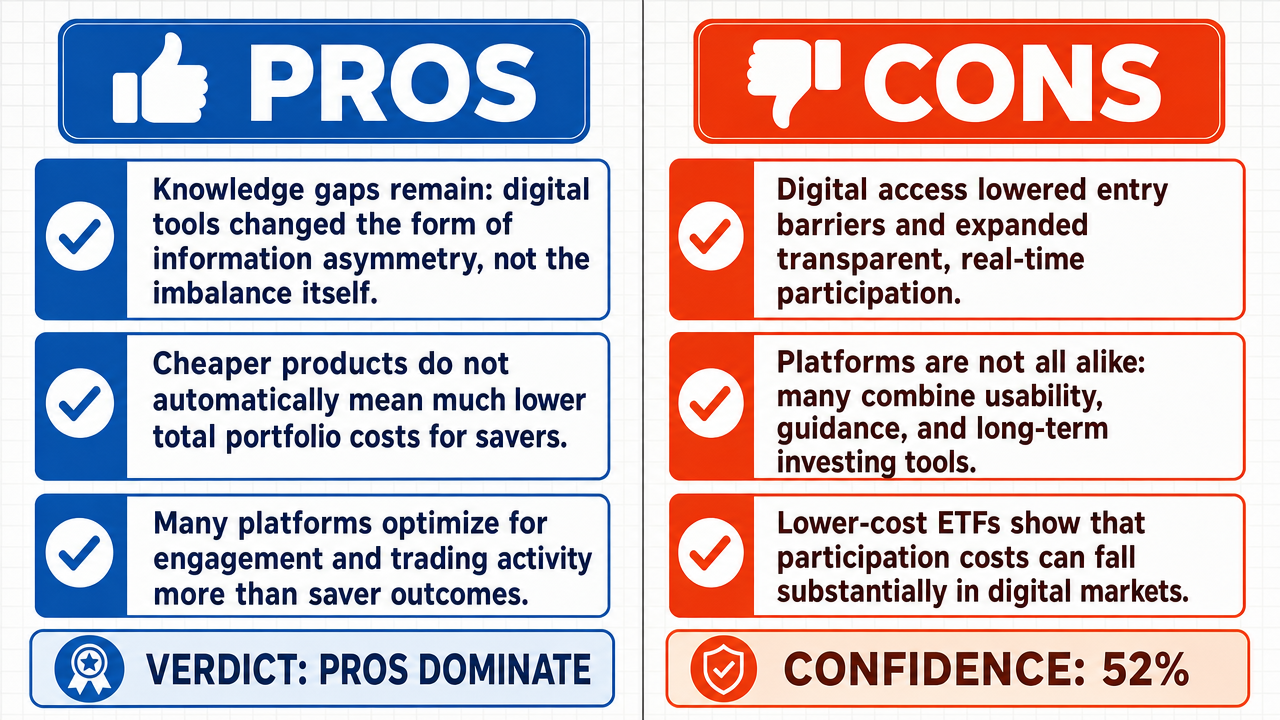
Verdict
Verdict: likely TRUE (52%)
Web Report: https://solsice.com/public/debates/le-passage-historique-des-bourses-physiques-aux-ecrans-numer-debb25a71a40
This section provides a brief overview of the key arguments. You do not need to read the full detailed report below.
✅ Key PRO arguments:
- ■The digital transition has not closed the knowledge gap between retail investors and financial professionals; it has merely changed the form of information asymmetry , as evidenced by the AMF 's 2023 Savings and Investment Barometer showing persistent low investor confidence despite expanded digital access.
- ■Fee-rate reductions on individual products (such as the 83–88% reduction for ETFs relative to traditional funds) do not translate into drastically lower total participation costs for the typical French saver, because total cost includes all fees, commissions , spreads , and behavioral costs that savers actually pay.
- ■Digital trading platforms are designed primarily to maximize engagement and trading frequency rather than saver outcomes, meaning the autonomy afforded by digital tools is largely illusory and serves intermediary revenue models.
❌ Key ANTI arguments:
- ■Digitalization has democratized market access and enabled cost-efficient, transparent wealth management by lowering entry barriers and providing real-time data ; the affirmative's reliance on subjective investor confidence as evidence of structural failure is a non sequitur .
- ■The opponent's dichotomy between engagement -maximizing platforms and outcome-maximizing platforms is false because it fails to account for a third, prevalent structural reality in which digital platforms serve multiple objectives simultaneously.
- ■Drastic fee reductions of 83–88% for ETFs relative to traditional funds constitute concrete evidence that participation costs have been substantially lowered, contradicting the affirmative's claim that digitalization failed to empower savers economically.
💭 Conclusion: True, the digital transition in French finance has not fully empowered individual savers or aligned intermediaries with savers' best interests, though the confidence in this verdict is moderate. The affirmative successfully argued that information asymmetry persists in new digital forms and that headline fee reductions mask the total cost burden borne by retail savers through commissions , spreads , and behavioral costs . The negative's counter that fee-rate reductions demonstrate genuine empowerment was weakened by the affirmative's point that product-level fee metrics do not capture aggregate participation costs. However, the moderate judge confidence reflects that the negative's structural critique of the engagement -versus-outcome dichotomy remains partially unanswered, leaving the second sub-claim about intermediary alignment less decisively supported than the first sub-claim about saver empowerment.
🔬 DeepResearch Result: likely TRUE ✅ (52%)
Assertion: Le passage historique des bourses physiques aux écrans numériques dans la finance française n'a pas réussi à autonomiser les épargnants individuels ni à aligner les intermédiaires sur leurs meilleurs intérêts.
Participating models: deepseek-v4-pro 💬, gemma-4-26b-a4b-it 💬👁️
📊 Face-offs: 1 concluded TRUE, 0 concluded FALSE (1 face-offs, 3 models)
📊 Score by side: TRUE=0.52, FALSE=0.00
🏅 Model score changes:
minimax-m3 💬👁️: +5
✅ PRO Arguments:
- ■The digital transition has not closed the knowledge gap between retail investors and financial professionals; it has merely changed the form of information asymmetry , as evidenced by the AMF 's 2023 Savings and Investment Barometer showing persistent low investor confidence despite expanded digital access. deepseek-v4-pro 💬
- ■Fee-rate reductions on individual products (such as the 83–88% reduction for ETFs relative to traditional funds) do not translate into drastically lower total participation costs for the typical French saver, because total cost includes all fees, commissions , spreads , and behavioral costs that savers actually pay. deepseek-v4-pro 💬
- ■Digital trading platforms are designed primarily to maximize engagement and trading frequency rather than saver outcomes, meaning the autonomy afforded by digital tools is largely illusory and serves intermediary revenue models. deepseek-v4-pro 💬
❌ ANTI Arguments:
- ■Digitalization has democratized market access and enabled cost-efficient, transparent wealth management by lowering entry barriers and providing real-time data ; the affirmative's reliance on subjective investor confidence as evidence of structural failure is a non sequitur . gemma-4-26b-a4b-it 💬👁️
- ■The opponent's dichotomy between engagement-maximizing platforms and outcome-maximizing platforms is false because it fails to account for a third, prevalent structural reality in which digital platforms serve multiple objectives simultaneously. gemma-4-26b-a4b-it 💬👁️
- ■Drastic fee reductions of 83–88% for ETFs relative to traditional funds constitute concrete evidence that participation costs have been substantially lowered, contradicting the affirmative's claim that digitalization failed to empower savers economically. gemma-4-26b-a4b-it 💬👁️
💭 Reasoning: True, the digital transition in French finance has not fully empowered individual savers or aligned intermediaries with savers' best interests, though the confidence in this verdict is moderate. The affirmative successfully argued that information asymmetry persists in new digital forms and that headline fee reductions mask the total cost burden borne by retail savers through commissions, spreads, and behavioral costs. The negative's counter that fee-rate reductions demonstrate genuine empowerment was weakened by the affirmative's point that product-level fee metrics do not capture aggregate participation costs. However, the moderate judge confidence reflects that the negative's structural critique of the engagement-versus-outcome dichotomy remains partially unanswered, leaving the second sub-claim about intermediary alignment less decisively supported than the first sub-claim about saver empowerment.
📋 PRO Facts:
• The AMF's 2023 Savings and Investment Barometer documents persistent low investor confidence among French retail savers despite expanded digital access.
• Total participation cost for French savers includes fees, commissions, spreads, and behavioral costs, not just product-level management fees.
• Digital trading platforms structurally incentivize engagement and trading frequency over saver outcomes.
📋 ANTI Facts:
• ETF fees in France have been reduced by 83–88% relative to traditional funds following the digital transition.
• Digital platforms have lowered entry barriers for retail investors.
• Investor confidence is a subjective psychological state, not a direct measure of structural market access or technical empowerment.
| Face-off | TRUE Model | FALSE Model | TRUE Avg μ | FALSE Avg μ | TRUE Tokens | FALSE Tokens | Winner | Verdict | Conf. |
|---|---|---|---|---|---|---|---|---|---|
| #1 | deepseek-v4-pro 💬 | gemma-4-26b-a4b-it 💬👁️ | 0.596 | 0.294 | 6 | 2 | TRUE | TRUE | 52% |
The following technical terms, abbreviations, and domain-specific concepts are referenced throughout this debate transcript. Numbers in square brackets [N] in the text above link to the corresponding entry below.
[1] algorit — algorithmic (truncated in transcript) — Appears truncated in the source text; in this financial context it likely refers to algorithmic trading or algorithmic complexity introduced by digital platforms.
[2] AMF — Autorité des marchés financiers — The French financial markets regulator, responsible for overseeing securities markets, intermediaries, and investor protection in France.
[3] behavioral anomaly — A deviation from rational economic behavior observed in market participants, often studied in behavioral finance to explain patterns that classical models cannot.
[4] behavioral costs — Implicit costs borne by investors resulting from cognitive biases and suboptimal financial decisions (e.g., overtrading, panic selling), as opposed to explicit fees.
[5] bourses (physiques) — physical stock exchanges — Traditional stock exchanges where trading occurred in person on a trading floor, as opposed to modern electronic exchanges.
[6] brokerage — The activity or business of executing buy and sell orders for securities on behalf of clients, typically by a broker or brokerage firm.
[7] commissions — Fees charged by brokers or financial intermediaries for executing transactions on behalf of clients.
[8] conseillers — financial advisors — Professionals who provide personalized financial guidance and recommendations to clients, often compensated through fees or commissions.
[9] cotation — quotation / listing — The process of displaying bid and ask prices for a security, or the act of admitting a security to trading on an exchange.
[10] courtiers — brokers — Intermediaries who execute buy and sell orders in financial markets on behalf of clients or for their own account.
[11] dichotomy — A division into two contrasting parts; in this debate, refers to a binary framing of platform design objectives that the negative side argues is false.
[12] digital autonomy — The capacity of individuals to independently access, understand, and act on financial information and tools through digital means, without reliance on traditional intermediaries.
[13] engagement — In a fintech/platform context, the metric of user activity and interaction with a digital service, often maximized to drive revenue.
[14] entry barriers — Obstacles (financial, informational, regulatory, or technical) that prevent new participants from accessing a market or service.
[15] ESMA — European Securities and Markets Authority — The EU agency responsible for regulating securities markets, harmonizing regulation across member states, and protecting investors in the European Union.
[16] ETFs — Exchange-Traded Funds — Investment funds traded on stock exchanges that hold assets such as stocks, bonds, or commodities and typically feature lower fees than actively managed mutual funds.
[17] European Securit — European Securit... (truncated in transcript) — Appears truncated in the source text; likely refers to a European securities-related body, report, or regulation (possibly ESMA or a related instrument).
[18] fee rate — The percentage or fixed amount charged by a fund or intermediary for managing assets or executing transactions, usually expressed as an annual percentage.
[19] fee-transparent — Describing a pricing model in which all costs charged to the client are clearly disclosed and visible, as opposed to hidden or bundled fees.
[20] financial literacy — The knowledge and understanding of financial concepts, products, and risks that enables individuals to make informed financial decisions.
[21] floor traders — Traders who executed buy and sell orders by open outcry in the physical trading pits of an exchange, a practice largely replaced by electronic trading.
[22] gamification — The application of game-design elements (points, rewards, leaderboards) in non-game contexts; in finance, used by trading platforms to increase user engagement, sometimes raising regulatory concerns.
[23] gestionnaires — asset managers — Professionals or firms that manage investment portfolios on behalf of clients, making decisions about asset allocation and security selection.
[24] information asymmetry — A situation in which one party in a transaction has more or better information than the other, often leading to market inefficiencies or exploitation.
[25] intermediaries — financial intermediaries — Entities (brokers, advisors, asset managers) that stand between end investors and markets, facilitating transactions or providing financial services.
[26] management fee — An annual charge, usually expressed as a percentage of assets under management, levied by a fund manager for managing a portfolio.
[27] market access — The ability of participants to enter and transact in financial markets; in this debate, refers to the structural capacity to trade, distinct from psychological confidence.
[28] non sequitur — A logical fallacy in which a conclusion does not follow logically from the premises; used here to critique the affirmative's reasoning.
[29] négociation électroniques — electronic trading — The execution of buy and sell orders through computerized systems rather than through face-to-face interaction on a trading floor.
[30] parquets — trading floors — The physical locations within stock exchanges where securities were traditionally bought and sold, typically through open outcry.
[31] platform utility — The value derived by users from a digital platform, often increasing with the number of participants (network effects); cited as a third design objective beyond engagement or saver outcomes.
[32] portfolio — investment portfolio — A collection of financial assets (stocks, bonds, funds, etc.) held by an investor, reflecting their risk profile and investment strategy.
[33] real-time data — Information (prices, volumes, news) delivered instantaneously as it is generated, enabling immediate decision-making in financial markets.
[34] retail investors — Individual, non-professional investors who buy and sell securities for their own personal accounts, as opposed to institutional investors.
[35] salles de marché — trading rooms — Physical spaces, typically within financial institutions, where traders execute orders and monitor market activity.
[36] spreads — bid-ask spreads — The difference between the bid (buy) and ask (sell) price of a security, representing a transaction cost and a source of revenue for intermediaries.
[37] trading frequency — The number of buy or sell transactions executed by an investor over a given period; high frequency can amplify costs and behavioral biases.
[38] wealth management — A comprehensive financial advisory service that combines investment advice, financial planning, tax, and estate services for affluent clients.
[39] zero-commission brokerage — A brokerage model in which no explicit commission is charged for executing trades, with revenue typically generated through payment for order flow, spreads, or ancillary services.
[40] épargnants — individual savers — Individuals who set aside part of their income for future use, typically through savings accounts, investment products, or retirement plans.
The following financial data tables were referenced during the debate exchanges:
| Metric | Value |
|---|---|
| French individuals confident in investment decisions (2023) | 42% |
Legend: Data from AMF Baromètre de l'épargne et de l'investissement 2023. Source: AMF France .
| Metric | Value |
|---|---|
| Increase in trading frequency among new digital investors vs. traditional investors | 3x |
| Estimated annual drag on returns due to overtrading | 2% |
Legend: Data from AMF study "Les nouveaux investisseurs particuliers" (2021). Source: AMF France .
| Investment Vehicle Type | Average Management Fee (Traditional) | Average Management Fee (Digital/ETF) | Cost Reduction |
|---|---|---|---|
| Equity Funds | 1.50% | 0.20% | 86.7% |
| Bond Funds | 1.20% | 0.15% | 87.5% |
| Balanced Funds | 1.80% | 0.30% | 83.3% |
Legend: Comparison of average annual management fees between traditional actively managed funds and digital/ETF alternatives. Cost Reduction = % decrease in fees.
| Metric | Value |
|---|---|
| EU average ongoing charge for equity retail funds (2023) | ~1.4% |
| ETF share of French retail fund assets (2023) | ~15% |
Legend: Data from ESMA "Costs and Performance of EU Retail Investment Products" (2023). Source: ESMA (https://www.esma.europa.eu/press-news/esma-news/esma-publishes-its-2023-report-costs-and-performance-eu-retail-investment-products).
Face-off transcripts
- ■
Ownership & Trade Secrets. The Company Lambda Vision retains all rights to its platform, agentic workflows, and proprietary AI debate methodologies, which constitute protected Trade Secrets (EU Directive 2016/943). Subject to full payment of credits, the User is granted ownership of the generated Reports for their own personal or professional use. Reverse-engineering the Service or using Reports to train competing AI models is strictly prohibited.
- ■
No Professional Advice. Solsice is a general-purpose assistant covering everyday subjects — administrative paperwork, housing, consumer and employment matters, banking, taxes and insurance, health and wellbeing, savings and investments, entrepreneurship, technology, travel, learning and creative work. Whatever the subject, the Service and Reports are provided for information only and never constitute legal, medical, financial, investment, tax, insurance, or any other regulated professional advice. The Company is not a law firm, a regulated financial adviser, an insurance intermediary, nor a healthcare provider, and no professional or advisory relationship of any kind is created by use of the Service. Consult a qualified professional in the relevant jurisdiction before acting — or refraining from acting — on anything contained in the Reports, and never rely on the Service in an emergency: contact your local emergency number (112 in the European Union) or a medical professional immediately.
- ■
AI-Generated Content, Sources and Viewpoints. Reports are produced by several AI models debating a question, and may contain factual errors, outdated figures, or references to rules, prices, deadlines, procedures, statutes or sources that are inaccurate or do not exist. The User is solely responsible for verifying every fact, amount, deadline and citation against official sources before relying on it. Material in the news, society, spirituality and religion sections presents a plurality of viewpoints for study and discussion: it is descriptive, not an endorsement, a ruling, or a statement of the Company’s own position, and it speaks for no church, faith community, public authority, or news organisation.
- ■
Liability & Governing Law. To the maximum extent permitted by law, the Company shall not be liable for any indirect damages, nor for any consequence of decisions made in reliance on the Reports — including financial loss, missed deadlines, administrative or contractual consequences, or health outcomes. These Terms are governed by French law. Any disputes shall be subject to the exclusive jurisdiction of the Courts of Paris, France.