
LeBron James's career, despite his team-stacking, does not constitute four Hall of Fame-worthy iterations because he only has four championships.
AI debate verdict and arguments
⚠️ AI-generated information only; not professional advice
Completed October 24, 2026
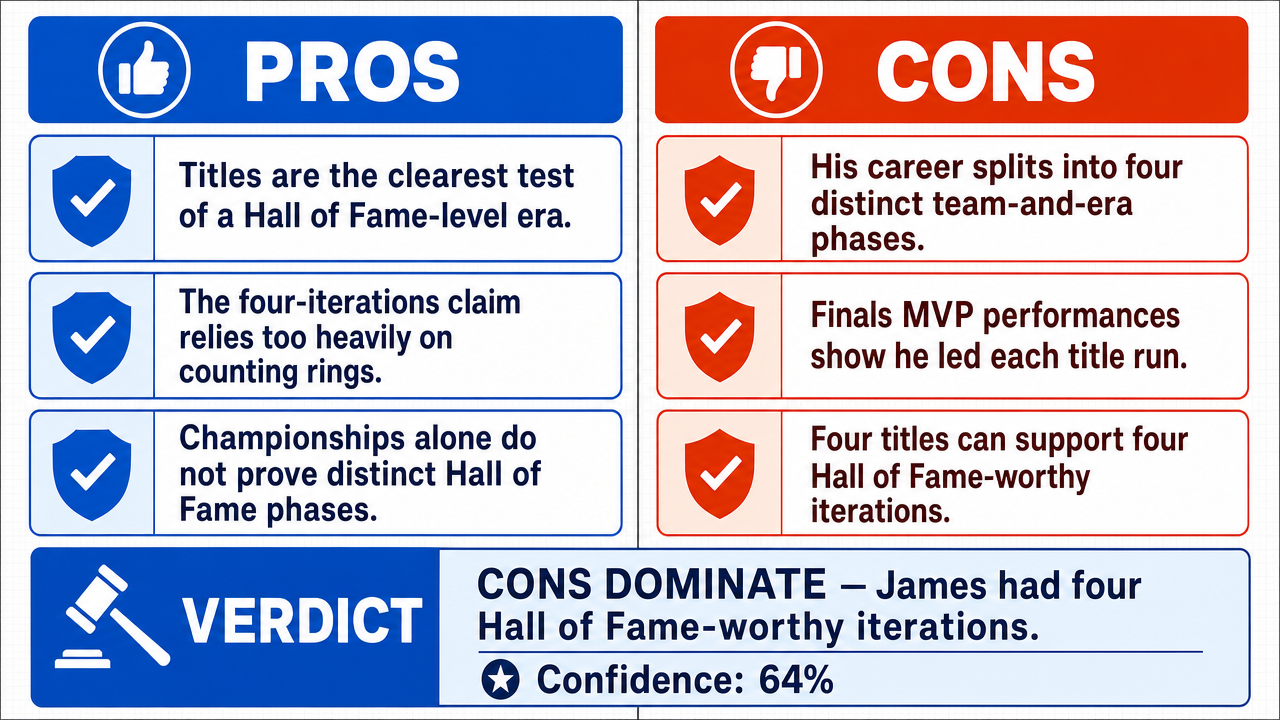
Verdict
Verdict: likely FALSE (64%)
Web Report: https://solsice.com/public/debates/lebron-james-s-career-despite-his-team-stacking-does-not-con-7972d5d74ce3
This section provides a brief overview of the key arguments. You do not need to read the full detailed report below.
✅ Key PRO arguments:
- ■The TRUE side argued that championship count is the fundamental benchmark for a Hall of Fame-worthy iteration , because such an iteration implies a period of dominance proven at the highest level of postseason competition . On that standard, James's four titles provide insufficient empirical proof of four separate peak-level championship runs despite his statistical output .
- ■The TRUE side further charged the opposing case with circular reasoning: asserting that four championships validate four distinct iterations and then citing those same championships as proof of the distinct iterations embeds the conclusion in the premise. Establishing four iterations would require four independently demonstrated periods of dominance, each reaching the championship threshold, which the four total titles cannot supply.
❌ Key ANTI arguments:
- ■The FALSE side argued that James's career is objectively divided into four eras - 2003-2010 with Cleveland, 2010-2014 with Miami, 2014-2018 with Cleveland, and 2018-present with the Lakers - each culminating in a championship and a Finals MVP, thereby satisfying the criteria for four separate Hall of Fame-worthy iterations.
- ■The FALSE side added that his four Finals MVPs, the most in NBA history, demonstrate his individual dominance was the primary driver of success in each iteration rather than merely a product of stacked talent.
- ■The FALSE side noted that the assertion can hold only if either four titles are insufficient to define four distinct iterations or a Hall of Fame-worthy iteration inherently demands more than four championships, and neither condition is supported by evidence.
💭 Conclusion: False - the panel rejected the assertion, finding that James's career does constitute four Hall of Fame-worthy iterations, one for each of his championship runs. The winning side's strongest evidence was the mapping of his career onto four distinct eras - Cleveland (2003-2010), Miami (2010-2014), Cleveland (2014-2018), and the Lakers (2018-present) - each associated with a championship and a Finals MVP. It also cited his four Finals MVPs, described in the debate as the most in NBA history, as proof that individual dominance drove each run rather than team composition alone. The opposing circularity objection did not carry, because the four titles coincide with four separate career phases, and nothing in the record showed that a Hall of Fame-worthy iteration requires more than four championships. Confidence is held to the judge's 64% because the result rests on a single debate and the separate role of team stacking was not independently tested in the evidence.
🔬 DeepResearch Result: likely FALSE ❌ (64%)
Assertion: LeBron James's career, despite his team-stacking , does not constitute four Hall of Fame-worthy iterations because he only has four championships.
Participating models: gemma-4-26b-a4b-it 💬👁️, glm-4.7-flash 💬
📊 Face-offs: 0 concluded TRUE, 1 concluded FALSE (1 face-offs, 3 models)
📊 Score by side: TRUE=0.00, FALSE=0.64
🏅 Model score changes:
minimax-m3 💬👁️: +6
✅ PRO Arguments:
- ■The TRUE side argued that championship count is the fundamental benchmark for a Hall of Fame-worthy iteration , because such an iteration implies a period of dominance proven at the highest level of postseason competition . On that standard, James's four titles provide insufficient empirical proof of four separate peak-level championship runs despite his statistical output . gemma-4-26b-a4b-it 💬👁️
- ■The TRUE side further charged the opposing case with circular reasoning: asserting that four championships validate four distinct iterations and then citing those same championships as proof of the distinct iterations embeds the conclusion in the premise. Establishing four iterations would require four independently demonstrated periods of dominance, each reaching the championship threshold , which the four total titles cannot supply. gemma-4-26b-a4b-it 💬👁️
❌ ANTI Arguments:
- ■The FALSE side argued that James's career is objectively divided into four eras - 2003-2010 with Cleveland, 2010-2014 with Miami, 2014-2018 with Cleveland, and 2018-present with the Lakers - each culminating in a championship and a Finals MVP, thereby satisfying the criteria for four separate Hall of Fame-worthy iterations. glm-4.7-flash 💬
- ■The FALSE side added that his four Finals MVPs, the most in NBA history, demonstrate his individual dominance was the primary driver of success in each iteration rather than merely a product of stacked talent. glm-4.7-flash 💬
- ■The FALSE side noted that the assertion can hold only if either four titles are insufficient to define four distinct iterations or a Hall of Fame-worthy iteration inherently demands more than four championships, and neither condition is supported by evidence. glm-4.7-flash 💬
- ■The FALSE side pointed out that each of James's championships occurred with a different team composition or in a different phase of his career, with significant contextual changes marking each run as a distinct iteration. glm-4.7-flash 💬
💭 Reasoning: False - the panel rejected the assertion, finding that James's career does constitute four Hall of Fame-worthy iterations, one for each of his championship runs. The winning side's strongest evidence was the mapping of his career onto four distinct eras - Cleveland (2003-2010), Miami (2010-2014), Cleveland (2014-2018), and the Lakers (2018-present) - each associated with a championship and a Finals MVP. It also cited his four Finals MVPs, described in the debate as the most in NBA history, as proof that individual dominance drove each run rather than team composition alone. The opposing circularity objection did not carry, because the four titles coincide with four separate career phases, and nothing in the record showed that a Hall of Fame-worthy iteration requires more than four championships. Confidence is held to the judge's 64% because the result rests on a single debate and the separate role of team stacking was not independently tested in the evidence.
📋 PRO Facts:
• James has won four NBA championships.
• A Hall of Fame-worthy iteration was defined in the debate as a period of dominance reaching the highest level of postseason competition.
• The TRUE side identified circularity - using the championships to validate the iterations while using the iterations to validate the championships - as a defect in the opposing reasoning.
📋 ANTI Facts:
• James won a Finals MVP in each of his four championship runs.
• His four Finals MVPs are the most in NBA history, according to the debate.
• Each of his championships came with a different team composition or in a different phase of his career.
• The record presented did not establish that four championships are insufficient to define four distinct iterations, nor that Hall of Fame-worthy iterations inherently require more than four championships.
| Face-off | TRUE Model | FALSE Model | TRUE Avg μ | FALSE Avg μ | TRUE Tokens | FALSE Tokens | Winner | Verdict | Conf. |
|---|---|---|---|---|---|---|---|---|---|
| #1 | gemma-4-26b-a4b-it 💬👁️ | glm-4.7-flash 💬 | 0.238 | 0.401 | 4 | 4 | FALSE | FALSE | 64% |
The following technical terms, abbreviations, and domain-specific concepts are referenced throughout this debate transcript. Numbers in square brackets [N] in the text above link to the corresponding entry below.
[1] career iteration — A distinct phase of a player's career, identified in the debate by tenure and performance during a period. The sides dispute whether James had four separate iterations.
[2] career peaks — Periods regarded as the high points of a player's career. The negative side identifies four championship-associated career peaks, while the affirmative disputes that count.
[3] championship — A title won by the player's team and used in the debate as the central achievement that a career iteration should demonstrate. The sides disagree about what four championships establish.
[4] championship count — The numerical tally of championships won during a career, stated in the debate as four for James. The affirmative treats it as a cap on championship-validated iterations, while the negative treats each title as validation.
[5] championship runs — Stretches of peak-level title performance cited as evidence that a player achieved an elite phase of a career.
[6] championship threshold — The proposed requirement that each separate career iteration include a championship before it can be considered validated. Whether four championships satisfy this standard is disputed.
[7] circular demonstration — An argument accused of using the proposition it seeks to prove as its own support: four championships are used both to establish and validate four iterations.
[8] conclusion embedded within the premise — A description of circular reasoning in which the desired conclusion is assumed as part of the evidence used to support it.
[9] distinct campaigns — Separate title-oriented periods cited as evidence of different phases of James's career, including the 2012, 2013, 2016, and 2020 championship campaigns.
[10] distinct eras — Career phases associated with particular teams and periods, including the Cleveland, Miami, and Lakers eras identified in the negative side's account.
[11] Finals MVP award — Finals Most Valuable Player award — An award recognizing the most valuable player of the championship Finals. The negative side cites James's four awards as evidence supporting four iterations.
[12] Hall of Fame-worthy iteration — A proposed distinct career phase that merits Hall of Fame-level recognition. The affirmative says four championships do not validate four such phases, while the negative says they do.
[13] high-volume statistical performances — Periods of high statistical production that the affirmative characterizes as lacking a decisive, championship-winning culmination.
[14] individual dominance — The interpretation that James's individual performance was the primary driver of success in each championship period. The debate contests how this interpretation relates to roster construction.
[15] logical fallacy — A reasoning error involving an invalid connection between premises and a conclusion; the debate identifies circular demonstration as the relevant example.
[16] NBA — National Basketball Association — The basketball league whose records, history, championships, and Finals MVP awards are referenced in the debate.
[17] peak performance — A stretch of performance presented as a high point in a player's career and as evidence for a separate career iteration.
[18] postseason competition — The high-level postseason contests referred to as the setting in which a player seeks a championship and demonstrates dominance.
[19] pre-assembled rosters — Rosters that were assembled before the player joined them, used by the affirmative side in its characterization of team-stacking.
[20] primary metric — The main benchmark selected for evaluating the claim. In this debate, that benchmark is the championship count, whose interpretation is disputed.
[21] rings — Sports slang for championship titles, used in the debate when discussing whether multiple titles validate multiple career phases.
[22] roster construction — The process of assembling a team's roster. The debate considers whether different roster compositions and construction methods help establish distinct career iterations.
[23] stacked roster — A roster characterized in the debate as assembled around a superstar. The negative side argues that this characterization does not determine whether a career iteration is valid.
[24] statistical dominance — The label for sustained statistical superiority, cited by the negative side alongside championships and Finals MVP awards as evidence of separate elite iterations.
[25] statistical output — The volume and level of production statistics recorded over a period, considered by the affirmative independently of championship results.
[26] supporting cast — The teammates surrounding a featured player. Changes in the supporting cast are cited as one basis for distinguishing championship campaigns.
[27] team composition — The makeup of players on a team, with changes in composition cited as evidence that title-winning periods were distinct.
[28] team-stacking — Joining or participating in a roster assembled around concentrated talent or a superstar. The affirmative argues this weakens the claim of four individual iterations, while the negative disputes that implication.
[29] titles — Shorthand for championships, especially in the debate's references to James's four titles.
[30] validated iterations — Career phases deemed to satisfy the debate's proposed championship threshold. The sides dispute both the number of iterations and whether championships are the proper validation method.
Face-off transcripts
- ■
Ownership & Trade Secrets. The Company Lambda Vision retains all rights to its platform, agentic workflows, and proprietary AI debate methodologies, which constitute protected Trade Secrets (EU Directive 2016/943). Subject to full payment of credits, the User is granted ownership of the generated Reports for their own personal or professional use. Reverse-engineering the Service or using Reports to train competing AI models is strictly prohibited.
- ■
No Professional Advice. Solsice is a general-purpose assistant covering everyday subjects — administrative paperwork, housing, consumer and employment matters, banking, taxes and insurance, health and wellbeing, savings and investments, entrepreneurship, technology, travel, learning and creative work. Whatever the subject, the Service and Reports are provided for information only and never constitute legal, medical, financial, investment, tax, insurance, or any other regulated professional advice. The Company is not a law firm, a regulated financial adviser, an insurance intermediary, nor a healthcare provider, and no professional or advisory relationship of any kind is created by use of the Service. Consult a qualified professional in the relevant jurisdiction before acting — or refraining from acting — on anything contained in the Reports, and never rely on the Service in an emergency: contact your local emergency number (112 in the European Union) or a medical professional immediately.
- ■
AI-Generated Content, Sources and Viewpoints. Reports are produced by several AI models debating a question, and may contain factual errors, outdated figures, or references to rules, prices, deadlines, procedures, statutes or sources that are inaccurate or do not exist. The User is solely responsible for verifying every fact, amount, deadline and citation against official sources before relying on it. Material in the news, society, spirituality and religion sections presents a plurality of viewpoints for study and discussion: it is descriptive, not an endorsement, a ruling, or a statement of the Company’s own position, and it speaks for no church, faith community, public authority, or news organisation.
- ■
Liability & Governing Law. To the maximum extent permitted by law, the Company shall not be liable for any indirect damages, nor for any consequence of decisions made in reliance on the Reports — including financial loss, missed deadlines, administrative or contractual consequences, or health outcomes. These Terms are governed by French law. Any disputes shall be subject to the exclusive jurisdiction of the Courts of Paris, France.