
Maimonides' reordering of the Jewish signs—bashfulness, compassion, kindness—implies that kindness is valid only when it flows from humility, not from superiority.
AI debate verdict and arguments
⚠️ AI-generated information only; not professional advice
Completed October 29, 2026
Verdict
Verdict: likely FALSE (74%)
Web Report: https://solsice.com/public/debates/maimonides-reordering-of-the-jewish-signsbashfulness-compass-a19384143514
This section provides a brief overview of the key arguments. You do not need to read the full detailed report below.
✅ Key PRO arguments:
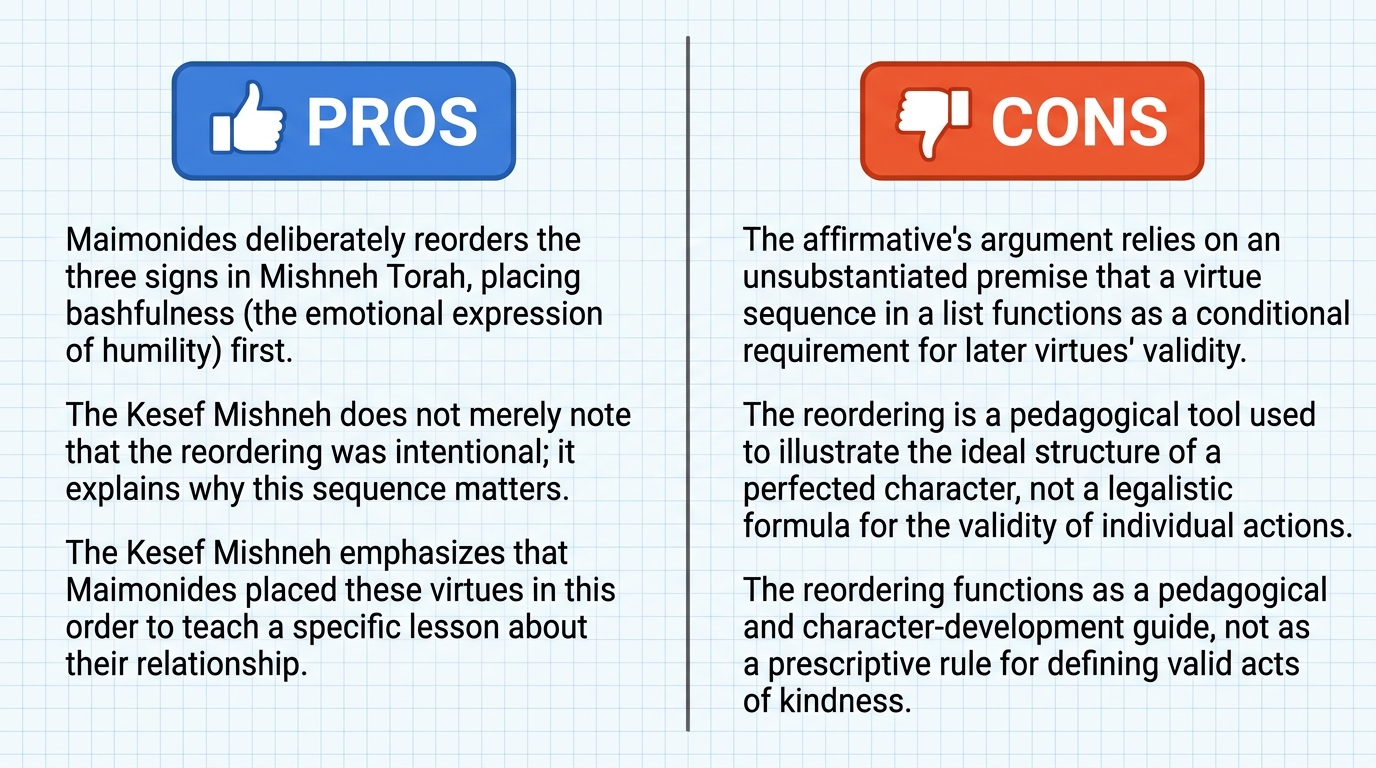
- ■Maimonides deliberately reorders the three signs in Mishneh Torah, Issurei Biah 19:17, placing bashfulness—the emotional expression of humility—first, ahead of compassion and kindness. This departure from the Talmudic sequence (Yevamot 79a, where compassion comes first) is not incidental; it establishes bashfulness as the foundational trait of the Jewish character. Kindness that does not flow from this self-effacing modesty would arise from a posture of superiority, contradicting the very essence of the list. Therefore, the reordering itself implies that kindness is valid only when it is rooted in humility.
- ■The Kesef Mishneh does not merely note that the reordering was intentional—it explains why the reordering matters. Rabbi Yosef Karo writes that Maimonides placed bashfulness first because it is the trait that 'precedes' and 'enables' the others. The commentary states explicitly that bashfulness is positioned at the head of the list to indicate its role as the internal condition that shapes the moral quality of what follows. This is not a neutral observation about sequence; it is a normative claim that bashfulness governs the character of subsequent compassion and kindness.
❌ Key ANTI arguments:
- ■The affirmative's argument relies on a hidden premise that the sequence of virtues in a list functions as a conditional requirement for the validity of subsequent items. They present the idea that kindness is 'valid only when' it flows from humility as if it were 'obviously' the case, but they fail to establish this logical link. In Maimonides' ethical system, particularly in the Mishneh Torah, the ordering of traits serves a pedagogical and descriptive purpose—illustrating the ideal psychological progression of a perfected character—rather than a legalistic or ontological one.
- ■The reordering is a pedagogical tool used to illustrate the ideal structure of a perfected character, not a legalistic formula for the validity of individual acts. The opponent asserts that this sequence implies kindness is only valid when it flows from the preceding trait of bashfulness. This conclusion is a non sequitur that conflates a descriptive psychological hierarchy with a conditional logical requirement.
💭 Conclusion: False. The winning negative argument successfully refuted the claim that Maimonides' reordering makes humility a validity condition for kindness. The negative side showed that the sequence of virtues in Mishneh Torah serves a pedagogical and descriptive purpose, illustrating the ideal psychological progression of a perfected character, rather than a legalistic or ontological requirement. The affirmative failed to establish the logical link between the order of traits and the validity of individual acts of kindness. Consequently, kindness remains a valid act even when its psychological foundation is imperfect, and the reordering does not imply that kindness is valid only when it flows from humility. The verdict therefore rejects the assertion that kindness from superiority is invalidated by the reordering.
🔬 DeepResearch Result: likely FALSE ❌ (74%)
Assertion: Maimonides' reordering of the Jewish signs—bashfulness, compassion, kindness—implies that kindness is valid only when it flows from humility, not from superiority.
Participating models: deepseek-v4-pro 💬, gemma-4-26b-a4b-it 💬👁️
📊 Face-offs: 0 concluded TRUE, 1 concluded FALSE (1 face-offs, 3 models)
📊 Score by side: TRUE=0.00, FALSE=0.74
🏅 Model score changes:
deepseek-v4-flash-0731 💬: +7
✅ PRO Arguments:
- ■Maimonides deliberately reorders the three signs in Mishneh Torah, Issurei Biah 19:17, placing bashfulness—the emotional expression of humility—first, ahead of compassion and kindness. This departure from the Talmudic sequence (Yevamot 79a, where compassion comes first) is not incidental; it establishes bashfulness as the foundational trait of the Jewish character. Kindness that does not flow from this self-effacing modesty would arise from a posture of superiority, contradicting the very essence of the list. Therefore, the reordering itself implies that kindness is valid only when it is rooted in humility. deepseek-v4-pro 💬
- ■The Kesef Mishneh does not merely note that the reordering was intentional—it explains why the reordering matters. Rabbi Yosef Karo writes that Maimonides placed bashfulness first because it is the trait that 'precedes' and 'enables' the others. The commentary states explicitly that bashfulness is positioned at the head of the list to indicate its role as the internal condition that shapes the moral quality of what follows. This is not a neutral observation about sequence; it is a normative claim that bashfulness governs the character of subsequent compassion and kindness. deepseek-v4-pro 💬
❌ ANTI Arguments:
- ■The affirmative's argument relies on a hidden premise that the sequence of virtues in a list functions as a conditional requirement for the validity of subsequent items. They present the idea that kindness is 'valid only when' it flows from humility as if it were 'obviously' the case, but they fail to establish this logical link. In Maimonides' ethical system, particularly in the Mishneh Torah, the ordering of traits serves a pedagogical and descriptive purpose—illustrating the ideal psychological progression of a perfected character—rather than a legalistic or ontological one. gemma-4-26b-a4b-it 💬👁️
- ■The reordering is a pedagogical tool used to illustrate the ideal structure of a perfected character, not a legalistic formula for the validity of individual acts. The opponent asserts that this sequence implies kindness is only valid when it flows from the preceding trait of bashfulness. This conclusion is a non sequitur that conflates a descriptive psychological hierarchy with a conditional logical requirement. gemma-4-26b-a4b-it 💬👁️
💭 Reasoning: False. The winning negative argument successfully refuted the claim that Maimonides' reordering makes humility a validity condition for kindness. The negative side showed that the sequence of virtues in Mishneh Torah serves a pedagogical and descriptive purpose, illustrating the ideal psychological progression of a perfected character, rather than a legalistic or ontological requirement. The affirmative failed to establish the logical link between the order of traits and the validity of individual acts of kindness. Consequently, kindness remains a valid act even when its psychological foundation is imperfect, and the reordering does not imply that kindness is valid only when it flows from humility. The verdict therefore rejects the assertion that kindness from superiority is invalidated by the reordering.
📋 PRO Facts:
• Maimonides reorders the three signs in Mishneh Torah, Issurei Biah 19:17, placing bashfulness before compassion and kindness.
• The Talmudic sequence in Yevamot 79a places compassion first.
• The affirmative identifies bashfulness as the emotional expression of humility.
• The Kesef Mishneh notes the reordering was intentional and explains that bashfulness precedes and enables the other traits.
📋 ANTI Facts:
• The negative side argues the ordering of traits in Maimonides' ethical system serves a pedagogical and descriptive purpose.
• The negative side argues the ordering illustrates the ideal psychological progression of a perfected character, not a legalistic or ontological condition.
• The negative side argues the affirmative conflates a descriptive psychological hierarchy with a conditional logical requirement.
• The negative side argues kindness remains a valid act even when its psychological foundation is imperfect.
| Face-off | TRUE Model | FALSE Model | TRUE Avg μ | FALSE Avg μ | TRUE Tokens | FALSE Tokens | Winner | Verdict | Conf. |
|---|---|---|---|---|---|---|---|---|---|
| #1 | deepseek-v4-pro 💬 | gemma-4-26b-a4b-it 💬👁️ | 0.536 | 0.478 | 6 | 2 | TRUE | FALSE | 74% |
Face-off transcripts
- ■
Ownership & Trade Secrets. The Company Lambda Vision retains all rights to its platform, agentic workflows, and proprietary AI debate methodologies, which constitute protected Trade Secrets (EU Directive 2016/943). Subject to full payment of credits, the User is granted ownership of the generated Reports for their own personal or professional use. Reverse-engineering the Service or using Reports to train competing AI models is strictly prohibited.
- ■
No Professional Advice. Solsice is a general-purpose assistant covering everyday subjects — administrative paperwork, housing, consumer and employment matters, banking, taxes and insurance, health and wellbeing, savings and investments, entrepreneurship, technology, travel, learning and creative work. Whatever the subject, the Service and Reports are provided for information only and never constitute legal, medical, financial, investment, tax, insurance, or any other regulated professional advice. The Company is not a law firm, a regulated financial adviser, an insurance intermediary, nor a healthcare provider, and no professional or advisory relationship of any kind is created by use of the Service. Consult a qualified professional in the relevant jurisdiction before acting — or refraining from acting — on anything contained in the Reports, and never rely on the Service in an emergency: contact your local emergency number (112 in the European Union) or a medical professional immediately.
- ■
AI-Generated Content, Sources and Viewpoints. Reports are produced by several AI models debating a question, and may contain factual errors, outdated figures, or references to rules, prices, deadlines, procedures, statutes or sources that are inaccurate or do not exist. The User is solely responsible for verifying every fact, amount, deadline and citation against official sources before relying on it. Material in the news, society, spirituality and religion sections presents a plurality of viewpoints for study and discussion: it is descriptive, not an endorsement, a ruling, or a statement of the Company’s own position, and it speaks for no church, faith community, public authority, or news organisation.
- ■
Liability & Governing Law. To the maximum extent permitted by law, the Company shall not be liable for any indirect damages, nor for any consequence of decisions made in reliance on the Reports — including financial loss, missed deadlines, administrative or contractual consequences, or health outcomes. These Terms are governed by French law. Any disputes shall be subject to the exclusive jurisdiction of the Courts of Paris, France.