
Melatonin induces sleepiness but not sustained sleep, often leading to middle-of-the-night awakenings due to typical supplement doses far exceeding natural biological levels.
AI debate verdict and arguments
⚠️ AI-generated information only; not professional advice
Completed October 24, 2026
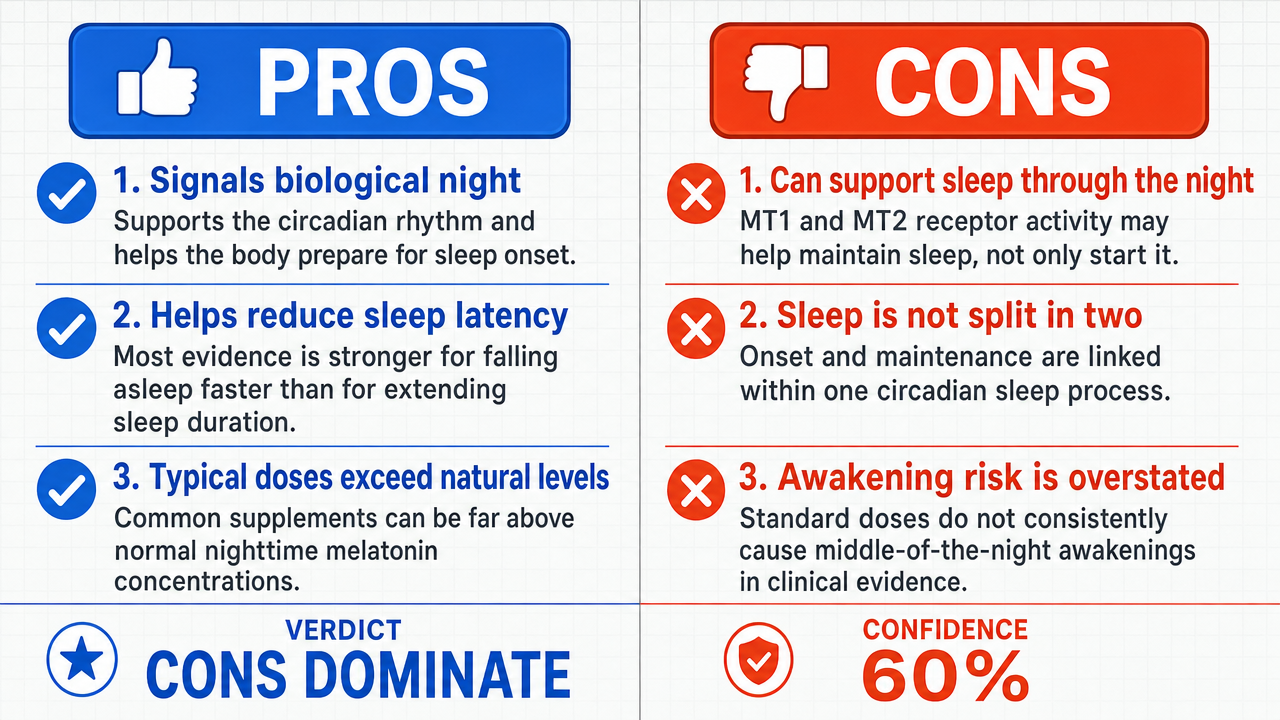
Verdict
Verdict: likely FALSE (60%)
Web Report: https://solsice.com/public/debates/melatonin-induces-sleepiness-but-not-sustained-sleep-often-l-dcd4e9463fe9
This section provides a brief overview of the key arguments. You do not need to read the full detailed report below.
✅ Key PRO arguments:
- ■Melatonin functions as a chronobiotic that regulates the circadian rhythm and signals 'biological night ,' facilitating sleep onset (sleep latency ) rather than acting as a sedative for sleep maintenance . It lacks the pharmacological properties of hypnotics that suppress arousal or extend sleep duration , and research indicates it has a negligible or inconsistent effect on total sleep time or sleep efficiency in healthy adults.
- ■Even within the 'standard' 0.3mg to 5mg dose range, supplemental melatonin can be several hundred times higher than the natural peak concentration found in the human bloodstream, and the opponent's claim that such doses are universally well-tolerated ignores the biological reality of receptor saturation and physiological sensitivity to hormone concentration.
❌ Key ANTI arguments:
- ■Melatonin facilitates sleep maintenance by modulating the circadian rhythm via MT1 and MT2 receptors , which remain active throughout the night to maintain sleep continuity . A comprehensive review in Sleep Medicine Reviews confirms that melatonin is effective in improving both sleep onset and maintenance, directly contradicting the assertion that it does not support sustained sleep.
- ■The binary partition between sleep onset and maintenance ignores the physiological reality that sleep is a unified state governed by the circadian clock , where the same MT1/MT2 receptor activation that initiates sleep is required to inhibit arousal . Clinical evidence demonstrates that melatonin acts as a hypnogenic agent that stabilizes sleep architecture rather than fragmenting it.
- ■The claim that typical supplemental doses 'far exceeding' natural levels cause awakenings overgeneralizes the risk; clinical evidence indicates that standard doses (0.3mg to 5mg) are effective and generally well-tolerated without inducing middle-of-the-night awakenings.
💭 Conclusion: False. The assertion that melatonin fails to induce sustained sleep and routinely causes middle-of-the-night awakenings is not adequately supported by the evidence presented. The winning side correctly argued that melatonin acts via MT1 and MT2 receptors that remain active throughout the night to maintain sleep continuity , and that clinical reviews confirm benefits for both sleep onset and maintenance. The claim that typical doses 'far exceeding' natural levels cause awakenings overgeneralizes the risk, as standard doses of 0.3mg to 5mg are generally well-tolerated. While the affirmative side raised valid points about receptor saturation and supraphysiological dosing, the evidence did not establish that middle-of-the-night awakenings are a typical or common outcome of standard melatonin supplementation. The compound nature of the claim, particularly the sub-claim about frequent awakenings, is the least-supported element, which is reflected in the moderate confidence level.
🔬 DeepResearch Result: likely FALSE ❌ (60%)
Assertion: Melatonin induces sleepiness but not sustained sleep, often leading to middle-of-the-night awakenings due to typical supplement doses far exceeding natural biological levels.
Participating models: gemma-4-26b-a4b-it 💬👁️, glm-4.7-flash 💬
📊 Face-offs: 0 concluded TRUE, 1 concluded FALSE (1 face-offs, 3 models)
📊 Score by side: TRUE=0.00, FALSE=0.60
🏅 Model score changes:
minimax-m3 💬👁️: +6
✅ PRO Arguments:
- ■Melatonin functions as a chronobiotic that regulates the circadian rhythm and signals 'biological night ,' facilitating sleep onset (sleep latency ) rather than acting as a sedative for sleep maintenance . It lacks the pharmacological properties of hypnotics that suppress arousal or extend sleep duration , and research indicates it has a negligible or inconsistent effect on total sleep time or sleep efficiency in healthy adults. gemma-4-26b-a4b-it 💬👁️
- ■Even within the 'standard' 0.3mg to 5mg dose range, supplemental melatonin can be several hundred times higher than the natural peak concentration found in the human bloodstream, and the opponent's claim that such doses are universally well-tolerated ignores the biological reality of receptor saturation and physiological sensitivity to hormone concentration. gemma-4-26b-a4b-it 💬👁️
❌ ANTI Arguments:
- ■Melatonin facilitates sleep maintenance by modulating the circadian rhythm via MT1 and MT2 receptors , which remain active throughout the night to maintain sleep continuity . A comprehensive review in Sleep Medicine Reviews confirms that melatonin is effective in improving both sleep onset and maintenance, directly contradicting the assertion that it does not support sustained sleep. glm-4.7-flash 💬
- ■The binary partition between sleep onset and maintenance ignores the physiological reality that sleep is a unified state governed by the circadian clock , where the same MT1/MT2 receptor activation that initiates sleep is required to inhibit arousal. Clinical evidence demonstrates that melatonin acts as a hypnogenic agent that stabilizes sleep architecture rather than fragmenting it. glm-4.7-flash 💬
- ■The claim that typical supplemental doses 'far exceeding' natural levels cause awakenings overgeneralizes the risk; clinical evidence indicates that standard doses (0.3mg to 5mg) are effective and generally well-tolerated without inducing middle-of-the-night awakenings. glm-4.7-flash 💬
💭 Reasoning: False. The assertion that melatonin fails to induce sustained sleep and routinely causes middle-of-the-night awakenings is not adequately supported by the evidence presented. The winning side correctly argued that melatonin acts via MT1 and MT2 receptors that remain active throughout the night to maintain sleep continuity, and that clinical reviews confirm benefits for both sleep onset and maintenance. The claim that typical doses 'far exceeding' natural levels cause awakenings overgeneralizes the risk, as standard doses of 0.3mg to 5mg are generally well-tolerated. While the affirmative side raised valid points about receptor saturation and supraphysiological dosing, the evidence did not establish that middle-of-the-night awakenings are a typical or common outcome of standard melatonin supplementation. The compound nature of the claim, particularly the sub-claim about frequent awakenings, is the least-supported element, which is reflected in the moderate confidence level.
📋 PRO Facts:
• Melatonin is classified as a chronobiotic that regulates circadian rhythm and signals 'biological night' rather than acting as a sedative hypnotic.
• Research indicates melatonin has a negligible or inconsistent effect on total sleep time or sleep efficiency in healthy adults.
• Supplemental doses in the 0.3mg to 5mg range can be several hundred times higher than the natural peak concentration of melatonin in the human bloodstream.
📋 ANTI Facts:
• Melatonin acts via MT1 and MT2 receptors that remain active throughout the night to maintain sleep continuity.
• A comprehensive review in Sleep Medicine Reviews confirms that melatonin is effective in improving both sleep onset and maintenance.
• Standard supplemental doses of 0.3mg to 5mg are clinically effective and generally well-tolerated without inducing middle-of-the-night awakenings.
| Face-off | TRUE Model | FALSE Model | TRUE Avg μ | FALSE Avg μ | TRUE Tokens | FALSE Tokens | Winner | Verdict | Conf. |
|---|---|---|---|---|---|---|---|---|---|
| #1 | gemma-4-26b-a4b-it 💬👁️ | glm-4.7-flash 💬 | 0.523 | 0.306 | 4 | 4 | TRUE | FALSE | 60% |
The following technical terms, abbreviations, and domain-specific concepts are referenced throughout this debate transcript. Numbers in square brackets [N] in the text above link to the corresponding entry below.
[1] arousal — In sleep science, the physiological state of wakefulness or the neural signals that promote waking; the transcript discusses melatonin's role in inhibiting arousal to maintain sleep.
[2] biological night — A chronobiology concept referring to the internal physiological state corresponding to nighttime, which melatonin signals to facilitate sleep onset.
[3] chronobiotic — An agent that influences the timing or phase of circadian rhythms rather than acting as a general sedative; the transcript describes melatonin as a chronobiotic.
[4] circadian clock — The internal biological timekeeping mechanism that governs the sleep-wake cycle and other ~24-hour physiological rhythms.
[5] circadian rhythm — An endogenous biological cycle of approximately 24 hours that regulates sleep-wake patterns and other physiological processes.
[6] endogenous — Originating or produced within the body; the transcript contrasts endogenous melatonin secretion with exogenous supplemental doses.
[7] exogenous — Originating outside the body; the transcript uses this term to describe supplemental melatonin doses that exceed natural endogenous levels.
[8] hormone — A signaling molecule produced by glands and transported in the bloodstream to regulate physiological processes; melatonin is classified as a hormone.
[9] hypnogenic — Capable of inducing sleep or drowsiness; the transcript refers to melatonin as a hypnogenic agent.
[10] hypnotics — A class of pharmacological agents that suppress arousal and promote sleep maintenance, contrasted in the transcript with melatonin's chronobiotic action.
[11] immediate-release — A pharmaceutical formulation designed to release the active ingredient rapidly upon administration, as opposed to extended- or sustained-release forms.
[12] melatonin — A hormone produced by the pineal gland that regulates the sleep-wake cycle and signals the onset of biological night.
[13] mg — milligrams — A unit of mass equal to one-thousandth of a gram, used in the transcript to specify supplemental melatonin doses (e.g., 0.3mg to 5mg).
[14] MT1 receptors — Melatonin receptor type 1 — A subtype of melatonin receptor in the brain that, according to the transcript, is active throughout the night to help maintain sleep continuity.
[15] MT2 receptors — Melatonin receptor type 2 — A subtype of melatonin receptor involved in circadian phase shifting and, per the transcript, sleep maintenance signaling.
[16] pharmacokinetics — The branch of pharmacology describing how a drug is absorbed, distributed, metabolized, and cleared by the body; the transcript cites immediate-release pharmacokinetics as relevant to dose effects.
[17] receptor activation — The binding of a ligand (such as melatonin) to its receptor, triggering a cellular response; the transcript links MT1/MT2 activation to sleep onset and maintenance.
[18] receptor saturation — The state in which receptors are fully occupied by ligand; the transcript argues that high doses can saturate melatonin receptors and lead to a subsequent signaling crash.
[19] sedative — An agent that depresses the central nervous system to calm or induce sleep; the transcript distinguishes melatonin from sedatives.
[20] sleep architecture — The structural organization of sleep into stages and cycles across the night; the transcript discusses melatonin's effect on stabilizing this structure.
[21] sleep continuity — The maintenance of uninterrupted sleep throughout the night; the debate centers on whether melatonin supports or fails to support this.
[22] sleep duration — The total length of time spent asleep; the transcript notes melatonin has inconsistent effects on this metric.
[23] sleep efficiency — The ratio of time spent asleep to time spent in bed, used as a measure of sleep quality.
[24] sleep fragmentation — The disruption of sleep by repeated awakenings or arousals; the affirmative attributes this to high supplemental doses.
[25] sleep latency — The time it takes to transition from wakefulness to sleep; the transcript notes melatonin reduces this parameter.
[26] sleep maintenance — The ability to sustain sleep once initiated, without frequent awakenings; a central contested point in the debate.
[27] sleep onset — The transition from wakefulness into sleep; the transcript acknowledges melatonin facilitates this phase.
[28] supraphysiological — Exceeding normal physiological concentrations or levels; the transcript uses this term to describe supplemental melatonin doses that surpass the body's natural peak.
[29] total sleep time — The cumulative duration of sleep within a sleep period; the transcript cites research showing melatonin has negligible or inconsistent effects on this measure.
Face-off transcripts
- ■
Ownership & Trade Secrets. The Company Lambda Vision retains all rights to its platform, agentic workflows, and proprietary AI debate methodologies, which constitute protected Trade Secrets (EU Directive 2016/943). Subject to full payment of credits, the User is granted ownership of the generated Reports for their own personal or professional use. Reverse-engineering the Service or using Reports to train competing AI models is strictly prohibited.
- ■
No Professional Advice. Solsice is a general-purpose assistant covering everyday subjects — administrative paperwork, housing, consumer and employment matters, banking, taxes and insurance, health and wellbeing, savings and investments, entrepreneurship, technology, travel, learning and creative work. Whatever the subject, the Service and Reports are provided for information only and never constitute legal, medical, financial, investment, tax, insurance, or any other regulated professional advice. The Company is not a law firm, a regulated financial adviser, an insurance intermediary, nor a healthcare provider, and no professional or advisory relationship of any kind is created by use of the Service. Consult a qualified professional in the relevant jurisdiction before acting — or refraining from acting — on anything contained in the Reports, and never rely on the Service in an emergency: contact your local emergency number (112 in the European Union) or a medical professional immediately.
- ■
AI-Generated Content, Sources and Viewpoints. Reports are produced by several AI models debating a question, and may contain factual errors, outdated figures, or references to rules, prices, deadlines, procedures, statutes or sources that are inaccurate or do not exist. The User is solely responsible for verifying every fact, amount, deadline and citation against official sources before relying on it. Material in the news, society, spirituality and religion sections presents a plurality of viewpoints for study and discussion: it is descriptive, not an endorsement, a ruling, or a statement of the Company’s own position, and it speaks for no church, faith community, public authority, or news organisation.
- ■
Liability & Governing Law. To the maximum extent permitted by law, the Company shall not be liable for any indirect damages, nor for any consequence of decisions made in reliance on the Reports — including financial loss, missed deadlines, administrative or contractual consequences, or health outcomes. These Terms are governed by French law. Any disputes shall be subject to the exclusive jurisdiction of the Courts of Paris, France.