
Neuralink's use of animals in research is conducted with a level of humane treatment that is ethically justifiable given the potential medical benefits.
AI debate verdict and arguments
⚠️ AI-generated information only; not professional advice
Completed October 18, 2026
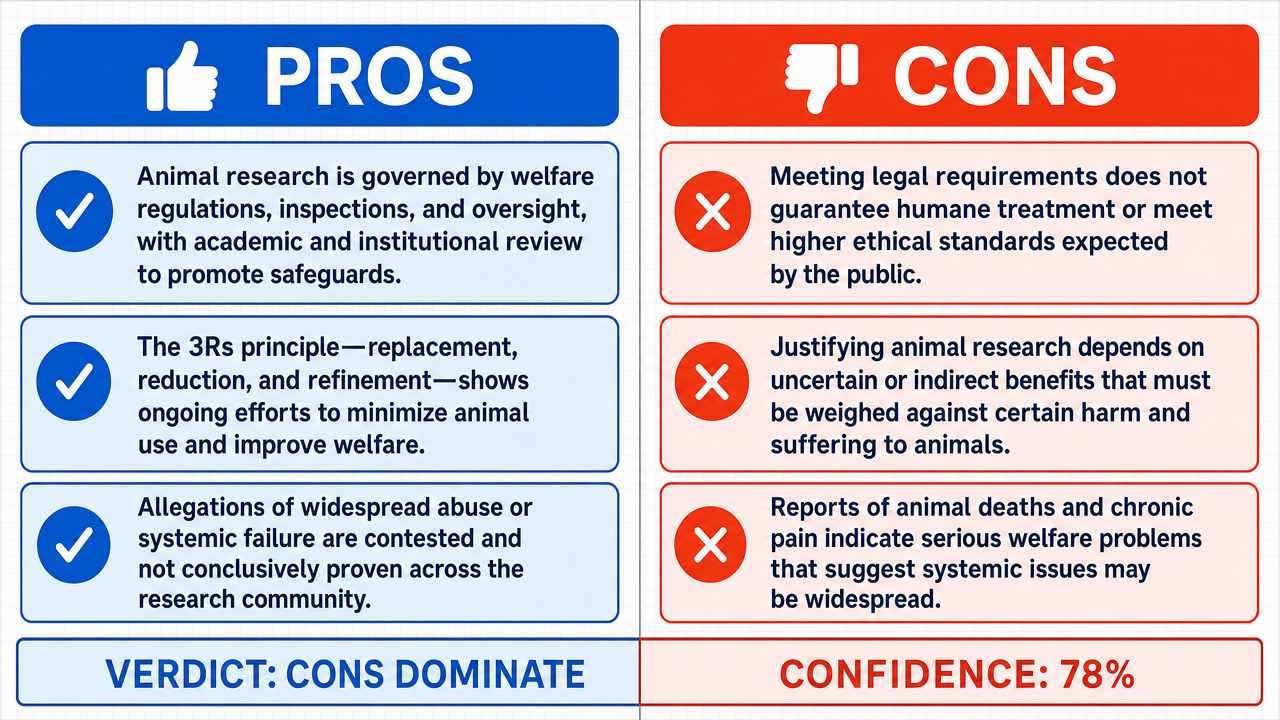
Verdict
Verdict: likely FALSE (78%)
Web Report: https://solsice.com/public/debates/neuralink-s-use-of-animals-in-research-is-conducted-with-a-l-021fca34e2f4
This section provides a brief overview of the key arguments. You do not need to read the full detailed report below.
✅ Key PRO arguments:
- ■Neuralink's animal research operates under robust regulatory oversight , including the Animal Welfare Act and USDA inspections, and its collaboration with UC Davis—an AAALAC-accredited institution—demonstrates a commitment to the highest standards of veterinary care , environmental enrichment , and ethical review .
- ■The opposing side's argument contains an internal contradiction : claiming both that mortality is structural (harm is not minimized) and that surgical refinement minimizes harm, which cannot both be true simultaneously.
❌ Key ANTI arguments:
- ■Regulatory compliance is a proxy, not equivalent to humane treatment; USDA inspections verify adherence to minimum legal standards , not the presence of ethical humane treatment, and a facility can be fully compliant while still inflicting significant, non-justifiable suffering.
- ■Even if humane standards are met, ethical justification is not a mathematical certainty but a contingent utilitarian calculation —the 'justification' depends entirely on whether medical benefits outweigh the harms, which the affirmative fails to demonstrate.
- ■Neuralink's animal research involves systemic welfare failures, including documented mortality and chronic harm , that challenge its ethical justification regardless of regulatory compliance .
💭 Conclusion: The evidence indicates that the affirmative's case is grounded in the surgical platform's demonstrated capacity rather than regulatory compliance , and that the premise of systemic welfare failures is contested rather than established. The opponent's framing of these failures as a given mischaracterizes the structure of the ethical calculus.
🔬 DeepResearch Result: likely FALSE ❌ (78%)
Assertion: Neuralink's use of animals in research is conducted with a level of humane treatment that is ethically justifiable given the potential medical benefits.
Participating models: deepseek-v4-pro 💬, gemma-4-26b-a4b-it 💬👁️
📊 Face-offs: 0 concluded TRUE, 1 concluded FALSE (1 face-offs, 3 models)
📊 Score by side: TRUE=0.00, FALSE=0.78
🏅 Model score changes:
minimax-m3 💬👁️: +8
✅ PRO Arguments:
- ■Neuralink's animal research operates under robust regulatory oversight , including the Animal Welfare Act and USDA inspections, and its collaboration with UC Davis—an AAALAC-accredited institution—demonstrates a commitment to the highest standards of veterinary care , environmental enrichment , and ethical review . deepseek-v4-pro 💬
- ■The opposing side's argument contains an internal contradiction : claiming both that mortality is structural (harm is not minimized) and that surgical refinement minimizes harm, which cannot both be true simultaneously. deepseek-v4-pro 💬
❌ ANTI Arguments:
- ■Regulatory compliance is a proxy, not equivalent to humane treatment; USDA inspections verify adherence to minimum legal standards , not the presence of ethical humane treatment, and a facility can be fully compliant while still inflicting significant, non-justifiable suffering. gemma-4-26b-a4b-it 💬👁️
- ■Even if humane standards are met, ethical justification is not a mathematical certainty but a contingent utilitarian calculation —the 'justification' depends entirely on whether medical benefits outweigh the harms, which the affirmative fails to demonstrate. gemma-4-26b-a4b-it 💬👁️
- ■Neuralink's animal research involves systemic welfare failures, including documented mortality and chronic harm , that challenge its ethical justification regardless of regulatory compliance. gemma-4-26b-a4b-it 💬👁️
💭 Reasoning: The evidence indicates that the affirmative's case is grounded in the surgical platform's demonstrated capacity rather than regulatory compliance, and that the premise of systemic welfare failures is contested rather than established. The opponent's framing of these failures as a given mischaracterizes the structure of the ethical calculus.
📋 PRO Facts:
• The affirmative case rests on the demonstrated capacity of the surgical platform, not on regulatory compliance as a substitute for welfare.
• The existence of systemic welfare failures at Neuralink is in dispute, not assumed.
📋 ANTI Facts:
• The opponent treats systemic welfare failures as a given, which misunderstands the structure of the ethical calculus because the existence of such failures is precisely what is in dispute.
| Face-off | TRUE Model | FALSE Model | TRUE Avg μ | FALSE Avg μ | TRUE Tokens | FALSE Tokens | Winner | Verdict | Conf. |
|---|---|---|---|---|---|---|---|---|---|
| #1 | deepseek-v4-pro 💬 | gemma-4-26b-a4b-it 💬👁️ | 0.526 | 0.219 | 6 | 2 | TRUE | FALSE | 78% |
The following technical terms, abbreviations, and domain-specific concepts are referenced throughout this debate transcript. Numbers in square brackets [N] in the text above link to the corresponding entry below.
[1] AAALAC International — Association for Assessment and Accreditation of Laboratory Animal Care International — A private, nonprofit organization that accredits animal research programs worldwide after evaluating adherence to standards of veterinary care, housing, and ethical treatment.
[2] acute phase — The initial, short-term period following an intervention or injury, during which immediate physiological responses and complications occur.
[3] Animal Welfare Act — A U.S. federal law referenced in the debate as the regulatory framework governing the treatment of animals used in research and other settings.
[4] background assumption — A premise accepted without explicit justification that underlies and supports an argument's conclusion.
[5] biological or psychological distress — Harm experienced by an animal at the level of bodily function or mental state, used in the debate as the actual subject of welfare evaluation.
[6] chronic harm — Long-lasting or persistent injury, suffering, or dysfunction resulting from an intervention or condition.
[7] clinical outcomes — Measurable results of a medical intervention in human patients, such as restored function or symptom relief.
[8] contingent — In the debate's logical context, a claim whose truth depends on empirical or conditional factors rather than on logical necessity.
[9] environmental enrichment — Modifications to an animal's housing and care intended to promote species-typical behavior and psychological well-being.
[10] ethical review — Formal evaluation of a research protocol by a designated body to assess its compliance with ethical standards.
[11] exhaustive possibilities — A logical structure in which the alternatives presented cover every possible case, leaving no other option.
[12] hidden premises — Unstated assumptions on which an argument depends but which are not explicitly asserted by the arguer.
[13] IACUC — Institutional Animal Care and Use Committee — A committee required at research institutions that reviews and oversees protocols involving animals to ensure ethical and regulatory compliance.
[14] internal contradiction — A logical inconsistency in which an argument simultaneously affirms and denies the same proposition under the same conditions.
[15] invasive neural implant studies — Research involving the surgical implantation of devices into neural tissue, cited in the debate as a generic category of risk.
[16] locked-in syndrome — A neurological condition in which a person is conscious and cognitively intact but completely paralyzed and unable to speak or move.
[17] mathematical certainty — A conclusion derived through necessary logical or mathematical reasoning, contrasted in the debate with empirical judgment.
[18] minimum legal standards — The baseline requirements established by law that a facility must meet, distinguished in the debate from higher ethical standards.
[19] mortality — The incidence of death within a study population, referenced in the debate as a measure of harm in animal research.
[20] neurological distress — Suffering caused by damage, dysfunction, or disease affecting the nervous system.
[21] projection — In the debate's logical usage, the mapping of a general claim or risk onto a specific case without explicit justification.
[22] quantified balance — A numerical comparison of aggregate benefits against aggregate harms, used in utilitarian ethical analysis.
[23] regulatory compliance — Adherence to laws, regulations, and guidelines governing a particular practice, cited in the debate as a proxy for humane treatment.
[24] regulatory oversight — Supervision of activities by a government agency or authorized body to ensure compliance with applicable rules.
[25] surgical refinement — Iterative improvements to operative technique intended to reduce harm and improve outcomes.
[26] transfer operator — In the debate's logical usage, the missing link that would connect a proxy measure (such as regulatory status) to the actual subject being evaluated (such as animal welfare).
[27] transformative medical benefits — Potential clinical advances that would substantially alter the treatment or prognosis of a serious medical condition.
[28] USDA — U.S. Department of Agriculture — The U.S. federal agency referenced in the debate as the inspector of research facilities under the Animal Welfare Act.
[29] utilitarian calculation — An ethical assessment that weighs aggregate benefits against aggregate harms to determine whether an action is justified.
[30] veterinary care — Medical treatment and health management provided to animals, cited in the debate as a standard of research facility quality.
Face-off transcripts
- ■
Ownership & Trade Secrets. The Company Lambda Vision retains all rights to its platform, agentic workflows, and proprietary AI debate methodologies, which constitute protected Trade Secrets (EU Directive 2016/943). Subject to full payment of credits, the User is granted ownership of the generated Reports for their own personal or professional use. Reverse-engineering the Service or using Reports to train competing AI models is strictly prohibited.
- ■
No Professional Advice. Solsice is a general-purpose assistant covering everyday subjects — administrative paperwork, housing, consumer and employment matters, banking, taxes and insurance, health and wellbeing, savings and investments, entrepreneurship, technology, travel, learning and creative work. Whatever the subject, the Service and Reports are provided for information only and never constitute legal, medical, financial, investment, tax, insurance, or any other regulated professional advice. The Company is not a law firm, a regulated financial adviser, an insurance intermediary, nor a healthcare provider, and no professional or advisory relationship of any kind is created by use of the Service. Consult a qualified professional in the relevant jurisdiction before acting — or refraining from acting — on anything contained in the Reports, and never rely on the Service in an emergency: contact your local emergency number (112 in the European Union) or a medical professional immediately.
- ■
AI-Generated Content, Sources and Viewpoints. Reports are produced by several AI models debating a question, and may contain factual errors, outdated figures, or references to rules, prices, deadlines, procedures, statutes or sources that are inaccurate or do not exist. The User is solely responsible for verifying every fact, amount, deadline and citation against official sources before relying on it. Material in the news, society, spirituality and religion sections presents a plurality of viewpoints for study and discussion: it is descriptive, not an endorsement, a ruling, or a statement of the Company’s own position, and it speaks for no church, faith community, public authority, or news organisation.
- ■
Liability & Governing Law. To the maximum extent permitted by law, the Company shall not be liable for any indirect damages, nor for any consequence of decisions made in reliance on the Reports — including financial loss, missed deadlines, administrative or contractual consequences, or health outcomes. These Terms are governed by French law. Any disputes shall be subject to the exclusive jurisdiction of the Courts of Paris, France.