
New investors are more likely to succeed by focusing on lead generation and deal sourcing tasks that established, successful investors typically neglect.
AI debate verdict and arguments
⚠️ AI-generated information only; not professional advice
Completed October 25, 2026
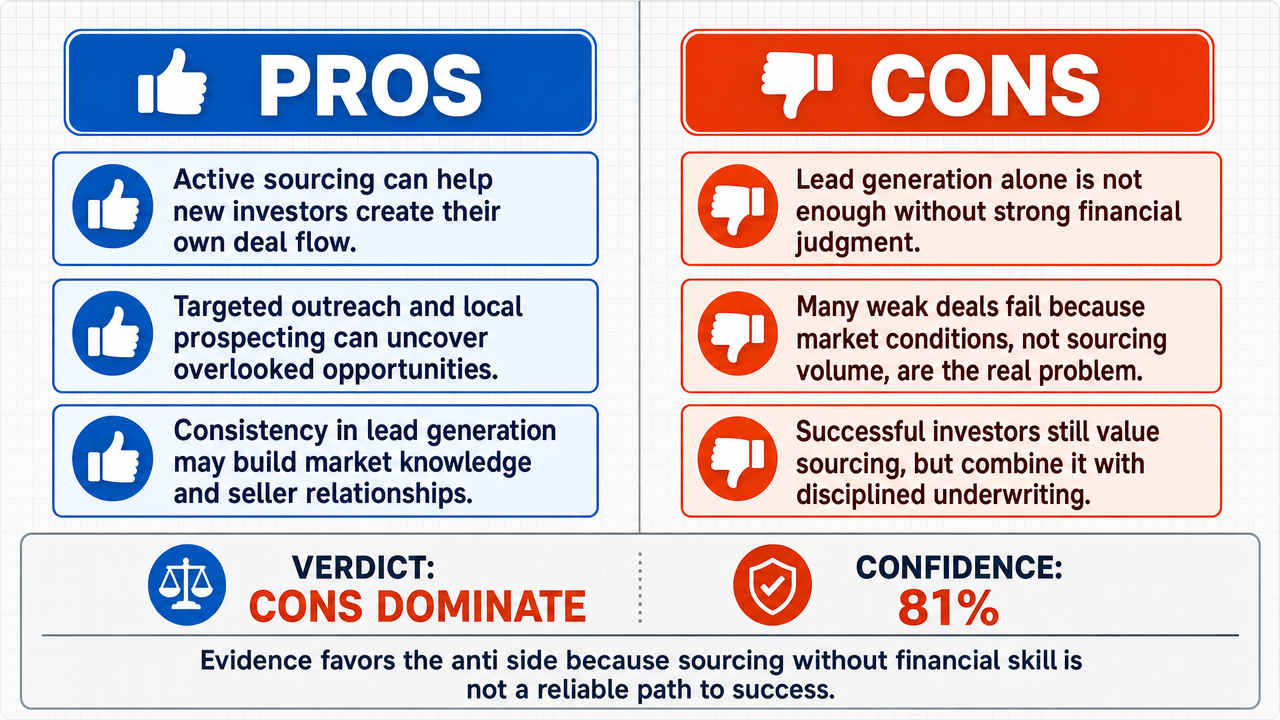
Verdict
Verdict: likely FALSE (81%)
Web Report: https://solsice.com/public/debates/new-investors-are-more-likely-to-succeed-by-focusing-on-lead-231f4154a61f
This section provides a brief overview of the key arguments. You do not need to read the full detailed report below.
✅ Key PRO arguments:
- ■New investors lack proprietary deal flow , so intensive lead generation (direct-to-owner outreach, niche market scraping , localized prospecting ) gives them access to off-market opportunities not yet priced into the broader market, allowing higher margins without competing against institutional capital reserves .
- ■The opposing position is logically incoherent because it tries to hold that established investors both 'refine' sourcing and 'neglect' it simultaneously; if a task is neglected, it is by definition no longer a primary focus of operational energy.
❌ Key ANTI arguments:
- ■Focusing solely on lead generation and deal sourcing is insufficient for new investors to succeed because it neglects the critical financial acumen (financial modeling , valuation techniques , risk assessment ) required to evaluate and execute deals effectively; without it, a new investor may source many opportunities but lack the capability to identify profitable ones or avoid detrimental investments.
- ■The 'deal flow crisis' shows the market is saturated with off-market opportunities that are often unviable due to macroeconomic conditions rather than merely hidden from institutional networks ; new investors without capital reserves or analytical rigor encounter 'zombie' deals that are unsalvageable, leading to losses rather than the claimed higher margins .
- ■Foundational financial literacy is not typically neglected by established investors; rather, it is their core competency, enabling them to discern quality from quantity in deal flow , which means the assertion's premise that established investors neglect these tasks is factually incorrect.
💭 Conclusion: The anti side's position is supported by the evidence. The 'comparative advantage ' argument is flawed because established investors do not entirely abandon sourcing; they outsource high-volume, low-margin aspects while maintaining robust internal teams and networks for strategic deal sourcing and validation. The pro side's claim that new investors can exploit a structural vacuum through high-volume sourcing is countered by the fact that neglecting these tasks would lead to a significant decline, showing established investors continue to value them. The evidence does not substantiate specific pro side claims about proprietary deal flow gaps, off-market access methods, zombie deals , or financial literacy as a core competency.
🔬 DeepResearch Result: likely FALSE ❌ (81%)
Assertion: New investors are more likely to succeed by focusing on lead generation and deal sourcing tasks that established, successful investors typically neglect.
Participating models: gemma-4-26b-a4b-it 💬👁️, glm-4.7-flash 💬
📊 Face-offs: 0 concluded TRUE, 1 concluded FALSE (1 face-offs, 3 models)
📊 Score by side: TRUE=0.00, FALSE=0.81
🏅 Model score changes:
minimax-m3 💬👁️: +8
✅ PRO Arguments:
- ■New investors lack proprietary deal flow , so intensive lead generation (direct-to-owner outreach, niche market scraping , localized prospecting ) gives them access to off-market opportunities not yet priced into the broader market, allowing higher margins without competing against institutional capital reserves . gemma-4-26b-a4b-it 💬👁️
- ■The opposing position is logically incoherent because it tries to hold that established investors both 'refine' sourcing and 'neglect' it simultaneously; if a task is neglected, it is by definition no longer a primary focus of operational energy. gemma-4-26b-a4b-it 💬👁️
❌ ANTI Arguments:
- ■Focusing solely on lead generation and deal sourcing is insufficient for new investors to succeed because it neglects the critical financial acumen (financial modeling , valuation techniques , risk assessment ) required to evaluate and execute deals effectively; without it, a new investor may source many opportunities but lack the capability to identify profitable ones or avoid detrimental investments. glm-4.7-flash 💬
- ■The 'deal flow crisis ' shows the market is saturated with off-market opportunities that are often unviable due to macroeconomic conditions rather than merely hidden from institutional networks ; new investors without capital reserves or analytical rigor encounter 'zombie' deals that are unsalvageable, leading to losses rather than the claimed higher margins. glm-4.7-flash 💬
- ■Foundational financial literacy is not typically neglected by established investors; rather, it is their core competency, enabling them to discern quality from quantity in deal flow, which means the assertion's premise that established investors neglect these tasks is factually incorrect. glm-4.7-flash 💬
💭 Reasoning: The anti side's position is supported by the evidence. The 'comparative advantage ' argument is flawed because established investors do not entirely abandon sourcing; they outsource high-volume, low-margin aspects while maintaining robust internal teams and networks for strategic deal sourcing and validation. The pro side's claim that new investors can exploit a structural vacuum through high-volume sourcing is countered by the fact that neglecting these tasks would lead to a significant decline, showing established investors continue to value them. The evidence does not substantiate specific pro side claims about proprietary deal flow gaps, off-market access methods, zombie deals , or financial literacy as a core competency.
📋 PRO Facts:
• As investment firms grow, they transition from 'hunting' (active sourcing) to 'farming' (managing existing assets and relationships), creating a structural vacuum that new investors can exploit by adopting a high-volume, high-activity sourcing model.
📋 ANTI Facts:
• The 'comparative advantage' argument is flawed because it implies established investors entirely abandon sourcing, which is not the case; they outsource high-volume, low-margin aspects while maintaining robust internal teams and networks for strategic deal sourcing and validation.
• Neglecting sourcing tasks would lead to a significant decline in firm performance.
| Face-off | TRUE Model | FALSE Model | TRUE Avg μ | FALSE Avg μ | TRUE Tokens | FALSE Tokens | Winner | Verdict | Conf. |
|---|---|---|---|---|---|---|---|---|---|
| #1 | gemma-4-26b-a4b-it 💬👁️ | glm-4.7-flash 💬 | 0.229 | 0.229 | 4 | 4 | FALSE | FALSE | 81% |
The following technical terms, abbreviations, and domain-specific concepts are referenced throughout this debate transcript. Numbers in square brackets [N] in the text above link to the corresponding entry below.
[1] Analytical rigor — Thorough, disciplined analysis. In the debate, refers to the depth of financial analysis applied to investment opportunities, which the negative side argues new investors lack.
[2] Capital reserves — Available financial resources. In the debate, refers to the capital that established firms possess, which new investors are said to lack.
[3] Cold outreach — Unsolicited contact with potential prospects. In the debate, cited as an example of intensive lead generation that new investors can perform.
[4] Comparative advantage — An economic principle stating that success is maximized when an agent focuses on tasks where they possess a relative edge. The affirmative side applies this to argue new investors should focus on sourcing.
[5] Deal flow — The rate or volume of investment opportunities presented to investors. A central concept in the debate, with both sides discussing its dynamics.
[6] Deal flow crisis — A phenomenon referenced via Harvard Business Review research, described in the debate as a situation where the market is saturated with off-market opportunities that are often unviable due to macroeconomic conditions.
[7] Deal sourcing — The process of finding and identifying investment opportunities. A central concept in the debate resolution.
[8] Financial literacy — Understanding of financial concepts and practices. In the debate, the negative side argues this foundational knowledge is critical and not neglected by established investors.
[9] Financial modeling — Building mathematical representations of financial situations. In the debate, listed by the negative side as a critical skill for evaluating deals.
[10] Higher margins — Greater profit margins. In the debate, the affirmative side claims new investors can secure higher margins by accessing off-market opportunities.
[11] Inbound inquiries — Unsolicited contacts or requests. In the debate, refers to deal flow that established investors receive through their reputation and networks.
[12] Institutional networks — Networks of institutional investors. In the debate, refers to the connections established investors rely on for deal flow.
[13] Lead generation — The process of attracting and identifying potential prospects or investment opportunities. A central concept in the debate resolution.
[14] Localized prospecting — Targeted search for opportunities in specific geographic areas. In the debate, listed as a sourcing technique new investors can employ.
[15] Macroeconomic conditions — Broad economic factors affecting the overall market. In the debate, cited by the negative side as a reason off-market opportunities may be unviable.
[16] Marginal utility — An economic concept measuring the additional benefit derived from an incremental unit of activity. In the debate, used to argue that established investors gain less utility from cold outreach than from portfolio management.
[17] Niche market scraping — Extracting data from specific market segments. In the debate, listed as a sourcing technique new investors can employ.
[18] Off-market — Investment opportunities not publicly listed or advertised. In the debate, refers to deals not yet priced into the broader market that new investors can access through intensive sourcing.
[19] Open market — Publicly accessible market where assets are openly listed and competed for. In the debate, contrasted with off-market opportunities.
[20] Portfolio — A collection of investments held by an investor. In the debate, refers to what established investors manage, which takes priority over sourcing.
[21] Private equity — Investment in private companies or assets not traded on public exchanges. In the debate, referenced as major private equity firms that employ internal teams.
[22] Proprietary deal flow — Exclusive access to investment opportunities not available to competitors. In the debate, identified as the primary barrier to entry for new investors.
[23] Risk assessment — The process of evaluating potential risks associated with an investment. In the debate, listed by the negative side as a critical skill for evaluating deals.
[24] Selection bias — A statistical bias arising from non-random selection. In the debate, refers to the bias toward high-quality, highly competitive assets in institutional networks.
[25] Tax structures — Arrangements for tax planning and optimization. In the debate, referenced as a task established investors focus on instead of sourcing.
[26] Track record — A history of past investment performance. In the debate, refers to building credibility through successful deals.
[27] Valuation techniques — Methods used to determine the worth of an asset or company. In the debate, listed by the negative side as a critical skill for evaluating deals.
[28] Zombie deals — Deals that are essentially unsalvageable or non-viable. In the debate, refers to off-market opportunities that new investors may encounter and lose money on.
Face-off transcripts
- ■
Ownership & Trade Secrets. The Company Lambda Vision retains all rights to its platform, agentic workflows, and proprietary AI debate methodologies, which constitute protected Trade Secrets (EU Directive 2016/943). Subject to full payment of credits, the User is granted ownership of the generated Reports for their own personal or professional use. Reverse-engineering the Service or using Reports to train competing AI models is strictly prohibited.
- ■
No Professional Advice. Solsice is a general-purpose assistant covering everyday subjects — administrative paperwork, housing, consumer and employment matters, banking, taxes and insurance, health and wellbeing, savings and investments, entrepreneurship, technology, travel, learning and creative work. Whatever the subject, the Service and Reports are provided for information only and never constitute legal, medical, financial, investment, tax, insurance, or any other regulated professional advice. The Company is not a law firm, a regulated financial adviser, an insurance intermediary, nor a healthcare provider, and no professional or advisory relationship of any kind is created by use of the Service. Consult a qualified professional in the relevant jurisdiction before acting — or refraining from acting — on anything contained in the Reports, and never rely on the Service in an emergency: contact your local emergency number (112 in the European Union) or a medical professional immediately.
- ■
AI-Generated Content, Sources and Viewpoints. Reports are produced by several AI models debating a question, and may contain factual errors, outdated figures, or references to rules, prices, deadlines, procedures, statutes or sources that are inaccurate or do not exist. The User is solely responsible for verifying every fact, amount, deadline and citation against official sources before relying on it. Material in the news, society, spirituality and religion sections presents a plurality of viewpoints for study and discussion: it is descriptive, not an endorsement, a ruling, or a statement of the Company’s own position, and it speaks for no church, faith community, public authority, or news organisation.
- ■
Liability & Governing Law. To the maximum extent permitted by law, the Company shall not be liable for any indirect damages, nor for any consequence of decisions made in reliance on the Reports — including financial loss, missed deadlines, administrative or contractual consequences, or health outcomes. These Terms are governed by French law. Any disputes shall be subject to the exclusive jurisdiction of the Courts of Paris, France.