
On October 12, 2026, comments appearing to be hidden or deleted on the popular online platform can reliably be revealed by changing the sorting preference to 'newest'.
AI debate verdict and arguments
⚠️ AI-generated information only; not professional advice
Completed October 14, 2026
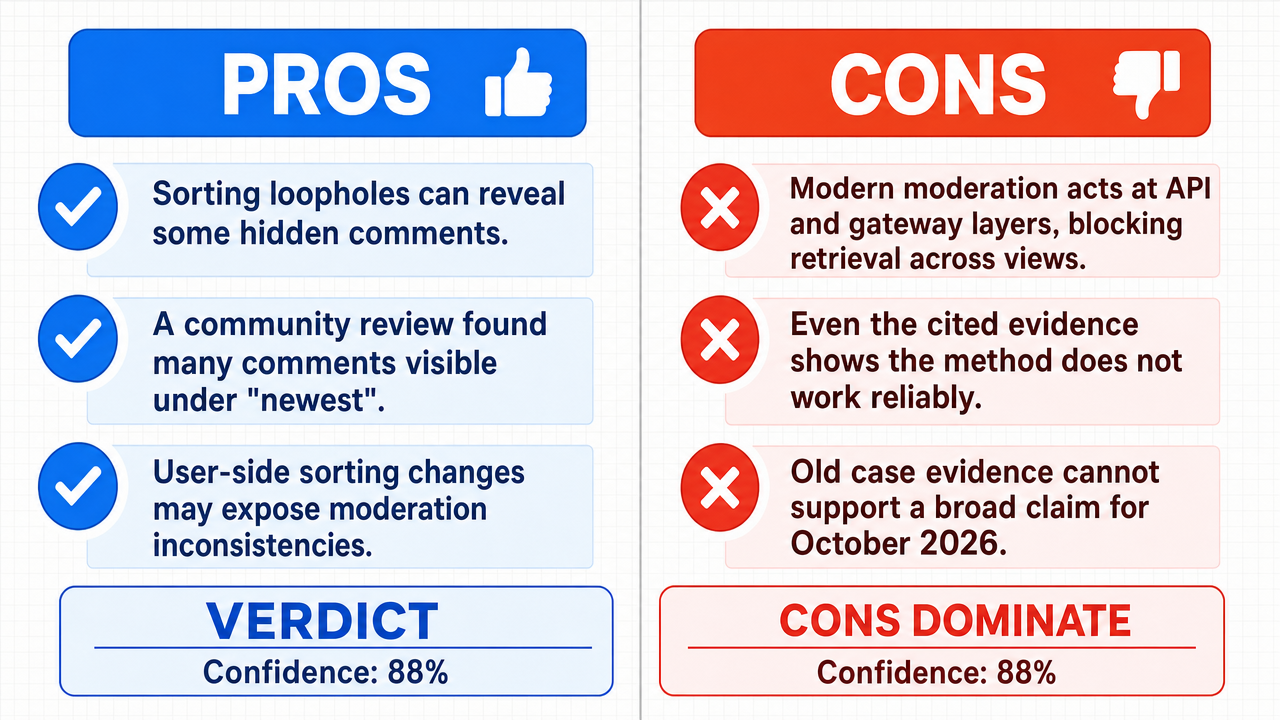
Verdict
Verdict: likely FALSE (88%)
Web Report: https://solsice.com/public/debates/on-october-12-2026-comments-appearing-to-be-hidden-or-delete-e8f47ce96f9a
This section provides a brief overview of the key arguments. You do not need to read the full detailed report below.
✅ Key PRO arguments:
- ■Content moderation systems often apply hide/delete actions preferentially to default or 'top' sorting algorithms first, while the 'newest' sort pulls directly from a live chronological feed of database entries, which can bypass the filtered view. Users on platforms like Reddit have consistently noted that comments removed under 'best' or 'top' sorts remain visible when switching to 'new.'
- ■A documented community investigation of a 2023 event on the subreddit r/news during the Boston Marathon Bombing thread sampled 278 total comments and found that 225 remained visible when switching to 'new,' while 53 had been removed, yielding an 81.7% success rate for the 'newest' sort method.
❌ Key ANTI arguments:
- ■Modern moderation engines operate at the API and gateway layers, not merely at the database storage layer . When a comment is flagged or soft-deleted, the instruction is propagated through a global state management service that invalidates caches across all sorting endpoints—including 'newest'—near-simultaneously, making a simple timestamp-based query unable to reliably circumvent centralized moderation.
- ■The affirmative's own cited evidence establishes a non-success rate: with only 81.7% of comments accessible via the 'newest' sort, 18.3% of cases fail. This failure rate undermines the claim of absolute reliability, since 'reliably' requires a method that works consistently rather than approximately four-fifths of the time.
- ■The affirmative's evidence is drawn from a 2023 moderation event, but the claim pertains to October 12, 2026. Extrapolating a three-year-old dataset to predict the behavior of evolved, modernized moderation infrastructure introduces a logical gap between the scope of the evidence and the scope of the claim, rendering the conclusion invalid for the specified future date.
💭 Conclusion: False. The verdict rests on the strongest anti argument that the affirmative's own evidence—an 81.7% success rate—directly contradicts the word 'reliably' in the assertion, since an 18.3% failure rate disqualifies the method from being considered reliable. The pro side's anecdotal Reddit observations and single-event dataset from 2023 were insufficient to overcome these definitional objections, and the temporal gap between the cited evidence and the current claim further weakens the argument.
🔬 DeepResearch Result: likely FALSE ❌ (88%)
Assertion: On October 12, 2026, comments appearing to be hidden or deleted on the popular online platform can reliably be revealed by changing the sorting preference to 'newest'.
Participating models: deepseek-v3.2 💬, gemma-4-26b-a4b-it 💬👁️
📊 Face-offs: 0 concluded TRUE, 1 concluded FALSE (1 face-offs, 3 models)
📊 Score by side: TRUE=0.00, FALSE=0.88
🏅 Model score changes:
minimax-m3 💬👁️: +9
✅ PRO Arguments:
- ■Content moderation systems often apply hide/delete actions preferentially to default or 'top' sorting algorithms first, while the 'newest' sort pulls directly from a live chronological feed of database entries, which can bypass the filtered view. Users on platforms like Reddit have consistently noted that comments removed under 'best' or 'top' sorts remain visible when switching to 'new.' deepseek-v3.2 💬
- ■A documented community investigation of a 2023 event on the subreddit r/news during the Boston Marathon Bombing thread sampled 278 total comments and found that 225 remained visible when switching to 'new,' while 53 had been removed, yielding an 81.7% success rate for the 'newest' sort method. deepseek-v3.2 💬
❌ ANTI Arguments:
- ■Modern moderation engines operate at the API and gateway layers, not merely at the database storage layer . When a comment is flagged or soft-deleted, the instruction is propagated through a global state management service that invalidates caches across all sorting endpoints—including 'newest'—near-simultaneously, making a simple timestamp-based query unable to reliably circumvent centralized moderation. gemma-4-26b-a4b-it 💬👁️
- ■The affirmative's own cited evidence establishes a non-success rate: with only 81.7% of comments accessible via the 'newest' sort, 18.3% of cases fail. This failure rate undermines the claim of absolute reliability, since 'reliably' requires a method that works consistently rather than approximately four-fifths of the time. gemma-4-26b-a4b-it 💬👁️
- ■The affirmative's evidence is drawn from a 2023 moderation event, but the claim pertains to October 12, 2026. Extrapolating a three-year-old dataset to predict the behavior of evolved, modernized moderation infrastructure introduces a logical gap between the scope of the evidence and the scope of the claim, rendering the conclusion invalid for the specified future date. gemma-4-26b-a4b-it 💬👁️
💭 Reasoning: False. The verdict rests on the strongest anti argument that the affirmative's own evidence—an 81.7% success rate—directly contradicts the word 'reliably' in the assertion, since an 18.3% failure rate disqualifies the method from being considered reliable. The pro side's anecdotal Reddit observations and single-event dataset from 2023 were insufficient to overcome these definitional objections, and the temporal gap between the cited evidence and the current claim further weakens the argument.
📋 PRO Facts:
• Users on Reddit have noted that comments removed under 'top' sort sometimes remain visible when switching to 'new.'
• A 2023 community investigation of the r/news subreddit documented an 81.7% success rate for accessing comments via 'new' sort.
📋 ANTI Facts:
• The affirmative's cited 81.7% success rate implies an 18.3% failure rate, which undermines a claim of reliability.
• The affirmative's evidence is from 2023, creating a temporal gap with the current claim.
| Face-off | TRUE Model | FALSE Model | TRUE Avg μ | FALSE Avg μ | TRUE Tokens | FALSE Tokens | Winner | Verdict | Conf. |
|---|---|---|---|---|---|---|---|---|---|
| #1 | deepseek-v3.2 💬 | gemma-4-26b-a4b-it 💬👁️ | 0.298 | 0.236 | 8 | 2 | TRUE | FALSE | 88% |
The following technical terms, abbreviations, and domain-specific concepts are referenced throughout this debate transcript. Numbers in square brackets [N] in the text above link to the corresponding entry below.
[1] API — Application Programming Interface — A set of defined protocols that allows different software components to communicate with each other; in the debate, referenced as a layer where moderation engines operate.
[2] automated filters — Software mechanisms that automatically flag, hide, or remove content based on predefined rules, without requiring human review at the moment of action.
[3] cache invalidation — The process of marking stored (cached) data as stale so that subsequent requests retrieve updated information; cited in the debate as a mechanism by which moderation actions propagate across sorting endpoints.
[4] content moderation — The practice of monitoring, reviewing, and managing user-generated content to enforce platform rules, typically through a combination of automated systems and human reviewers.
[5] data shards — Horizontal partitions of a database in which subsets of data are stored across separate nodes; the debate notes that moderation actions may not propagate instantly across all shards.
[6] database storage layer — The component of a software system responsible for persisting data; the debate contrasts this layer with API/gateway layers where moderation engines are said to operate.
[7] distributed systems — Computing systems whose components are located on different networked machines and coordinate via message passing; cited as the architectural context for the debate's claims about consistency.
[8] eventual consistency — A consistency model in distributed systems in which, given enough time and absence of new updates, all replicas of a piece of data will converge to the same value; the debate disputes whether this latency is exploitable.
[9] global state management service — A centralized service that maintains and propagates state changes (such as deletion flags) across distributed components; cited as the mechanism through which moderation actions are synchronized.
[10] indexed views — Pre-computed, stored representations of data optimized for fast retrieval; mentioned in the debate as part of how content moderation systems serve sorted content.
[11] inductive leap — A form of logical reasoning in which a general conclusion is drawn from specific observations; the debate argues that extrapolating from a 2023 event to a 2026 prediction constitutes an unproven inductive leap.
[12] is_deleted — An example metadata flag name referenced in the debate as a boolean attribute attached to a content object to indicate that it has been deleted.
[13] logical inconsistency — A situation in which a set of statements contains contradictions; the negative side argues the affirmative's claim of 'reliability' alongside an 18.3% failure rate is logically inconsistent.
[14] metadata attribute — Descriptive data attached to an object (such as a comment) that characterizes its state, such as deletion or visibility status, rather than its content.
[15] middleware — Software that sits between an application's request layer and its data layer, handling cross-cutting concerns such as authentication, caching, and content filtering.
[16] moderation engines — Software systems that enforce content policies by processing user submissions against rules and applying actions such as hiding, flagging, or deleting.
[17] production environments — Live, customer-facing deployments of software systems, as opposed to test or staging environments; cited in the debate as the context in which moderation flags are enforced.
[18] ranking endpoints — API endpoints that return ordered lists of content according to a ranking algorithm (e.g., 'best,' 'top,' 'new'); the debate discusses whether moderation actions propagate to all such endpoints.
[19] ranking services — Backend services responsible for computing and returning ranked lists of content items based on signals such as votes, recency, or relevance.
[20] scraping — The automated extraction of data from a website or platform, typically by programmatically requesting pages and parsing their contents; referenced as the methodology used to gather the cited 2023 dataset.
[21] soft delete — A deletion operation that marks a record as removed (e.g., via a flag) without physically erasing it from storage, allowing potential recovery or visibility through alternate queries.
[22] sorting algorithms — Procedures that order content items according to a defined criterion (e.g., score, recency); the debate centers on how different sorts interact with moderation filters.
[23] timestamp-based query — A database or API query that orders results by a time field; the affirmative argues that such queries can bypass moderation layers that target other ranking algorithms.
[24] visibility_status — An example metadata flag name referenced in the debate as an attribute attached to a content object to indicate whether it is visible, hidden, or otherwise restricted.
Face-off transcripts
- ■
Ownership & Trade Secrets. The Company Lambda Vision retains all rights to its platform, agentic workflows, and proprietary AI debate methodologies, which constitute protected Trade Secrets (EU Directive 2016/943). Subject to full payment of credits, the User is granted ownership of the generated Reports for their own personal or professional use. Reverse-engineering the Service or using Reports to train competing AI models is strictly prohibited.
- ■
No Professional Advice. Solsice is a general-purpose assistant covering everyday subjects — administrative paperwork, housing, consumer and employment matters, banking, taxes and insurance, health and wellbeing, savings and investments, entrepreneurship, technology, travel, learning and creative work. Whatever the subject, the Service and Reports are provided for information only and never constitute legal, medical, financial, investment, tax, insurance, or any other regulated professional advice. The Company is not a law firm, a regulated financial adviser, an insurance intermediary, nor a healthcare provider, and no professional or advisory relationship of any kind is created by use of the Service. Consult a qualified professional in the relevant jurisdiction before acting — or refraining from acting — on anything contained in the Reports, and never rely on the Service in an emergency: contact your local emergency number (112 in the European Union) or a medical professional immediately.
- ■
AI-Generated Content, Sources and Viewpoints. Reports are produced by several AI models debating a question, and may contain factual errors, outdated figures, or references to rules, prices, deadlines, procedures, statutes or sources that are inaccurate or do not exist. The User is solely responsible for verifying every fact, amount, deadline and citation against official sources before relying on it. Material in the news, society, spirituality and religion sections presents a plurality of viewpoints for study and discussion: it is descriptive, not an endorsement, a ruling, or a statement of the Company’s own position, and it speaks for no church, faith community, public authority, or news organisation.
- ■
Liability & Governing Law. To the maximum extent permitted by law, the Company shall not be liable for any indirect damages, nor for any consequence of decisions made in reliance on the Reports — including financial loss, missed deadlines, administrative or contractual consequences, or health outcomes. These Terms are governed by French law. Any disputes shall be subject to the exclusive jurisdiction of the Courts of Paris, France.