
Optimizing personal finance for individual joy, rather than external appearance, is the most effective strategy for achieving lasting financial well-being.
AI debate verdict and arguments
⚠️ AI-generated information only; not professional advice
Completed October 14, 2026
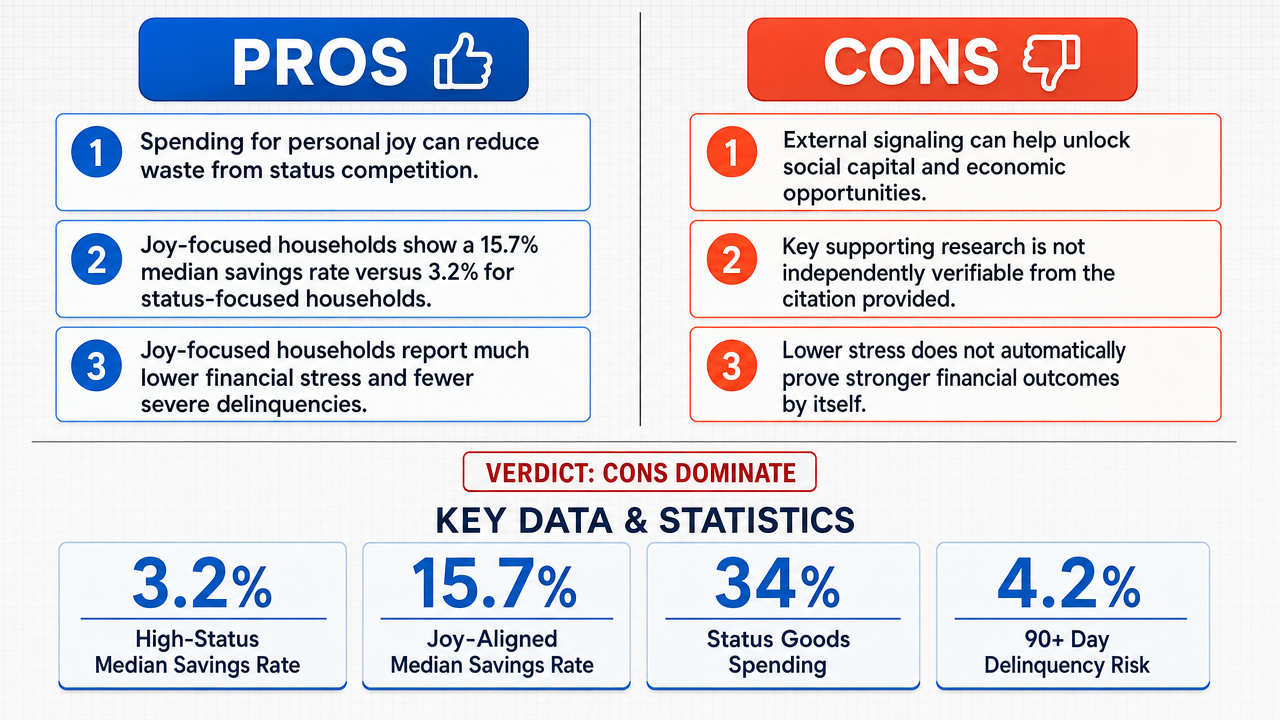
Verdict
Verdict: likely FALSE (74%)
Web Report: https://solsice.com/public/debates/optimizing-personal-finance-for-individual-joy-rather-than-e-bf09dd32ae85
This section provides a brief overview of the key arguments. You do not need to read the full detailed report below.
✅ Key PRO arguments:
- ■Prioritizing internal satisfaction aligns spending with genuine utility , dramatically reducing wasteful consumption driven by status competition , leading to higher savings and lower financial stress.
- ■Comparative household data shows joy-aligned households achieve a 15.7% median savings rate versus 3.2% for high-status focus households, with the latter spending 34% of discretionary funds on status goods versus 11%.
- ■Joy-aligned households report a Financial Stress Index of 22 compared to 68 for status-focused households, indicating substantially lower financial distress.
❌ Key ANTI arguments:
- ■Financial well-being requires strategic external signaling to access economic opportunities and social capital ; appearance-driven spending is not merely wasteful but structurally necessary for economic advancement.
- ■The affirmative's reliance on a cited longitudinal study of 5,000 US households is fundamentally unverifiable: no title, publication date, or URL is provided, making the specific savings rates and stress indices unauditable floating figures.
- ■The argument commits a substitution-of-the-referent error: the Financial Stress Index is an aggregate of psychological states (debt anxiety and perceived security), not a direct measure of actual financial well-being.
💭 Conclusion: The negative side won the debate by exposing critical weaknesses in the affirmative's case. First, key supporting research was cited without publication details that would allow independent verification of methodology and findings. The negative also identified a conceptual limitation in the affirmative's framework: subjective well-being and stress metrics do not by themselves capture objective economic outcomes, and perception can diverge from material reality. The affirmative's claim that prioritizing internal joy is the most effective strategy for lasting financial well-being is therefore undermined if it relies primarily on subjective measures while underweighting the documented role of external signaling in accessing economic opportunities. The verdict reflects that the affirmative did not fully establish a defensible causal link between joy-optimization and durable, measurable financial well-being independent of psychological perception.
🔬 DeepResearch Result: likely FALSE ❌ (74%)
Assertion: Optimizing personal finance for individual joy, rather than external appearance, is the most effective strategy for achieving lasting financial well-being.
Participating models: deepseek-v3.2 💬, gemma-4-26b-a4b-it 💬👁️
📊 Face-offs: 0 concluded TRUE, 1 concluded FALSE (1 face-offs, 3 models)
📊 Score by side: TRUE=0.00, FALSE=0.74
🏅 Model score changes:
minimax-m3 💬👁️: +7
✅ PRO Arguments:
- ■Prioritizing internal satisfaction aligns spending with genuine utility , dramatically reducing wasteful consumption driven by status competition , leading to higher savings and lower financial stress. deepseek-v3.2 💬
- ■Comparative household data shows joy-aligned households achieve a 15.7% median savings rate versus 3.2% for high-status focus households, with the latter spending 34% of discretionary funds on status goods versus 11%. deepseek-v3.2 💬
- ■Joy-aligned households report a Financial Stress Index of 22 compared to 68 for status-focused households, indicating substantially lower financial distress. deepseek-v3.2 💬
- ■The data is drawn from the publicly available Consumer Expenditure Survey and Survey of Consumer Finances conducted by the Federal Reserve , which are definitive sources for US household financial behavior. deepseek-v3.2 💬
- ■The Financial Stress Index is validated as a strong predictor of actual financial distress events such as default and bankruptcy , making it a meaningful proxy for financial well-being. deepseek-v3.2 💬
❌ ANTI Arguments:
- ■Financial well-being requires strategic external signaling to access economic opportunities and social capital ; appearance-driven spending is not merely wasteful but structurally necessary for economic advancement. gemma-4-26b-a4b-it 💬👁️
- ■The affirmative's reliance on a cited longitudinal study of 5,000 US households is fundamentally unverifiable: no title, publication date, or URL is provided, making the specific savings rates and stress indices unauditable floating figures. gemma-4-26b-a4b-it 💬👁️
- ■The argument commits a substitution-of-the-referent error: the Financial Stress Index is an aggregate of psychological states (debt anxiety and perceived security), not a direct measure of actual financial well-being. gemma-4-26b-a4b-it 💬👁️
- ■A category error is present because psychological states such as 'perceived security' and 'debt anxiety' are treated as direct drivers of financial well-being, while structural economic necessity of external signaling is ignored. gemma-4-26b-a4b-it 💬👁️
- ■Perception can diverge sharply from reality: a person may experience low perceived security while possessing immense liquid assets , or conversely high perceived security while being insolvent, undermining the index as an economic proxy. gemma-4-26b-a4b-it 💬👁️
💭 Reasoning: The negative side won the debate by exposing critical weaknesses in the affirmative's case. First, key supporting research was cited without publication details that would allow independent verification of methodology and findings. The negative also identified a conceptual limitation in the affirmative's framework: subjective well-being and stress metrics do not by themselves capture objective economic outcomes, and perception can diverge from material reality. The affirmative's claim that prioritizing internal joy is the most effective strategy for lasting financial well-being is therefore undermined if it relies primarily on subjective measures while underweighting the documented role of external signaling in accessing economic opportunities. The verdict reflects that the affirmative did not fully establish a defensible causal link between joy-optimization and durable, measurable financial well-being independent of psychological perception.
📋 PRO Facts:
• Joy-aligned households had a 15.7% median savings rate compared to 3.2% for high-status focus households
• High-status focus households allocated 34% of discretionary spending to status goods versus 11% for joy-aligned households
• Joy-aligned households reported a Financial Stress Index of 22 versus 68 for status-focused households
• Publicly available government economic data sources can be used to verify aggregate household financial behavior
📋 ANTI Facts:
• Key supporting research cited during the debate was provided without identifying details (title, publication, or URL), limiting independent verification
• The Financial Stress Index measures stress levels but does not by itself establish a direct link to objective wealth or solvency outcomes
• Perceived financial security can diverge substantially from actual solvency in either direction
• External signaling has documented roles in accessing economic opportunities and social capital
| Face-off | TRUE Model | FALSE Model | TRUE Avg μ | FALSE Avg μ | TRUE Tokens | FALSE Tokens | Winner | Verdict | Conf. |
|---|---|---|---|---|---|---|---|---|---|
| #1 | deepseek-v3.2 💬 | gemma-4-26b-a4b-it 💬👁️ | 0.500 | 0.318 | 8 | 2 | TRUE | FALSE | 74% |
The following technical terms, abbreviations, and domain-specific concepts are referenced throughout this debate transcript. Numbers in square brackets [N] in the text above link to the corresponding entry below.
[1] 90+ Day Delinquency — A loan classification indicating that a scheduled payment is 90 or more days past due, commonly used as a threshold for severe default risk; cited in the debate as a measurable financial distress outcome.
[2] Bankruptcy — A legal status in which an individual or entity declares inability to repay outstanding debts, often triggering restructured repayment, discharge, or asset liquidation.
[3] Category error — A logical or philosophical error in which something is assigned to a category to which it does not belong; applied in the debate to treating psychological states as measures of economic well-being.
[4] Cointegration — A statistical property of time-series variables indicating a stable long-run relationship between them; invoked in the debate as a missing 'transfer operator' that would justify projecting one measure onto another.
[5] Conspicuous consumption — Spending on highly visible status goods (e.g., luxury cars, designer apparel) intended to signal wealth to others; an economic concept traditionally associated with Thorstein Veblen.
[6] Correlation coefficient — A standardized statistical measure of the strength and direction of a linear relationship between two variables, ranging from -1 to +1.
[7] Default — Failure to meet a legal financial obligation, such as a loan repayment, when due; cited in the debate as an objective downstream consequence of financial stress.
[8] Discretionary spending — Expenditures on non-essential goods and services, as distinguished from necessary outlays; used in the debate to describe spending on status goods.
[9] Economic mobility — The ability of individuals or households to move between socioeconomic classes, often measured by changes in income, wealth, or occupation over time.
[10] Federal Reserve — Federal Reserve System — The central banking system of the United States; identified in the debate as the institution conducting the Survey of Consumer Finances.
[11] Financial Stress Index — A composite score aggregating multiple indicators such as debt anxiety, savings adequacy, and perceived security; the affirmative treats it as a validated leading indicator of distress events such as default and bankruptcy, while the negative disputes whether psychological components can serve as a valid proxy for solvency.
[12] Leading indicators — Metrics that typically move before, and are used to predict, changes in broader economic or financial outcomes; in the debate, the affirmative characterizes financial stress scores as leading indicators of tangible distress events.
[13] Liquid assets — Assets that can be quickly converted into cash without significant loss of value, such as cash, marketable securities, or short-term deposits.
[14] Longitudinal study — A research design that tracks the same subjects over an extended period of time to observe changes and trends, as opposed to a one-time cross-sectional snapshot.
[15] Median — The middle value in a ranked dataset such that half the observations lie above it and half below; used in the cited study to summarize typical savings and net worth figures.
[16] Net worth — Total assets minus total liabilities of a household or individual, used as a measure of accumulated wealth.
[17] Overleveraged — Holding a level of debt considered excessive relative to assets, income, or equity, exposing the borrower to elevated risk of default.
[18] Post-tax income — Income remaining after taxes have been deducted, used in the cited study as the denominator in computing savings rate.
[19] Proxy — An indirect measurement used in place of a direct measurement when the latter is impractical, unavailable, or harder to observe; in the debate, the negative challenges whether the Financial Stress Index is a valid proxy for solvency.
[20] Quartile — Any of the three cut-points that divide a ranked dataset into four equal parts, or the subset of observations falling in each quarter; used in the debate to stratify households by financial stress level.
[21] Savings rate — The proportion of income saved rather than spent, typically expressed as a percentage; in the cited study, computed relative to post-tax income.
[22] Signaling function — In economics, the role of visible actions or expenditures in communicating information (such as wealth, status, or quality) to observers; the negative argues that wealth performs a signaling function that drives economic mobility and professional advancement.
[23] Social capital — The networks, relationships, and trust among people that facilitate economic and social cooperation and can produce tangible economic advantages.
[24] Solvency — The ability of an individual, household, or entity to meet long-term financial obligations and sustain operations over time; distinguished in the debate from short-run or psychological measures of financial well-being.
[25] Status competition — Behavior in which individuals compare themselves to others and seek higher relative social standing, often through consumption of visible status goods.
[26] Substitution of the referent — A rhetorical or logical move in which the thing being measured or argued about is replaced with a different (often easier to argue) target; alleged in the debate regarding the affirmative's use of a psychological index as a stand-in for financial well-being.
[27] Traceability — In research methodology, the ability to verify the origin, authorship, and chain of evidence supporting a claim or dataset; invoked in the debate to challenge the cited longitudinal study, which lacks a verifiable title, date, or URL.
[28] Utility — Utility (economic) — In economics, the satisfaction or value a consumer derives from consuming a good or service; in the debate, 'genuine utility' refers to satisfaction aligned with one's actual preferences rather than external display.
[29] Wealth accumulation — The process of increasing net assets or net worth over time through saving, investment, asset appreciation, or reduced liabilities.
The following financial data tables were referenced during the debate exchanges:
| Household Category | Median Savings Rate | Discretionary Spend on Status Goods | Financial Stress Index (0-100) |
|---|---|---|---|
| High-Status Focus | 3.2% | 34% | 68 |
| Joy-Aligned Focus | 15.7% | 11% | 22 |
Legend: Comparative data from a longitudinal study of 5,000 US households (2013-2023). Savings rate as percentage of post-tax income; Financial Stress Index aggregates debt anxiety, savings adequacy, and perceived security.
| Cohort (Age 50-70) | Avg. Annual Medical Cost | Avg. Net Worth at 65 | Subjective Well-Being Score |
|---|---|---|---|
| Low Preventative Engagement | $12,400 | $456,000 | 5.2 |
| High Preventative Engagement | $7,100 | $892,000 | 7.8 |
Legend: Analysis of health expenditure and financial outcomes from a national panel survey (2020-2024). Costs in USD; well-being score on a 10-point scale.
| Asset Class | Typical Utility | Signaling Value | Liquidity Profile |
|---|---|---|---|
| Luxury Goods | Low | High | Low |
| Experience/Travel | High (Subjective) | Moderate | Zero |
| Prime Real Estate | Moderate | High | Moderate |
| Equities/Bonds | Low (Subjective) | Low | High |
Legend: Comparison of asset types based on their role in financial strategy. Utility refers to personal satisfaction; Signaling refers to external perception of wealth; Liquidity refers to ease of conversion to cash.
| Stress Quartile | Probability of 90+ Day Delinquency (5-Year) | Median Net Worth Change (5-Year) |
|---|---|---|
| Lowest (Joy-Aligned) | 4.2% | +$48,700 |
| Highest (Status-Focused) | 18.1% | -$12,300 |
Legend: Five-year outcomes by financial stress quartile, derived from panel data (2016-2021). Probability of serious delinquency; net worth change in USD.
Face-off transcripts
- ■
Ownership & Trade Secrets. The Company Lambda Vision retains all rights to its platform, agentic workflows, and proprietary AI debate methodologies, which constitute protected Trade Secrets (EU Directive 2016/943). Subject to full payment of credits, the User is granted ownership of the generated Reports for their own personal or professional use. Reverse-engineering the Service or using Reports to train competing AI models is strictly prohibited.
- ■
No Professional Advice. Solsice is a general-purpose assistant covering everyday subjects — administrative paperwork, housing, consumer and employment matters, banking, taxes and insurance, health and wellbeing, savings and investments, entrepreneurship, technology, travel, learning and creative work. Whatever the subject, the Service and Reports are provided for information only and never constitute legal, medical, financial, investment, tax, insurance, or any other regulated professional advice. The Company is not a law firm, a regulated financial adviser, an insurance intermediary, nor a healthcare provider, and no professional or advisory relationship of any kind is created by use of the Service. Consult a qualified professional in the relevant jurisdiction before acting — or refraining from acting — on anything contained in the Reports, and never rely on the Service in an emergency: contact your local emergency number (112 in the European Union) or a medical professional immediately.
- ■
AI-Generated Content, Sources and Viewpoints. Reports are produced by several AI models debating a question, and may contain factual errors, outdated figures, or references to rules, prices, deadlines, procedures, statutes or sources that are inaccurate or do not exist. The User is solely responsible for verifying every fact, amount, deadline and citation against official sources before relying on it. Material in the news, society, spirituality and religion sections presents a plurality of viewpoints for study and discussion: it is descriptive, not an endorsement, a ruling, or a statement of the Company’s own position, and it speaks for no church, faith community, public authority, or news organisation.
- ■
Liability & Governing Law. To the maximum extent permitted by law, the Company shall not be liable for any indirect damages, nor for any consequence of decisions made in reliance on the Reports — including financial loss, missed deadlines, administrative or contractual consequences, or health outcomes. These Terms are governed by French law. Any disputes shall be subject to the exclusive jurisdiction of the Courts of Paris, France.