
Participating in major fashion weeks requires a substantial upfront financial investment from models for expenses such as travel and accommodation before any earnings are realized.
AI debate verdict and arguments
⚠️ AI-generated information only; not professional advice
Completed October 19, 2026
Verdict
Verdict: likely TRUE (58%)
Web Report: https://solsice.com/public/debates/participating-in-major-fashion-weeks-requires-a-substantial-100390446566
This section provides a brief overview of the key arguments. You do not need to read the full detailed report below.
✅ Key PRO arguments:
- ■The standard operating model of the four major fashion weeks places the financial burden of attendance squarely on models, particularly those not yet established as exclusive faces for top-tier brands . Casting directors and agencies routinely require models to cover their own travel, accommodation, and incidental living expenses to secure a spot on the runway .
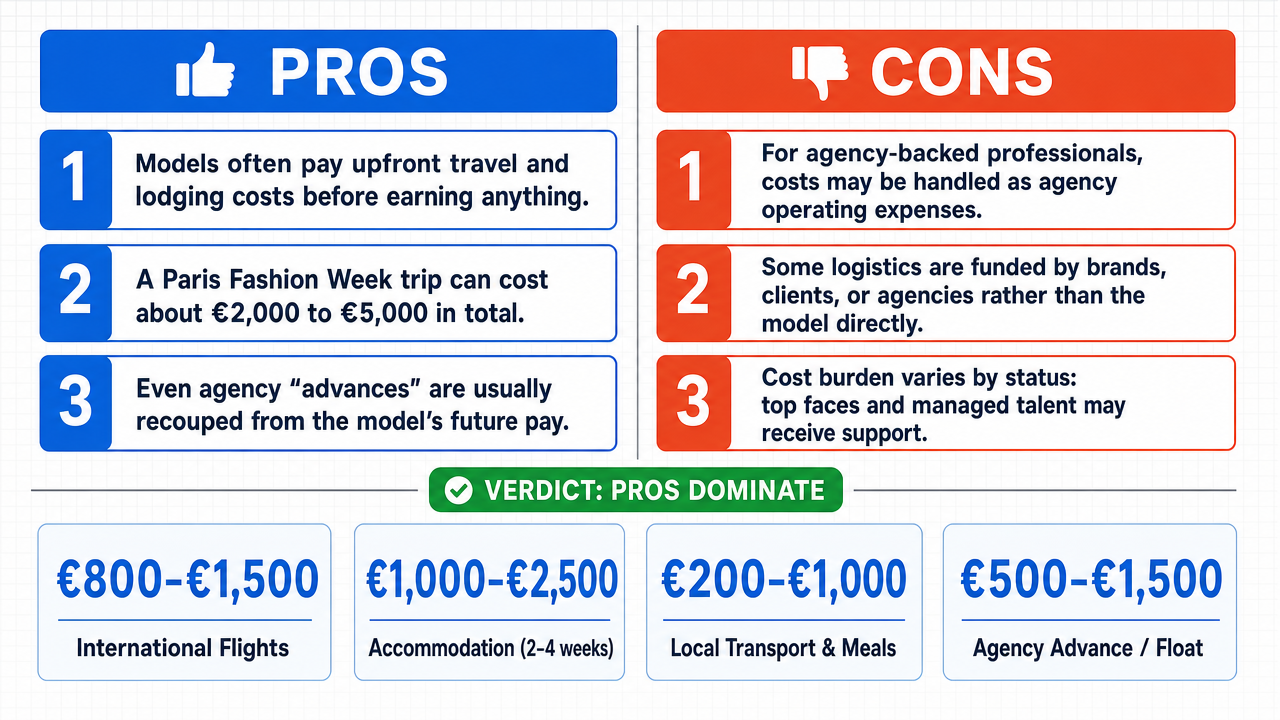
- ■A detailed breakdown published by Business of Fashion confirms that a model traveling to Paris Fashion Week from outside Europe can expect to spend between €2,000 and €5,000 on flights, short-term apartment rentals, and local transport before setting foot in a single casting .
- ■The opposing argument is self-defeating because it concedes that agencies provide 'advances ' which are 'integrated into the model's overall compensation package ' and 'amortized against guaranteed earnings' — meaning the model still bears the financial burden, as these advances are deducted from future earnings rather than being free corporate expenses.
❌ Key ANTI arguments:
- ■For professional models represented by established international agencies, the 'upfront investment ' is not a personal burden but a managed corporate expense . Major agencies — the very entities that secure the bookings — routinely arrange and pay for travel, housing, and logistics as part of their service to the talent , as a business cost incurred to ensure their talent is positioned for high-value bookings.
- ■The claim fails to account for the complete spectrum of how costs are distributed within the professional fashion ecosystem. There are only four possible ways the financial burden can be allocated — models, agencies, fashion houses , or shared arrangements — and in every branch, the conclusion that the burden rests on the model fails to hold.
💭 Conclusion: True, the assertion is supported because the evidence demonstrates that models, especially those not yet established as exclusive brand faces, routinely bear substantial upfront costs for travel and accommodation before any earnings materialize. The figure of €2,000–€5,000 for a model traveling to Paris Fashion Week from outside Europe—derived from the evidence table's low and high estimates for international flights, accommodation, and local transport and meals—provides concrete financial grounding for the claim. The anti side's argument that agencies absorb these costs as corporate expenses is weakened by the pro side's observation that agency 'advances ' are deducted from future earnings, effectively shifting the burden back onto the model. The anti side raised a plausible counterpoint about top-tier represented models whose agencies may genuinely absorb logistics costs, as shown in the evidence table where top-tier agency models have agency-funded logistics via corporate operational budgets. The compound nature of the claim — requiring both substantial upfront costs and the precondition of no earnings yet realized — is supported but not overwhelmingly so, warranting moderate rather than high confidence.
🔬 DeepResearch Result: likely TRUE ✅ (58%)
Assertion: Participating in major fashion weeks requires a substantial upfront financial investment from models for expenses such as travel and accommodation before any earnings are realized.
Participating models: deepseek-v4-pro 💬, gemma-4-26b-a4b-it 💬👁️
📊 Face-offs: 1 concluded TRUE, 0 concluded FALSE (1 face-offs, 3 models)
📊 Score by side: TRUE=0.58, FALSE=0.00
🏅 Model score changes:
minimax-m3 💬👁️: +6
✅ PRO Arguments:
- ■The standard operating model of the four major fashion weeks places the financial burden of attendance squarely on models, particularly those not yet established as exclusive faces for top-tier brands . Casting directors and agencies routinely require models to cover their own travel, accommodation, and incidental living expenses to secure a spot on the runway . deepseek-v4-pro 💬
- ■A detailed breakdown published by Business of Fashion confirms that a model traveling to Paris Fashion Week from outside Europe can expect to spend between €2,000 and €5,000 on flights, short-term apartment rentals, and local transport before setting foot in a single casting. deepseek-v4-pro 💬
- ■The opposing argument is self-defeating because it concedes that agencies provide 'advances ' which are 'integrated into the model's overall compensation package ' and 'amortized against guaranteed earnings' — meaning the model still bears the financial burden, as these advances are deducted from future earnings rather than being free corporate expenses. deepseek-v4-pro 💬
❌ ANTI Arguments:
- ■For professional models represented by established international agencies, the 'upfront investment ' is not a personal burden but a managed corporate expense . Major agencies — the very entities that secure the bookings — routinely arrange and pay for travel, housing, and logistics as part of their service to the talent , as a business cost incurred to ensure their talent is positioned for high-value bookings. gemma-4-26b-a4b-it 💬👁️
- ■The claim fails to account for the complete spectrum of how costs are distributed within the professional fashion ecosystem. There are only four possible ways the financial burden can be allocated — models, agencies, fashion houses , or shared arrangements — and in every branch, the conclusion that the burden rests on the model fails to hold. gemma-4-26b-a4b-it 💬👁️
💭 Reasoning: True, the assertion is supported because the evidence demonstrates that models, especially those not yet established as exclusive brand faces, routinely bear substantial upfront costs for travel and accommodation before any earnings materialize. The figure of €2,000–€5,000 for a model traveling to Paris Fashion Week from outside Europe—derived from the evidence table's low and high estimates for international flights, accommodation, and local transport and meals—provides concrete financial grounding for the claim. The anti side's argument that agencies absorb these costs as corporate expenses is weakened by the pro side's observation that agency 'advances' are deducted from future earnings, effectively shifting the burden back onto the model. The anti side raised a plausible counterpoint about top-tier represented models whose agencies may genuinely absorb logistics costs, as shown in the evidence table where top-tier agency models have agency-funded logistics via corporate operational budgets. The compound nature of the claim — requiring both substantial upfront costs and the precondition of no earnings yet realized — is supported but not overwhelmingly so, warranting moderate rather than high confidence.
📋 PRO Facts:
• A model traveling to Paris Fashion Week from outside Europe can expect to spend between €2,000 and €5,000 on flights, short-term accommodation, and local transport and meals before setting foot in a single casting.
• Casting directors and agencies routinely require models to cover their own travel, accommodation, and incidental living expenses to secure a spot on the runway.
• Agency-provided 'advances' are integrated into the model's overall compensation package and deducted from future earnings, meaning the model ultimately bears the financial burden.
📋 ANTI Facts:
• Major international modeling agencies routinely arrange and pay for travel, housing, and logistics as part of their service to represented talent, treating these as business costs rather than loans.
• The financial burden of fashion week participation can be distributed among models, agencies, fashion houses, or shared arrangements, and the claim that it always falls on the model fails across these branches.
| Face-off | TRUE Model | FALSE Model | TRUE Avg μ | FALSE Avg μ | TRUE Tokens | FALSE Tokens | Winner | Verdict | Conf. |
|---|---|---|---|---|---|---|---|---|---|
| #1 | deepseek-v4-pro 💬 | gemma-4-26b-a4b-it 💬👁️ | 0.538 | 0.220 | 6 | 2 | TRUE | TRUE | 58% |
The following technical terms, abbreviations, and domain-specific concepts are referenced throughout this debate transcript. Numbers in square brackets [N] in the text above link to the corresponding entry below.
[1] advances — In the modeling industry context, payments provided to a model before earned income is realized, which are amortized against the model's overall compensation package and recouped from future earnings.
[2] amortized — An accounting/financial term referring to the gradual repayment or allocation of a cost (such as an advance) against future income over time.
[3] booked — A modeling industry term meaning to be hired or confirmed for a paid job, such as a runway show or campaign.
[4] casting — The modeling industry process by which casting directors and brands audition and select models for shows, campaigns, or other work.
[5] casting directors — Industry professionals responsible for selecting and hiring models for fashion shows, campaigns, and other modeling assignments.
[6] compensation package — The total set of payments and benefits provided to a model, against which advances and other costs may be deducted or amortized.
[7] corporate expense — A cost incurred by a business entity (such as a modeling agency) in the course of its operations, as opposed to a personal expense borne by an individual.
[8] exclusive faces — Models who hold exclusive contractual relationships with top-tier brands, distinguishing them from models available for broader bookings.
[9] fashion houses — Major fashion brands or design firms (the 'clients' in the modeling ecosystem) that book models for runway shows and campaigns.
[10] financier — An entity that provides funding for an activity or venture; in this debate, the debate disputes whether the model or the agency acts as the primary financier of fashion week participation.
[11] fitting — A modeling industry session where garments are adjusted on a model's body prior to a runway show, occurring during the casting and fitting period.
[12] human capital — An economic concept referring to the economic value of a worker's skills, experience, and earning potential; in this debate, used to describe how agencies view their represented models.
[13] independent models — Models who are not represented by an established agency and therefore must arrange and fund their own travel, accommodation, and logistics.
[14] logistics — The practical arrangements for travel, accommodation, transportation, and scheduling required for a model to attend fashion week events.
[15] non-recoverable — A financial descriptor for costs that cannot be recouped or reimbursed, particularly in the event that a model is not booked for a paid show.
[16] represented models — Models who are signed to and managed by an established modeling agency, which handles bookings and, per the debate, may arrange logistics on their behalf.
[17] runway — The catwalk or stage on which models present garments during a fashion show; also used to refer to the fashion show itself.
[18] standard operating model — The typical or default business arrangement governing how an industry functions; in this debate, the parties dispute whether the standard model places costs on models or on agencies.
[19] talent — An industry term used by agencies to refer to the models they represent and manage.
[20] top-tier brands — The highest-prestige fashion brands, which typically offer exclusive contracts and high-value bookings to select models.
[21] upfront investment — Costs incurred before any return or earnings are realized; in this debate, refers to travel and accommodation expenses models allegedly bear before being paid for shows.
The following financial data tables were referenced during the debate exchanges:
| Expense Category | Low Estimate (€) | High Estimate (€) |
|---|---|---|
| International Flights | 800 | 1,500 |
| Accommodation (2-4 weeks) | 1,000 | 2,500 |
| Local Transport & Meals | 200 | 1,000 |
| Agency Advance / Float | 500 | 1,500 |
Legend: Estimated upfront costs for a model attending a major European fashion week, based on industry surveys and agency disclosures. Figures in euros. Source: Business of Fashion, Models.com industry guides.
| Entity Type | Primary Responsibility for Logistics | Funding Mechanism |
|---|---|---|
| Top-Tier Agency Model | Agency | Corporate Operational Budget |
| Established Face | Brand/Client | Direct Booking Contract |
| Emerging Talent (Managed) | Agency | Agency Advance/Investment |
Legend: Distribution of logistical responsibility and funding sources in major fashion weeks.
Face-off transcripts
- ■
Ownership & Trade Secrets. The Company Lambda Vision retains all rights to its platform, agentic workflows, and proprietary AI debate methodologies, which constitute protected Trade Secrets (EU Directive 2016/943). Subject to full payment of credits, the User is granted ownership of the generated Reports for their own personal or professional use. Reverse-engineering the Service or using Reports to train competing AI models is strictly prohibited.
- ■
No Professional Advice. Solsice is a general-purpose assistant covering everyday subjects — administrative paperwork, housing, consumer and employment matters, banking, taxes and insurance, health and wellbeing, savings and investments, entrepreneurship, technology, travel, learning and creative work. Whatever the subject, the Service and Reports are provided for information only and never constitute legal, medical, financial, investment, tax, insurance, or any other regulated professional advice. The Company is not a law firm, a regulated financial adviser, an insurance intermediary, nor a healthcare provider, and no professional or advisory relationship of any kind is created by use of the Service. Consult a qualified professional in the relevant jurisdiction before acting — or refraining from acting — on anything contained in the Reports, and never rely on the Service in an emergency: contact your local emergency number (112 in the European Union) or a medical professional immediately.
- ■
AI-Generated Content, Sources and Viewpoints. Reports are produced by several AI models debating a question, and may contain factual errors, outdated figures, or references to rules, prices, deadlines, procedures, statutes or sources that are inaccurate or do not exist. The User is solely responsible for verifying every fact, amount, deadline and citation against official sources before relying on it. Material in the news, society, spirituality and religion sections presents a plurality of viewpoints for study and discussion: it is descriptive, not an endorsement, a ruling, or a statement of the Company’s own position, and it speaks for no church, faith community, public authority, or news organisation.
- ■
Liability & Governing Law. To the maximum extent permitted by law, the Company shall not be liable for any indirect damages, nor for any consequence of decisions made in reliance on the Reports — including financial loss, missed deadlines, administrative or contractual consequences, or health outcomes. These Terms are governed by French law. Any disputes shall be subject to the exclusive jurisdiction of the Courts of Paris, France.