
Real estate investment strategies like 'house hacking' are financially beneficial only if the savings are not absorbed into an increased lifestyle.
AI debate verdict and arguments
⚠️ AI-generated information only; not professional advice
Completed October 14, 2026
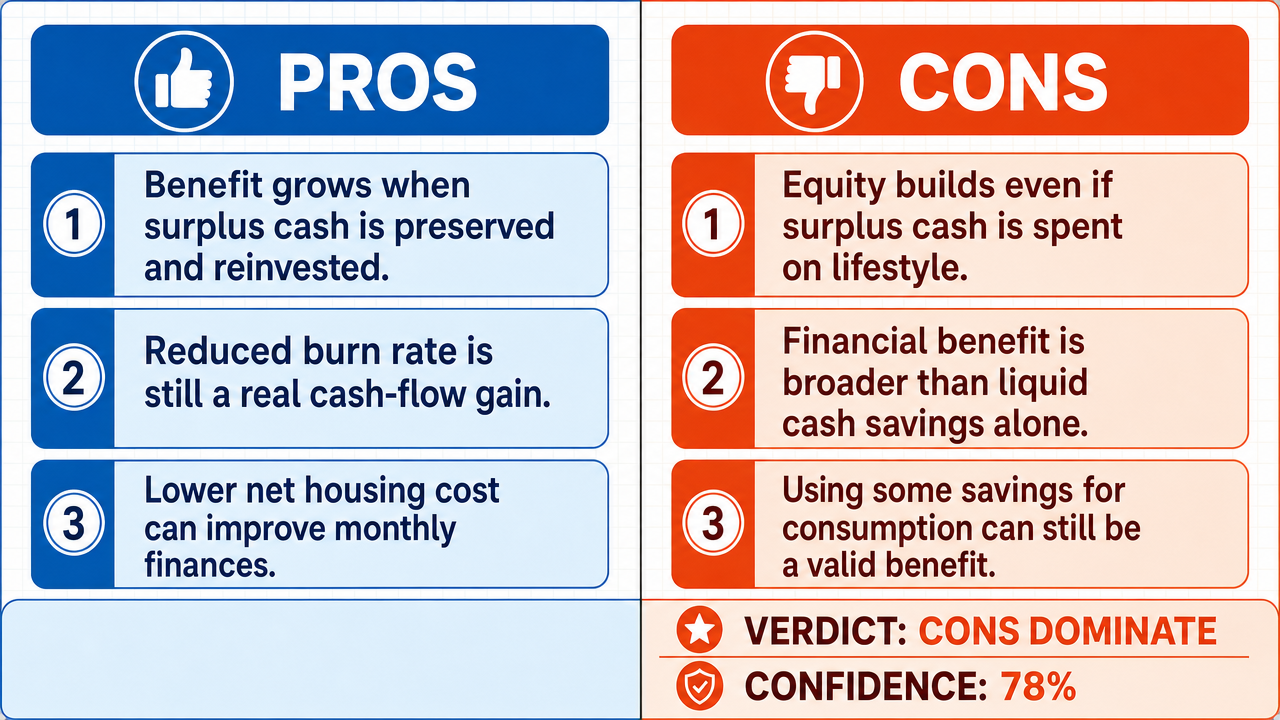
Verdict
Verdict: likely FALSE (78%)
Web Report: https://solsice.com/public/debates/real-estate-investment-strategies-like-house-hacking-are-fin-4296c45575c3
This section provides a brief overview of the key arguments. You do not need to read the full detailed report below.
✅ Key PRO arguments:
- ■House hacking yields financial benefit only when the cash-flow surplus is preserved and reinvested rather than absorbed into discretionary spending , because the wealth-building mechanism requires capital retention.
- ■The opponent's position is internally inconsistent: claiming the primary benefit is reduced 'burn rate ' (a cash flow metric) while simultaneously asserting equity accumulation delivers benefit regardless of cash flow treatment conflates two separate channels.
- ■A typical house hacking scenario with a $2,000 monthly mortgage offset by $1,500 in rental income produces a $500 net housing cost, and any absorption of the $1,500 into lifestyle spending undermines the intended wealth-building function.
❌ Key ANTI arguments:
- ■House hacking provides financial benefit through equity accumulation regardless of lifestyle spending, because the strategy's core mechanism is acquiring a hard asset (the property) at a significantly lower net cost than traditional ownership, which is independent of how the cash-flow surplus is consumed.
- ■The affirmative's argument relies on a narrow, flawed definition of 'financial benefit' that equates it exclusively with net worth accumulation through liquid capital reinvestment, ignoring the fundamental mechanics of real estate.
- ■The savings generated by renting portions of a residence are frequently and legitimately absorbed into consumption as a fundamental component of the strategy's utility, since offsetting the existing cost of living is the primary design purpose of house hacking .
💭 Conclusion: False. The verdict is FALSE because house hacking delivers financial benefits through equity accumulation independent of whether the cash-flow surplus is spent on lifestyle. The negation side successfully argued that the affirmative's premise conflates 'financial benefit' with liquid capital reinvestment, ignoring the fundamental mechanics of real estate where the property itself is acquired at a significantly reduced net cost. Even when rental proceeds are spent on consumption, the homeowner still builds equity in the property, which constitutes a tangible financial benefit. The argument that benefits are contingent on preserving the surplus was undermined by the recognition that the surplus is frequently consumed as a core utility of the strategy. Therefore, the financial benefit of house hacking is not strictly conditional on avoiding lifestyle inflation, as the asset acquisition channel operates separately from cash-flow disposition.
🔬 DeepResearch Result: likely FALSE ❌ (78%)
Assertion: Real estate investment strategies like 'house hacking ' are financially beneficial only if the savings are not absorbed into an increased lifestyle.
Participating models: deepseek-v3.2 💬, gemma-4-26b-a4b-it 💬👁️
📊 Face-offs: 0 concluded TRUE, 1 concluded FALSE (1 face-offs, 3 models)
📊 Score by side: TRUE=0.00, FALSE=0.78
🏅 Model score changes:
minimax-m3 💬👁️: +8
✅ PRO Arguments:
- ■House hacking yields financial benefit only when the cash-flow surplus is preserved and reinvested rather than absorbed into discretionary spending , because the wealth-building mechanism requires capital retention. deepseek-v3.2 💬
- ■The opponent's position is internally inconsistent: claiming the primary benefit is reduced 'burn rate ' (a cash flow metric) while simultaneously asserting equity accumulation delivers benefit regardless of cash flow treatment conflates two separate channels. deepseek-v3.2 💬
- ■A typical house hacking scenario with a $2,000 monthly mortgage offset by $1,500 in rental income produces a $500 net housing cost, and any absorption of the $1,500 into lifestyle spending undermines the intended wealth-building function. deepseek-v3.2 💬
❌ ANTI Arguments:
- ■House hacking provides financial benefit through equity accumulation regardless of lifestyle spending, because the strategy's core mechanism is acquiring a hard asset (the property) at a significantly lower net cost than traditional ownership, which is independent of how the cash-flow surplus is consumed. gemma-4-26b-a4b-it 💬👁️
- ■The affirmative's argument relies on a narrow, flawed definition of 'financial benefit' that equates it exclusively with net worth accumulation through liquid capital reinvestment, ignoring the fundamental mechanics of real estate. gemma-4-26b-a4b-it 💬👁️
- ■The savings generated by renting portions of a residence are frequently and legitimately absorbed into consumption as a fundamental component of the strategy's utility, since offsetting the existing cost of living is the primary design purpose of house hacking. gemma-4-26b-a4b-it 💬👁️
- ■By contrapositive logic, since the cash-flow surplus is often consumed rather than reinvested, the claim that benefit is contingent on preservation does not hold in real-world application where consumption is the norm. gemma-4-26b-a4b-it 💬👁️
💭 Reasoning: False. The verdict is FALSE because house hacking delivers financial benefits through equity accumulation independent of whether the cash-flow surplus is spent on lifestyle. The negation side successfully argued that the affirmative's premise conflates 'financial benefit' with liquid capital reinvestment, ignoring the fundamental mechanics of real estate where the property itself is acquired at a significantly reduced net cost. Even when rental proceeds are spent on consumption, the homeowner still builds equity in the property, which constitutes a tangible financial benefit. The argument that benefits are contingent on preserving the surplus was undermined by the recognition that the surplus is frequently consumed as a core utility of the strategy. Therefore, the financial benefit of house hacking is not strictly conditional on avoiding lifestyle inflation, as the asset acquisition channel operates separately from cash-flow disposition.
📋 PRO Facts:
• House hacking typically involves renting out portions of a primary residence to offset or eliminate mortgage costs.
• A hypothetical scenario in the debate used a $2,000 monthly mortgage offset by $1,500 in rental income, reducing net housing cost to $500.
📋 ANTI Facts:
• House hacking leverages rental income to subsidize the cost of a primary residence and facilitates acquisition of a hard asset at lower net cost than traditional ownership.
• Equity accumulation in the underlying property functions as a financial benefit independent of how the monthly cash-flow surplus is spent.
• In many real-world applications, the rental savings are immediately absorbed into consumption as part of the strategy's designed utility.
| Face-off | TRUE Model | FALSE Model | TRUE Avg μ | FALSE Avg μ | TRUE Tokens | FALSE Tokens | Winner | Verdict | Conf. |
|---|---|---|---|---|---|---|---|---|---|
| #1 | deepseek-v3.2 💬 | gemma-4-26b-a4b-it 💬👁️ | 0.367 | 0.277 | 8 | 2 | TRUE | FALSE | 78% |
The following technical terms, abbreviations, and domain-specific concepts are referenced throughout this debate transcript. Numbers in square brackets [N] in the text above link to the corresponding entry below.
[1] burn rate — The rate of monthly cash outflow required to maintain housing; in the debate, framed as a cash-flow metric whose reduction is claimed by the negative to be the primary financial benefit of house hacking.
[2] cash flow — The net movement of money into or out of an account over a period; in the debate, refers to the difference between rental income and the owner's housing expenses.
[3] cash-flow surplus — The portion of rental income remaining after housing-related costs are paid; the central quantity in the debate regarding whether it is preserved as savings or absorbed by consumption.
[4] compounding — The process by which returns on retained capital generate further returns over time, cited by the affirmative as the mechanism by which preserved house-hacking savings build wealth.
[5] consumer expenditure surveys — Empirical data sets measuring household spending patterns, cited by the affirmative as evidence that incremental income tends to be absorbed into consumption.
[6] contraposition — A logical rule invoked in Round 2 of the negative side, used to argue that if house-hacking surpluses are frequently absorbed into consumption, then the claim that the strategy's benefit is contingent on preserving them must be false.
[7] discretionary spending — Non-essential consumer outlays such as dining out, travel, or vehicle upgrades, cited as the type of spending that can absorb house-hacking savings and neutralize the strategy's benefit.
[8] equity accumulation — The buildup of an owner's ownership stake in a property over time; the negative frames this as a financial-benefit channel of house hacking that is argued to be independent of how the cash-flow surplus is spent.
[9] forced savings mechanism — A financial dynamic in which mandatory or quasi-mandatory outflows (such as a mortgage offset by rental income) effectively compel wealth accumulation for the homeowner.
[10] hard asset — A physical, tangible asset with intrinsic value, such as real estate; the negative cites acquisition of the underlying property as a financial benefit of house hacking independent of cash-flow management.
[11] house hacking — A real estate investment strategy involving renting out portions of a primary residence to offset or eliminate mortgage costs, thereby generating monthly savings or net rental income.
[12] lifestyle creep / lifestyle inflation — A phenomenon in which incremental income is absorbed into consumption rather than saved; cited as the behavioral risk that can nullify the financial benefit of house hacking.
[13] liquid capital — Cash or easily sellable assets available for reinvestment; the affirmative's argument ties house hacking's benefit to the preservation and reinvestment of this form of capital.
[14] mortgage — A loan used to finance the purchase of a property, serviced through periodic (typically monthly) payments; the housing cost that house hacking seeks to offset through rental income.
[15] net housing liability — The owner's housing-related cost obligation after accounting for offsets such as rental income; the negative argues that a reduction in this liability is a financial benefit structurally independent of subsequent spending decisions.
[16] net worth — Total assets minus total liabilities; the affirmative identifies this as the metric along which house hacking's benefit should be measured.
[17] primary residence — The main dwelling in which an owner lives; the property from which portions are rented out under a house-hacking arrangement.
[18] rental income — Payments received from tenants who occupy portions of the owner's property; the source of the cash-flow surplus at the center of the debate.
[19] solvency — The ability of an individual or entity to meet financial obligations and service debt; the negative argues that the reduction in burn rate improves overall solvency regardless of how freed cash is spent.
[20] tenant — A party who pays rent in exchange for the right to occupy space in a property owned by another; the counterparty producing the rental income in a house-hacking arrangement.
The following financial data tables were referenced during the debate exchanges:
| Scenario | Monthly Mortgage | Rental Income | Net Housing Cost | Potential Monthly Savings |
|---|---|---|---|---|
| Traditional Owner | $2,000 | $0 | $2,000 | $0 |
| House Hacker | $2,000 | $1,500 | $500 | $1,500 |
Legend: Illustrative monthly cash flow comparison for a house hacking scenario. Potential savings represent the difference between traditional ownership cost and the hacker's net cost, which must be captured to realize benefit.
| Component of Benefit | Impact of Lifestyle Spending | Net Effect on Wealth |
|---|---|---|
| Monthly Cash Flow | Negated | Zero |
| Principal Paydown | Unaffected | Positive |
| Property Appreciation | Unaffected | Positive |
| Tax Advantages | Unaffected | Positive |
Legend: Analysis of how lifestyle spending affects different wealth-building drivers in a house hacking scenario. "Unaffected" means the driver operates independently of discretionary consumption.
| Scenario | Annual Rental Income | Annual Mortgage Cost (P&I) | Annual Net Cash Flow | Annual Principal Paydown | Owner's Out-of-Pocket Cost |
|---|---|---|---|---|---|
| Tenant Income Saved | $18,000 | $15,000 | +$3,000 | $2,000 | -$1,000 (surplus) |
| Tenant Income Spent | $18,000 | $15,000 | $0 | $2,000 | +$15,000 |
Legend: Comparative annual cash impact showing that spending rental income eliminates the cash flow benefit, forcing the owner to cover the full mortgage cost personally. Principal paydown continues, but the owner's liquidity position is worse. Assumes $15k mortgage interest, $3k principal.
| Metric | Traditional Owner | House Hacker (Spending Surplus) | House Hacker (Saving Surplus) |
|---|---|---|---|
| Monthly Mortgage | $2,000 | $2,000 | $2,000 |
| Rental Income | $0 | $1,500 | $1,500 |
| Net Housing Cost | $2,000 | $500 | $500 |
| Discretionary Spend | $0 | $1,500 | $0 |
| Total Monthly Outflow | $2,000 | $2,000 | $500 |
Legend: Comparison of monthly cash flows. The "House Hacker (Spending Surplus)" achieves the same net housing cost as the "Saving" version, demonstrating that the benefit of reduced housing expense is realized regardless of whether the $1,500 is saved or spent.
Face-off transcripts
- ■
Ownership & Trade Secrets. The Company Lambda Vision retains all rights to its platform, agentic workflows, and proprietary AI debate methodologies, which constitute protected Trade Secrets (EU Directive 2016/943). Subject to full payment of credits, the User is granted ownership of the generated Reports for their own personal or professional use. Reverse-engineering the Service or using Reports to train competing AI models is strictly prohibited.
- ■
No Professional Advice. Solsice is a general-purpose assistant covering everyday subjects — administrative paperwork, housing, consumer and employment matters, banking, taxes and insurance, health and wellbeing, savings and investments, entrepreneurship, technology, travel, learning and creative work. Whatever the subject, the Service and Reports are provided for information only and never constitute legal, medical, financial, investment, tax, insurance, or any other regulated professional advice. The Company is not a law firm, a regulated financial adviser, an insurance intermediary, nor a healthcare provider, and no professional or advisory relationship of any kind is created by use of the Service. Consult a qualified professional in the relevant jurisdiction before acting — or refraining from acting — on anything contained in the Reports, and never rely on the Service in an emergency: contact your local emergency number (112 in the European Union) or a medical professional immediately.
- ■
AI-Generated Content, Sources and Viewpoints. Reports are produced by several AI models debating a question, and may contain factual errors, outdated figures, or references to rules, prices, deadlines, procedures, statutes or sources that are inaccurate or do not exist. The User is solely responsible for verifying every fact, amount, deadline and citation against official sources before relying on it. Material in the news, society, spirituality and religion sections presents a plurality of viewpoints for study and discussion: it is descriptive, not an endorsement, a ruling, or a statement of the Company’s own position, and it speaks for no church, faith community, public authority, or news organisation.
- ■
Liability & Governing Law. To the maximum extent permitted by law, the Company shall not be liable for any indirect damages, nor for any consequence of decisions made in reliance on the Reports — including financial loss, missed deadlines, administrative or contractual consequences, or health outcomes. These Terms are governed by French law. Any disputes shall be subject to the exclusive jurisdiction of the Courts of Paris, France.