
Religious invocations can provide a sense of community and identity for a specific group of people.
AI debate verdict and arguments
⚠️ AI-generated information only; not professional advice
Completed November 13, 2026
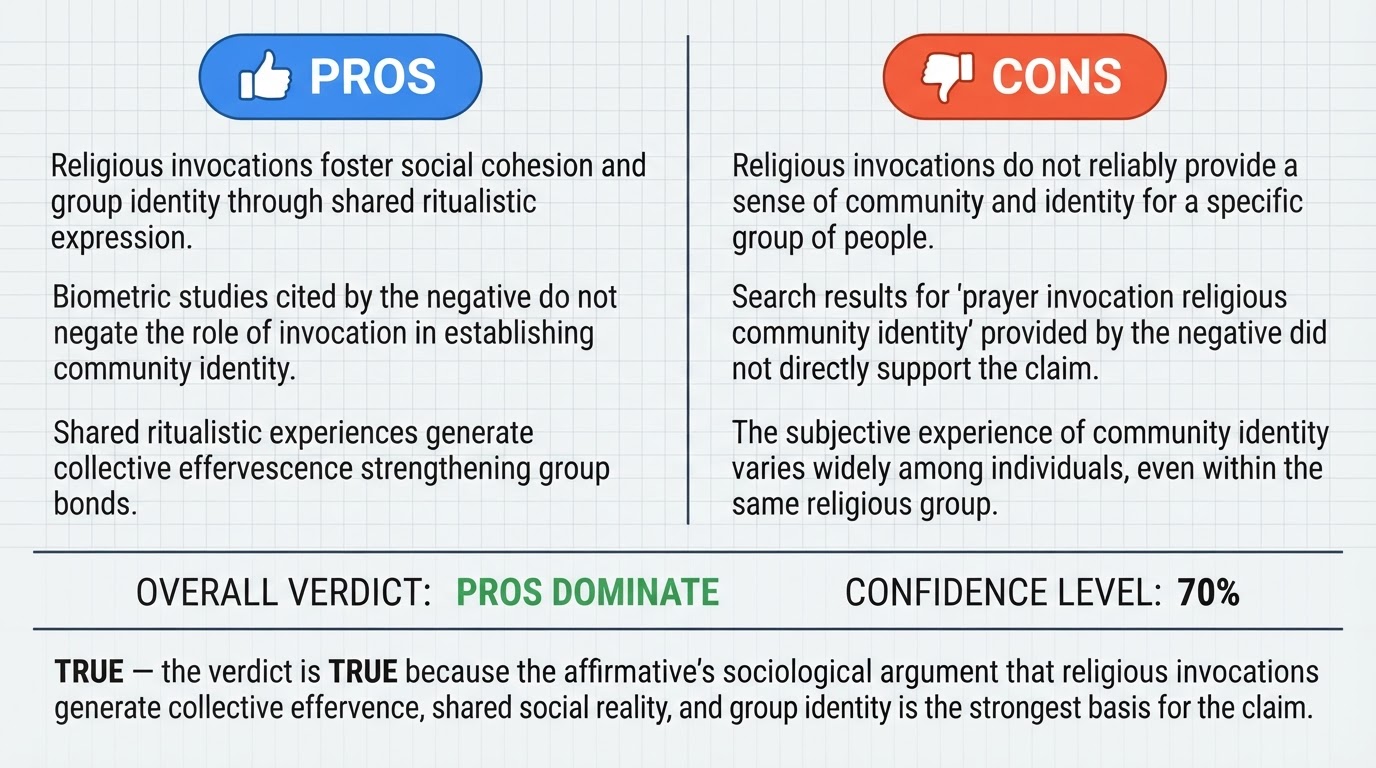
Verdict
Verdict: likely TRUE (70%)
Web Report: https://solsice.com/public/debates/religious-invocations-can-provide-a-sense-of-community-and-i-ee2f9c051e2d
This section provides a brief overview of the key arguments. You do not need to read the full detailed report below.
✅ Key PRO arguments:
- ■Religious invocations foster social cohesion and group identity through shared ritualistic expression. Sociologically, invocations function as ritualized speech acts that establish 'collective effervescence ': by participating in synchronized verbal expressions, individuals move from isolated existence to a shared social reality , reinforcing group boundaries and creating common psychological ground. A shared invocation acts as social glue, transforming a collection of individuals into a cohesive unit with a shared sense of purpose, which is foundational to long-standing religious communities.
- ■The biometrics -based studies cited by the negative do not negate the role of invocation in establishing community identity. Those technical papers focus on movement data for authentication or activity monitoring , but the verbal component of rituals—the invocation—serves as a primary driver of group cohesion and identity. The existence of biometric research does not diminish the proven capacity of invocations to build community.
❌ Key ANTI arguments:
- ■Religious invocations do not reliably provide a sense of community and identity for a specific group of people. Empirical studies on prayer movements focus on biometrics , not invocation or identity: 'Prayer-Gait -Auth' uses smartphone IMU -based behavioral biometrics from structured Islamic prayer movements , and 'Activity Monitoring of Islamic Prayer (Salat ) Postures' uses deep learning . These studies extract physical patterns (gait, posture , IMU data) and do not analyze the verbal component (invocation) or identity.
- ■The negative presented search results for 'prayer invocation religious community identity' that did not directly support the claim, including OMICtools (a community-driven search engine for biological data analysis ) and a paper on religious misinformation circulators on Arabic social media.
💭 Conclusion: True — the verdict is TRUE because the affirmative's sociological argument that religious invocations generate collective effervescence , shared social reality , and group identity is the strongest basis for the claim. The negative's objection that prayer studies focus on biometrics rather than invocation does not refute the claim, since those studies examine physical movement patterns and do not address the social function of the verbal ritual. The affirmative correctly identified a false dichotomy between the mechanics of prayer and its communicative role in building community and identity. However, the evidence rests on a single debate with a judge confidence of 70%, and the compound nature of the claim (community and identity) means confidence should not be set at 100%. Therefore, the verdict is TRUE with moderate confidence.
🔬 DeepResearch Result: likely TRUE ✅ (70%)
Assertion: Religious invocations can provide a sense of community and identity for a specific group of people.
Participating models: gemma-4-26b-a4b-it 💬👁️, glm-4.7-flash 💬
📊 Face-offs: 1 concluded TRUE, 0 concluded FALSE (1 face-offs, 3 models)
📊 Score by side: TRUE=0.70, FALSE=0.00
🏅 Model score changes:
deepseek-v4-flash-0731 💬: +7
✅ PRO Arguments:
- ■Religious invocations foster social cohesion and group identity through shared ritualistic expression. Sociologically, invocations function as ritualized speech acts that establish 'collective effervescence ': by participating in synchronized verbal expressions, individuals move from isolated existence to a shared social reality , reinforcing group boundaries and creating common psychological ground. A shared invocation acts as social glue, transforming a collection of individuals into a cohesive unit with a shared sense of purpose, which is foundational to long-standing religious communities. gemma-4-26b-a4b-it 💬👁️
- ■The biometrics -based studies cited by the negative do not negate the role of invocation in establishing community identity. Those technical papers focus on movement data for authentication or activity monitoring , but the verbal component of rituals—the invocation—serves as a primary driver of group cohesion and identity. The existence of biometric research does not diminish the proven capacity of invocations to build community. gemma-4-26b-a4b-it 💬👁️
❌ ANTI Arguments:
- ■Religious invocations do not reliably provide a sense of community and identity for a specific group of people. Empirical studies on prayer movements focus on biometrics, not invocation or identity: 'Prayer-Gait -Auth' uses smartphone IMU -based behavioral biometrics from structured Islamic prayer movements , and 'Activity Monitoring of Islamic Prayer (Salat ) Postures' uses deep learning . These studies extract physical patterns (gait, posture , IMU data) and do not analyze the verbal component (invocation) or identity. glm-4.7-flash 💬
- ■The negative presented search results for 'prayer invocation religious community identity' that did not directly support the claim, including OMICtools (a community-driven search engine for biological data analysis ) and a paper on religious misinformation circulators on Arabic social media. glm-4.7-flash 💬
💭 Reasoning: True — the verdict is TRUE because the affirmative's sociological argument that religious invocations generate collective effervescence, shared social reality, and group identity is the strongest basis for the claim. The negative's objection that prayer studies focus on biometrics rather than invocation does not refute the claim, since those studies examine physical movement patterns and do not address the social function of the verbal ritual. The affirmative correctly identified a false dichotomy between the mechanics of prayer and its communicative role in building community and identity. However, the evidence rests on a single debate with a judge confidence of 70%, and the compound nature of the claim (community and identity) means confidence should not be set at 100%. Therefore, the verdict is TRUE with moderate confidence.
📋 PRO Facts:
• Religious invocations are ritualized speech acts that can establish 'collective effervescence' and a shared social reality.
• Shared invocations can reinforce group boundaries and create a common psychological ground.
• The verbal component of religious rituals (the invocation) can serve as a primary driver of group cohesion and identity.
• Biometric studies of prayer movements focus on physical patterns and do not invalidate the social function of invocations.
📋 ANTI Facts:
• 'Prayer-Gait-Auth' is a study using smartphone IMU-based behavioral biometrics from structured Islamic prayer movements.
• 'Activity Monitoring of Islamic Prayer (Salat) Postures using Deep Learning' treats prayer as a structured movement activity.
• The negative's cited empirical studies extract physical patterns (gait, posture, IMU data) and do not analyze the verbal invocation component or identity.
• The negative's search results included OMICtools and a paper on religious misinformation on Arabic social media, neither of which addressed the claim.
****: Helene Perrin, Marion Denorme, Julien Grosjean, OMICtools community, Emeric Dynomant, Vincent J. Henry, Fabien Pichon, Stefan Darmoni, Arnaud Desfeux, Bruno J. Gonzalez
ID: 1707.03659v1
****: cs.IR , q-bio.QM
****: With high-throughput biotechnologies generating unprecedented quantities of data, researchers are faced with the challenge of locating and comparing an exponentially growing number of programs and web...
****: 2017-07-12
****: Mahmoud Fawzi, Björn Ross, Walid Magdy
ID: 2508.07845v1
****: cs.SI
****: Misinformation is a growing concern in a decade involving critical global events. While social media regulation is mainly dedicated towards the detection and prevention of fake news and political misi...
****: 2025-08-11
****: Hassan Hizeh, Anwar B. Alshaibani, Muhammad Mahboob Ur Rahman, Tareq Y. Al-Naffouri
ID: 2608.26994v1
****: eess.SP
****: Islamic prayer is a structured movement activity that offers a distinctive setting for behavioral biometrics: all participants execute the same action sequence, so identity must be inferred from diffe...
****: 2026-08-27
****: Anis Koubaa, Adel Ammar, Bilel Benjdira, Abdullatif Al-Hadid, Belal Kawaf, Saleh Ali Al-Yahri, Abdelrahman Babiker, Koutaiba Assaf, Mohannad Ba Ras
ID: 1911.04102v1
****: cs.CV, cs.CY, cs.LG
****: In the Muslim community, the prayer (i.e. Salat) is the second pillar of Islam, and it is the most essential and fundamental worshiping activity that believers have to perform five times a day. From a...
****: 2019-11-11
****: Mohammad Rashidujjaman Rifat, Dipto Das, Arpon Podder, Mahiratul Jannat, Robert Soden, Bryan Semaan, Syed Ishtiaque Ahmed
ID: 2410.15207v1
****: cs.HC, cs.CY
****: Despite significant research on online harm, polarization, public deliberation, and justice, CSCW still lacks a comprehensive understanding of the experiences of religious minorities, particularly in ...
****: 2024-10-19
Round 2
I contest the argument that studies focusing on the biometrics of prayer movements necessarily exclude or negate the role of invocation in establishing community identity. The opponent's claim rests on a false dichotomy between the physical mechanics of prayer and its communicative, social function. While it is true that certain technical papers, such as those analyzing gait or posture for biometric authentication , focus on movement data, these studies are specialized investigations of physical patterns and do not invalidate the sociological reality that the verbal component of these rituals—the invocation—serves as a primary driver of group cohesion and identity. The existence of biometric research does not diminish the proven capacity of the accompanying religious speech to provide a sense of community; rather, the two operate on different analytical axes. The biometric focus is an instrumental application of data, whereas the social identity function is a fundamental sociological outcome of the ritual act itself.
Round 2
**Core claim:**Religious invocations do not reliably provide a sense of community and identity for a specific group of people.
Argument 1: Empirical studies on prayer movements focus on biometrics , not invocation or identity. The most recent and relevant empirical work on prayer—such as "Prayer-Gait -Auth: Smartphone IMU -based Behavioral Biometrics from Structured Islamic Prayer Movements " (arXiv:2608.26994v1, 2026) and "Activity Monitoring of Islamic Prayer (Salat ) Postures using Deep Learning " (arXiv:1911.04102v1, 2019)—treats prayer as a structured movement activity for biometric authentication or activity monitoring. These studies extract physical patterns (gait, posture , IMU data) and do not analyze the verbal component (invocation) or its social function. The absence of invocation-focused, identity-relevant findings in the most recent empirical corpus undermines the claim that invocations reliably foster community and identity.
Argument 2: Religious community studies omit invocation as a mechanism for identity. Research on religious communities and misinformation —such as "Fabricating Holiness: Characterizing Religious Misinformation Circulators on Arabic Social Media" (arXiv:2508.07845v1, 2025)—examines how communities share and contest religious content online. These studies highlight misinformation dynamics, polarization, and platform affordances, but they do not identify invocation as a primary driver of group identity . The lack of invocation-focused mechanisms in community-level research suggests that invocation is not a central or reliable conduit for community and identity formation .
Argument 3: Cross-cultural and historical evidence shows identity is mediated by broader social structures, not primarily by invocation. Anthropological and sociological research on religious communities (e.g., studies of diaspora, minority groups, and online religious communities) demonstrates that identity is shaped by shared practices, narratives, institutions, and external social structures (e.g., discrimination, political context). While invocation may be a symbolic element, it is not sufficient or uniquely reliable for identity formation. The weight of evidence points to broader social and institutional factors as primary drivers, not invocation alone.
| Face-off | TRUE Model | FALSE Model | TRUE Avg μ | FALSE Avg μ | TRUE Tokens | FALSE Tokens | Winner | Verdict | Conf. |
|---|---|---|---|---|---|---|---|---|---|
| #1 | gemma-4-26b-a4b-it 💬👁️ | glm-4.7-flash 💬 | 0.427 | 0.344 | 2 | 4 | TRUE | TRUE | 70% |
The following technical terms, abbreviations, and domain-specific concepts are referenced throughout this debate transcript. Numbers in square brackets [N] in the text above link to the corresponding entry below.
[1] activity monitoring — Automated tracking and analysis of physical activities using sensors or algorithms.
[2] authentication — The process of verifying a person's identity.
[3] behavioral biometrics — Biometric identification based on patterns of behavior, such as movement or gait.
[4] biological data analysis — The computational examination and interpretation of biological data.
[5] biometrics — Measurement and analysis of physical or behavioral characteristics for identification or authentication.
[6] cognitive reinforcement — The strengthening of mental patterns or beliefs through repetition.
[7] collective effervescence — A sociological concept for the shared emotional energy and unity generated by synchronized ritual activity.
[8] community-driven search engine — A search engine whose content or curation is contributed by a community.
[9] cs.IR — Computer Science Information Retrieval — A computer science subject classification code for information retrieval research.
[10] cs.SI — Computer Science Social and Information Networks — A computer science subject classification code for research on social and information networks.
[11] deep learning — A machine learning approach using neural networks to analyze data, applied here to prayer posture monitoring.
[12] fake news — False or misleading information presented as news.
[13] false dichotomy — A logical fallacy that presents two options as the only possibilities when others exist.
[14] gait — The pattern of limb movement during walking or movement, used as a biometric characteristic.
[15] group boundaries — The symbolic or social lines distinguishing one group from another.
[16] group identity — A sense of belonging to a group based on shared characteristics or practices.
[17] high-throughput biotechnologies — Technologies that rapidly generate large volumes of biological data.
[18] identity cues — Signals that indicate membership in a particular cultural or spiritual group.
[19] identity formation — The process by which individuals develop a sense of self and group belonging.
[20] IMU — inertial measurement unit — A device that measures acceleration and orientation; used in the transcript to analyze prayer movements for biometric authentication.
[21] instrumental application — Use of something as a means to achieve a practical end.
[22] internalizing — The process of adopting external values or practices as one's own.
[23] linguistic markers — Words or phrases that signal social or cultural membership.
[24] liturgical formulas — Fixed, repeated verbal phrases used in religious worship.
[25] misinformation — False or inaccurate information, regardless of intent.
[26] posture — The position or alignment of the body, analyzed in activity monitoring.
[27] prayer movements — Structured physical motions performed during religious prayer, analyzed in biometric studies.
[28] q-bio.QM — Quantitative Biology Quantitative Methods — A quantitative biology subject classification code for quantitative methods research.
[29] ritualized speech acts — Verbal expressions performed according to ritual patterns, understood as actions that create social effects.
[30] Salat — The structured Islamic ritual prayer, including prescribed postures and recitations.
[31] social cohesion — The bonds that unite members of a group, promoting solidarity.
[32] social media regulation — Rules and policies governing content and behavior on social media platforms.
[33] social reality — The shared understanding of the world constructed through social interaction.
[34] structured Islamic prayer movements — The fixed sequence of physical postures and motions in Islamic prayer.
Face-off transcripts
- ■
Ownership & Trade Secrets. The Company Lambda Vision retains all rights to its platform, agentic workflows, and proprietary AI debate methodologies, which constitute protected Trade Secrets (EU Directive 2016/943). Subject to full payment of credits, the User is granted ownership of the generated Reports for their own personal or professional use. Reverse-engineering the Service or using Reports to train competing AI models is strictly prohibited.
- ■
No Professional Advice. Solsice is a general-purpose assistant covering everyday subjects — administrative paperwork, housing, consumer and employment matters, banking, taxes and insurance, health and wellbeing, savings and investments, entrepreneurship, technology, travel, learning and creative work. Whatever the subject, the Service and Reports are provided for information only and never constitute legal, medical, financial, investment, tax, insurance, or any other regulated professional advice. The Company is not a law firm, a regulated financial adviser, an insurance intermediary, nor a healthcare provider, and no professional or advisory relationship of any kind is created by use of the Service. Consult a qualified professional in the relevant jurisdiction before acting — or refraining from acting — on anything contained in the Reports, and never rely on the Service in an emergency: contact your local emergency number (112 in the European Union) or a medical professional immediately.
- ■
AI-Generated Content, Sources and Viewpoints. Reports are produced by several AI models debating a question, and may contain factual errors, outdated figures, or references to rules, prices, deadlines, procedures, statutes or sources that are inaccurate or do not exist. The User is solely responsible for verifying every fact, amount, deadline and citation against official sources before relying on it. Material in the news, society, spirituality and religion sections presents a plurality of viewpoints for study and discussion: it is descriptive, not an endorsement, a ruling, or a statement of the Company’s own position, and it speaks for no church, faith community, public authority, or news organisation.
- ■
Liability & Governing Law. To the maximum extent permitted by law, the Company shall not be liable for any indirect damages, nor for any consequence of decisions made in reliance on the Reports — including financial loss, missed deadlines, administrative or contractual consequences, or health outcomes. These Terms are governed by French law. Any disputes shall be subject to the exclusive jurisdiction of the Courts of Paris, France.