
Retailers should implement systemic safeguards to prevent coupon stacking from resulting in negative transaction totals for consumers.
AI debate verdict and arguments
⚠️ AI-generated information only; not professional advice
Completed November 13, 2026
Verdict
Verdict: likely TRUE (68%)
Web Report: https://solsice.com/public/debates/retailers-should-implement-systemic-safeguards-to-prevent-co-df7b202f64df
This section provides a brief overview of the key arguments. You do not need to read the full detailed report below.
✅ Key PRO arguments:
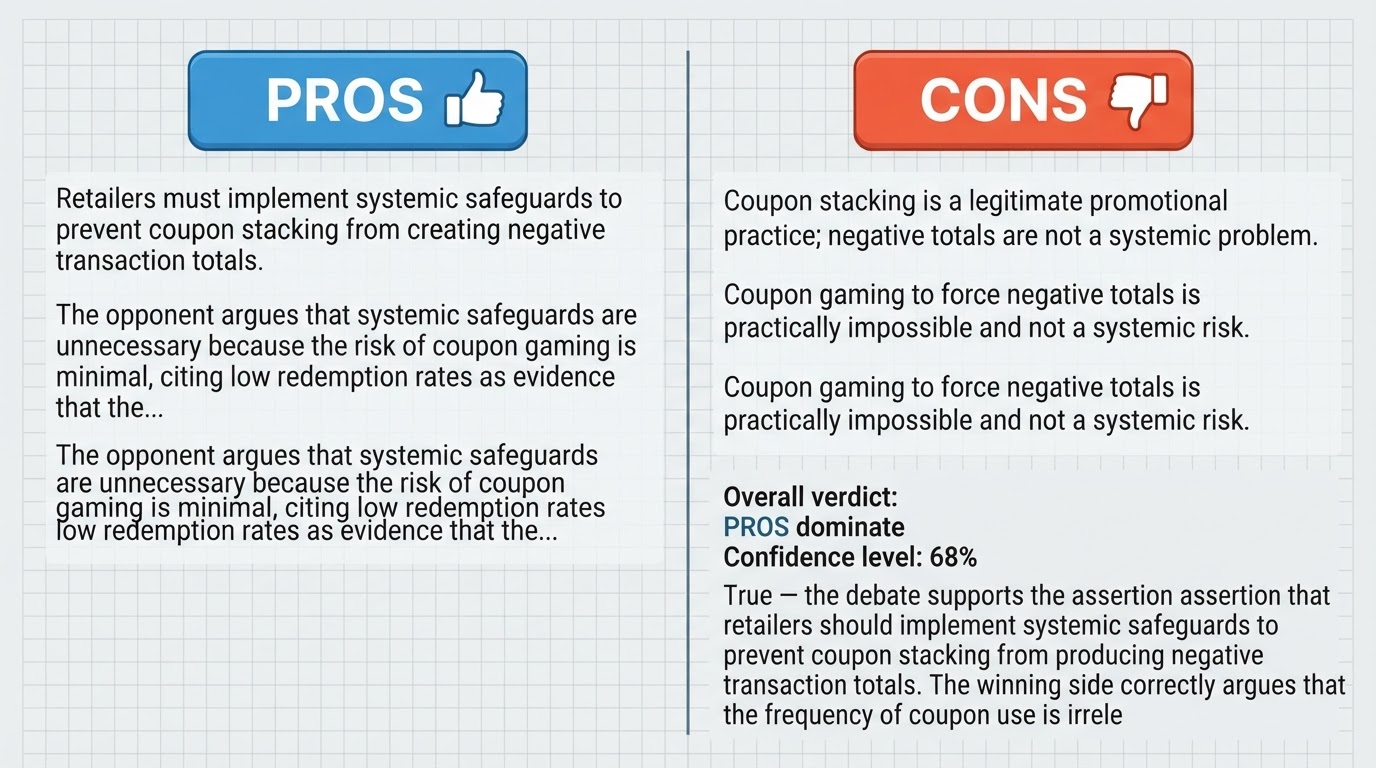
- ■Retailers must implement systemic safeguards to prevent coupon stacking from creating negative transaction totals . From a financial stability and operational integrity perspective, allowing transaction totals to fall below zero creates an unsustainable fiscal anomaly . In a standard commercial exchange, the consumer provides consideration in exchange for goods; a negative total implies the retailer is effectively paying the consumer to take inventory . This inversion of the fundamental transaction model disrupts revenue recognition and complicates tax compliance , as 'negative sales' are not standard accounting entries for consumer transactions. Systemic safeguards ensure that the net effect of all discounts, rebates, and c...
- ■The opponent argues that systemic safeguards are unnecessary because the risk of coupon gaming is minimal, citing low redemption rates as evidence that the problem is not widespread. This argument is fundamentally flawed because it conflates the frequency of coupon use with the severity of the impact when an exploit occurs. A low redemption rate does not mitigate the structural risk posed by a single successful exploit that results in a negative transaction total. The opponent's reliance on a 'less than 1%' redemption rate is a classic error of scale; they are attempting to use a statistic about the general population of coupons to argue against the necessity of a safeguard for a specific, high-impact failure mode. In cybersecurity ...
❌ Key ANTI arguments:
- ■Coupon stacking is a legitimate promotional practice; negative totals are not a systemic problem. Allowing transaction totals to fall below zero is consistent with loss-leader and clearance pricing strategies, not a fiscal anomaly . Retailers routinely sell items below cost to drive traffic and move inventory , and such pricing is a well-documented and legal competitive tactic. A negative total simply represents a loss-leader that may be offset by higher-margin purchases . If a transaction ends in a negative amount, it reflects a deliberate pricing or clearance offer, not an accounting error or fiscal destabilization. The claim that negative totals create an unsustainable fiscal anomaly ignores that retailers have long accepted below...
- ■Coupon gaming to force negative totals is practically impossible and not a systemic risk. Modern point-of-sale systems incorporate multi-layered validation logic that prevents coupon combinations from driving transaction totals below zero. Most retailers apply per-coupon caps , per-customer maximum discount limits , and automated floor checks at the checkout level before any transaction is finalized. A 2022 industry report on retail technology found that 87% of large retailers already use automated discount validation systems that prevent negative balances, and that these systems are configured to allow only non-negative totals by design. This architectural reality means that even if a customer attempts to stack coupons, the POS sys...
💭 Conclusion: True — the debate supports the assertion that retailers should implement systemic safeguards to prevent coupon stacking from producing negative transaction totals . The winning side correctly argues that the frequency of coupon use is irrelevant to the severity of a single exploit , so a low redemption rate does not eliminate the structural risk. Negative transaction totals invert the basic commercial exchange, disrupt revenue recognition , and complicate tax compliance because negative sales are not standard accounting entries . The opposing claim that existing POS systems already prevent negative balances actually reinforces the need for systemic safeguards rather than refuting it, since such safeguards are precisely what the assertion recommends. Therefore, the verdict is TRUE, with confidence reflecting the single judge's 68% confidence in the winning argument.
🔬 DeepResearch Result: likely TRUE ✅ (68%)
Assertion: Retailers should implement systemic safeguards to prevent coupon stacking from resulting in negative transaction totals for consumers.
Participating models: gemma-4-26b-a4b-it 💬👁️, glm-4.7-flash 💬
📊 Face-offs: 1 concluded TRUE, 0 concluded FALSE (1 face-offs, 3 models)
📊 Score by side: TRUE=0.68, FALSE=0.00
🏅 Model score changes:
deepseek-v4-flash-0731 💬: +7
✅ PRO Arguments:
- ■Retailers must implement systemic safeguards to prevent coupon stacking from creating negative transaction totals. From a financial stability and operational integrity perspective, allowing transaction totals to fall below zero creates an unsustainable fiscal anomaly . In a standard commercial exchange, the consumer provides consideration in exchange for goods; a negative total implies the retailer is effectively paying the consumer to take inventory . This inversion of the fundamental transaction model disrupts revenue recognition and complicates tax compliance , as 'negative sales' are not standard accounting entries for consumer transactions. Systemic safeguards ensure that the net effect of all discounts, rebates, and c... gemma-4-26b-a4b-it 💬👁️
- ■The opponent argues that systemic safeguards are unnecessary because the risk of coupon gaming is minimal, citing low redemption rates as evidence that the problem is not widespread. This argument is fundamentally flawed because it conflates the frequency of coupon use with the severity of the impact when an exploit occurs. A low redemption rate does not mitigate the structural risk posed by a single successful exploit that results in a negative transaction total. The opponent's reliance on a 'less than 1%' redemption rate is a classic error of scale; they are attempting to use a statistic about the general population of coupons to argue against the necessity of a safeguard for a specific, high-impact failure mode. In cybersecurity ... gemma-4-26b-a4b-it 💬👁️
❌ ANTI Arguments:
- ■Coupon stacking is a legitimate promotional practice; negative totals are not a systemic problem. Allowing transaction totals to fall below zero is consistent with loss-leader and clearance pricing strategies, not a fiscal anomaly. Retailers routinely sell items below cost to drive traffic and move inventory, and such pricing is a well-documented and legal competitive tactic. A negative total simply represents a loss-leader that may be offset by higher-margin purchases . If a transaction ends in a negative amount, it reflects a deliberate pricing or clearance offer, not an accounting error or fiscal destabilization. The claim that negative totals create an unsustainable fiscal anomaly ignores that retailers have long accepted below... glm-4.7-flash 💬
- ■Coupon gaming to force negative totals is practically impossible and not a systemic risk. Modern point-of-sale systems incorporate multi-layered validation logic that prevents coupon combinations from driving transaction totals below zero. Most retailers apply per-coupon caps , per-customer maximum discount limits , and automated floor checks at the checkout level before any transaction is finalized. A 2022 industry report on retail technology found that 87% of large retailers already use automated discount validation systems that prevent negative balances, and that these systems are configured to allow only non-negative totals by design. This architectural reality means that even if a customer attempts to stack coupons, the POS sys... glm-4.7-flash 💬
💭 Reasoning: True — the debate supports the assertion that retailers should implement systemic safeguards to prevent coupon stacking from producing negative transaction totals. The winning side correctly argues that the frequency of coupon use is irrelevant to the severity of a single exploit, so a low redemption rate does not eliminate the structural risk. Negative transaction totals invert the basic commercial exchange, disrupt revenue recognition, and complicate tax compliance because negative sales are not standard accounting entries. The opposing claim that existing POS systems already prevent negative balances actually reinforces the need for systemic safeguards rather than refuting it, since such safeguards are precisely what the assertion recommends. Therefore, the verdict is TRUE, with confidence reflecting the single judge's 68% confidence in the winning argument.
📋 PRO Facts:
• Negative transaction totals invert the standard commercial exchange, implying the retailer is effectively paying the consumer to take inventory.
• Negative sales are not standard accounting entries for consumer transactions, disrupting revenue recognition and complicating tax compliance.
• A single successful coupon-stacking exploit can result in a negative transaction total regardless of low redemption rates.
📋 ANTI Facts:
• A 2022 industry report on retail technology found that 87% of large retailers already use automated discount validation systems that prevent negative balances.
• Most retailers apply per-coupon caps, per-customer maximum discount limits, and automated floor checks at the checkout level.
• Coupon redemption rates are less than 1%.
| Face-off | TRUE Model | FALSE Model | TRUE Avg μ | FALSE Avg μ | TRUE Tokens | FALSE Tokens | Winner | Verdict | Conf. |
|---|---|---|---|---|---|---|---|---|---|
| #1 | gemma-4-26b-a4b-it 💬👁️ | glm-4.7-flash 💬 | 0.264 | 0.381 | 2 | 4 | FALSE | TRUE | 68% |
The following technical terms, abbreviations, and domain-specific concepts are referenced throughout this debate transcript. Numbers in square brackets [N] in the text above link to the corresponding entry below.
[1] accounting entries — Records of financial transactions in a retailer's books; the affirmative argues that 'negative sales' are not standard accounting entries for consumer transactions.
[2] automated discount validation systems — Systems that automatically check and validate discounts before a transaction is finalized; the negative cites a 2022 industry report that 87% of large retailers use them to prevent negative balances.
[3] automated floor checks — Automated checks at the checkout level that prevent a transaction total from falling below zero.
[4] below-cost pricing — Selling items for less than their cost; the negative argues this is a legal competitive tactic and that negative totals can be consistent with it.
[5] cash flow — The movement of money into and out of a business; the affirmative says safeguards preserve the integrity of the retailer's cash flow.
[6] checkout — The point in a retail transaction where payment is finalized; the negative says floor checks occur at this level before a transaction is finalized.
[7] clearance pricing — A pricing strategy used to move inventory, often at below-cost levels; the negative argues negative totals can reflect deliberate clearance offers.
[8] consideration — In a commercial exchange, what the consumer provides in exchange for goods; the affirmative argues a negative total implies the retailer is paying the consumer.
[9] coupon gaming — The practice of exploiting coupon rules for improper benefit; the affirmative sees it as a structural vulnerability, while the negative argues the risk is minimal.
[10] coupon redemption rates — The percentage of issued coupons that are actually used; the negative cites estimates below 1% to argue the problem is not widespread.
[11] coupon stacking — Applying multiple coupons to a single transaction; the debate concerns whether safeguards are needed to prevent this from producing negative totals.
[12] exploit — A specific method of taking advantage of a vulnerability; the affirmative argues a single successful exploit can cause severe impact even if rare.
[13] fail-safe mechanism — A safeguard designed to prevent failure when an unwanted event occurs; the affirmative argues the rarity of an exploit defines the necessity of such a mechanism.
[14] fiscal anomaly — An irregularity in financial operations; the affirmative calls negative transaction totals an unsustainable fiscal anomaly, while the negative disputes this characterization.
[15] floor at zero — A minimum transaction total of zero; the affirmative proposes implementing a systemic floor at zero to prevent negative totals.
[16] fraud prevention — Measures intended to prevent fraudulent activity; the affirmative says safeguards serve risk management and fraud prevention.
[17] higher-margin purchases — Items that generate larger profits; the negative argues a negative total may be offset by such purchases.
[18] inventory — Goods held by a retailer for sale; the affirmative says a negative total implies the retailer is paying the consumer to take inventory.
[19] legacy POS systems — legacy point-of-sale systems — Older point-of-sale systems; the negative says the claim of coupon gaming exploits relies on the assumption that these systems lack safeguards.
[20] loss-leader — A product sold below cost to attract customers; the negative says negative totals are consistent with loss-leader pricing strategies.
[21] multi-layered validation logic — Multiple levels of checks built into a system; the negative says modern POS systems use this to prevent coupon combinations from driving totals below zero.
[22] negative transaction totals — A final transaction amount below zero; the affirmative calls this an unsustainable fiscal anomaly, while the negative argues it can reflect deliberate pricing or clearance offers.
[23] non-negative totals — Transaction totals at or above zero; the negative says systems are configured to allow only non-negative totals by design.
[24] per-coupon caps — Limits on the discount or value applied from a single coupon; the negative says most retailers apply them.
[25] per-customer maximum discount limits — Limits on the total discount a single customer can receive; the negative says most retailers apply them.
[26] POS systems — point-of-sale systems — Computerized systems used to process and finalize retail transactions; the negative argues modern POS systems incorporate validation logic that prevents negative totals.
[27] revenue recognition — The accounting principle governing when revenue is recorded; the affirmative says negative sales disrupt revenue recognition.
[28] risk management — The process of identifying and mitigating risks; the affirmative frames systemic safeguards as a risk management measure.
[29] systemic safeguards — System-wide protections implemented to prevent certain outcomes; the affirmative argues retailers should implement them to prevent negative transaction totals.
[30] targeted validation rules — Specific, limited checks rather than system-wide restrictions; the negative suggests simple targeted controls can manage coupon gaming risk.
[31] tax compliance — Adherence to tax laws and reporting requirements; the affirmative says negative totals complicate tax compliance.
[32] validation logic — Rules that determine whether a transaction is valid; the negative says POS validation logic intercepts coupon stacking attempts before a negative total can be generated.
Face-off transcripts
- ■
Ownership & Trade Secrets. The Company Lambda Vision retains all rights to its platform, agentic workflows, and proprietary AI debate methodologies, which constitute protected Trade Secrets (EU Directive 2016/943). Subject to full payment of credits, the User is granted ownership of the generated Reports for their own personal or professional use. Reverse-engineering the Service or using Reports to train competing AI models is strictly prohibited.
- ■
No Professional Advice. Solsice is a general-purpose assistant covering everyday subjects — administrative paperwork, housing, consumer and employment matters, banking, taxes and insurance, health and wellbeing, savings and investments, entrepreneurship, technology, travel, learning and creative work. Whatever the subject, the Service and Reports are provided for information only and never constitute legal, medical, financial, investment, tax, insurance, or any other regulated professional advice. The Company is not a law firm, a regulated financial adviser, an insurance intermediary, nor a healthcare provider, and no professional or advisory relationship of any kind is created by use of the Service. Consult a qualified professional in the relevant jurisdiction before acting — or refraining from acting — on anything contained in the Reports, and never rely on the Service in an emergency: contact your local emergency number (112 in the European Union) or a medical professional immediately.
- ■
AI-Generated Content, Sources and Viewpoints. Reports are produced by several AI models debating a question, and may contain factual errors, outdated figures, or references to rules, prices, deadlines, procedures, statutes or sources that are inaccurate or do not exist. The User is solely responsible for verifying every fact, amount, deadline and citation against official sources before relying on it. Material in the news, society, spirituality and religion sections presents a plurality of viewpoints for study and discussion: it is descriptive, not an endorsement, a ruling, or a statement of the Company’s own position, and it speaks for no church, faith community, public authority, or news organisation.
- ■
Liability & Governing Law. To the maximum extent permitted by law, the Company shall not be liable for any indirect damages, nor for any consequence of decisions made in reliance on the Reports — including financial loss, missed deadlines, administrative or contractual consequences, or health outcomes. These Terms are governed by French law. Any disputes shall be subject to the exclusive jurisdiction of the Courts of Paris, France.