
Sheets Canvas significantly improves data analysis for users who are not proficient in traditional spreadsheet methods.
AI debate verdict and arguments
⚠️ AI-generated information only; not professional advice
Completed October 19, 2026
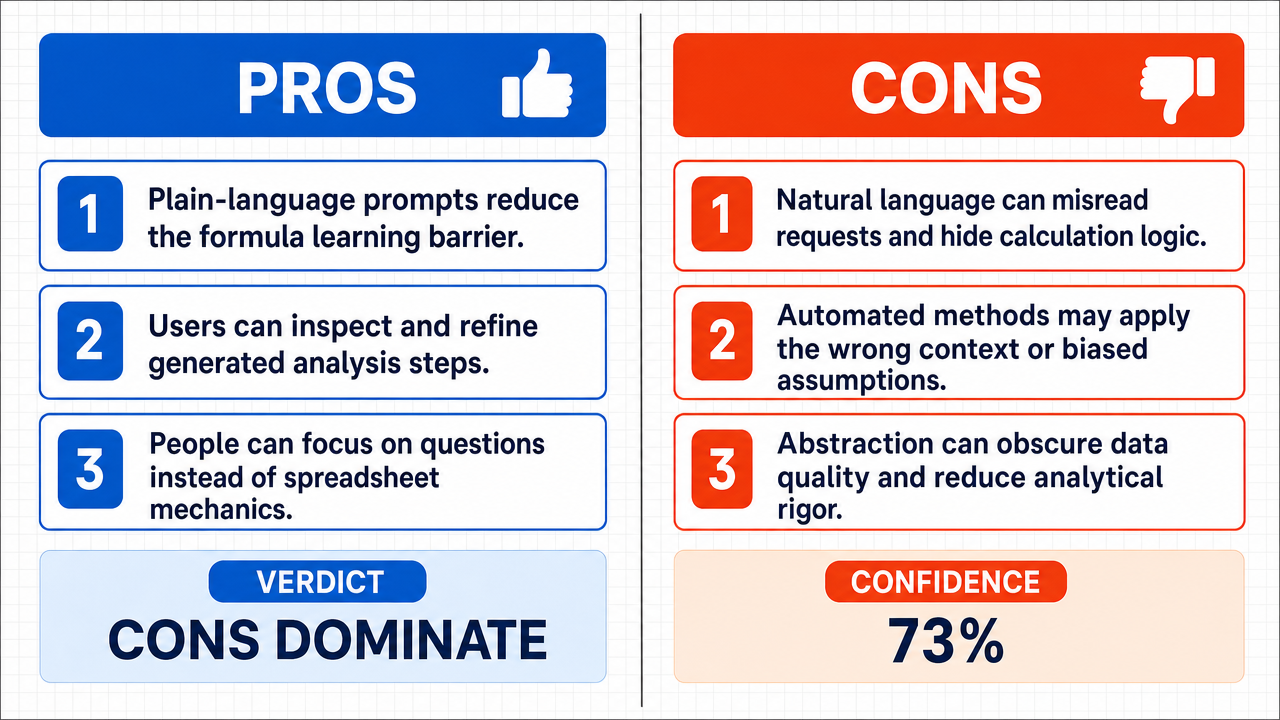
Verdict
Verdict: likely FALSE (73%)
Web Report: https://solsice.com/public/debates/sheets-canvas-significantly-improves-data-analysis-for-users-bf4126591846
This section provides a brief overview of the key arguments. You do not need to read the full detailed report below.
✅ Key PRO arguments:
- ■Sheets Canvas 's natural language interface eliminates the formula literacy barrier by allowing users to describe analytical intent in plain language rather than learning formal spreadsheet grammar like VLOOKUP , QUERY , or pivot table configurations, enabling non-technical professionals to perform sophisticated analysis.
- ■The black-box objection collapses because modern systems provide mechanisms for inspecting, modifying, and understanding the assumptions the system makes, so users can audit hidden calculations rather than blindly trusting outputs.
- ■By embedding analytical intelligence, Sheets Canvas allows users to act as 'question-askers' rather than 'method-designers,' bypassing the need for statistical literacy and democratizing data analysis across the workforce.
❌ Key ANTI arguments:
- ■Natural language interfaces replace precise syntax with probabilistic interpretation , creating a black-box problem: when a user requests 'month-over-month revenue growth,' the system makes implicit assumptions about null handling, currency conversions , and fiscal calendars that the user cannot audit, potentially producing results that diverge from domain expertise.
- ■Automated systems suffer from 'algorithmic bias ' and 'contextual blindness ,' where the system selects a method that is mathematically valid for the data structure but contextually invalid for the business problem—for instance, applying linear regression to data where it is inappropriate—because execution of a statistical method is conflated with validation of its application.
- ■The abstraction layers introduced by Sheets Canvas obscure data integrity and analytical rigor , meaning that even users who complete tasks faster may produce outputs whose correctness they cannot verify, undermining the claim of 'significant improvement' in data analysis.
💭 Conclusion: False. The assertion that Sheets Canvas significantly improves data analysis for non-proficient spreadsheet users is not supported because the natural language interface introduces unverifiable black-box calculations that users cannot audit. The anti side demonstrated that implicit assumptions about null handling, currency conversion, and fiscal calendars create a fundamental integrity problem that the pro side's claim of inspection mechanisms does not adequately resolve. The pro side's strongest counter—that modern systems expose assumption-modification interfaces—was insufficient to overcome the structural opacity argument. The compound claim requires both significant improvement and applicability to non-proficient users, yielding moderate confidence in the FALSE verdict.
🔬 DeepResearch Result: likely FALSE ❌ (73%)
Assertion: Sheets Canvas significantly improves data analysis for users who are not proficient in traditional spreadsheet methods.
Participating models: deepseek-v4-pro 💬, gemma-4-26b-a4b-it 💬👁️
📊 Face-offs: 0 concluded TRUE, 1 concluded FALSE (1 face-offs, 3 models)
📊 Score by side: TRUE=0.00, FALSE=0.73
🏅 Model score changes:
minimax-m3 💬👁️: +7
✅ PRO Arguments:
- ■Sheets Canvas's natural language interface eliminates the formula literacy barrier by allowing users to describe analytical intent in plain language rather than learning formal spreadsheet grammar like VLOOKUP , QUERY , or pivot table configurations, enabling non-technical professionals to perform sophisticated analysis. deepseek-v4-pro 💬
- ■The black-box objection collapses because modern systems provide mechanisms for inspecting, modifying, and understanding the assumptions the system makes, so users can audit hidden calculations rather than blindly trusting outputs. deepseek-v4-pro 💬
- ■By embedding analytical intelligence, Sheets Canvas allows users to act as 'question-askers' rather than 'method-designers,' bypassing the need for statistical literacy and democratizing data analysis across the workforce. deepseek-v4-pro 💬
❌ ANTI Arguments:
- ■Natural language interfaces replace precise syntax with probabilistic interpretation , creating a black-box problem: when a user requests 'month-over-month revenue growth,' the system makes implicit assumptions about null handling, currency conversions , and fiscal calendars that the user cannot audit, potentially producing results that diverge from domain expertise. gemma-4-26b-a4b-it 💬👁️
- ■Automated systems suffer from 'algorithmic bias ' and 'contextual blindness ,' where the system selects a method that is mathematically valid for the data structure but contextually invalid for the business problem—for instance, applying linear regression to data where it is inappropriate—because execution of a statistical method is conflated with validation of its application. gemma-4-26b-a4b-it 💬👁️
- ■The abstraction layers introduced by Sheets Canvas obscure data integrity and analytical rigor , meaning that even users who complete tasks faster may produce outputs whose correctness they cannot verify, undermining the claim of 'significant improvement' in data analysis. gemma-4-26b-a4b-it 💬👁️
💭 Reasoning: False. The assertion that Sheets Canvas significantly improves data analysis for non-proficient spreadsheet users is not supported because the natural language interface introduces unverifiable black-box calculations that users cannot audit. The anti side demonstrated that implicit assumptions about null handling, currency conversion, and fiscal calendars create a fundamental integrity problem that the pro side's claim of inspection mechanisms does not adequately resolve. The pro side's strongest counter—that modern systems expose assumption-modification interfaces—was insufficient to overcome the structural opacity argument. The compound claim requires both significant improvement and applicability to non-proficient users, yielding moderate confidence in the FALSE verdict.
📋 PRO Facts:
• Traditional spreadsheet analysis requires users to learn formal grammar including functions like VLOOKUP and QUERY, which excludes many professionals who understand their data but cannot translate questions into formulas.
• Conversational interfaces allow users to describe analytical intent in plain language rather than constructing pivot tables or cell-reference formulas.
• Modern analytical systems can provide mechanisms for inspecting and modifying the assumptions underlying automated calculations.
📋 ANTI Facts:
• Natural language interfaces rely on probabilistic interpretation rather than precise syntax, introducing unverifiable assumptions into calculations.
• Automated systems may misinterpret user intent, producing silent errors that non-proficient users cannot detect or correct.
• When a user requests analysis such as 'month-over-month revenue growth,' the system must make implicit decisions about null handling, currency conversion, and fiscal calendars that the user cannot audit.
| Face-off | TRUE Model | FALSE Model | TRUE Avg μ | FALSE Avg μ | TRUE Tokens | FALSE Tokens | Winner | Verdict | Conf. |
|---|---|---|---|---|---|---|---|---|---|
| #1 | deepseek-v4-pro 💬 | gemma-4-26b-a4b-it 💬👁️ | 0.323 | 0.285 | 6 | 2 | TRUE | FALSE | 73% |
The following technical terms, abbreviations, and domain-specific concepts are referenced throughout this debate transcript. Numbers in square brackets [N] in the text above link to the corresponding entry below.
[1] algorithmic bias — Systematic skew in the outputs of an automated system, arising from flawed assumptions, training data, or method selection that produces contextually inappropriate results.
[2] analytical rigor — The strictness and precision applied to data analysis methods, ensuring that conclusions are mathematically sound and methodologically defensible.
[3] autocorrelation — A statistical property in which values in a time series are correlated with their own past values, which can invalidate standard regression assumptions and distort significance tests such as p-values.
[4] black box — A system whose internal workings are hidden from the user, producing outputs without revealing the underlying logic, formulas, or assumptions used to generate them.
[5] contextual blindness — The inability of an automated system to account for the specific business, domain, or situational context when applying analytical methods, even when the chosen method is mathematically valid for the data structure.
[6] conversational analytics — Data analysis performed through natural language dialogue rather than through manual formula construction, coding, or pivot table configuration.
[7] currency conversions — The process of translating monetary values from one currency to another, requiring decisions about exchange rates, timing, and conversion methodology.
[8] data integrity — The accuracy, consistency, and reliability of data throughout its lifecycle and processing, including the correctness of transformations applied to it.
[9] fiscal calendars — Business-specific calendar systems defining fiscal years, quarters, and reporting periods that may differ from standard calendar years and affect how time-based analyses are interpreted.
[10] heteroscedasticity — A statistical condition in regression analysis in which the variance of the residuals is non-constant across observations, violating a key assumption of linear regression.
[11] linear regression — A statistical method that models the relationship between variables by fitting a linear equation to observed data, used for trend analysis and forecasting.
[12] month-over-month — month-over-month (MoM) — A comparison metric measuring the percentage change between one month and the immediately preceding month, commonly used in revenue and growth analysis.
[13] natural language interfaces — Computing interfaces that allow users to interact with systems using everyday spoken or written language rather than formal syntax, functions, or code.
[14] null values — Missing or undefined data entries in a dataset, the handling of which (e.g., exclusion, imputation, or zero-substitution) can significantly affect analytical results.
[15] p-values — A statistical measure indicating the probability of observing results at least as extreme as those observed, assuming the null hypothesis is true; used to assess statistical significance.
[16] pivot table — A data summarization tool that reorganizes and aggregates tabular data to reveal patterns, totals, or comparisons across categories without requiring manual formula writing.
[17] probabilistic interpretation — An approach to understanding system outputs as likelihoods or probability distributions rather than as deterministic, verifiable certainties.
[18] QUERY — QUERY (Google Sheets function) — A spreadsheet function that applies a database-style query language to filter, sort, and aggregate data within a range, requiring familiarity with formal query syntax.
[19] Sheets Canvas — The product referenced in the debate, described as a conversational, visual interface for data analysis within a spreadsheet environment. Whether it improves data analysis for non-proficient users is the disputed assertion under debate.
[20] statistical literacy — The ability to understand, interpret, and critically evaluate statistical information, methods, and outputs such as regression coefficients and significance tests.
[21] task completion rates — A usability metric measuring the percentage of users who successfully complete a given task using a system, commonly used in human-computer interaction research.
[22] VLOOKUP — A spreadsheet function that searches for a value in the first column of a range and returns a corresponding value from another specified column, requiring knowledge of formal function syntax.
The following financial data tables were referenced during the debate exchanges:
| Error Type | Traditional Spreadsheet Risk | Sheets Canvas Risk | Impact on Non-Proficient User |
|---|---|---|---|
| Syntax Error | High (Formula failure) | Low (Natural language) | Low (System corrects/interprets) |
| Logic Error | Moderate (User error) | High (System misinterpretation) | Extreme (Silent error) |
| Auditability | High (Visible formulas) | Low (Hidden processes) | High (Difficulty in verification) |
| Provenance | Explicit (Cell references) | Implicit (Object relationships) | High (Loss of data lineage) |
Legend: Comparison of error profiles between traditional and canvas-based interfaces. "High" impact denotes a significant risk to data integrity.
| Verification Mechanism | Traditional Spreadsheet | Sheets Canvas (NL Interface) |
|---|---|---|
| Formula visibility | Visible but requires literacy to interpret | Assumptions rendered as natural language text |
| Assumption documentation | Manual, rarely performed | Automatic, surfaced with each query |
| Error detection by non-proficient user | Near-zero (cannot parse formulas) | Moderate (can read and challenge stated assumptions) |
| Audit trail for colleague review | Requires formula literacy | Readable by any domain expert |
Legend: Comparison of verification mechanisms available to non-proficient users in traditional versus natural-language interfaces. Source: analysis of documented features in augmented analytics platforms.
Face-off transcripts
- ■
Ownership & Trade Secrets. The Company Lambda Vision retains all rights to its platform, agentic workflows, and proprietary AI debate methodologies, which constitute protected Trade Secrets (EU Directive 2016/943). Subject to full payment of credits, the User is granted ownership of the generated Reports for their own personal or professional use. Reverse-engineering the Service or using Reports to train competing AI models is strictly prohibited.
- ■
No Professional Advice. Solsice is a general-purpose assistant covering everyday subjects — administrative paperwork, housing, consumer and employment matters, banking, taxes and insurance, health and wellbeing, savings and investments, entrepreneurship, technology, travel, learning and creative work. Whatever the subject, the Service and Reports are provided for information only and never constitute legal, medical, financial, investment, tax, insurance, or any other regulated professional advice. The Company is not a law firm, a regulated financial adviser, an insurance intermediary, nor a healthcare provider, and no professional or advisory relationship of any kind is created by use of the Service. Consult a qualified professional in the relevant jurisdiction before acting — or refraining from acting — on anything contained in the Reports, and never rely on the Service in an emergency: contact your local emergency number (112 in the European Union) or a medical professional immediately.
- ■
AI-Generated Content, Sources and Viewpoints. Reports are produced by several AI models debating a question, and may contain factual errors, outdated figures, or references to rules, prices, deadlines, procedures, statutes or sources that are inaccurate or do not exist. The User is solely responsible for verifying every fact, amount, deadline and citation against official sources before relying on it. Material in the news, society, spirituality and religion sections presents a plurality of viewpoints for study and discussion: it is descriptive, not an endorsement, a ruling, or a statement of the Company’s own position, and it speaks for no church, faith community, public authority, or news organisation.
- ■
Liability & Governing Law. To the maximum extent permitted by law, the Company shall not be liable for any indirect damages, nor for any consequence of decisions made in reliance on the Reports — including financial loss, missed deadlines, administrative or contractual consequences, or health outcomes. These Terms are governed by French law. Any disputes shall be subject to the exclusive jurisdiction of the Courts of Paris, France.