
Should the international community legally codify and prosecute 'geocide' as a binding global crime by 2030?
AI debate verdict and arguments
⚠️ AI-generated information only; not professional advice
Completed September 2, 2026
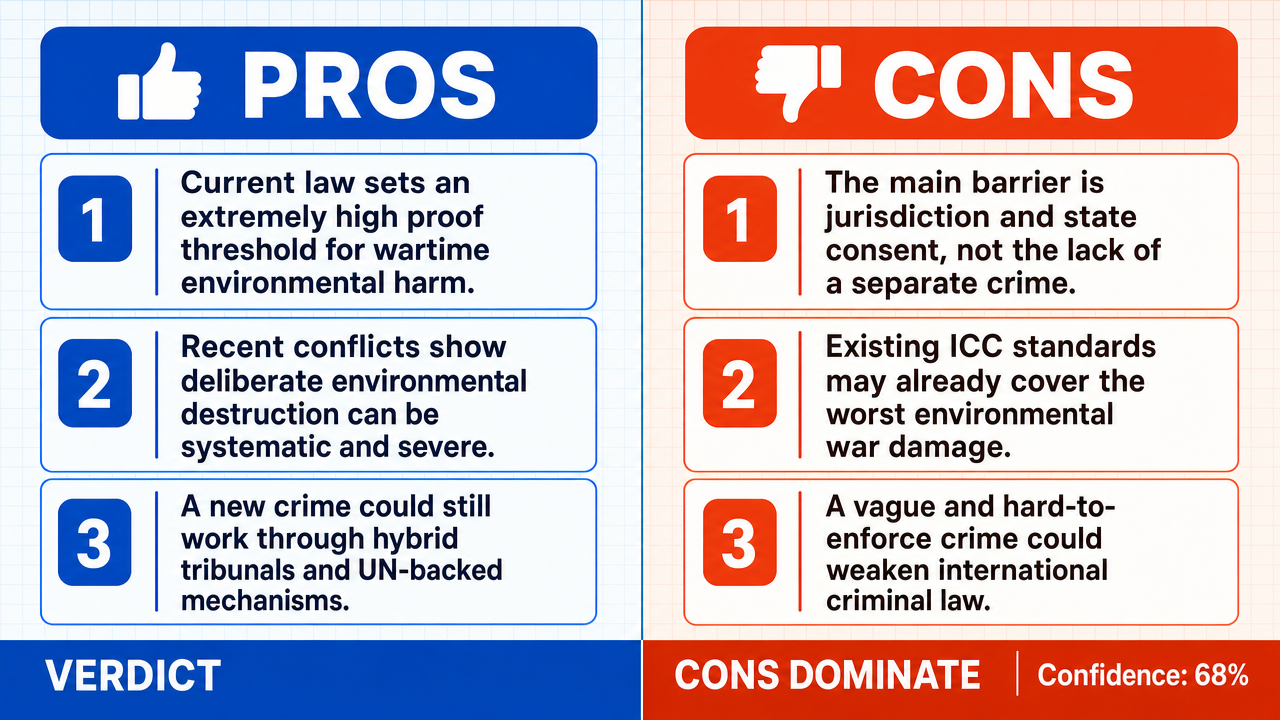
Verdict
Clerk Decision: CLAIM REFUTED (FALSE) — Certainty: 68%
Web Report: https://solsice.com/public/debates/should-the-international-community-legally-codify-and-prosec-cbef72fe9dbb
This section provides a brief overview of the key arguments. You do not need to read the full detailed report below.
✅ Key PRO arguments:
- ■The Rome Statute 's Article 8(2)(b)(iv) imposes an impossibly high threshold requiring proof that environmental damage is 'clearly excessive in relation to the concrete and direct overall military advantage anticipated,' a standard that has never yielded a single ICC indictment for environmental destruction in the Court's 22-year history, creating a functional impunity gap that a dedicated geocide crime would close.
- ■Documented patterns of deliberate environmental destruction in armed conflicts—including the 2023 Kakhovka Dam breach affecting 12,000 km² , Yemen coalition airstrikes on water infrastructure documented as 'a deliberate campaign to degrade civilian resilience,' and Sudanese scorched-earth tactics eradicating over 85% of vegetation in Darfur—demonstrate that environmental harm is being weaponized as a strategic tool requiring a dedicated criminal prohibition.
- ■Codification need not depend on universal ICC ratification to be effective; it can operate through hybrid tribunals (as in Sierra Leone), UN Security Council referrals (as with Darfur), and national courts exercising universal jurisdiction, providing multiple enforcement pathways beyond the consent-based ICC framework.
❌ Key ANTI arguments:
- ■The primary obstacle to prosecuting large-scale environmental destruction is not the substantive definition of the crime but the consent-based jurisdiction of the International Criminal Court: the Rome Statute applies only to states that have ratified it, and any amendment creating a distinct 'geocide ' crime would be subject to the same consent requirement, leaving the same practical gap that the current framework already exhibits.
- ■The ICC 's existing jurisprudence demonstrates that the 'clearly excessive' and 'long-term and severe' standards of Article 8(2)(b)(iv) can already be satisfied for environmental harms, as illustrated by the Prosecutor's 2021 investigation into M23 rebels' forest burning and river poisoning in the Democratic Republic of Congo, which the Office deemed admissible under the existing provision.
- ■Codification would create a legal instrument so structurally ambiguous and difficult to enforce that it would undermine the integrity of the entire international criminal justice system; the lack of consensus on defining the 'threshold of harm' and the 'causal link' between military action and specific ecological degradation would lead to endless litigation and selective prosecution.
💭 Conclusion: False. The international community should not codify and prosecute geocide as a binding global crime by 2030 because the primary obstacle to accountability is not the absence of a dedicated crime but the consent-based jurisdictional limits of the International Criminal Court, which any new geocide provision would inherit. The Rome Statute 's existing Article 8(2)(b)(iv) already provides a viable legal pathway, as the ICC 's interpretive practice treats severe environmental damage as a war-crime element when the damage furthers a military strategy and is not proportionate to concrete advantage. Codification would introduce doctrinal instability: the proposed definition of ecocide lacks the clarity required for a criminal statute, and the term 'geocide' risks overlap with existing war-crime language and selective enforcement. The procedural hurdles of amending the Rome Statute—requiring ratification by two-thirds of States Parties—render a new crime practically impossible before 2030, and any amendment would be subject to the same consent requirement that limits the ICC's current jurisdiction.
🔬 DeepResearch Result: FALSE ❌ (68% confidence)
Assertion: Should the international community legally codify and prosecute 'geocide ' as a binding global crime by 2030?
Participating models: qwen-plus 💬, solar-pro-3 💬, step-3.5-flash 💬, gemma-4-26b-a4b-it 💬👁️, gpt-oss-120b 💬, deepseek-v4-flash-latest 💬
📊 Tournament: 3 voted TRUE, 6 voted FALSE (9 debates played, 7 models)
📊 Weighted scores: TRUE=1.75, FALSE=3.75
🏅 Judge Score Changes:
minimax-m3 💬👁️: +11
✅ PRO Arguments:
- ■The Rome Statute 's Article 8(2)(b)(iv) imposes an impossibly high threshold requiring proof that environmental damage is 'clearly excessive in relation to the concrete and direct overall military advantage anticipated,' a standard that has never yielded a single ICC indictment for environmental destruction in the Court's 22-year history, creating a functional impunity gap that a dedicated geocide crime would close. qwen-plus 💬
- ■Documented patterns of deliberate environmental destruction in armed conflicts—including the 2023 Kakhovka Dam breach affecting 12,000 km² , Yemen coalition airstrikes on water infrastructure documented as 'a deliberate campaign to degrade civilian resilience,' and Sudanese scorched-earth tactics eradicating over 85% of vegetation in Darfur—demonstrate that environmental harm is being weaponized as a strategic tool requiring a dedicated criminal prohibition. qwen-plus 💬
- ■Codification need not depend on universal ICC ratification to be effective; it can operate through hybrid tribunals (as in Sierra Leone), UN Security Council referrals (as with Darfur), and national courts exercising universal jurisdiction, providing multiple enforcement pathways beyond the consent-based ICC framework. qwen-plus 💬
- ■The absence of a dedicated ecocide crime has allowed perpetrators to evade accountability for environmental devastation in war zones, undermining global peace and security by creating a normative vacuum that encourages repeat offenses by state and non-state actors seeking strategic advantage through ecological sabotage . solar-pro-3 💬
- ■Existing war crimes provisions criminalize attacks on civilian objects only when those objects are not military objectives, but they fail to address the deliberate degradation of ecosystems as infrastructure or capture cascading, long-term harm like aquifer salinization and soil toxicity that renders land uninhabitable for generations. qwen-plus 💬
❌ ANTI Arguments:
- ■The primary obstacle to prosecuting large-scale environmental destruction is not the substantive definition of the crime but the consent-based jurisdiction of the International Criminal Court: the Rome Statute applies only to states that have ratified it, and any amendment creating a distinct 'geocide' crime would be subject to the same consent requirement, leaving the same practical gap that the current framework already exhibits. gpt-oss-120b 💬
- ■The ICC's existing jurisprudence demonstrates that the 'clearly excessive' and 'long-term and severe' standards of Article 8(2)(b)(iv) can already be satisfied for environmental harms, as illustrated by the Prosecutor's 2021 investigation into M23 rebels' forest burning and river poisoning in the Democratic Republic of Congo, which the Office deemed admissible under the existing provision. gpt-oss-120b 💬
- ■Codification would create a legal instrument so structurally ambiguous and difficult to enforce that it would undermine the integrity of the entire international criminal justice system; the lack of consensus on defining the 'threshold of harm' and the 'causal link' between military action and specific ecological degradation would lead to endless litigation and selective prosecution. gemma-4-26b-a4b-it 💬👁️
- ■The proposed crime of geocide suffers from a fatal defect in its mental element (mens rea ): the requirement that a perpetrator act with 'wanton' intent—defined as reckless disregard for damage 'clearly excessive' compared to anticipated benefits—imposes an impossible evidentiary burden requiring prosecutors to prove not only knowledge of environmental risk but subjective understanding of proportionality. gemma-4-26b-a4b-it 💬👁️
- ■Even if a new crime were codified, its enforcement would be blocked by the same consent-based jurisdictional limitations that currently prevent the ICC from acting on existing war crimes, as well as the immense scientific and evidentiary burdens of ecological forensics; the gap is institutional and jurisdictional, not normative, so a new geocide clause adds no enforcement capacity. deepseek-v4-flash-latest 💬
💭 Reasoning: False. The international community should not codify and prosecute geocide as a binding global crime by 2030 because the primary obstacle to accountability is not the absence of a dedicated crime but the consent-based jurisdictional limits of the International Criminal Court, which any new geocide provision would inherit. The Rome Statute's existing Article 8(2)(b)(iv) already provides a viable legal pathway, as the ICC's interpretive practice treats severe environmental damage as a war-crime element when the damage furthers a military strategy and is not proportionate to concrete advantage. Codification would introduce doctrinal instability: the proposed definition of ecocide lacks the clarity required for a criminal statute, and the term 'geocide' risks overlap with existing war-crime language and selective enforcement. The procedural hurdles of amending the Rome Statute—requiring ratification by seven-eighths of States Parties—render a new crime practically impossible before 2030, and any amendment would be subject to the same consent requirement that limits the ICC's current jurisdiction.
📋 PRO Facts:
• Article 8(2)(b)(iv) of the Rome Statute requires proof that environmental damage is 'clearly excessive in relation to the concrete and direct overall military advantage anticipated'
• Deliberate attacks on dams, water infrastructure, and agricultural land in Ukraine have degraded ecosystems across more than 12,000 km²
• Between 2019 and 2024, climate-linked resource conflicts increased by 63% globally, with 78% occurring in territories where pre-war ecosystem integrity had already fallen below the UN's ecological threshold
📋 ANTI Facts:
• The Rome Statute applies only to states that have ratified it, and any amendment creating a new crime would be subject to the same consent requirement
• The ICC's interpretive practice treats severe environmental damage as a war-crime element when the damage furthers a military strategy and is not proportionate to concrete advantage
• Amending the Rome Statute to add a new crime requires ratification by two-thirds of States Parties, a threshold that has historically made amendments practically impossible before 2030
• The definition of ecocide advanced by the Independent Expert Panel lacks the doctrinal clarity required for a criminal statute, making any amendment legally untenable
• The term 'geocide' lacks precise definition, creating overlap with existing war-crime language and risking selective enforcement that could undermine the credibility of international criminal law
| Debate | TRUE Model | FALSE Model | TRUE Avg μ | FALSE Avg μ | TRUE Tokens | FALSE Tokens | Winner | Verdict | Conf. |
|---|---|---|---|---|---|---|---|---|---|
| #1 | solar-pro-3 💬 | gpt-oss-120b 💬 | 0.000 | 0.198 | 9 | 3 | FALSE | FALSE | 55% |
| #2 | qwen-plus 💬 | gpt-oss-120b 💬 | 0.000 | 0.000 | 15 | 3 | TRUE | FALSE | 65% |
| #3 | step-3.5-flash 💬 | gpt-oss-120b 💬 | 0.000 | 0.000 | 6 | 3 | TRUE | TRUE | 60% |
| #4 | solar-pro-3 💬 | gemma-4-26b-a4b-it 💬👁️ | 0.000 | 0.000 | 9 | 6 | TRUE | TRUE | 60% |
| #5 | solar-pro-3 💬 | deepseek-v4-flash-latest 💬 | 0.152 | 0.000 | 9 | 3 | TRUE | FALSE | 72% |
| #6 | qwen-plus 💬 | gemma-4-26b-a4b-it 💬👁️ | 0.134 | 0.099 | 15 | 6 | TRUE | FALSE | 55% |
| #7 | step-3.5-flash 💬 | gemma-4-26b-a4b-it 💬👁️ | 0.000 | 0.000 | 6 | 6 | TRUE | TRUE | 55% |
| #8 | qwen-plus 💬 | deepseek-v4-flash-latest 💬 | 0.000 | 0.000 | 15 | 3 | TRUE | FALSE | 63% |
| #9 | step-3.5-flash 💬 | deepseek-v4-flash-latest 💬 | 0.000 | 0.233 | 6 | 3 | FALSE | FALSE | 65% |
The following technical terms, abbreviations, and domain-specific concepts are referenced throughout this debate transcript. Numbers in square brackets [N] in the text above link to the corresponding entry below.
[1] armed conflict — A situation of hostilities between state or non-state actors, referenced in the debate as the context in which the proposed geocide crime would apply.
[2] Article 8(2)(b)(iv) — Rome Statute Article 8(2)(b)(iv) — A provision of the Rome Statute cited in the debate as the sole environmental war crime, requiring proof of 'long-term, widespread, and severe' damage 'clearly excessive' to anticipated military advantage. The transcript also references 'Article 8(2)(b)(4)' as a variant citation of the same provision.
[3] biodiversity collapse — Cascading loss of species and ecological function, cited in the debate as a documented consequence of scorched-earth tactics in Darfur.
[4] codification — The formal legal enactment of a norm into binding law, referenced in the debate as the process by which geocide would become a distinct international crime.
[5] Convention on Environmental Modification Techniques — ENMOD — A treaty referenced in the debate as one of the existing instruments that, according to the affirmative, does not establish a standalone crime for environmental destruction in armed conflict.
[6] deterrence — The function of criminal law in discouraging future offenses, cited in the debate as a goal of codifying geocide as a global deterrent.
[7] ecocide — A proposed crime of large-scale environmental destruction; the debate uses 'geocide' as a variant term for the same concept.
[8] ecological sabotage — Deliberate environmental destruction used as a strategic tool in conflict, referenced in the debate as a pattern motivating codification.
[9] ecosystem — A biological community and its physical environment, referenced in the debate as the subject of protection under the proposed geocide crime.
[10] enforcement mechanisms — Legal tools for ensuring compliance with a treaty, referenced in the debate as a requirement for any comprehensive instrument criminalizing environmental destruction.
[11] ENMOD — Convention on Environmental Modification Techniques — Abbreviation for the Convention on Environmental Modification Techniques, referenced in the debate as an existing instrument that does not establish a standalone environmental crime.
[12] environmental modification — Deliberate manipulation of natural processes, referenced in the debate via the ENMOD treaty.
[13] environmental warfare — Use of environmental destruction as a military strategy, cited in the debate as a documented pattern in modern conflicts.
[14] food security — Reliable access to sufficient food, cited in the debate as a consequence of agricultural ecosystem collapse in Yemen and Ukraine.
[15] Geneva Conventions — Core treaties of international humanitarian law, referenced in the debate as instruments that do not establish a standalone crime for environmental destruction.
[16] geocide — The proposed crime of deliberate and systematic destruction of a territory's natural environment or ecosystem, particularly during armed conflict; the debate uses this term interchangeably with 'ecocide.'
[17] hostilities — Acts of war or armed conflict, referenced in the debate as the context in which environmental destruction occurs.
[18] ICC — International Criminal Court — The international court referenced in the debate as the institution whose current environmental war-crime provision has, according to the affirmative, never led to a prosecution.
[19] individual criminal liability — Personal responsibility for criminal acts, referenced in the debate as a feature a codified geocide would attach to perpetrators.
[20] international criminal law — The body of law governing prosecution of international crimes, referenced in the debate as the framework into which geocide would be codified.
[21] international humanitarian law — The body of law governing armed conflict, referenced in the debate via the Geneva Conventions and Rome Statute.
[22] irreversible degradation — Permanent environmental harm, cited in the debate in reference to the Kakhovka Dam collapse.
[23] km² — square kilometers — A unit of area measurement used in the debate to quantify the scale of environmental damage (e.g., 12,000 km²).
[24] legal vacuum — Absence of applicable law, referenced in the debate as the consequence of having no dedicated environmental crime in armed conflict.
[25] mens rea — Criminal intent or mental element, referenced in the debate as a standard a distinct geocide crime would target with a lower threshold than existing law.
[26] military advantage — Strategic benefit in conflict, referenced in the debate as the threshold against which environmental damage must be 'clearly excessive' under Article 8(2)(b)(iv).
[27] military necessity — Justification for acts of war, referenced in the debate as a burden that must be disproved under the current Rome Statute environmental provision.
[28] non-state actors — Entities other than states, such as armed groups, referenced in the debate as potential perpetrators of environmental destruction.
[29] normative vacuum — Absence of a binding norm, referenced in the debate as the consequence of unpunished environmental destruction.
[30] Rome Statute — The treaty establishing the International Criminal Court, referenced in the debate as containing the sole environmental war crime in Article 8(2)(b)(iv).
[31] scorched-earth tactics — Military strategy of destroying resources during retreat or to deny them to the enemy, cited in the debate in reference to Darfur.
[32] state actors — Governments and their agents, referenced in the debate as potential perpetrators of environmental destruction.
[33] universal state ratification — Acceptance of a treaty by all states, referenced in the debate as a condition that would refute the need for a new geocide crime.
[34] war crime — A serious violation of international humanitarian law, referenced in the debate as the category under which environmental destruction currently falls (or fails to fall).
[35] WHO — World Health Organization — Referenced in the debate as the source of thresholds for soil toxicity levels in conflict-affected regions.
The following financial data tables were referenced during the debate exchanges:
| Amendment | Adopted in | Operable since | States ratified / 124 parties | Share |
| --- | --- | --- | --- |
| Rome Statute | 1998 | 2002 | 124 | — |
| Kampala (aggression) | 2010 | 2018 | 45 | 36 % |
| New geocide amendment | 2030 (proposed) | not operable | 0 | 0 % |
Face-off transcripts
- ■
Ownership & Trade Secrets. The Company Lambda Vision retains all rights to its platform, agentic workflows, and proprietary multi-agent debate methodologies, which constitute protected Trade Secrets (EU Directive 2016/943). Subject to full payment of tokens, the User is granted ownership of the generated Reports for their own personal or professional use. Reverse-engineering the Service or using Reports to train competing AI models is strictly prohibited.
- ■
No Professional Advice. Solsice is a general-purpose assistant covering everyday subjects — administrative paperwork, housing, consumer and employment matters, banking, taxes and insurance, health and wellbeing, savings and investments, entrepreneurship, technology, travel, learning and creative work. Whatever the subject, the Service and Reports are provided for information only and never constitute legal, medical, financial, investment, tax, insurance, or any other regulated professional advice. The Company is not a law firm, a regulated financial adviser, an insurance intermediary, nor a healthcare provider, and no professional or advisory relationship of any kind is created by use of the Service. Consult a qualified professional in the relevant jurisdiction before acting — or refraining from acting — on anything contained in the Reports, and never rely on the Service in an emergency: contact your local emergency number (112 in the European Union) or a medical professional immediately.
- ■
AI-Generated Content, Sources and Viewpoints. Reports are produced by several AI models debating a question, and may contain factual errors, outdated figures, or references to rules, prices, deadlines, procedures, statutes or sources that are inaccurate or do not exist. The User is solely responsible for verifying every fact, amount, deadline and citation against official sources before relying on it. Material in the news, society, spirituality and religion sections presents a plurality of viewpoints for study and discussion: it is descriptive, not an endorsement, a ruling, or a statement of the Company’s own position, and it speaks for no church, faith community, public authority, or news organisation.
- ■
Liability & Governing Law. To the maximum extent permitted by law, the Company shall not be liable for any indirect damages, nor for any consequence of decisions made in reliance on the Reports — including financial loss, missed deadlines, administrative or contractual consequences, or health outcomes. These Terms are governed by French law. Any disputes shall be subject to the exclusive jurisdiction of the Courts of Paris, France.