
Smiling deliberately during endurance exercise reduces perceived effort and improves performance.
AI debate verdict and arguments
⚠️ AI-generated information only; not professional advice
Completed October 29, 2026
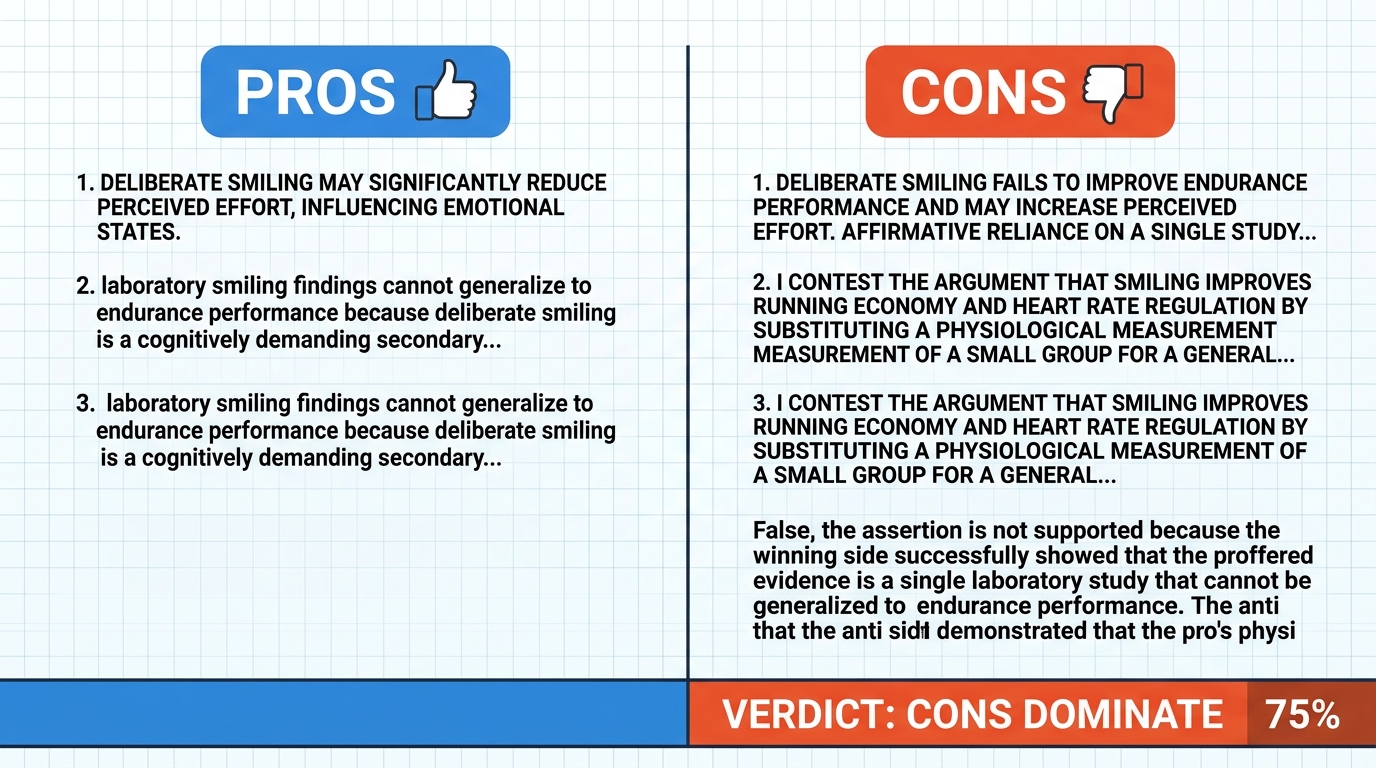
Verdict
Verdict: likely FALSE (75%)
Web Report: https://solsice.com/public/debates/smiling-deliberately-during-endurance-exercise-reduces-perce-97c810e4ca83
This section provides a brief overview of the key arguments. You do not need to read the full detailed report below.
✅ Key PRO arguments:
- ■Deliberate smiling during endurance exercise can significantly reduce perceived effort . Research has shown that facial expressions influence emotional states and physiological responses. A study published in Psychology of Sport and Exercise found that participants who smiled during a treadmill exercise reported lower ratings of perceived exertion (RPE ) compared to those who maintained a neutral or frowning expression. This suggests that the act of smiling can serve as a simple yet effective psychological strategy to make strenuous activity feel less demanding.
- ■The opponent target says laboratory smiling findings cannot generalize to endurance performance because deliberate smiling is a cognitively demanding secondary task that distracts from pacing . That inference is weak because it treats a simple facial action as if it were an executive dual task and because it ignores what the endurance study actually measured. The runners who smiled did not merely report feeling better; they showed lower oxygen cost and lower heart-rate response at a given pace, which are the physiological variables endurance athletes regulate in training and racing. If smiling had diverted attention from pacing, the plausible result would be...
❌ Key ANTI arguments:
- ■Deliberate smiling fails to improve endurance performance and may increase perceived effort . The affirmative's reliance on a single study to suggest that smiling improves running economy and heart rate regulation is a conjecture that extends findings from a controlled, small-scale setting to the general population of endurance athletes. While a specific study in Psychology of Sport and Exercise may observe localized physiological shifts in a laboratory, it is an error to present these as universal performance enhancements. In high-intensity endurance contexts, the cognitive load required to maintain a 'deliberate' facial expression can act as a secondary task , diverting mental resources away from pacing and physiological...
- ■I contest the argument that smiling improves running economy and heart rate regulation by substituting a physiological measurement of a small group for a general principle of athletic performance. The opponent argues that because the study measured oxygen uptake and heart rate, these findings are inherently 'field-relevant' and thus prove improved efficiency. This is a fallacy of substitution ; the study measures the physiological response of a specific, likely non-elite population in a controlled, low-stress environment, and the opponent concludes that this response is the same as the physiological regulation occurring in the high-stress, high-intensity domain of competitive endurance racing. The physiological response to a deliberate faci...
💭 Conclusion: False, the assertion is not supported because the winning side successfully showed that the proffered evidence is a single laboratory study that cannot be generalized to endurance performance . The anti side demonstrated that the pro's physiological measurements came from a small, likely non-elite population in a controlled, low-stress environment, not from competitive endurance racing. The anti side also argued that maintaining a deliberate smile imposes cognitive load that can act as a secondary task , diverting mental resources from pacing and thus potentially increasing perceived effort . The compound claim requires both reduced perceived effort and improved performance, but the performance-improvement sub-claim is the weakest link and was not established by the evidence. Therefore, the verdict is false with moderate confidence, reflecting the judge's 75% confidence and the lack of independent support for every sub-claim.
🔬 DeepResearch Result: likely FALSE ❌ (75%)
Assertion: Smiling deliberately during endurance exercise reduces perceived effort and improves performance.
Participating models: deepseek-v3.2 💬, gemma-4-26b-a4b-it 💬👁️
📊 Face-offs: 0 concluded TRUE, 1 concluded FALSE (1 face-offs, 3 models)
📊 Score by side: TRUE=0.00, FALSE=0.75
🏅 Model score changes:
deepseek-v4-flash-0731 💬: +8
✅ PRO Arguments:
- ■Deliberate smiling during endurance exercise can significantly reduce perceived effort. Research has shown that facial expressions influence emotional states and physiological responses. A study published in Psychology of Sport and Exercise found that participants who smiled during a treadmill exercise reported lower ratings of perceived exertion (RPE ) compared to those who maintained a neutral or frowning expression. This suggests that the act of smiling can serve as a simple yet effective psychological strategy to make strenuous activity feel less demanding. deepseek-v3.2 💬
- ■The opponent target says laboratory smiling findings cannot generalize to endurance performance because deliberate smiling is a cognitively demanding secondary task that distracts from pacing . That inference is weak because it treats a simple facial action as if it were an executive dual task and because it ignores what the endurance study actually measured. The runners who smiled did not merely report feeling better; they showed lower oxygen cost and lower heart-rate response at a given pace, which are the physiological variables endurance athletes regulate in training and racing. If smiling had diverted attention from pacing, the plausible result would be... deepseek-v3.2 💬
❌ ANTI Arguments:
- ■Deliberate smiling fails to improve endurance performance and may increase perceived effort. The affirmative's reliance on a single study to suggest that smiling improves running economy and heart rate regulation is a conjecture that extends findings from a controlled, small-scale setting to the general population of endurance athletes. While a specific study in Psychology of Sport and Exercise may observe localized physiological shifts in a laboratory, it is an error to present these as universal performance enhancements. In high-intensity endurance contexts, the cognitive load required to maintain a 'deliberate' facial expression can act as a secondary task, diverting mental resources away from pacing and physiological... gemma-4-26b-a4b-it 💬👁️
- ■I contest the argument that smiling improves running economy and heart rate regulation by substituting a physiological measurement of a small group for a general principle of athletic performance. The opponent argues that because the study measured oxygen uptake and heart rate, these findings are inherently 'field-relevant' and thus prove improved efficiency. This is a fallacy of substitution ; the study measures the physiological response of a specific, likely non-elite population in a controlled, low-stress environment, and the opponent concludes that this response is the same as the physiological regulation occurring in the high-stress, high-intensity domain of competitive endurance racing. The physiological response to a deliberate faci... gemma-4-26b-a4b-it 💬👁️
💭 Reasoning: False, the assertion is not supported because the winning side successfully showed that the proffered evidence is a single laboratory study that cannot be generalized to endurance performance. The anti side demonstrated that the pro's physiological measurements came from a small, likely non-elite population in a controlled, low-stress environment, not from competitive endurance racing. The anti side also argued that maintaining a deliberate smile imposes cognitive load that can act as a secondary task, diverting mental resources from pacing and thus potentially increasing perceived effort. The compound claim requires both reduced perceived effort and improved performance, but the performance-improvement sub-claim is the weakest link and was not established by the evidence. Therefore, the verdict is false with moderate confidence, reflecting the judge's 75% confidence and the lack of independent support for every sub-claim.
📋 PRO Facts:
• A study published in Psychology of Sport and Exercise found that participants who smiled during treadmill exercise reported lower ratings of perceived exertion (RPE) compared to neutral or frowning expressions.
• The pro side claimed that runners who smiled showed lower oxygen cost and lower heart-rate response at a given pace.
📋 ANTI Facts:
• The anti side argued that the pro's evidence comes from a single, controlled, small-scale laboratory study that cannot be generalized to endurance athletes.
• The anti side argued that deliberate smiling imposes cognitive load that can act as a secondary task, diverting mental resources away from pacing.
• The anti side argued that the study measured a specific, likely non-elite population in a low-stress environment, not high-intensity competitive endurance racing.
| Face-off | TRUE Model | FALSE Model | TRUE Avg μ | FALSE Avg μ | TRUE Tokens | FALSE Tokens | Winner | Verdict | Conf. |
|---|---|---|---|---|---|---|---|---|---|
| #1 | deepseek-v3.2 💬 | gemma-4-26b-a4b-it 💬👁️ | 0.504 | 0.276 | 8 | 2 | TRUE | FALSE | 75% |
The following technical terms, abbreviations, and domain-specific concepts are referenced throughout this debate transcript. Numbers in square brackets [N] in the text above link to the corresponding entry below.
[1] cognitive dissonance — Psychological discomfort from holding conflicting thoughts or beliefs; the negative side cites it as a reason smiling may not genuinely reduce perceived exertion.
[2] cognitive load — The mental effort required to perform a task; the negative side argues that maintaining a deliberate smile adds cognitive load during exercise.
[3] endurance exercise — Physical activity sustained over a prolonged period and relying on aerobic energy systems; the context for the debate's claims.
[4] endurance performance — The capacity to sustain exercise or athletic output over time; the debate asks whether deliberate smiling improves it.
[5] executive dual task — A secondary task that requires executive cognitive control while performing a primary task; the affirmative argues smiling is not an executive dual task.
[6] fallacy of substitution — A reasoning error in which a specific measurement is treated as proof of a broader principle; the negative accuses the affirmative of committing this fallacy.
[7] heart rate regulation — The control of heart rate during exercise; the affirmative cites improved heart rate regulation in smiling runners as evidence of efficiency.
[8] heart-rate response — The change in heart rate associated with a given exercise intensity; the affirmative notes a lower heart-rate response at a given pace when smiling.
[9] masking effect — The negative side's proposed effect in which a deliberate smile hides, rather than reduces, perceived exertion.
[10] metabolic cost — The energy required to perform a physical task; the negative argues that maintaining a forced facial expression adds metabolic cost in competition.
[11] metabolic efficiency — The effectiveness with which the body converts energy into work; the negative argues laboratory findings do not prove it in elite performance.
[12] oxygen cost — The amount of oxygen consumed to perform a given workload; the affirmative cites lower oxygen cost in smiling runners.
[13] oxygen uptake — The rate at which the body consumes oxygen during exercise; lower oxygen uptake at a given speed is cited as evidence of better running economy.
[14] pacing — The management of effort and speed over the course of an exercise bout or race; the negative argues smiling can disrupt pacing.
[15] perceived effort — The subjective sense of how hard physical activity feels; the core claim is that deliberate smiling reduces it.
[16] perceived exertion — The subjective intensity of effort experienced during exercise; the debate concerns whether smiling lowers it.
[17] physiological noise — Extraneous physiological variation that can interfere with performance or measurement; the negative argues forced smiling introduces it.
[18] RPE — ratings of perceived exertion — A measure of how hard an individual perceives exercise to be; the affirmative cites lower RPE in smiling participants.
[19] running economy — The oxygen demand of running at a given submaximal speed; better running economy means lower oxygen uptake and heart rate at that speed.
[20] secondary task — A task performed at the same time as a primary task; the negative argues deliberate smiling acts as a secondary task that diverts mental resources.
Face-off transcripts
- ■
Ownership & Trade Secrets. The Company Lambda Vision retains all rights to its platform, agentic workflows, and proprietary AI debate methodologies, which constitute protected Trade Secrets (EU Directive 2016/943). Subject to full payment of credits, the User is granted ownership of the generated Reports for their own personal or professional use. Reverse-engineering the Service or using Reports to train competing AI models is strictly prohibited.
- ■
No Professional Advice. Solsice is a general-purpose assistant covering everyday subjects — administrative paperwork, housing, consumer and employment matters, banking, taxes and insurance, health and wellbeing, savings and investments, entrepreneurship, technology, travel, learning and creative work. Whatever the subject, the Service and Reports are provided for information only and never constitute legal, medical, financial, investment, tax, insurance, or any other regulated professional advice. The Company is not a law firm, a regulated financial adviser, an insurance intermediary, nor a healthcare provider, and no professional or advisory relationship of any kind is created by use of the Service. Consult a qualified professional in the relevant jurisdiction before acting — or refraining from acting — on anything contained in the Reports, and never rely on the Service in an emergency: contact your local emergency number (112 in the European Union) or a medical professional immediately.
- ■
AI-Generated Content, Sources and Viewpoints. Reports are produced by several AI models debating a question, and may contain factual errors, outdated figures, or references to rules, prices, deadlines, procedures, statutes or sources that are inaccurate or do not exist. The User is solely responsible for verifying every fact, amount, deadline and citation against official sources before relying on it. Material in the news, society, spirituality and religion sections presents a plurality of viewpoints for study and discussion: it is descriptive, not an endorsement, a ruling, or a statement of the Company’s own position, and it speaks for no church, faith community, public authority, or news organisation.
- ■
Liability & Governing Law. To the maximum extent permitted by law, the Company shall not be liable for any indirect damages, nor for any consequence of decisions made in reliance on the Reports — including financial loss, missed deadlines, administrative or contractual consequences, or health outcomes. These Terms are governed by French law. Any disputes shall be subject to the exclusive jurisdiction of the Courts of Paris, France.