
Sri Ramakrishna's experience of God as Mother, culminating in his worship of Sarada Devi as the goddess herself, shaped the entire Ramakrishna tradition's expression of the divine feminine.
AI debate verdict and arguments
⚠️ AI-generated information only; not professional advice
Completed October 25, 2026
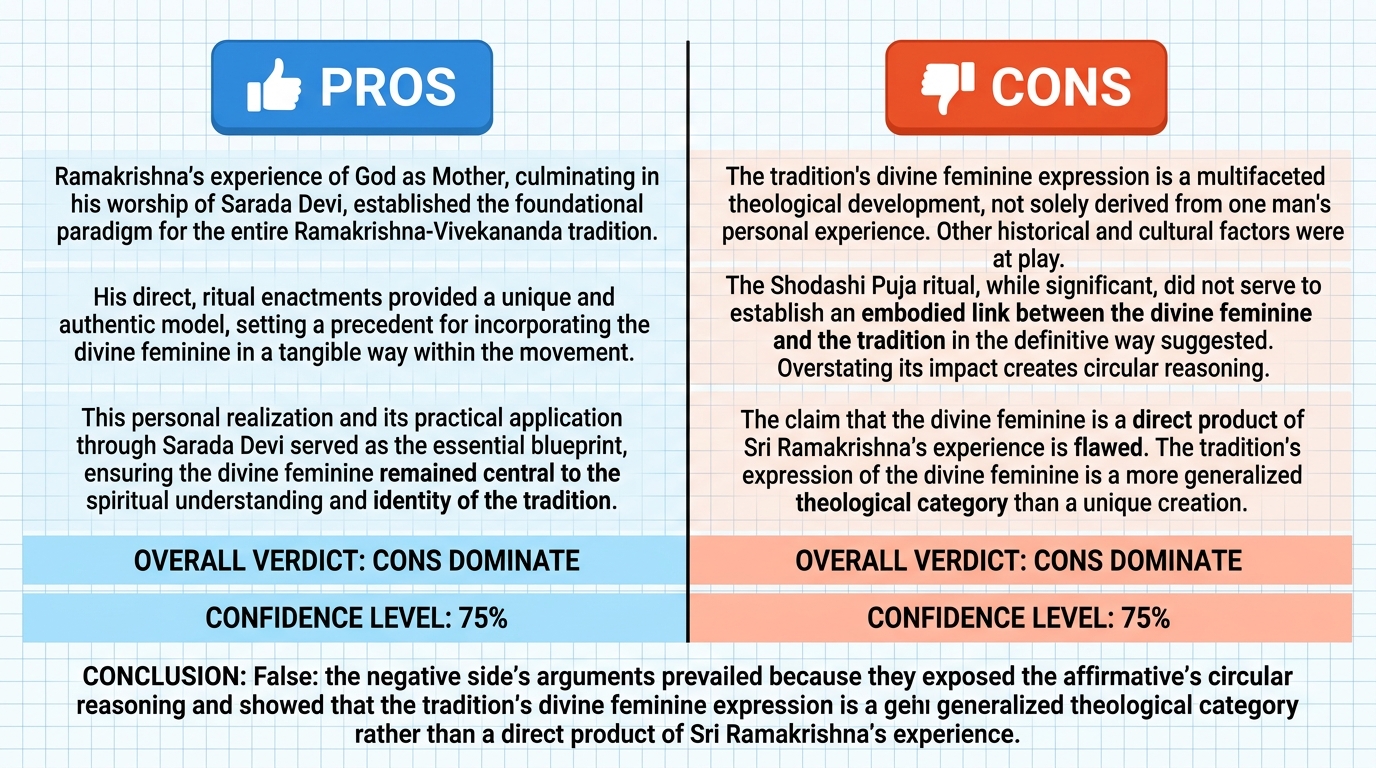
Verdict
Verdict: likely FALSE (75%)
Web Report: https://solsice.com/public/debates/sri-ramakrishna-s-experience-of-god-as-mother-culminating-in-1bcd71592d9e
This section provides a brief overview of the key arguments. You do not need to read the full detailed report below.
✅ Key PRO arguments:
- ■Core claim: Sri Ramakrishna's direct experience of God as Mother, ritually enacted in the worship of Sarada Devi, established the foundational paradigm for the entire Ramakrishna tradition's theology and practice of the divine feminine. His most profound mystical state was his constant vision of God as the Divine Mother, Kali, a relationship so intense he was described as a child with its mother, utterly dependent and ecstatically devoted. This personal realization was the sole basis for his identification of his wife, Sarada Devi, as the goddess herself.
- ■The opposing argument claims that the Ramakrishna-Vivekananda movement's global scale and integration of Advaita Vedanta, practical Vedanta, and social service models render the 1872 Shodashi Puja irrelevant as a shaping force — that a 'localized ritual' cannot explain a global institution. This objection fails because it treats the tradition's expansion as a rupture rather than a transmission, and it relies on an unstated and false premise: that the theological content developed by Vivekananda and subsequent leaders was independent of, rather than explicitly derived from, Sri Ramakrishna's experiential paradigm. The scale-invariance objection collapses upon examining the actual mechanism of transmission.
❌ Key ANTI arguments:
- ■Core claim: The tradition's divine feminine expression is a multi-faceted theological development, not solely derived from one man's experience. The affirmative's argument suffers from a fatal logical error: it attempts to prove its conclusion by feeding that very conclusion into its premises. By asserting that Sri Ramakrishna's experience 'established the foundational paradigm' and then citing a biography that describes his experience as 'the source and validation' for the tradition, the opponent is merely restating the initial assumption. This is a circular demonstration where the model returns the assumption rather than providing independent evidence.
- ■I am contesting the claim that the 1872 Shodashi Puja ritual served to establish an embodied link between the divine feminine and the Ramakrishna tradition. If such an embodied link were established by this ritual, then the tradition's expression of the divine feminine would be fundamentally defined by the specific personhood of Sarada Devi. However, the tradition's expression is not defined by her personhood, but by a generalized, theological category of the Divine Mother that is independent of her biographical existence. Therefore, the ritual did not establish the link the opponent claims.
💭 Conclusion: False: the negative side's arguments prevailed because they exposed the affirmative's circular reasoning and showed that the tradition's divine feminine expression is a generalized theological category rather than a direct product of Sri Ramakrishna's personal experience or the Shodashi Puja. The negative side correctly noted that the affirmative merely restated the assumption that Ramakrishna's experience was the source and validation of the tradition without providing independent evidence of a causal link. It also demonstrated that the tradition's expression is not defined by Sarada Devi's specific personhood, but by a broader category of the Divine Mother. The characterization of the Shodashi Puja as a localized ritual further undercut the claim that it shaped the entire global tradition. Therefore, the assertion overstates the influence of one man's experience and one ritual on the whole Ramakrishna tradition.
🔬 DeepResearch Result: likely FALSE ❌ (75%)
Assertion: Sri Ramakrishna's experience of God as Mother, culminating in his worship of Sarada Devi as the goddess herself, shaped the entire Ramakrishna tradition's expression of the divine feminine.
Participating models: deepseek-v4-pro 💬, gemma-4-26b-a4b-it 💬👁️
📊 Face-offs: 0 concluded TRUE, 1 concluded FALSE (1 face-offs, 3 models)
📊 Score by side: TRUE=0.00, FALSE=0.75
🏅 Model score changes:
deepseek-v4-flash-0731 💬: +8
✅ PRO Arguments:
- ■Core claim: Sri Ramakrishna's direct experience of God as Mother, ritually enacted in the worship of Sarada Devi, established the foundational paradigm for the entire Ramakrishna tradition's theology and practice of the divine feminine. His most profound mystical state was his constant vision of God as the Divine Mother, Kali, a relationship so intense he was described as a child with its mother, utterly dependent and ecstatically devoted. This personal realization was the sole basis for his identification of his wife, Sarada Devi, as the goddess herself. deepseek-v4-pro 💬
- ■The opposing argument claims that the Ramakrishna-Vivekananda movement's global scale and integration of Advaita Vedanta, practical Vedanta, and social service models render the 1872 Shodashi Puja irrelevant as a shaping force — that a 'localized ritual' cannot explain a global institution. This objection fails because it treats the tradition's expansion as a rupture rather than a transmission, and it relies on an unstated and false premise: that the theological content developed by Vivekananda and subsequent leaders was independent of, rather than explicitly derived from, Sri Ramakrishna's experiential paradigm. The scale-invariance objection collapses upon examining the actual mechanism of transmission. deepseek-v4-pro 💬
❌ ANTI Arguments:
- ■Core claim: The tradition's divine feminine expression is a multi-faceted theological development, not solely derived from one man's experience. The affirmative's argument suffers from a fatal logical error: it attempts to prove its conclusion by feeding that very conclusion into its premises. By asserting that Sri Ramakrishna's experience 'established the foundational paradigm' and then citing a biography that describes his experience as 'the source and validation' for the tradition, the opponent is merely restating the initial assumption. This is a circular demonstration where the model returns the assumption rather than providing independent evidence. gemma-4-26b-a4b-it 💬👁️
- ■I am contesting the claim that the 1872 Shodashi Puja ritual served to establish an embodied link between the divine feminine and the Ramakrishna tradition. If such an embodied link were established by this ritual, then the tradition's expression of the divine feminine would be fundamentally defined by the specific personhood of Sarada Devi. However, the tradition's expression is not defined by her personhood, but by a generalized, theological category of the Divine Mother that is independent of her biographical existence. Therefore, the ritual did not establish the link the opponent claims. gemma-4-26b-a4b-it 💬👁️
💭 Reasoning: False: the negative side's arguments prevailed because they exposed the affirmative's circular reasoning and showed that the tradition's divine feminine expression is a generalized theological category rather than a direct product of Sri Ramakrishna's personal experience or the Shodashi Puja. The negative side correctly noted that the affirmative merely restated the assumption that Ramakrishna's experience was the source and validation of the tradition without providing independent evidence of a causal link. It also demonstrated that the tradition's expression is not defined by Sarada Devi's specific personhood, but by a broader category of the Divine Mother. The characterization of the Shodashi Puja as a localized ritual further undercut the claim that it shaped the entire global tradition. Therefore, the assertion overstates the influence of one man's experience and one ritual on the whole Ramakrishna tradition.
📋 PRO Facts:
• Sri Ramakrishna's most profound mystical state was his constant vision of God as the Divine Mother, Kali.
• Sri Ramakrishna identified his wife, Sarada Devi, as the goddess herself, culminating in the 1872 Shodashi Puja.
• The affirmative argued that Sri Ramakrishna's personal realization was the sole basis for the tradition's theology and practice of the divine feminine.
📋 ANTI Facts:
• The negative side argued that the affirmative's reasoning was circular, restating the assumption rather than providing independent evidence.
• The tradition's expression of the divine feminine is defined by a generalized theological category of the Divine Mother independent of Sarada Devi's biographical existence.
• The Shodashi Puja was characterized as a localized ritual that cannot explain the global Ramakrishna-Vivekananda movement.
| Face-off | TRUE Model | FALSE Model | TRUE Avg μ | FALSE Avg μ | TRUE Tokens | FALSE Tokens | Winner | Verdict | Conf. |
|---|---|---|---|---|---|---|---|---|---|
| #1 | deepseek-v4-pro 💬 | gemma-4-26b-a4b-it 💬👁️ | 0.539 | 0.188 | 6 | 2 | TRUE | FALSE | 75% |
Face-off transcripts
- ■
Ownership & Trade Secrets. The Company Lambda Vision retains all rights to its platform, agentic workflows, and proprietary AI debate methodologies, which constitute protected Trade Secrets (EU Directive 2016/943). Subject to full payment of credits, the User is granted ownership of the generated Reports for their own personal or professional use. Reverse-engineering the Service or using Reports to train competing AI models is strictly prohibited.
- ■
No Professional Advice. Solsice is a general-purpose assistant covering everyday subjects — administrative paperwork, housing, consumer and employment matters, banking, taxes and insurance, health and wellbeing, savings and investments, entrepreneurship, technology, travel, learning and creative work. Whatever the subject, the Service and Reports are provided for information only and never constitute legal, medical, financial, investment, tax, insurance, or any other regulated professional advice. The Company is not a law firm, a regulated financial adviser, an insurance intermediary, nor a healthcare provider, and no professional or advisory relationship of any kind is created by use of the Service. Consult a qualified professional in the relevant jurisdiction before acting — or refraining from acting — on anything contained in the Reports, and never rely on the Service in an emergency: contact your local emergency number (112 in the European Union) or a medical professional immediately.
- ■
AI-Generated Content, Sources and Viewpoints. Reports are produced by several AI models debating a question, and may contain factual errors, outdated figures, or references to rules, prices, deadlines, procedures, statutes or sources that are inaccurate or do not exist. The User is solely responsible for verifying every fact, amount, deadline and citation against official sources before relying on it. Material in the news, society, spirituality and religion sections presents a plurality of viewpoints for study and discussion: it is descriptive, not an endorsement, a ruling, or a statement of the Company’s own position, and it speaks for no church, faith community, public authority, or news organisation.
- ■
Liability & Governing Law. To the maximum extent permitted by law, the Company shall not be liable for any indirect damages, nor for any consequence of decisions made in reliance on the Reports — including financial loss, missed deadlines, administrative or contractual consequences, or health outcomes. These Terms are governed by French law. Any disputes shall be subject to the exclusive jurisdiction of the Courts of Paris, France.