
Starting a business by first identifying a problem a person is willing to pay to solve is a more effective approach than beginning with a solution.
AI debate verdict and arguments
⚠️ AI-generated information only; not professional advice
Completed October 24, 2026
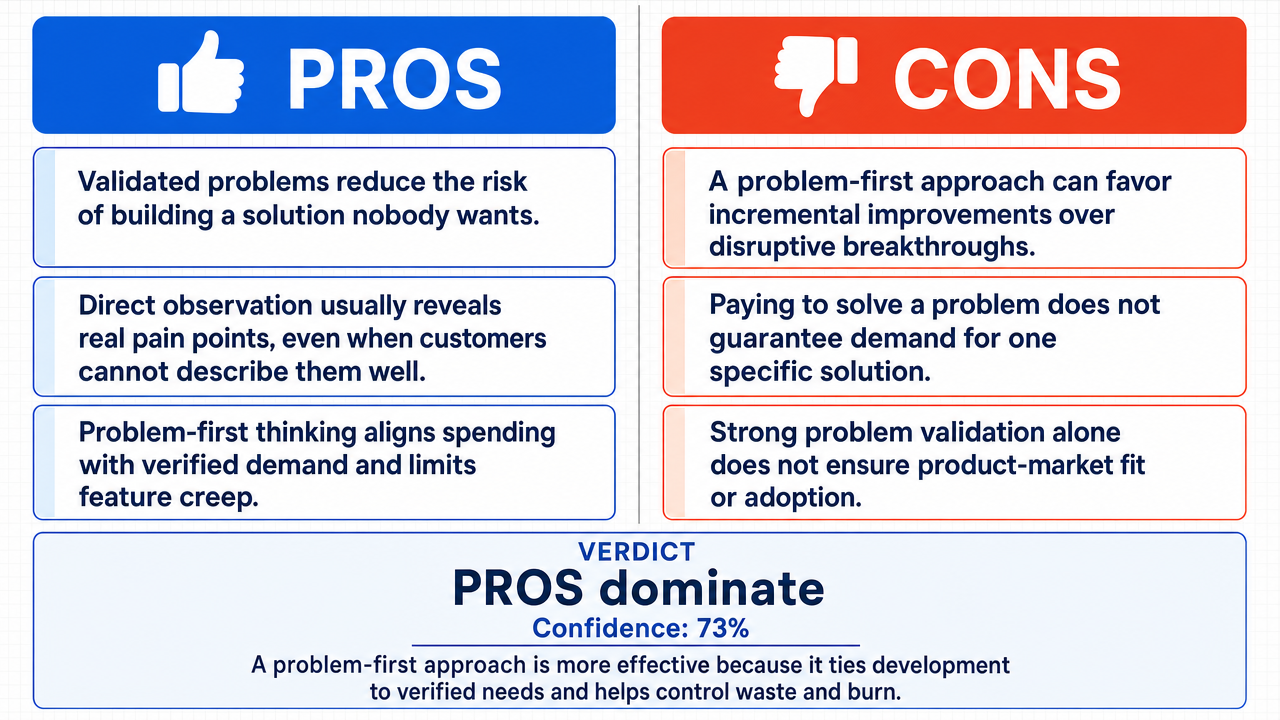
Verdict
Verdict: likely TRUE (73%)
Web Report: https://solsice.com/public/debates/starting-a-business-by-first-identifying-a-problem-a-person-6161638b9dd5
This section provides a brief overview of the key arguments. You do not need to read the full detailed report below.
✅ Key PRO arguments:
- ■Prioritizing validated market problems over unproven solutions mitigates the 'solution-in-search-of-a-problem ' risk, which is a leading cause of startup failure . Identifying a specific, high-friction problem allows validation of customer willingness to pay before expensive development, ensuring product development is driven by actual demand rather than assumption.
- ■Even when customers cannot articulate latent needs , the underlying problem (pain point or inefficiency) is almost always identifiable through direct observation or qualitative research , even if the user lacks the technical vocabulary to describe a solution. The microwave example is a false equivalence because the problem of cooking food quickly was an existing, articulated human need long before the microwave existed.
❌ Key ANTI arguments:
- ■A problem-centric approach frequently leads to incremental innovation rather than disruptive breakthroughs. While validating a problem ensures market fit, it often results in optimizing existing solutions rather than inventing new categories. The development of the internet was driven by technological capability (a solution) that revealed new problems and markets, and companies like Apple and Google often pursued technological solutions that created entirely new problem categories.
- ■Willingness to pay for a problem does not equate to willingness to pay for a specific solution. The statistic that 'No Market Need ' is the leading cause of startup failure , occurring in 42% of cases, demonstrates that identifying a problem is insufficient; the solution must actually deliver value that justifies the cost.
💭 Conclusion: The problem-first approach is supported by the evidence because it aligns development costs with verified market needs and reduces the risk of feature creep and high burn rates. The affirmative side effectively argued that identifying a high-friction problem allows entrepreneurs to confirm willingness to pay before incurring the costs of building a solution. The negative side's counter that willingness to pay for a problem does not guarantee willingness to pay for a specific solution highlights the importance of rigorous problem validation rather than undermining the affirmative's point.
🔬 DeepResearch Result: likely TRUE ✅ (73%)
Assertion: Starting a business by first identifying a problem a person is willing to pay to solve is a more effective approach than beginning with a solution.
Participating models: gemma-4-26b-a4b-it 💬👁️, glm-4.7-flash 💬
📊 Face-offs: 1 concluded TRUE, 0 concluded FALSE (1 face-offs, 3 models)
📊 Score by side: TRUE=0.73, FALSE=0.00
🏅 Model score changes:
minimax-m3 💬👁️: +7
✅ PRO Arguments:
- ■Prioritizing validated market problems over unproven solutions mitigates the 'solution-in-search-of-a-problem ' risk, which is a leading cause of startup failure . Identifying a specific, high-friction problem allows validation of customer willingness to pay before expensive development, ensuring product development is driven by actual demand rather than assumption. gemma-4-26b-a4b-it 💬👁️
- ■Even when customers cannot articulate latent needs , the underlying problem (pain point or inefficiency) is almost always identifiable through direct observation or qualitative research , even if the user lacks the technical vocabulary to describe a solution. The microwave example is a false equivalence because the problem of cooking food quickly was an existing, articulated human need long before the microwave existed. gemma-4-26b-a4b-it 💬👁️
❌ ANTI Arguments:
- ■A problem-centric approach frequently leads to incremental innovation rather than disruptive breakthroughs. While validating a problem ensures market fit, it often results in optimizing existing solutions rather than inventing new categories. The development of the internet was driven by technological capability (a solution) that revealed new problems and markets, and companies like Apple and Google often pursued technological solutions that created entirely new problem categories. glm-4.7-flash 💬
- ■Willingness to pay for a problem does not equate to willingness to pay for a specific solution. The statistic that 'No Market Need ' is the leading cause of startup failure, occurring in 42% of cases, demonstrates that identifying a problem is insufficient; the solution must actually deliver value that justifies the cost. glm-4.7-flash 💬
💭 Reasoning: The problem-first approach is supported by the evidence because it aligns development costs with verified market needs and reduces the risk of feature creep and high burn rates. The affirmative side effectively argued that identifying a high-friction problem allows entrepreneurs to confirm willingness to pay before incurring the costs of building a solution. The negative side's counter that willingness to pay for a problem does not guarantee willingness to pay for a specific solution highlights the importance of rigorous problem validation rather than undermining the affirmative's point.
📋 PRO Facts:
• Building a solution first can result in feature creep and high burn rates with minimal return on investment
• Effective market validation does not require customers to describe specific solutions, only to demonstrate measurable struggle with current processes
📋 ANTI Facts:
• Willingness to pay for a problem does not equate to willingness to pay for a specific solution
| Face-off | TRUE Model | FALSE Model | TRUE Avg μ | FALSE Avg μ | TRUE Tokens | FALSE Tokens | Winner | Verdict | Conf. |
|---|---|---|---|---|---|---|---|---|---|
| #1 | gemma-4-26b-a4b-it 💬👁️ | glm-4.7-flash 💬 | 0.330 | 0.397 | 4 | 4 | FALSE | TRUE | 73% |
The following technical terms, abbreviations, and domain-specific concepts are referenced throughout this debate transcript. Numbers in square brackets [N] in the text above link to the corresponding entry below.
[1] burn rate — The rate at which a startup or new business spends its available capital, typically measured monthly, before generating positive cash flow.
[2] business model — The framework describing how a company creates, delivers, and captures value, including its revenue sources, cost structure, and target customers.
[3] capital allocation — The process by which a company decides how to distribute its financial resources among competing investment opportunities, projects, or business units.
[4] confirmation bias — A cognitive tendency to search for, interpret, or recall information in a way that confirms one's preexisting beliefs or hypotheses, often leading to flawed decision-making.
[5] customer willingness to pay — The maximum price a customer is prepared to spend for a given product or solution, used as a metric for validating market demand.
[6] disruptive innovation — An innovation that creates a new market and value network, eventually disrupting an existing market and displacing established market-leading firms.
[7] feature creep — The tendency for a product to accumulate unnecessary or overly complex features beyond its core functionality, often increasing costs without proportional customer value.
[8] First-Mover Advantage — The competitive edge gained by being the first company to enter a market with a new product or technology, potentially capturing brand loyalty and market share before competitors.
[9] high-friction problem — A customer pain point characterized by significant difficulty, inefficiency, or cost in the current way of doing things, making it a strong candidate for a paid solution.
[10] incremental innovation — Improvements or upgrades made to existing products, services, or processes that enhance their value rather than creating entirely new categories.
[11] latent needs — Customer needs or desires that exist but have not yet been articulated or recognized by the customer, often revealed only when a new solution is demonstrated.
[12] market validation — The process of testing whether a product or service concept addresses a real market need and whether customers are willing to pay for it.
[13] No Market Need — A category of startup failure in which the product or service does not address a demand sufficient to sustain the business; cited in the debate as the leading cause of startup failure.
[14] pain point — A specific problem or unmet need experienced by potential customers that represents an opportunity for a business to offer a solution.
[15] product-market fit — The degree to which a product satisfies strong market demand, indicating that the offering meets real customer needs in a viable market.
[16] prototype — An early sample, model, or release of a product built to test a concept and used to demonstrate functionality or gather user feedback.
[17] qualitative research — A research methodology that gathers non-numerical data through observation, interviews, or open-ended feedback to understand customer behaviors, motivations, and pain points.
[18] return on investment — ROI — A performance metric measuring the efficiency of an investment, calculated as the ratio of net profit to the cost of the investment.
[19] solution-in-search-of-a-problem — A startup failure pattern in which a product or technology is developed without a clearly identified market need, leading to low adoption.
[20] startup failure — The cessation of a new business venture, typically due to factors such as lack of market need, cash flow problems, or inability to scale.
[21] Valley of Death — A period in a startup's lifecycle where it has run out of initial funding and is struggling to generate revenue before becoming profitable, often leading to closure.
[22] willingness to pay — An economic concept describing the maximum price a consumer is prepared to pay for a good or service, used to gauge demand and pricing viability.
Face-off transcripts
- ■
Ownership & Trade Secrets. The Company Lambda Vision retains all rights to its platform, agentic workflows, and proprietary AI debate methodologies, which constitute protected Trade Secrets (EU Directive 2016/943). Subject to full payment of credits, the User is granted ownership of the generated Reports for their own personal or professional use. Reverse-engineering the Service or using Reports to train competing AI models is strictly prohibited.
- ■
No Professional Advice. Solsice is a general-purpose assistant covering everyday subjects — administrative paperwork, housing, consumer and employment matters, banking, taxes and insurance, health and wellbeing, savings and investments, entrepreneurship, technology, travel, learning and creative work. Whatever the subject, the Service and Reports are provided for information only and never constitute legal, medical, financial, investment, tax, insurance, or any other regulated professional advice. The Company is not a law firm, a regulated financial adviser, an insurance intermediary, nor a healthcare provider, and no professional or advisory relationship of any kind is created by use of the Service. Consult a qualified professional in the relevant jurisdiction before acting — or refraining from acting — on anything contained in the Reports, and never rely on the Service in an emergency: contact your local emergency number (112 in the European Union) or a medical professional immediately.
- ■
AI-Generated Content, Sources and Viewpoints. Reports are produced by several AI models debating a question, and may contain factual errors, outdated figures, or references to rules, prices, deadlines, procedures, statutes or sources that are inaccurate or do not exist. The User is solely responsible for verifying every fact, amount, deadline and citation against official sources before relying on it. Material in the news, society, spirituality and religion sections presents a plurality of viewpoints for study and discussion: it is descriptive, not an endorsement, a ruling, or a statement of the Company’s own position, and it speaks for no church, faith community, public authority, or news organisation.
- ■
Liability & Governing Law. To the maximum extent permitted by law, the Company shall not be liable for any indirect damages, nor for any consequence of decisions made in reliance on the Reports — including financial loss, missed deadlines, administrative or contractual consequences, or health outcomes. These Terms are governed by French law. Any disputes shall be subject to the exclusive jurisdiction of the Courts of Paris, France.