
Starting a business through acquisition is inherently less risky for a single mother than starting one from scratch.
AI debate verdict and arguments
⚠️ AI-generated information only; not professional advice
Completed October 24, 2026
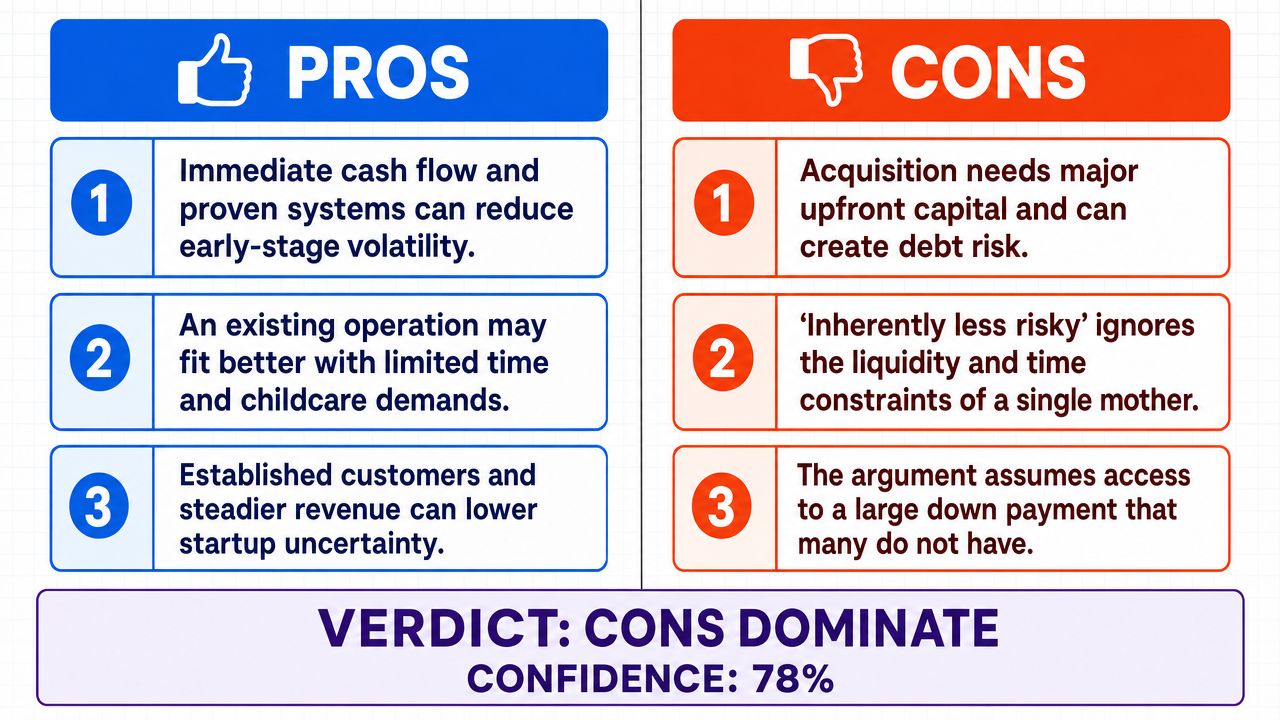
Verdict
Verdict: likely FALSE (78%)
Web Report: https://solsice.com/public/debates/starting-a-business-through-acquisition-is-inherently-less-r-349ee8be2760
This section provides a brief overview of the key arguments. You do not need to read the full detailed report below.
✅ Key PRO arguments:
- ■Acquisition provides immediate cash flow and proven systems, reducing risk for single mothers by mitigating the extreme volatility inherent in the 'zero-to-one ' phase of a startup.
- ■For a single mother whose time is constrained by childcare and domestic responsibilities, stepping into an existing cash-flowing entity is a critical risk-reduction mechanism compared to the lengthy unproven period of customer acquisition required by a startup.
- ■An acquired business arrives with an established customer base and predictable revenue streams, whereas a startup requires high capital burn with non-existent income during the product-market fit phase.
❌ Key ANTI arguments:
- ■Acquisition demands high upfront capital, creating leverage risks that startups avoid; the Affirmative measures survival rates of general businesses and concludes about single mothers without establishing the correlation that makes such rates predictive for this specific population.
- ■The claim that acquisition is 'inherently less risky' extends a general business principle beyond the specific constraints of a single mother's liquidity and time constraints, making it a conjecture rather than a proven fact.
- ■The Affirmative relies on the hidden premise that a single mother possesses the liquid capital required for a down payment , which is statistically unlikely given the barriers to capital access faced by this demographic.
💭 Conclusion: The assertion fails because the evidence shows that acquisition requires a down payment of 20-40% of the purchase price plus closing costs , often exceeding $100,000, which a single mother with limited liquid assets cannot meet. Furthermore, the leverage and fixed debt obligations inherent in acquisition create insolvency risks—foreclosure if cash flow dips—that are particularly dangerous for single-income households, whereas a bootstrapped startup avoids these fixed financial burdens. Additionally, acquired businesses are illiquid assets that take significantly longer to exit (18 months vs 3 months for startups), transferring risk from operational uncertainty to asset illiquidity, which is a structural disadvantage for a single mother who may need to exit quickly due to personal circumstances. The demographic-specific sub-claim is not adequately supported because the capital threshold required for acquisition is incompatible with the limited liquid assets available to single mothers.
🔬 DeepResearch Result: likely FALSE ❌ (78%)
Assertion: Starting a business through acquisition is inherently less risky for a single mother than starting one from scratch.
Participating models: gemma-4-26b-a4b-it 💬👁️, glm-4.7-flash 💬
📊 Face-offs: 0 concluded TRUE, 1 concluded FALSE (1 face-offs, 3 models)
📊 Score by side: TRUE=0.00, FALSE=0.78
🏅 Model score changes:
minimax-m3 💬👁️: +8
✅ PRO Arguments:
- ■Acquisition provides immediate cash flow and proven systems, reducing risk for single mothers by mitigating the extreme volatility inherent in the 'zero-to-one ' phase of a startup. gemma-4-26b-a4b-it 💬👁️
- ■For a single mother whose time is constrained by childcare and domestic responsibilities, stepping into an existing cash-flowing entity is a critical risk-reduction mechanism compared to the lengthy unproven period of customer acquisition required by a startup. gemma-4-26b-a4b-it 💬👁️
- ■An acquired business arrives with an established customer base and predictable revenue streams, whereas a startup requires high capital burn with non-existent income during the product-market fit phase. gemma-4-26b-a4b-it 💬👁️
- ■The leverage used in an acquisition is secured by the existing, proven assets and cash flows of the target business, making it fundamentally different from unsecured startup risk. gemma-4-26b-a4b-it 💬👁️
- ■The true risk for a single mother is the absence of cash flow, not the absence of capital; a low-capital startup often operates with zero or negative cash flow for an extended period, creating a high-risk burn rate that threatens single-income household stability. gemma-4-26b-a4b-it 💬👁️
❌ ANTI Arguments:
- ■Acquisition demands high upfront capital, creating leverage risks that startups avoid; the Affirmative measures survival rates of general businesses and concludes about single mothers without establishing the correlation that makes such rates predictive for this specific population. glm-4.7-flash 💬
- ■The claim that acquisition is 'inherently less risky' extends a general business principle beyond the specific constraints of a single mother's liquidity and time constraints, making it a conjecture rather than a proven fact. glm-4.7-flash 💬
- ■The Affirmative relies on the hidden premise that a single mother possesses the liquid capital required for a down payment , which is statistically unlikely given the barriers to capital access faced by this demographic. glm-4.7-flash 💬
- ■Starting from scratch allows for low-capital, service-based models that avoid the crushing weight of fixed debt obligations ; while this phase lacks revenue, it avoids the leverage risk that can force immediate insolvency if cash flow dips. glm-4.7-flash 💬
- ■The risk in a startup is operational and manageable, whereas an acquisition introduces a fixed financial burden that the buyer must service regardless of business success, making it inherently more precarious for a resource-constrained single mother. glm-4.7-flash 💬
💭 Reasoning: The assertion fails because the evidence shows that acquisition requires a down payment of 20-40% of the purchase price plus closing costs , often exceeding $100,000, which a single mother with limited liquid assets cannot meet. Furthermore, the leverage and fixed debt obligations inherent in acquisition create insolvency risks—foreclosure if cash flow dips—that are particularly dangerous for single-income households, whereas a bootstrapped startup avoids these fixed financial burdens. Additionally, acquired businesses are illiquid assets that take significantly longer to exit (18 months vs 3 months for startups), transferring risk from operational uncertainty to asset illiquidity, which is a structural disadvantage for a single mother who may need to exit quickly due to personal circumstances. The demographic-specific sub-claim is not adequately supported because the capital threshold required for acquisition is incompatible with the limited liquid assets available to single mothers.
📋 PRO Facts:
• Acquired businesses arrive with established customer bases and predictable revenue streams
• Startups typically require a lengthy unproven period of customer acquisition and product-market fit
• Leverage in acquisitions is secured by existing proven assets and cash flows of the target business
📋 ANTI Facts:
• Acquisition requires high upfront capital that single mothers are unlikely to possess
• Low-capital, service-based startup models can avoid fixed debt obligations entirely
• Fixed financial obligations from acquisition debt must be serviced regardless of business performance
| Face-off | TRUE Model | FALSE Model | TRUE Avg μ | FALSE Avg μ | TRUE Tokens | FALSE Tokens | Winner | Verdict | Conf. |
|---|---|---|---|---|---|---|---|---|---|
| #1 | gemma-4-26b-a4b-it 💬👁️ | glm-4.7-flash 💬 | 0.293 | 0.393 | 4 | 4 | FALSE | FALSE | 78% |
The following technical terms, abbreviations, and domain-specific concepts are referenced throughout this debate transcript. Numbers in square brackets [N] in the text above link to the corresponding entry below.
[1] bootstrapped — Refers to starting and growing a business using minimal external capital, typically relying on personal savings or operating revenues rather than outside investment or significant debt.
[2] burn rate — The rate at which a company spends its cash reserves before generating positive cash flow, often used to describe how quickly a startup is consuming its capital.
[3] capital burn — The depletion of a company's cash reserves as it spends money on operations before achieving profitability or stable revenue.
[4] cash flow — The net movement of money into and out of a business, representing the actual liquidity available to meet obligations rather than accounting profit.
[5] closing costs — Fees and expenses incurred beyond the purchase price when finalizing a business or real estate transaction, typically including legal, administrative, and financing charges.
[6] conjecture — In debate logic, an assertion or conclusion drawn without sufficient evidence or established logical support, treated as an unproven hypothesis.
[7] correlation — A statistical or logical relationship between two variables; in debate logic, the term is used to question whether evidence about one group can validly predict outcomes for another.
[8] customer acquisition — The process of attracting and converting new customers for a business, often cited as a costly and uncertain activity for early-stage startups.
[9] customer contracts — Formal agreements with clients that establish recurring or predictable revenue streams, which can be used to service debt obligations in an acquisition context.
[10] down payment — An initial upfront payment made at the time of purchase, representing a percentage of the total price rather than financed through debt.
[11] fixed debt obligations — Scheduled debt payments that must be met regardless of the business's revenue performance, creating a baseline financial burden on the owner.
[12] fixed financial burden — Recurring financial commitments that must be paid regardless of business performance, contrasting with variable costs that scale with revenue.
[13] hidden premise — An unstated assumption underlying an argument that must be true for the conclusion to follow, often a target of critique in formal debate.
[14] high-leverage debt — Borrowed capital used to finance a large portion of a purchase, magnifying both potential returns and the risk of default if cash flow falters.
[15] historical proof of concept — Evidence that a business model has previously succeeded, based on past operating data of the target company prior to acquisition.
[16] income-producing asset — An asset acquired specifically for the cash flow it generates, as opposed to speculative or appreciation-based holdings.
[17] insolvency — A financial state in which an entity cannot meet its debt obligations as they come due, potentially leading to bankruptcy proceedings.
[18] leverage — The use of borrowed capital to finance an investment or acquisition, amplifying both potential gains and the risk of loss.
[19] liquid assets — Cash or assets that can be quickly converted to cash without significant loss in value, used to measure a person's ability to fund a purchase.
[20] liquid capital — Funds readily available in cash or near-cash form, distinct from illiquid assets like real estate or retirement accounts.
[21] operational risk — The risk of loss arising from inadequate or failed internal processes, systems, or external events affecting day-to-day business operations.
[22] product-market fit — The degree to which a product satisfies strong market demand, typically achieved only after an extended period of iteration for startups.
[23] proof of concept — Evidence demonstrating that a business idea or model is viable and can succeed in the market, often cited as a benefit of acquiring an existing business.
[24] SBA-backed loans — Small Business Administration-backed loans — Loans partially guaranteed by the U.S. Small Business Administration, designed to make acquisition financing more accessible to buyers who might not qualify for conventional loans.
[25] service-based models — Business models centered on selling labor, expertise, or services rather than physical products, often requiring lower startup capital.
[26] single-income household — A household supported financially by one earner, making income stability particularly critical for meeting household obligations.
[27] survival rate — The statistical measure of what proportion of businesses remain operational after a given period, commonly used to compare risk across business types.
[28] wealth accumulation — The process of building net worth over time through savings, investment, and asset ownership, often constrained for single-parent households.
[29] zero-to-one — Startup terminology describing the earliest phase of building a company from nothing, characterized by unproven concepts and high volatility.
The following financial data tables were referenced during the debate exchanges:
| Venture Type | Primary Risk Driver | Revenue Predictability | Initial Operational Load |
|---|---|---|---|
| Startup (From Scratch) | Market Fit / Cash Burn | Low | Very High |
| Acquisition | Due Diligence / Integration | High | Moderate |
Legend: Comparison of risk profiles between new ventures and acquisitions. "Low/High" refers to the level of certainty and effort required respectively.
| Venture Type | Upfront Capital Required | Liquidity (Time to Exit) | Typical Down Payment |
|---|---|---|---|
| Acquisition | $250,000 | 18 months | 40% |
| Startup | $15,000 | 3 months | 0% |
Legend: Comparison of capital requirements and exit liquidity for acquisitions versus startups. Capital in USD; Liquidity in months. Source: SBA Loan Data, Business Brokerage Industry Reports.
Face-off transcripts
- ■
Ownership & Trade Secrets. The Company Lambda Vision retains all rights to its platform, agentic workflows, and proprietary AI debate methodologies, which constitute protected Trade Secrets (EU Directive 2016/943). Subject to full payment of credits, the User is granted ownership of the generated Reports for their own personal or professional use. Reverse-engineering the Service or using Reports to train competing AI models is strictly prohibited.
- ■
No Professional Advice. Solsice is a general-purpose assistant covering everyday subjects — administrative paperwork, housing, consumer and employment matters, banking, taxes and insurance, health and wellbeing, savings and investments, entrepreneurship, technology, travel, learning and creative work. Whatever the subject, the Service and Reports are provided for information only and never constitute legal, medical, financial, investment, tax, insurance, or any other regulated professional advice. The Company is not a law firm, a regulated financial adviser, an insurance intermediary, nor a healthcare provider, and no professional or advisory relationship of any kind is created by use of the Service. Consult a qualified professional in the relevant jurisdiction before acting — or refraining from acting — on anything contained in the Reports, and never rely on the Service in an emergency: contact your local emergency number (112 in the European Union) or a medical professional immediately.
- ■
AI-Generated Content, Sources and Viewpoints. Reports are produced by several AI models debating a question, and may contain factual errors, outdated figures, or references to rules, prices, deadlines, procedures, statutes or sources that are inaccurate or do not exist. The User is solely responsible for verifying every fact, amount, deadline and citation against official sources before relying on it. Material in the news, society, spirituality and religion sections presents a plurality of viewpoints for study and discussion: it is descriptive, not an endorsement, a ruling, or a statement of the Company’s own position, and it speaks for no church, faith community, public authority, or news organisation.
- ■
Liability & Governing Law. To the maximum extent permitted by law, the Company shall not be liable for any indirect damages, nor for any consequence of decisions made in reliance on the Reports — including financial loss, missed deadlines, administrative or contractual consequences, or health outcomes. These Terms are governed by French law. Any disputes shall be subject to the exclusive jurisdiction of the Courts of Paris, France.