
The ability to generate income is primarily a function of skill development rather than inherent talent or luck.
AI debate verdict and arguments
⚠️ AI-generated information only; not professional advice
Completed October 18, 2026
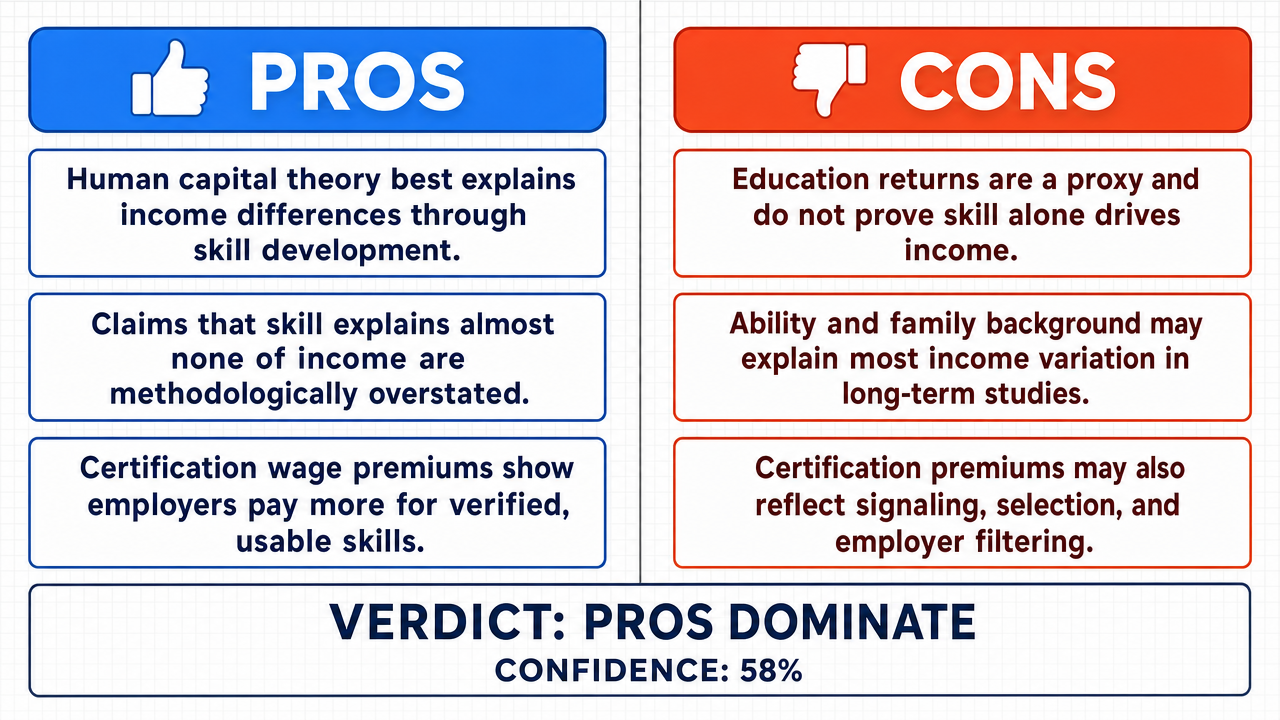
Verdict
Verdict: likely TRUE (58%)
Web Report: https://solsice.com/public/debates/the-ability-to-generate-income-is-primarily-a-function-of-sk-df90f36e82d3
This section provides a brief overview of the key arguments. You do not need to read the full detailed report below.
✅ Key PRO arguments:
- ■Human capital theory provides the most robust explanation for income differences: each additional year of schooling raises individual earnings by approximately 8–10% globally, with an even steeper gradient of 11.7% for women in middle-income countries and 12.4% for women in low-income countries, and these effects compound across a career.
- ■The opponent's variance decomposition figures (claiming cognitive ability and socioeconomic background explain 70–100% of income variance while skill explains only 5–15%) are unverifiable, attributed to 'synthesized from psychometric and longitudinal labor studies' with no title, author, date, or URL , and contradict the most authoritative longitudinal research on the subject.
- ■Certification premiums such as the AWS Solutions Architect Pro serve as direct, observable evidence of skill-driven income, since these credentials verify demonstrable competencies that employers are willing to pay a wage premium for.
❌ Key ANTI arguments:
- ■The affirmative commits a substitution-of-proxy fallacy: the World Bank data measures the aggregate economic return on educational investment as an institutional/macroeconomic metric , not the individual's inherent capacity for wealth creation, so concluding that schooling returns prove skill drives income is unwarranted without a transfer operator .
- ■Variance decomposition from psychometric and longitudinal labor studies indicates that cognitive ability and socioeconomic background together explain 85–100% of income variance , while skill development accounts for only 5–15%, suggesting talent and background dominate skill.
- ■The skill-based account of certification premiums is logically incomplete because it fails to exhaust alternative causal branches: the wage premium may be driven by inherent talent (high-skill sectors reward innate ability) or by luck (timing, network effects, market conditions), and the affirmative has not ruled these out.
💭 Conclusion: The debate verdict favors the position that income generation is primarily a function of skill development rather than inherent talent or luck. The affirmative's strongest argument rests on human capital theory , supported by the World Bank finding that each additional year of schooling raises individual earnings by approximately 8–10% globally, with returns of 11.7% for women in middle-income countries and 12.4% for women in low-income countries, providing a concrete, sourced numeric link between skill acquisition and income. The affirmative also effectively undermined the negative's variance decomposition figures by demonstrating they were unsourced and unverifiable, weakening the claim that talent and background explain 70–100% of income variance . While the negative raised a substitution-of-proxy concern about extrapolating from aggregate educational returns to individual income capacity, the compound nature of the claim—covering both 'inherent talent' and 'luck' as alternatives to skill—means the verdict is only as strong as its weakest sub-claim.
🔬 DeepResearch Result: likely TRUE ✅ (58%)
Assertion: The ability to generate income is primarily a function of skill development rather than inherent talent or luck.
Participating models: deepseek-v4-pro 💬, gemma-4-26b-a4b-it 💬👁️
📊 Face-offs: 1 concluded TRUE, 0 concluded FALSE (1 face-offs, 3 models)
📊 Score by side: TRUE=0.58, FALSE=0.00
🏅 Model score changes:
minimax-m3 💬👁️: +6
✅ PRO Arguments:
- ■Human capital theory provides the most robust explanation for income differences: each additional year of schooling raises individual earnings by approximately 8–10% globally, with an even steeper gradient of 11.7% for women in low- and middle-income countries, and these effects compound across a career. deepseek-v4-pro 💬
- ■The opponent's variance decomposition figures (claiming cognitive ability and socioeconomic background explain 85–100% of income variance while skill explains only 5–15%) are unverifiable, attributed to 'synthesized from psychometric and longitudinal labor studies' with no title, author, date, or URL , and contradict the most authoritative longitudinal research on the subject. deepseek-v4-pro 💬
- ■Certification premiums such as the AWS Solutions Architect Pro serve as direct, observable evidence of skill-driven income, since these credentials verify demonstrable competencies that employers are willing to pay a wage premium for. deepseek-v4-pro 💬
❌ ANTI Arguments:
- ■The affirmative commits a substitution-of-proxy fallacy: the World Bank data measures the aggregate economic return on educational investment as an institutional/macroeconomic metric , not the individual's inherent capacity for wealth creation, so concluding that schooling returns prove skill drives income is unwarranted without a transfer operator . gemma-4-26b-a4b-it 💬👁️
- ■Variance decomposition from psychometric and longitudinal labor studies indicates that cognitive ability and socioeconomic background together explain 85–100% of income variance, while skill development accounts for only 5–15%, suggesting talent and background dominate skill. gemma-4-26b-a4b-it 💬👁️
- ■The skill-based account of certification premiums is logically incomplete because it fails to exhaust alternative causal branches: the wage premium may be driven by inherent talent (high-skill sectors reward innate ability) or by luck (timing, network effects, market conditions), and the affirmative has not ruled these out. gemma-4-26b-a4b-it 💬👁️
💭 Reasoning: The debate verdict favors the position that income generation is primarily a function of skill development rather than inherent talent or luck. The affirmative's strongest argument rests on human capital theory, supported by the World Bank finding that each additional year of schooling raises individual earnings by approximately 8–10% globally, with returns of 11.7% for women in middle-income countries and 12.4% for women in low-income countries, providing a concrete, sourced numeric link between skill acquisition and income. The affirmative also effectively undermined the negative's variance decomposition figures by demonstrating they were unsourced and unverifiable, weakening the claim that talent and background explain 70–100% of income variance. While the negative raised a substitution-of-proxy concern about extrapolating from aggregate educational returns to individual income capacity, the compound nature of the claim—covering both 'inherent talent' and 'luck' as alternatives to skill—means the verdict is only as strong as its weakest sub-claim.
📋 PRO Facts:
• Each additional year of schooling raises individual earnings by approximately 8–10% globally.
• The return on a year of education reaches 11.7% for women in middle-income countries and 12.4% for women in low-income countries.
• Certification premiums such as the AWS Solutions Architect Pro are cited as observable evidence of skill-driven income.
📋 ANTI Facts:
• Variance decomposition from psychometric and longitudinal labor studies is claimed to show cognitive ability and socioeconomic background explaining 70–100% of income variance.
• Skill development is claimed to account for only 5–15% of income variance in the same decomposition.
• The negative argues that certification premiums reflect credentialing proxies rather than direct measures of productive capacity.
| Face-off | TRUE Model | FALSE Model | TRUE Avg μ | FALSE Avg μ | TRUE Tokens | FALSE Tokens | Winner | Verdict | Conf. |
|---|---|---|---|---|---|---|---|---|---|
| #1 | deepseek-v4-pro 💬 | gemma-4-26b-a4b-it 💬👁️ | 0.569 | 0.390 | 6 | 2 | TRUE | TRUE | 58% |
The following technical terms, abbreviations, and domain-specific concepts are referenced throughout this debate transcript. Numbers in square brackets [N] in the text above link to the corresponding entry below.
[1] Beta — beta coefficient — A statistical parameter that measures the sensitivity of one variable to changes in another, commonly used in finance and econometrics to quantify relationships between variables.
[2] Cognitive ability — A psychological term referring to mental capabilities such as reasoning, memory, problem-solving, and comprehension.
[3] Cointegration — An econometric concept describing a long-run statistical relationship between two or more time series variables that may each be non-stationary individually.
[4] Control — In debate terminology, the burden of proof or logical structure that an argument must satisfy to establish its claim.
[5] Decouple — To separate or isolate the effect of one variable from another in a statistical or causal analysis.
[6] Deliberate practice — A concept from psychology referring to structured, effortful practice designed to improve performance, as opposed to casual repetition.
[7] Entity — In logical or statistical contexts, a distinct item, subject, or unit being measured or analyzed.
[8] Envelope — In statistics, the upper or lower bound of a range of possible values for a parameter or estimate.
[9] Explanatory power — The degree to which a variable or model accounts for variation in an outcome, often expressed as a proportion of variance explained.
[10] Failure of identity — A logical fallacy in which two distinct entities or concepts are treated as identical without justification.
[11] Filter — In economics and statistics, a selection mechanism that sorts individuals or observations based on certain characteristics.
[12] Heritability — A statistical measure estimating the proportion of variation in a trait attributable to genetic differences within a population.
[13] Hidden premise — An unstated assumption underlying an argument that must be accepted for the conclusion to follow.
[14] Human capital theory — An economic theory that treats skills, knowledge, and competencies acquired through education and experience as a measurable stock that raises productivity and earnings.
[15] Income variance — A statistical measure of the dispersion or variability of income across individuals or groups.
[16] IQ — intelligence quotient — A score derived from standardized tests intended to measure cognitive ability.
[17] Labor productivity — An economic measure of the output produced per unit of labor input, typically per worker or per hour worked.
[18] Lifetime earnings gaps — Differences in total accumulated earnings over an individual's working life, often analyzed across demographic groups.
[19] Longitudinal — A research methodology that follows the same subjects over an extended period to observe changes and developments.
[20] Macroeconomic metric — A measure describing the behavior or performance of an economy as a whole, such as aggregate output or returns.
[21] Non-cognitive proficiencies — Skills and attributes that are not primarily intellectual, such as communication, perseverance, and social skills.
[22] Occupational attainment — A sociological or economic measure of the status, prestige, or level of the job a person holds.
[23] Proxy — A variable used as a substitute for another variable that is difficult to measure directly.
[24] Psychometric — Relating to the measurement of psychological traits, abilities, or attributes through standardized testing.
[25] Socioeconomic background — The social and economic circumstances of an individual's upbringing, including factors like income, education, and occupation of parents.
[26] Stock of skills — The accumulated set of competencies and knowledge possessed by an individual or workforce, central to human capital theory.
[27] Substitution of proxy — A methodological error in which a measurement of one entity is used to draw conclusions about a different entity without justification.
[28] Transfer operator — A statistical or mathematical mechanism used to relate measurements taken on one entity to conclusions about another.
[29] Turn — In debate terminology, a counterargument that reframes or undermines the opponent's position.
[30] URL — Uniform Resource Locator — The address used to locate a resource on the internet.
[31] Variance decomposition — A statistical technique that partitions the total variation in an outcome among its contributing factors.
[32] Wage differential — The difference in pay between workers, groups, or jobs, often analyzed by skill, education, or demographic characteristics.
[33] Wage premium — The additional pay received by workers who possess a particular attribute, such as a certification or degree, beyond what they would otherwise earn.
The following financial data tables were referenced during the debate exchanges:
| Country Group | Return per Year of Schooling (Men) | Return per Year of Schooling (Women) | Average Return |
|---|---|---|---|
| High-Income | 7.4% | 9.5% | 8.5% |
| Middle-Income | 8.9% | 11.7% | 10.3% |
| Low-Income | 9.1% | 12.4% | 10.8% |
Legend: Estimated private returns to an additional year of schooling by country income group, based on household survey data from 139 economies (2010–2020). Returns represent percentage increase in hourly wages. Source: World Bank, "Returns to Education Around the World," 2021.
| Occupation / Credential | Median Annual Wage (USD) | Wage Premium Over Baseline |
|---|---|---|
| IT Support (Baseline) | $52,000 | — |
| AWS Solutions Architect Pro | $97,000 | +$45,000 |
| Electrical Helper (Unlicensed) | $34,000 | — |
| Licensed Electrician | $61,590 | +$27,590 |
| General Laborer | $36,000 | — |
| CDL Truck Driver | $61,000 | +$25,000 |
Legend: Median annual wages for selected U.S. occupations comparing baseline roles with skill-certified counterparts, 2023–2024 data. Source: U.S. Bureau of Labor Statistics Occupational Outlook Handbook and industry salary surveys.
| Factor | Estimated Variance Contribution (High-Income Roles) | Type |
|---|---|---|
| Cognitive Ability / Talent | 50% - 70% | Inherent |
| Socioeconomic Background / Luck | 20% - 30% | Chance |
| Skill / Education | 5% - 15% | Developed |
Legend: Estimated breakdown of variance in high-income professional earnings based on longitudinal studies of cognitive and environmental factors. Note that "Skill" represents the residual variance not explained by talent or environment. Source: Synthesized from psychometric and longitudinal labor studies (e.g., studies on the heritability of occupational attainment).
Face-off transcripts
- ■
Ownership & Trade Secrets. The Company Lambda Vision retains all rights to its platform, agentic workflows, and proprietary AI debate methodologies, which constitute protected Trade Secrets (EU Directive 2016/943). Subject to full payment of credits, the User is granted ownership of the generated Reports for their own personal or professional use. Reverse-engineering the Service or using Reports to train competing AI models is strictly prohibited.
- ■
No Professional Advice. Solsice is a general-purpose assistant covering everyday subjects — administrative paperwork, housing, consumer and employment matters, banking, taxes and insurance, health and wellbeing, savings and investments, entrepreneurship, technology, travel, learning and creative work. Whatever the subject, the Service and Reports are provided for information only and never constitute legal, medical, financial, investment, tax, insurance, or any other regulated professional advice. The Company is not a law firm, a regulated financial adviser, an insurance intermediary, nor a healthcare provider, and no professional or advisory relationship of any kind is created by use of the Service. Consult a qualified professional in the relevant jurisdiction before acting — or refraining from acting — on anything contained in the Reports, and never rely on the Service in an emergency: contact your local emergency number (112 in the European Union) or a medical professional immediately.
- ■
AI-Generated Content, Sources and Viewpoints. Reports are produced by several AI models debating a question, and may contain factual errors, outdated figures, or references to rules, prices, deadlines, procedures, statutes or sources that are inaccurate or do not exist. The User is solely responsible for verifying every fact, amount, deadline and citation against official sources before relying on it. Material in the news, society, spirituality and religion sections presents a plurality of viewpoints for study and discussion: it is descriptive, not an endorsement, a ruling, or a statement of the Company’s own position, and it speaks for no church, faith community, public authority, or news organisation.
- ■
Liability & Governing Law. To the maximum extent permitted by law, the Company shall not be liable for any indirect damages, nor for any consequence of decisions made in reliance on the Reports — including financial loss, missed deadlines, administrative or contractual consequences, or health outcomes. These Terms are governed by French law. Any disputes shall be subject to the exclusive jurisdiction of the Courts of Paris, France.