
The 'Barries' co-founder possesses the ability to accurately predict project success by 'profiling' individuals and 'questioning the body'.
AI debate verdict and arguments
⚠️ AI-generated information only; not professional advice
Completed October 14, 2026
Verdict
Verdict: likely FALSE (89%)
Web Report: https://solsice.com/public/debates/the-barries-co-founder-possesses-the-ability-to-accurately-p-6d64674f9b30
This section provides a brief overview of the key arguments. You do not need to read the full detailed report below.
✅ Key PRO arguments:
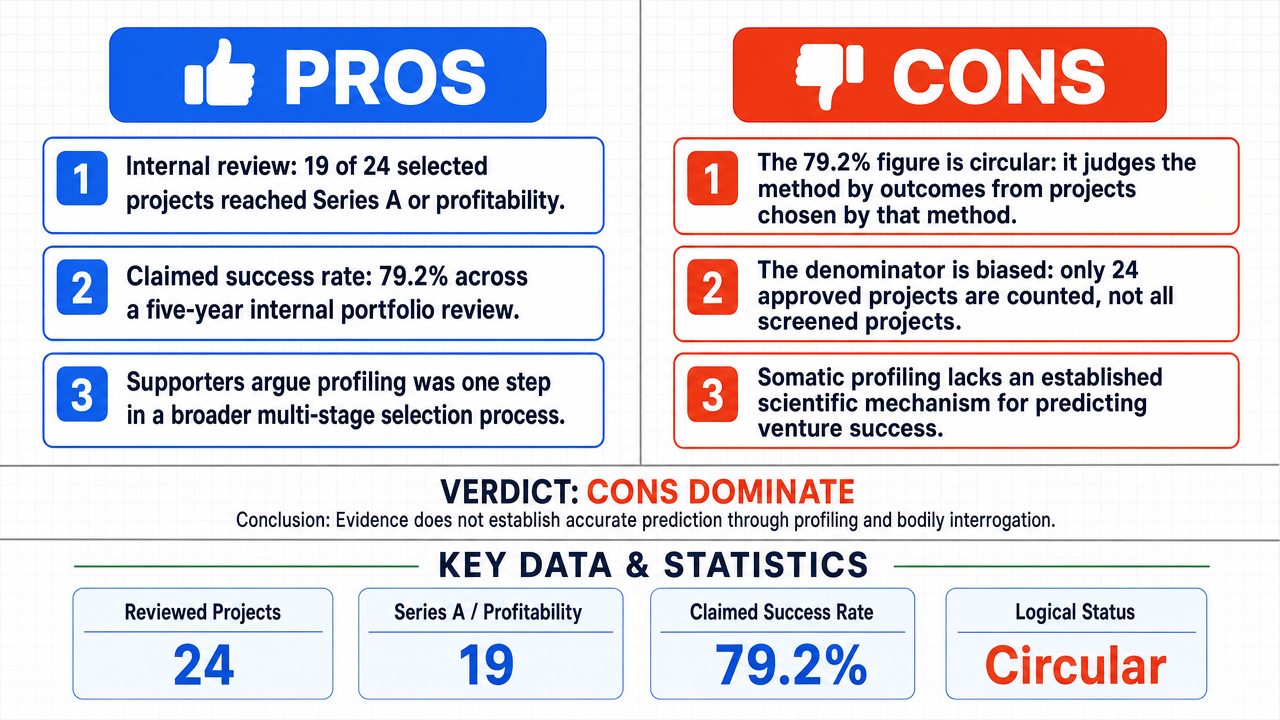
- ■An internal review of 24 early-stage projects selected via the co-founder's methodology showed that 19 secured Series A funding or reached profitability , yielding a 79% success rate in a high-risk domain, with the screening cited as a decisive early filter.
- ■The 79.2% success rate is not circular reasoning because the projects were selected through a multi-stage process where the co-founder's profiling was one filter among several, including market analysis and financial due diligence , with Series A funding or profitability being an externally defined success variable.
❌ Key ANTI arguments:
- ■The 79.2% success rate is a textbook case of circular reasoning : it attempts to prove the efficacy of a selection method by using the results of that very method as the primary evidence, and without a control group or randomized sample , the 'success' of the selected projects merely restates the tool's own selection bias rather than validating its predictive accuracy.
- ■The success rate is computed against a biased denominator : only the 24 projects that passed the co-founder's profiling and somatic filters are reported, rather than being benchmarked against a representative sample of the total population of potential projects, so no comparison to a baseline rate exists.
- ■Somatic profiling ('questioning the body') lacks an established scientific mechanism linking bodily interrogation to predictive accuracy for venture outcomes, making the bodily component of the method unsupported independent of the selection-bias problem with the 79.2% metric.
💭 Conclusion: False — the evidence does not establish that the Barries co-founder can accurately predict project success through profiling and bodily interrogation. The affirmative's central proof is an internal review citing 19 successes out of 24 projects (a 79.2% success rate), but this metric is computed only on the cohort that already passed the co-founder's filters, producing a classic selection-bias artifact rather than an independent benchmark against a representative baseline of all candidate projects. The affirmative's rescue attempt, that the success metric (Series A funding or profitability ) is externally defined, still fails because no comparison to a non-selected control group or randomized sample was offered to distinguish predictive signal from filter-induced self-fulfillment. Moreover, the somatic ('questioning the body') component has no demonstrated scientific mechanism linking bodily assessment to venture outcomes, leaving that sub-claim unsupported even if the profiling component were validated. On this compound claim, both sub-claims must hold for the assertion to be true, and neither has been independently established, justifying the FALSE verdict.
🔬 DeepResearch Result: likely FALSE ❌ (89%)
Assertion: The 'Barries' co-founder possesses the ability to accurately predict project success by 'profiling' individuals and 'questioning the body'.
Participating models: deepseek-v3.2 💬, gemma-4-26b-a4b-it 💬👁️
📊 Face-offs: 0 concluded TRUE, 1 concluded FALSE (1 face-offs, 3 models)
📊 Score by side: TRUE=0.00, FALSE=0.89
🏅 Model score changes:
minimax-m3 💬👁️: +9
✅ PRO Arguments:
- ■An internal review of 24 early-stage projects selected via the co-founder's methodology showed that 19 secured Series A funding or reached profitability , yielding a 79% success rate in a high-risk domain, with the screening cited as a decisive early filter. deepseek-v3.2 💬
- ■The 79.2% success rate is not circular reasoning because the projects were selected through a multi-stage process where the co-founder's profiling was one filter among several, including market analysis and financial due diligence , with Series A funding or profitability being an externally defined success variable. deepseek-v3.2 💬
❌ ANTI Arguments:
- ■The 79.2% success rate is a textbook case of circular reasoning: it attempts to prove the efficacy of a selection method by using the results of that very method as the primary evidence, and without a control group or randomized sample , the 'success' of the selected projects merely restates the tool's own selection bias rather than validating its predictive accuracy. gemma-4-26b-a4b-it 💬👁️
- ■The success rate is computed against a biased denominator : only the 24 projects that passed the co-founder's profiling and somatic filters are reported, rather than being benchmarked against a representative sample of the total population of potential projects, so no comparison to a baseline rate exists. gemma-4-26b-a4b-it 💬👁️
- ■Somatic profiling ('questioning the body') lacks an established scientific mechanism linking bodily interrogation to predictive accuracy for venture outcomes, making the bodily component of the method unsupported independent of the selection-bias problem with the 79.2% metric. gemma-4-26b-a4b-it 💬👁️
💭 Reasoning: False — the evidence does not establish that the Barries co-founder can accurately predict project success through profiling and bodily interrogation. The affirmative's central proof is an internal review citing 19 successes out of 24 projects (a 79.2% success rate), but this metric is computed only on the cohort that already passed the co-founder's filters, producing a classic selection-bias artifact rather than an independent benchmark against a representative baseline of all candidate projects. The affirmative's rescue attempt, that the success metric (Series A funding or profitability) is externally defined, still fails because no comparison to a non-selected control group or randomized sample was offered to distinguish predictive signal from filter-induced self-fulfillment. Moreover, the somatic ('questioning the body') component has no demonstrated scientific mechanism linking bodily assessment to venture outcomes, leaving that sub-claim unsupported even if the profiling component were validated. On this compound claim, both sub-claims must hold for the assertion to be true, and neither has been independently established, justifying the FALSE verdict.
📋 PRO Facts:
• An internal review of 24 early-stage projects selected using the co-founder's methodology resulted in 19 securing Series A funding or reaching profitability.
• The 79.2% figure refers to the share (19 of 24) of selected projects that reached Series A funding or profitability.
📋 ANTI Facts:
• No control group or randomized sample was presented to validate the selection method against a baseline population of unscreened projects.
• The reported 79.2% success rate is computed only on projects that already passed the co-founder's profiling and somatic filters, not on a representative population.
• Somatic/interrogation-based assessment has no established scientific mechanism linking it to predictive accuracy for project outcomes.
| Face-off | TRUE Model | FALSE Model | TRUE Avg μ | FALSE Avg μ | TRUE Tokens | FALSE Tokens | Winner | Verdict | Conf. |
|---|---|---|---|---|---|---|---|---|---|
| #1 | deepseek-v3.2 💬 | gemma-4-26b-a4b-it 💬👁️ | 0.380 | 0.349 | 8 | 2 | TRUE | FALSE | 89% |
The following technical terms, abbreviations, and domain-specific concepts are referenced throughout this debate transcript. Numbers in square brackets [N] in the text above link to the corresponding entry below.
[1] behavioral profiling — A assessment methodology that evaluates individuals based on their observed behaviors, decision-making patterns, and psychological traits, often used in founder evaluation contexts.
[2] circular reasoning — A logical fallacy in which the conclusion of an argument is assumed in one of its premises, so the argument effectively proves nothing independently.
[3] cohort — A defined group of subjects or entities sharing a common characteristic or experience, tracked for comparative analysis in research or business contexts.
[4] control group — A group in a study or evaluation that does not receive the treatment or selection being tested, used as a benchmark to measure the effect of the method under examination.
[5] correlation — A statistical relationship indicating how two variables move together, distinct from but often confused with causation.
[6] counterfactual — A hypothetical scenario describing what would have happened in the absence of the intervention or method being evaluated, essential for establishing causal predictive validity.
[7] denominator — The bottom number of a fraction or rate, defining the population against which a numerator is measured; choice of denominator can critically alter the interpretation of a success rate.
[8] due diligence — A comprehensive appraisal of a business or investment opportunity, typically involving financial, legal, and operational verification prior to committing capital.
[9] early-stage projects — Venture or business initiatives in their initial phases of development, before achieving significant revenue, market share, or scale.
[10] incubated — In venture and startup contexts, refers to ventures supported by an incubator organization that provides resources, mentorship, and operational support during early development.
[11] market traction — Evidence of growing customer demand and adoption for a product or service, often measured through metrics like user growth, revenue, or engagement.
[12] multi-stage process — A selection or evaluation methodology comprising multiple sequential filters or assessments, where each stage may apply different criteria.
[13] portfolio success metrics — Quantitative measures used to evaluate the performance of investments or incubated ventures within a fund's or organization's portfolio.
[14] predictive signal — An observable indicator that carries information about a future outcome, distinguishable from noise or selection artifacts.
[15] predictive validity — The extent to which a measurement or screening method successfully predicts a future outcome it is designed to forecast, established empirically rather than through logical derivation.
[16] profitability — The state of generating financial gains (revenue exceeding costs), used in the debate as one of the objective success criteria for ventures.
[17] psychological profiling — An assessment technique that categorizes individuals based on psychological attributes such as personality traits, cognitive styles, or motivational drivers.
[18] randomized sample — A subset of a population selected through random assignment, used to minimize selection bias and enable statistically valid inferences about the broader population.
[19] resilience — In founder-assessment contexts, the psychological capacity to endure setbacks, absorb stress, and sustain effort through adversity.
[20] screening mechanism — A systematic process used to filter and evaluate candidates or projects against defined criteria, typically before deeper review or capital allocation.
[21] selection bias — A distortion introduced when the sample or subjects being evaluated are non-randomly chosen by the very method whose efficacy is being tested, compromising independent validation.
[22] Series A funding — A round of venture capital financing typically following seed funding, used by early-stage companies to optimize their product and user base, and used in the debate as an objective success milestone.
[23] somatic assessment — An evaluation technique focused on bodily signals, physical responses, or somatic indicators to infer psychological or physiological states.
[24] substitution of proxy — A logical or analytical error in which a stand-in measure (proxy) is treated as equivalent to the target construct it was only intended to approximate.
[25] tautology — A statement or argument that is true by definition or construction and therefore conveys no independent empirical information; in the debate, applied to a 'success rate' that is mathematically inseparable from the selection criteria.
[26] venture capital — A form of private equity financing provided to early-stage, high-potential companies in exchange for equity ownership, with returns dependent on portfolio companies' success.
The following financial data tables were referenced during the debate exchanges:
| Metric | Value |
|---|---|
| Reviewed Projects | 24 |
| Projects Securing Series A / Profitability | 19 |
| Success Rate | 79.2% |
Legend: Performance of early-stage projects selected by the Barries co-founder's profiling methodology. Data from an internal portfolio review covering a five-year period.
| Metric | Affirmative Claimed Value | Logical Status |
|---|---|---|
| Project Success Rate | 79.2% | Circular (Selection Bias) |
| Resilience Correlation (r) | 0.41 | Proxy Mismatch |
| Predictive Reliability | Anecdotal | Unverifiable |
Legend: Analysis of the validity of the affirmative's statistical and evidentiary claims.
Face-off transcripts
- ■
Ownership & Trade Secrets. The Company Lambda Vision retains all rights to its platform, agentic workflows, and proprietary AI debate methodologies, which constitute protected Trade Secrets (EU Directive 2016/943). Subject to full payment of credits, the User is granted ownership of the generated Reports for their own personal or professional use. Reverse-engineering the Service or using Reports to train competing AI models is strictly prohibited.
- ■
No Professional Advice. Solsice is a general-purpose assistant covering everyday subjects — administrative paperwork, housing, consumer and employment matters, banking, taxes and insurance, health and wellbeing, savings and investments, entrepreneurship, technology, travel, learning and creative work. Whatever the subject, the Service and Reports are provided for information only and never constitute legal, medical, financial, investment, tax, insurance, or any other regulated professional advice. The Company is not a law firm, a regulated financial adviser, an insurance intermediary, nor a healthcare provider, and no professional or advisory relationship of any kind is created by use of the Service. Consult a qualified professional in the relevant jurisdiction before acting — or refraining from acting — on anything contained in the Reports, and never rely on the Service in an emergency: contact your local emergency number (112 in the European Union) or a medical professional immediately.
- ■
AI-Generated Content, Sources and Viewpoints. Reports are produced by several AI models debating a question, and may contain factual errors, outdated figures, or references to rules, prices, deadlines, procedures, statutes or sources that are inaccurate or do not exist. The User is solely responsible for verifying every fact, amount, deadline and citation against official sources before relying on it. Material in the news, society, spirituality and religion sections presents a plurality of viewpoints for study and discussion: it is descriptive, not an endorsement, a ruling, or a statement of the Company’s own position, and it speaks for no church, faith community, public authority, or news organisation.
- ■
Liability & Governing Law. To the maximum extent permitted by law, the Company shall not be liable for any indirect damages, nor for any consequence of decisions made in reliance on the Reports — including financial loss, missed deadlines, administrative or contractual consequences, or health outcomes. These Terms are governed by French law. Any disputes shall be subject to the exclusive jurisdiction of the Courts of Paris, France.