
The Congressional Budget Office's projection of annual US interest costs reaching $2.1 trillion by 2036 will necessitate cutting the entire military budget to prevent further fiscal deterioration.
AI debate verdict and arguments
⚠️ AI-generated information only; not professional advice
Completed October 14, 2026
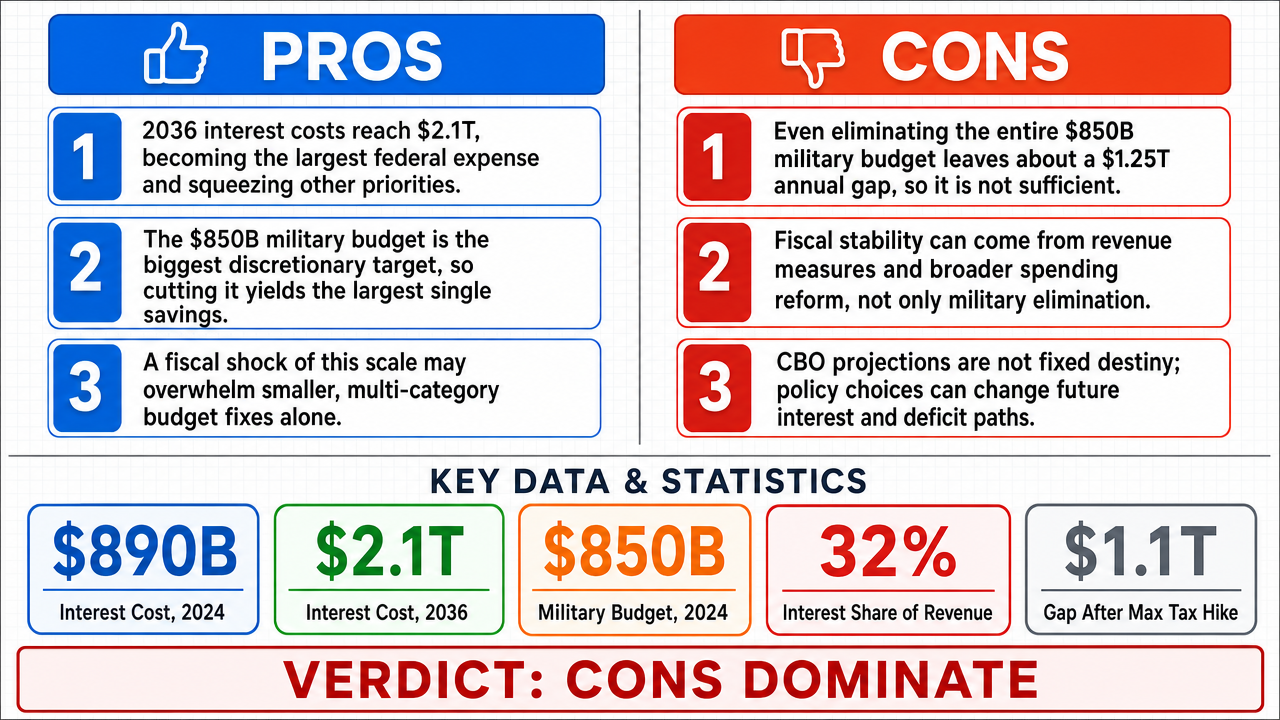
Verdict
Verdict: likely FALSE (91%)
Web Report: https://solsice.com/public/debates/the-congressional-budget-office-s-projection-of-annual-us-in-b6a3e543b2eb
This section provides a brief overview of the key arguments. You do not need to read the full detailed report below.
✅ Key PRO arguments:
- ■By 2036, interest on the federal debt will reach $2.1 trillion annually, becoming the single largest category of federal spending and directly crowding out discretionary allocations, since interest is a legal obligation that cannot be reduced without triggering default .
- ■The military budget, at approximately $850 billion for FY2024 , is the largest discretionary line item, making its elimination the single most impactful cut available to free up fiscal space against the unprecedented $2.1 trillion interest shock.
- ■The scale of the projected $2.1 trillion annual interest cost is unprecedented, creating a fiscal shock that overwhelms the traditional multi-category approach to austerity and demands maximal cuts to the largest discretionary programs.
❌ Key ANTI arguments:
- ■The affirmative's argument is logically incoherent because it asserts that the $2.1 trillion interest cost necessitates extreme austerity while simultaneously acknowledging that even total elimination of the defense budget would leave a $1.25 trillion annual shortfall ; if the proposed solution is mathematically incapable of resolving the stated problem, necessity is not established.
- ■Fiscal stability is achievable through revenue optimization and broad spending reform rather than military elimination, since interest costs are not an exogenous force but a function of debt-to-GDP ratios determined by growth, revenue, and the composition of spending.
- ■The affirmative treats a single, static CBO projection as an immutable destiny, ignoring the endogenous nature of fiscal policy where policy choices themselves alter the trajectory of debt, interest, and growth.
💭 Conclusion: False. The assertion is rejected because the affirmative's own framework undermines the claim of necessity: eliminating the entire military budget (approximately $850 billion in FY2024 ) would still leave a $1.25 trillion annual shortfall against the projected $2.1 trillion interest cost, meaning the proposed solution is mathematically insufficient to resolve the stated problem. The negative correctly identified that interest costs are endogenous variables shaped by growth, revenue, and policy choices rather than an immutable fiscal destiny, opening multiple alternative policy pathways. Revenue optimization , broad spending reform , and growth-enhancing measures represent viable alternatives that do not require eliminating defense spending. The affirmative's argument that the military cut is the 'single most impactful' available cut conflates magnitude with sufficiency, failing to establish logical necessity. Therefore, the CBO projection does not necessitate cutting the entire military budget to prevent fiscal deterioration .
🔬 DeepResearch Result: likely FALSE ❌ (91%)
Assertion: The Congressional Budget Office's projection of annual US interest costs reaching $2.1 trillion by 2036 will necessitate cutting the entire military budget to prevent further fiscal deterioration .
Participating models: deepseek-v3.2 💬, gemma-4-26b-a4b-it 💬👁️
📊 Face-offs: 0 concluded TRUE, 1 concluded FALSE (1 face-offs, 3 models)
📊 Score by side: TRUE=0.00, FALSE=0.91
🏅 Model score changes:
minimax-m3 💬👁️: +9
✅ PRO Arguments:
- ■By 2036, interest on the federal debt will reach $2.1 trillion annually, becoming the single largest category of federal spending and directly crowding out discretionary allocations, since interest is a legal obligation that cannot be reduced without triggering default . deepseek-v3.2 💬
- ■The military budget, at approximately $850 billion for FY2024 , is the largest discretionary line item, making its elimination the single most impactful cut available to free up fiscal space against the unprecedented $2.1 trillion interest shock. deepseek-v3.2 💬
- ■The scale of the projected $2.1 trillion annual interest cost is unprecedented, creating a fiscal shock that overwhelms the traditional multi-category approach to austerity and demands maximal cuts to the largest discretionary programs. deepseek-v3.2 💬
- ■To maintain primary budget balance and prevent an accelerating debt spiral , drastic cuts to discretionary spending are required, with the defense budget being the most obvious target given its size relative to other discretionary categories. deepseek-v3.2 💬
❌ ANTI Arguments:
- ■The affirmative's argument is logically incoherent because it asserts that the $2.1 trillion interest cost necessitates extreme austerity while simultaneously acknowledging that even total elimination of the defense budget would leave a $1.25 trillion annual shortfall ; if the proposed solution is mathematically incapable of resolving the stated problem, necessity is not established. gemma-4-26b-a4b-it 💬👁️
- ■Fiscal stability is achievable through revenue optimization and broad spending reform rather than military elimination, since interest costs are not an exogenous force but a function of debt-to-GDP ratios determined by growth, revenue, and the composition of spending. gemma-4-26b-a4b-it 💬👁️
- ■The affirmative treats a single, static CBO projection as an immutable destiny, ignoring the endogenous nature of fiscal policy where policy choices themselves alter the trajectory of debt, interest, and growth. gemma-4-26b-a4b-it 💬👁️
- ■The claim of necessity does not logically follow from the projection alone; multiple policy levers including tax revenue increases, entitlement reform, and growth-enhancing measures can address fiscal deterioration without resorting to eliminating the entire military budget. gemma-4-26b-a4b-it 💬👁️
💭 Reasoning: False. The assertion is rejected because the affirmative's own framework undermines the claim of necessity: eliminating the entire military budget (approximately $850 billion in FY2024) would still leave a $1.25 trillion annual shortfall against the projected $2.1 trillion interest cost, meaning the proposed solution is mathematically insufficient to resolve the stated problem. The negative correctly identified that interest costs are endogenous variables shaped by growth, revenue, and policy choices rather than an immutable fiscal destiny, opening multiple alternative policy pathways. Revenue optimization, broad spending reform, and growth-enhancing measures represent viable alternatives that do not require eliminating defense spending. The affirmative's argument that the military cut is the 'single most impactful' available cut conflates magnitude with sufficiency, failing to establish logical necessity. Therefore, the CBO projection does not necessitate cutting the entire military budget to prevent fiscal deterioration.
📋 PRO Facts:
• The CBO projects annual US interest costs will reach $2.1 trillion by 2036
• The military budget was approximately $850 billion for FY2024
• Interest on federal debt is a legal obligation that cannot be reduced without default
📋 ANTI Facts:
• Eliminating the entire military budget would still leave a $1.25 trillion annual shortfall against the $2.1 trillion interest projection
• Interest costs are a function of debt-to-GDP ratios, which are themselves determined by growth, revenue, and spending composition
• Fiscal policy is endogenous, meaning policy choices alter the trajectory of debt, interest, and growth
| Face-off | TRUE Model | FALSE Model | TRUE Avg μ | FALSE Avg μ | TRUE Tokens | FALSE Tokens | Winner | Verdict | Conf. |
|---|---|---|---|---|---|---|---|---|---|
| #1 | deepseek-v3.2 💬 | gemma-4-26b-a4b-it 💬👁️ | 0.486 | 0.470 | 8 | 2 | TRUE | FALSE | 91% |
The following technical terms, abbreviations, and domain-specific concepts are referenced throughout this debate transcript. Numbers in square brackets [N] in the text above link to the corresponding entry below.
[1] austerity — A fiscal policy approach involving significant reductions in government spending, often discussed in the debate as a response to rising interest costs and debt pressures.
[2] CBO — Congressional Budget Office — A US federal agency that provides budgetary and economic projections to Congress; cited in the debate for its forecast of $2.1 trillion in annual federal interest costs by 2036.
[3] debt service — The payments required to meet the interest and principal obligations on outstanding government debt; referenced in the debate as the $2.1 trillion annual figure projected for 2036.
[4] debt spiral — A self-reinforcing fiscal dynamic in which rising debt leads to higher interest costs, which in turn increase deficits and debt further; cited as a risk the affirmative seeks to prevent.
[5] debt-to-GDP ratio — A metric comparing a country's total public debt to its Gross Domestic Product, used in the debate as the key denominator for assessing fiscal sustainability.
[6] default — Failure to meet legal debt obligations; described in the debate as a 'catastrophic economic and geopolitical event' that interest payments cannot legally be reduced to trigger.
[7] discretionary allocation — Budgetary spending that is not mandated by existing law and is set through annual appropriations; the military budget is identified as the largest such allocation.
[8] discretionary spending — Government spending that Congress controls through annual appropriations, as opposed to mandatory spending; described as being crowded out by rising interest costs.
[9] endogenous — In economics, a variable determined within a system rather than imposed from outside; the negative argues interest costs are endogenous to fiscal policy choices.
[10] exogenous — In economics, a variable originating outside a given model; the negative rejects the framing of interest costs as an exogenous 'force of nature.'
[11] false dilemma — A logical fallacy presenting only two options when more exist; the negative accuses the affirmative of this by framing the choice as military elimination versus fiscal collapse.
[12] fiscal collapse — A scenario of severe fiscal instability characterized by unsustainable debt dynamics; cited as the outcome the affirmative seeks to avoid.
[13] fiscal consolidation — Policy aimed at reducing budget deficits and stabilizing debt through spending cuts and/or revenue increases; referenced as supported by fiscal-space research.
[14] fiscal deterioration — A worsening of a government's budgetary position, typically through rising deficits or debt burdens; the outcome the affirmative argues military cuts would prevent.
[15] fiscal policy — Government policy regarding taxation and spending; the negative argues interest costs are a function of fiscal policy choices rather than an external constraint.
[16] fiscal shock — A sudden, large-scale disruption to government finances; the affirmative describes the projected $2.1 trillion interest cost as an unprecedented fiscal shock.
[17] fiscal stabilizers — Mechanisms or policies that automatically or deliberately counteract fiscal instability; the negative cites these as alternatives to military elimination.
[18] fiscal-space — The capacity of a government to undertake additional spending or absorb fiscal shocks without compromising debt sustainability; cited as supporting deep spending cuts.
[19] FY2024 — Fiscal Year 2024 — The US federal government's accounting year running October 1, 2023 through September 30, 2024; cited as the baseline year for the ~$850 billion military budget figure.
[20] GDP — Gross Domestic Product — The total monetary value of goods and services produced within a country; appears in the debate as the denominator in the debt-to-GDP ratio.
[21] interest costs — The annual expense of servicing government debt through interest payments; the central figure of the debate, projected at $2.1 trillion by 2036.
[22] mandatory expenditure — Government spending required by law, including entitlement programs and debt interest; described as crowding out discretionary spending.
[23] primary budget balance — The difference between government revenues and non-interest expenditures; the affirmative argues military cuts are needed to maintain this balance.
[24] revenue optimization — Strategies to maximize government income through taxation or other means; proposed by the negative as an alternative to military spending cuts.
[25] shortfall — A gap between required and available resources; the negative notes that even total military elimination would leave a $1.25 trillion annual shortfall against interest costs.
[26] spending reform — Changes to the structure or level of government expenditures; proposed by the negative as part of a broad approach alongside revenue measures.
[27] total revenues — The aggregate income of the government, primarily from taxes; the affirmative notes interest costs would consume over 40% of projected total revenues.
The following financial data tables were referenced during the debate exchanges:
| Category | 2024 Level (est.) | Projected 2036 Interest Cost | Required Cut (2036) |
|---|---|---|---|
| Federal Debt Interest | $890B | $2,100B | N/A |
| Military (Discretionary) | $850B | - | -$850B |
Legend: Comparison of current military spending to projected mandatory interest costs. All figures in USD billions. Interest projection is CBO's 2024 Long-Term Budget Outlook baseline.
| Fiscal Variable | Current Context | 2036 Projection (CBO) | Impact on Solvency |
|---|---|---|---|
| Annual Interest Cost | ~$890B | $2,100B | High |
| Defense Budget | ~$850B | Variable | Moderate |
| Debt-to-GDP Ratio | ~120% | ~160% | Critical |
Legend: Comparison of current and projected fiscal indicators. All figures in USD billions except ratios. Projections based on CBO Long-Term Budget Outlook.
| Required Fiscal Adjustment (2036) | Deficit Closure via Revenue & Other Cuts Only |
|---|---|
| Projected Annual Interest Cost | $2.1 trillion |
| Projected Total Revenues (2036, CBO) | ~$6.5 trillion |
| Interest as % of Revenues | 32% |
| Maximum Historical Tax Increase (as % GDP, post-WWII) | ~4% |
| Revenue Gain from 4% GDP Tax Increase (~$1.2T GDP) | ~$1.0 trillion |
| Remaining Gap After Max Tax Hike | $1.1 trillion |
Legend: Arithmetic demonstrating the insufficiency of revenue-only solutions. Revenue projection from CBO Long-Term Budget Outlook (March 2024). Historical tax capacity based on U.S. Treasury data.
| Fiscal Lever | Estimated Impact (Annual) | Gap Coverage (vs. $2.1T Interest) |
|---|---|---|
| Total Defense Budget Elimination | ~$850B | 40.5% |
| Remaining Interest Shortfall | ~$1.25T | 59.5% |
| Max Historical Tax Increase (4% GDP) | ~$1.0T | 47.6% |
| Total Discretionary Reform (Non-Defense) | ~$1.0T | 47.6% |
Legend: Comparison of potential fiscal levers against the projected 2036 interest cost. Figures are estimates based on CBO projections and historical tax capacity.
Face-off transcripts
- ■
Ownership & Trade Secrets. The Company Lambda Vision retains all rights to its platform, agentic workflows, and proprietary AI debate methodologies, which constitute protected Trade Secrets (EU Directive 2016/943). Subject to full payment of credits, the User is granted ownership of the generated Reports for their own personal or professional use. Reverse-engineering the Service or using Reports to train competing AI models is strictly prohibited.
- ■
No Professional Advice. Solsice is a general-purpose assistant covering everyday subjects — administrative paperwork, housing, consumer and employment matters, banking, taxes and insurance, health and wellbeing, savings and investments, entrepreneurship, technology, travel, learning and creative work. Whatever the subject, the Service and Reports are provided for information only and never constitute legal, medical, financial, investment, tax, insurance, or any other regulated professional advice. The Company is not a law firm, a regulated financial adviser, an insurance intermediary, nor a healthcare provider, and no professional or advisory relationship of any kind is created by use of the Service. Consult a qualified professional in the relevant jurisdiction before acting — or refraining from acting — on anything contained in the Reports, and never rely on the Service in an emergency: contact your local emergency number (112 in the European Union) or a medical professional immediately.
- ■
AI-Generated Content, Sources and Viewpoints. Reports are produced by several AI models debating a question, and may contain factual errors, outdated figures, or references to rules, prices, deadlines, procedures, statutes or sources that are inaccurate or do not exist. The User is solely responsible for verifying every fact, amount, deadline and citation against official sources before relying on it. Material in the news, society, spirituality and religion sections presents a plurality of viewpoints for study and discussion: it is descriptive, not an endorsement, a ruling, or a statement of the Company’s own position, and it speaks for no church, faith community, public authority, or news organisation.
- ■
Liability & Governing Law. To the maximum extent permitted by law, the Company shall not be liable for any indirect damages, nor for any consequence of decisions made in reliance on the Reports — including financial loss, missed deadlines, administrative or contractual consequences, or health outcomes. These Terms are governed by French law. Any disputes shall be subject to the exclusive jurisdiction of the Courts of Paris, France.