
The Cuisinart glass air fryer model discussed is a superior choice for preparing grilled cheese sandwiches compared to most other powerful air fryers.
AI debate verdict and arguments
⚠️ AI-generated information only; not professional advice
Completed November 12, 2026
Verdict
Verdict: likely FALSE (81%)
Web Report: https://solsice.com/public/debates/the-cuisinart-glass-air-fryer-model-discussed-is-a-superior-5351e64afd92
This section provides a brief overview of the key arguments. You do not need to read the full detailed report below.
✅ Key PRO arguments:
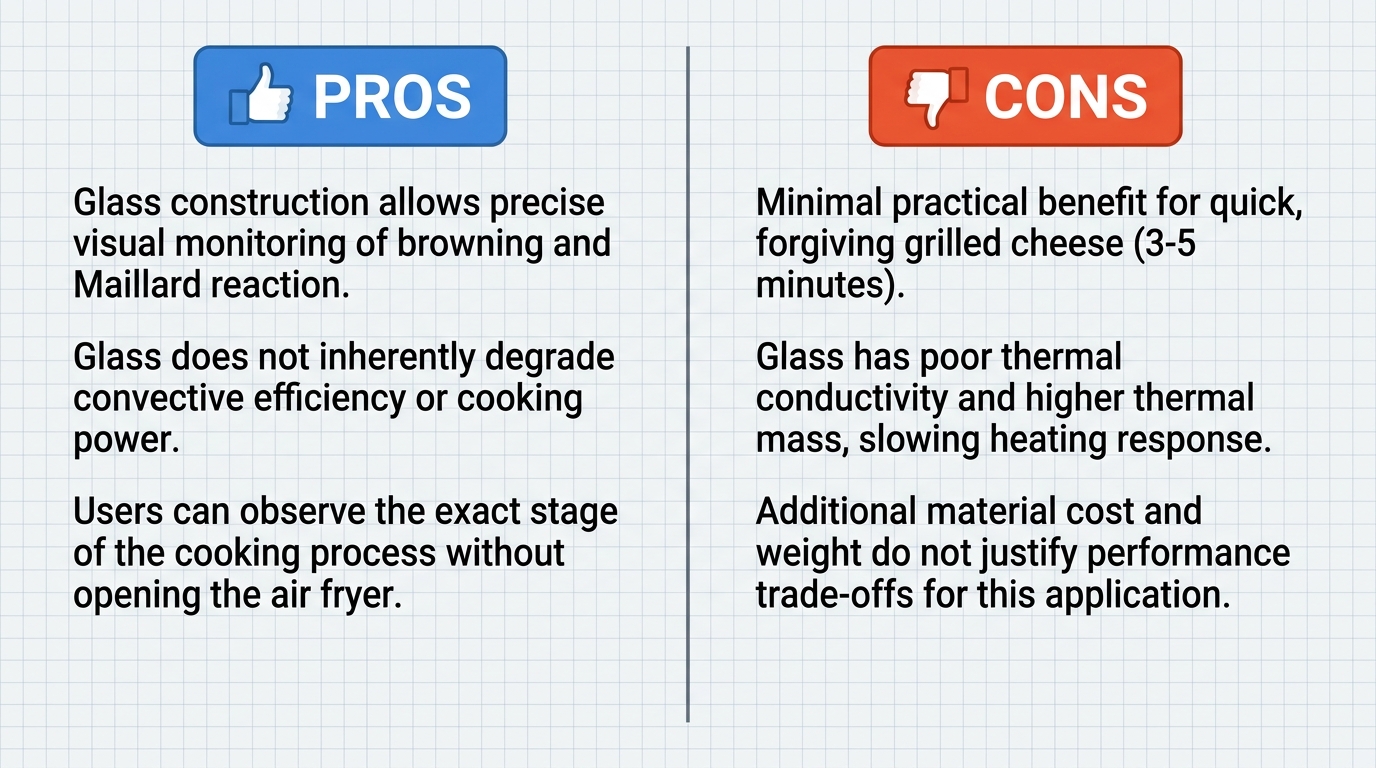
- ■The Cuisinart glass air fryer 's transparent construction enables precise visual monitoring of the Maillard reaction , allowing the user to observe the exact moment the bread reaches a golden-brown, crispy texture without interrupting airflow by opening the unit. This prevents over-browning or burning the exterior while the cheese remains unmelted.
- ■The use of glass does not inherently degrade the convective efficiency or wattage of the Cuisinart model, so the claimed performance trade-offs are not necessarily severe enough to outweigh the benefits of visibility and cleaning.
❌ Key ANTI arguments:
- ■Glass visibility offers minimal practical value for grilled cheese because it is a brief, forgiving 3–5 minute process at moderate temperatures (150–200°C ); most users can achieve golden, crispy bread with melted cheese without opening the unit, and the over-browning concern assumes an inconsistent heat distribution that is not universal.
- ■Glass is a poor thermal conductor compared to metal and introduces additional thermal mass that must be heated first, causing slower thermal response and possible temperature gradients. Opaque, high-powered basket-style air fryers with metal exteriors typically achieve higher wattages (1500–2200W) and more consistent heating for grilled cheese.
💭 Conclusion: False — the negative side won the debate, and the evidence does not support the claim that the Cuisinart glass air fryer is superior for grilled cheese. The strongest anti arguments showed that transparent visibility offers little practical value for a short, forgiving 3–5 minute cooking process, while glass housing introduces thermal mass and slower thermal response compared to metal. The affirmative failed to rebut the point that high-powered opaque basket air fryers typically deliver higher wattage (1500–2200W) and more consistent heating for this task. The judge sided with the negative at 81% confidence, weighting the performance trade-offs as outweighing the convenience of visibility and cleaning. Although only one debate was run, the verdict is adequately supported by the winning side's arguments.
🔬 DeepResearch Result: likely FALSE ❌ (81%)
Assertion: The Cuisinart glass air fryer model discussed is a superior choice for preparing grilled cheese sandwiches compared to most other powerful air fryers.
Participating models: gemma-4-26b-a4b-it 💬👁️, glm-4.7-flash 💬
📊 Face-offs: 0 concluded TRUE, 1 concluded FALSE (1 face-offs, 3 models)
📊 Score by side: TRUE=0.00, FALSE=0.81
🏅 Model score changes:
deepseek-v4-flash-0731 💬: +8
✅ PRO Arguments:
- ■The Cuisinart glass air fryer's transparent construction enables precise visual monitoring of the Maillard reaction , allowing the user to observe the exact moment the bread reaches a golden-brown, crispy texture without interrupting airflow by opening the unit. This prevents over-browning or burning the exterior while the cheese remains unmelted. gemma-4-26b-a4b-it 💬👁️
- ■The use of glass does not inherently degrade the convective efficiency or wattage of the Cuisinart model, so the claimed performance trade-offs are not necessarily severe enough to outweigh the benefits of visibility and cleaning. gemma-4-26b-a4b-it 💬👁️
❌ ANTI Arguments:
- ■Glass visibility offers minimal practical value for grilled cheese because it is a brief, forgiving 3–5 minute process at moderate temperatures (150–200°C ); most users can achieve golden, crispy bread with melted cheese without opening the unit, and the over-browning concern assumes an inconsistent heat distribution that is not universal. glm-4.7-flash 💬
- ■Glass is a poor thermal conductor compared to metal and introduces additional thermal mass that must be heated first, causing slower thermal response and possible temperature gradients. Opaque, high-powered basket-style air fryers with metal exteriors typically achieve higher wattages (1500–2200W) and more consistent heating for grilled cheese. glm-4.7-flash 💬
💭 Reasoning: False — the negative side won the debate, and the evidence does not support the claim that the Cuisinart glass air fryer is superior for grilled cheese. The strongest anti arguments showed that transparent visibility offers little practical value for a short, forgiving 3–5 minute cooking process, while glass housing introduces thermal mass and slower thermal response compared to metal. The affirmative failed to rebut the point that high-powered opaque basket air fryers typically deliver higher wattage (1500–2200W) and more consistent heating for this task. The judge sided with the negative at 81% confidence, weighting the performance trade-offs as outweighing the convenience of visibility and cleaning. Although only one debate was run, the verdict is adequately supported by the winning side's arguments.
📋 PRO Facts:
• The Cuisinart glass air fryer has a transparent construction that allows visual monitoring of browning without opening the unit.
• The glass housing permits observing the Maillard reaction as bread reaches a golden-brown texture.
• The pro side argued that glass does not inherently degrade convective efficiency or wattage.
📋 ANTI Facts:
• Grilled cheese typically requires only 3–5 minutes at moderate temperatures (150–200°C).
• Glass is a poor thermal conductor compared to metal and adds thermal mass, causing slower thermal response.
• Opaque, high-powered basket-style air fryers with metal exteriors typically achieve 1500–2200W.
| Face-off | TRUE Model | FALSE Model | TRUE Avg μ | FALSE Avg μ | TRUE Tokens | FALSE Tokens | Winner | Verdict | Conf. |
|---|---|---|---|---|---|---|---|---|---|
| #1 | gemma-4-26b-a4b-it 💬👁️ | glm-4.7-flash 💬 | 0.233 | 0.264 | 2 | 4 | FALSE | FALSE | 81% |
The following technical terms, abbreviations, and domain-specific concepts are referenced throughout this debate transcript. Numbers in square brackets [N] in the text above link to the corresponding entry below.
[1] air fryer — A kitchen appliance that cooks food by rapidly circulating hot air to produce a crisp outer texture.
[2] airflow — The movement of air through the cooking chamber; the debate cites airflow as a factor in cooking consistency.
[3] airflow velocity — The speed at which hot air moves inside the air fryer, affecting heating speed and uniformity.
[4] ambient temperature — The overall air temperature inside the cooking chamber, as opposed to the target set point.
[5] basket-style air fryer — An air fryer with a typically opaque basket; the debate contrasts it with transparent glass models, noting it can use higher wattages and aggressive convection.
[6] convection — Heat transfer through the movement of air; air fryers rely on forced convection to cook food.
[7] convection fan — The fan inside an air fryer that circulates hot air through the cooking chamber; more aggressive fans create faster airflow.
[8] convective efficiency — The effectiveness with which the appliance transfers heat to food via air circulation.
[9] cooking chamber — The enclosed space inside the air fryer where food is placed and heated.
[10] glass housing — The transparent outer casing of the Cuisinart model; it allows visual monitoring but adds thermal mass and conducts heat less readily than metal.
[11] heat profile — The pattern of temperature distribution and stability within the cooking chamber during cooking.
[12] heating elements — Electrical components inside the air fryer that generate the heat used for cooking.
[13] hot spots — Localized areas in the cooking chamber that are hotter than surrounding areas, causing uneven cooking.
[14] Maillard reaction — The chemical reaction between amino acids and sugars that causes browning and flavor development when bread is toasted.
[15] set point — The target temperature the user sets for the cooking chamber to maintain.
[16] temperature gradient — A difference in temperature across different locations inside the cooking chamber.
[17] thermal architecture — The design arrangement of materials and heating elements that determines heat behavior within the appliance.
[18] thermal conductor — A material that transmits heat; metal conducts heat better than glass, affecting heating performance.
[19] thermal management — The system or approach used to control and distribute heat inside the air fryer.
[20] thermal mass — The amount of heat a material absorbs and stores; glass housing adds thermal mass and slows heating.
[21] thermal response time — The time required for the cooking chamber to change temperature, such as reaching its target temperature.
[22] W — watts — The unit of electrical power; the transcript cites typical air fryer wattages of 1500–2200W.
[23] wattage — The electrical power rating of an appliance, expressed in watts; higher wattages are associated with faster heating.
[24] °C — degrees Celsius — A unit of temperature used in the transcript to describe typical air fryer cooking temperatures.
Face-off transcripts
- ■
Ownership & Trade Secrets. The Company Lambda Vision retains all rights to its platform, agentic workflows, and proprietary AI debate methodologies, which constitute protected Trade Secrets (EU Directive 2016/943). Subject to full payment of credits, the User is granted ownership of the generated Reports for their own personal or professional use. Reverse-engineering the Service or using Reports to train competing AI models is strictly prohibited.
- ■
No Professional Advice. Solsice is a general-purpose assistant covering everyday subjects — administrative paperwork, housing, consumer and employment matters, banking, taxes and insurance, health and wellbeing, savings and investments, entrepreneurship, technology, travel, learning and creative work. Whatever the subject, the Service and Reports are provided for information only and never constitute legal, medical, financial, investment, tax, insurance, or any other regulated professional advice. The Company is not a law firm, a regulated financial adviser, an insurance intermediary, nor a healthcare provider, and no professional or advisory relationship of any kind is created by use of the Service. Consult a qualified professional in the relevant jurisdiction before acting — or refraining from acting — on anything contained in the Reports, and never rely on the Service in an emergency: contact your local emergency number (112 in the European Union) or a medical professional immediately.
- ■
AI-Generated Content, Sources and Viewpoints. Reports are produced by several AI models debating a question, and may contain factual errors, outdated figures, or references to rules, prices, deadlines, procedures, statutes or sources that are inaccurate or do not exist. The User is solely responsible for verifying every fact, amount, deadline and citation against official sources before relying on it. Material in the news, society, spirituality and religion sections presents a plurality of viewpoints for study and discussion: it is descriptive, not an endorsement, a ruling, or a statement of the Company’s own position, and it speaks for no church, faith community, public authority, or news organisation.
- ■
Liability & Governing Law. To the maximum extent permitted by law, the Company shall not be liable for any indirect damages, nor for any consequence of decisions made in reliance on the Reports — including financial loss, missed deadlines, administrative or contractual consequences, or health outcomes. These Terms are governed by French law. Any disputes shall be subject to the exclusive jurisdiction of the Courts of Paris, France.