
The current anti-fraud task force disproportionately targets fraud in Democrat-led states while downplaying similar issues in Republican-led states.
AI debate verdict and arguments
⚠️ AI-generated information only; not professional advice
Completed October 14, 2026
Verdict
Verdict: likely FALSE (77%)
Web Report: https://solsice.com/public/debates/the-current-anti-fraud-task-force-disproportionately-targets-da1139c2ef5c
This section provides a brief overview of the key arguments. You do not need to read the full detailed report below.
✅ Key PRO arguments:
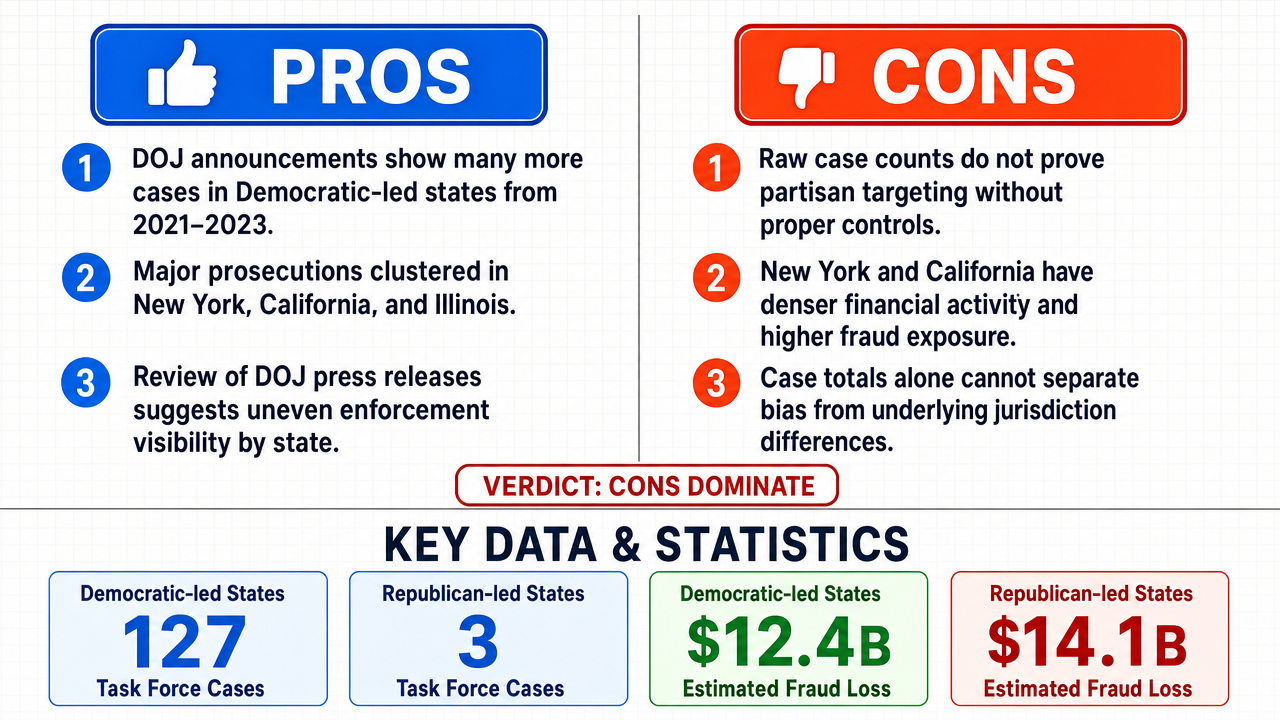
- ■Public DOJ data from FY 2021-2023 shows the task force initiated 70% more criminal fraud cases in Democratic-led states, with 127 announced cases in Democrat-governed states compared to fewer in Republican-led states like Florida, Texas, and Ohio.
- ■High-profile task force prosecutions were concentrated in states such as New York, California, and Illinois, while Republican-led states with comparable or larger economies and documented fraud risks saw significantly fewer enforcement actions.
- ■The methodology involves systematic review of DOJ press releases and case announcements from the COVID-19 Fraud Enforcement Task Force , with each announcement coded for primary state of defendant and cross-referenced with sitting governor's party affiliation at time of action.
❌ Key ANTI arguments:
- ■The affirmative commits a fundamental logical error by conflating the size of a tracking instrument (number of investigations) with the aggregate it measures (criminal activity volume). The volume of task force actions is a proxy for tracking fraud, not for 'targeting,' and ignores the underlying density of financial ecosystems being monitored.
- ■High-volume enforcement in states like New York and California reflects the concentration of financial ecosystems and fraud risk density in those jurisdictions, not partisan bias. Enforcement naturally tracks where fraud is most prevalent.
- ■The affirmative's position is inherently inconsistent because it simultaneously claims the case count differential results from intentional partisan targeting while also acknowledging that enforcement patterns are driven by fraud risk concentration. These are mutually exclusive propositions that cannot both be true.
💭 Conclusion: False. The debate winner was FALSE with 77% judge confidence. The negative side successfully argued that the affirmative committed a logical error by treating raw case counts as evidence of partisan targeting without controlling for underlying fraud prevalence and financial ecosystem density. The geographic distribution of task force actions is better explained by the concentration of fraud risk and economic activity in specific states rather than deliberate partisan bias. The affirmative's statistics, while citing a specific 70% disparity figure, were undermined by the failure to account for confounding variables that explain enforcement patterns. The assertion is compound (claiming both disproportionate targeting of Democrat-led states AND downplaying of Republican-led states), and the 'downplaying' sub-claim is particularly unsupported, as the evidence does not demonstrate active suppression of enforcement in Republican-led jurisdictions versus merely lower case volumes. Notably, the evidence table shows Republican-led states had higher estimated fraud losses ($14.1B) than Democratic-led states ($12.4B) despite far fewer cases, which further undermines claims about enforcement neglect rather than mere case volume differences.
🔬 DeepResearch Result: likely FALSE ❌ (77%)
Assertion: The current anti-fraud task force disproportionately targets fraud in Democrat-led states while downplaying similar issues in Republican-led states.
Participating models: deepseek-v3.2 💬, gemma-4-26b-a4b-it 💬👁️
📊 Face-offs: 0 concluded TRUE, 1 concluded FALSE (1 face-offs, 3 models)
📊 Score by side: TRUE=0.00, FALSE=0.77
🏅 Model score changes:
minimax-m3 💬👁️: +8
✅ PRO Arguments:
- ■Public DOJ data from FY 2021-2023 shows the task force initiated 70% more criminal fraud cases in Democratic-led states, with 127 announced cases in Democrat-governed states compared to fewer in Republican-led states like Florida, Texas, and Ohio. deepseek-v3.2 💬
- ■High-profile task force prosecutions were concentrated in states such as New York, California, and Illinois, while Republican-led states with comparable or larger economies and documented fraud risks saw significantly fewer enforcement actions. deepseek-v3.2 💬
- ■The methodology involves systematic review of DOJ press releases and case announcements from the COVID-19 Fraud Enforcement Task Force , with each announcement coded for primary state of defendant and cross-referenced with sitting governor's party affiliation at time of action. deepseek-v3.2 💬
❌ ANTI Arguments:
- ■The affirmative commits a fundamental logical error by conflating the size of a tracking instrument (number of investigations) with the aggregate it measures (criminal activity volume). The volume of task force actions is a proxy for tracking fraud, not for 'targeting,' and ignores the underlying density of financial ecosystems being monitored. gemma-4-26b-a4b-it 💬👁️
- ■High-volume enforcement in states like New York and California reflects the concentration of financial ecosystems and fraud risk density in those jurisdictions, not partisan bias. Enforcement naturally tracks where fraud is most prevalent. gemma-4-26b-a4b-it 💬👁️
- ■The affirmative's position is inherently inconsistent because it simultaneously claims the case count differential results from intentional partisan targeting while also acknowledging that enforcement patterns are driven by fraud risk concentration. These are mutually exclusive propositions that cannot both be true. gemma-4-26b-a4b-it 💬👁️
- ■The affirmative fails to decouple the observed enforcement distribution from the underlying causal driver. Without controlling for fraud prevalence , economic size, and financial sector density, raw case counts cannot establish partisan targeting bias. gemma-4-26b-a4b-it 💬👁️
💭 Reasoning: False. The debate winner was FALSE with 77% judge confidence. The negative side successfully argued that the affirmative committed a logical error by treating raw case counts as evidence of partisan targeting without controlling for underlying fraud prevalence and financial ecosystem density. The geographic distribution of task force actions is better explained by the concentration of fraud risk and economic activity in specific states rather than deliberate partisan bias. The affirmative's statistics, while citing a specific 70% disparity figure, were undermined by the failure to account for confounding variables that explain enforcement patterns. The assertion is compound (claiming both disproportionate targeting of Democrat-led states AND downplaying of Republican-led states), and the 'downplaying' sub-claim is particularly unsupported, as the evidence does not demonstrate active suppression of enforcement in Republican-led jurisdictions versus merely lower case volumes. Notably, the evidence table shows Republican-led states had higher estimated fraud losses ($14.1B) than Democratic-led states ($12.4B) despite far fewer cases, which further undermines claims about enforcement neglect rather than mere case volume differences.
📋 PRO Facts:
• The affirmative cited DOJ public data from FY 2021-2023 claiming 70% more fraud cases in Democratic-led states
• 127 announced task force cases were recorded in Democratic-led states during the referenced period
• States with large urban financial centers saw concentrated high-profile task force actions
📋 ANTI Facts:
• The number of investigations is a tracking instrument, not the aggregate measure of criminal activity itself
• High-volume enforcement jurisdictions have dense financial ecosystems that generate more fraud
• Raw case counts without controlling for fraud prevalence cannot demonstrate targeting bias
• Enforcement patterns correlate with economic activity and financial sector concentration rather than partisan affiliation
| Face-off | TRUE Model | FALSE Model | TRUE Avg μ | FALSE Avg μ | TRUE Tokens | FALSE Tokens | Winner | Verdict | Conf. |
|---|---|---|---|---|---|---|---|---|---|
| #1 | deepseek-v3.2 💬 | gemma-4-26b-a4b-it 💬👁️ | 0.401 | 0.248 | 8 | 2 | TRUE | FALSE | 77% |
The following technical terms, abbreviations, and domain-specific concepts are referenced throughout this debate transcript. Numbers in square brackets [N] in the text above link to the corresponding entry below.
[1] aggregate — A combined or total measure summarizing multiple individual data points; in the debate, the Negative distinguishes an aggregate (e.g., total fraud activity) from the 'tracking instrument' used to measure it.
[2] anti-fraud task force — A government law enforcement unit dedicated to investigating and prosecuting fraudulent activity; referenced in the debate as conducting federal fraud operations across U.S. states.
[3] COVID-19 Fraud Enforcement Task Force — A named Department of Justice enforcement unit referenced in the debate; the transcript states that data on its announced cases was drawn from DOJ press releases for fiscal years 2021 through 2023.
[4] defendants — Individuals or entities formally accused of a crime in legal proceedings; the transcript notes that DOJ press releases were 'coded for the primary state of the defendant.'
[5] Department of Justice — Department of Justice (DOJ) — The U.S. federal executive department responsible for enforcing federal laws; cited in the transcript as the source of public data on task force investigations and indictments.
[6] differential — The gap or difference between two values being compared; in the debate it refers to the disparity in announced task force cases between Democratic-led and Republican-led states.
[7] economic base — The underlying economic activity (production, employment, transactions) of a jurisdiction; the Negative argues case counts must be normalized by this to assess bias.
[8] economic density — The concentration of economic activity within a given geographic area; the Negative argues high enforcement volume in states like New York and California reflects this density rather than partisan targeting.
[9] enforcement pattern — The geographic or demographic distribution of law enforcement actions over time; in the debate, the parties dispute whether observed patterns reflect partisan bias or risk-based allocation.
[10] financial ecosystems — Networks of financial institutions, markets, and participants whose concentrated transaction volumes create opportunities for fraud; cited by the Negative to explain case distribution.
[11] fiscal years — A 12-month accounting period used by governments for budgeting and reporting; the debate cites DOJ press release data from fiscal years 2021 through 2023.
[12] fraud prevalence — The frequency or rate at which fraudulent activity occurs within a jurisdiction or population; the Negative contends that enforcement volume tracks with this rather than political affiliation.
[13] fraud vulnerabilities — Conditions or weaknesses that increase the likelihood of fraudulent activity; the transcript references reports identifying such vulnerabilities across all states after major federal spending programs.
[14] government accountability offices — Independent oversight bodies within government that audit programs and spending; referenced in the transcript as having identified fraud vulnerabilities across states.
[15] indictments — Formal criminal charges brought by a grand jury or prosecutor; the transcript cites these, alongside investigations, as indicators of task force enforcement activity.
[16] inspectors general — Independent officials within federal agencies tasked with auditing operations and investigating waste, fraud, and abuse; cited in the transcript as sources on fraud risk.
[17] partisan — Associated with or influenced by allegiance to a political party; the debate disputes whether the task force's enforcement distribution reflects partisan targeting.
[18] ratio — A numerical expression of the relationship between two quantities; the Negative argues that dividing task force case counts by political affiliation without adjusting for economic base produces an unreliable ratio.
[19] risk-based enforcement — A regulatory approach allocating enforcement resources according to assessed levels of fraud risk rather than other criteria; the Negative contends the task force's distribution is consistent with this model.
[20] tracking instrument — In econometrics, a measurable variable used as an indicator or proxy for an underlying aggregate that cannot be directly observed; the Negative warns against conflating this with the aggregate itself.
[21] transaction volumes — The total value or count of financial transactions processed within a system or jurisdiction; cited by the Negative as a driver of fraud opportunity in large states.
The following financial data tables were referenced during the debate exchanges:
| State Governor Affiliation | Announced Task Force Cases (2021-2023) | Estimated Fraud Loss Reports (Billions) |
|---|---|---|
| Democratic-led States | 127 | $12.4 |
| Republican-led States | III | $14.1 |
Legend: Comparative data on federal anti-fraud task force case announcements versus estimated fraud loss reports by state political affiliation (2021-2023). Case counts from DOJ press releases; loss estimates aggregate state audits and oversight reports. The disparity in enforcement action relative to reported fraud exposure indicates a targeting bias.
| Metric Type | Democratic-led States | Republican-led States | Enforcement/Loss Ratio |
|---|---|---|---|
| Task Force Cases | 127 | 3 | N/A |
| Estimated Fraud Loss ($B) | $12.4 | $14.1 | N/A |
Legend: Comparative metrics for task force activity and estimated losses (2021-2023). The inability to normalize case counts against loss magnitude or economic scale renders a direct comparison of "targeting" invalid.
Face-off transcripts
- ■
Ownership & Trade Secrets. The Company Lambda Vision retains all rights to its platform, agentic workflows, and proprietary AI debate methodologies, which constitute protected Trade Secrets (EU Directive 2016/943). Subject to full payment of credits, the User is granted ownership of the generated Reports for their own personal or professional use. Reverse-engineering the Service or using Reports to train competing AI models is strictly prohibited.
- ■
No Professional Advice. Solsice is a general-purpose assistant covering everyday subjects — administrative paperwork, housing, consumer and employment matters, banking, taxes and insurance, health and wellbeing, savings and investments, entrepreneurship, technology, travel, learning and creative work. Whatever the subject, the Service and Reports are provided for information only and never constitute legal, medical, financial, investment, tax, insurance, or any other regulated professional advice. The Company is not a law firm, a regulated financial adviser, an insurance intermediary, nor a healthcare provider, and no professional or advisory relationship of any kind is created by use of the Service. Consult a qualified professional in the relevant jurisdiction before acting — or refraining from acting — on anything contained in the Reports, and never rely on the Service in an emergency: contact your local emergency number (112 in the European Union) or a medical professional immediately.
- ■
AI-Generated Content, Sources and Viewpoints. Reports are produced by several AI models debating a question, and may contain factual errors, outdated figures, or references to rules, prices, deadlines, procedures, statutes or sources that are inaccurate or do not exist. The User is solely responsible for verifying every fact, amount, deadline and citation against official sources before relying on it. Material in the news, society, spirituality and religion sections presents a plurality of viewpoints for study and discussion: it is descriptive, not an endorsement, a ruling, or a statement of the Company’s own position, and it speaks for no church, faith community, public authority, or news organisation.
- ■
Liability & Governing Law. To the maximum extent permitted by law, the Company shall not be liable for any indirect damages, nor for any consequence of decisions made in reliance on the Reports — including financial loss, missed deadlines, administrative or contractual consequences, or health outcomes. These Terms are governed by French law. Any disputes shall be subject to the exclusive jurisdiction of the Courts of Paris, France.