
The current bull market, which began in late 2022, will continue with valuations increasing for an extended period, similar to the 1990s.
AI debate verdict and arguments
⚠️ AI-generated information only; not professional advice
Completed October 25, 2026
Verdict
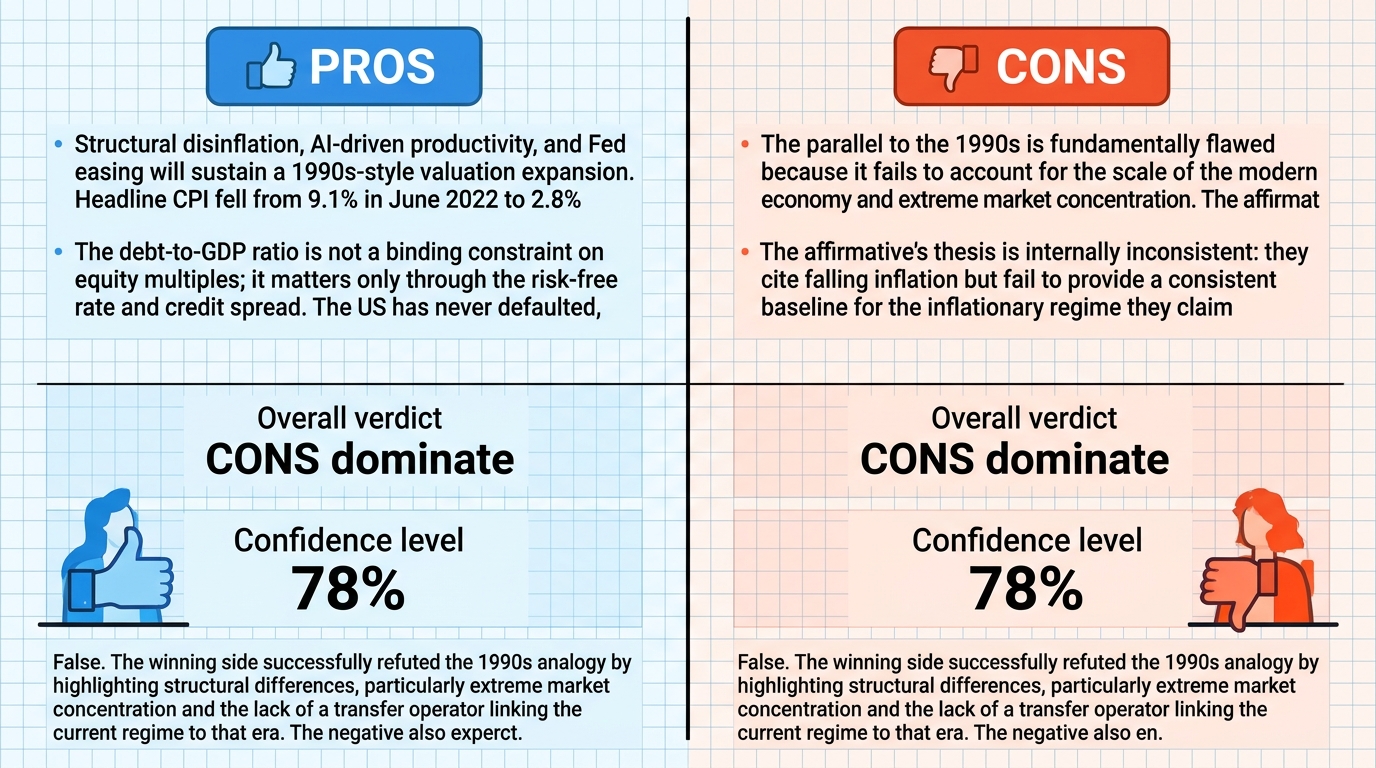
Verdict: likely FALSE (78%)
Web Report: https://solsice.com/public/debates/the-current-bull-market-which-began-in-late-2022-will-contin-780cb02da3e5
This section provides a brief overview of the key arguments. You do not need to read the full detailed report below.
✅ Key PRO arguments:
- ■Structural disinflation, AI-driven productivity, and Fed easing will sustain a 1990s-style valuation expansion. Headline CPI fell from 9.1% in June 2022 to 2.8% in February 2025, while core PCE declined to 2.6%, reflecting durable normalization of supply chains and anchored inflation expectations.
- ■The debt-to-GDP ratio is not a binding constraint on equity multiples; it matters only through the risk-free rate and credit spread. The US has never defaulted, and the Treasury market remains the deepest and most liquid in the world, so the 1995-1999 parallel remains valid.
❌ Key ANTI arguments:
- ■The parallel to the 1990s is fundamentally flawed because it fails to account for the scale of the modern economy and extreme market concentration. The affirmative provides no transfer operator—a mathematical or structural link—explaining how a regime of extreme concentration can replicate the 1990s multiple expansion.
- ■The affirmative's thesis is internally inconsistent: they cite falling inflation but fail to provide a consistent baseline for the inflationary regime they claim to be exiting. The argument suffers from a failure of resolution, undermining the causal link between disinflation and multiple expansion.
💭 Conclusion: False. The winning side successfully refuted the 1990s analogy by highlighting structural differences, particularly extreme market concentration and the lack of a transfer operator linking the current regime to that era. The negative also exposed an internal inconsistency in the affirmative's inflation data, which lacked a consistent baseline. These arguments directly undermine the claim that valuations will continue increasing for an extended period similar to the 1990s. The judge's confidence of 78% reflects a clear but not absolute rejection of the assertion.
🔬 DeepResearch Result: likely FALSE ❌ (78%)
Assertion: The current bull market, which began in late 2022, will continue with valuations increasing for an extended period, similar to the 1990s.
Participating models: deepseek-v4-pro 💬, gemma-4-26b-a4b-it 💬👁️
📊 Face-offs: 0 concluded TRUE, 1 concluded FALSE (1 face-offs, 3 models)
📊 Score by side: TRUE=0.00, FALSE=0.78
🏅 Model score changes:
deepseek-v4-flash-0731 💬: +8
✅ PRO Arguments:
- ■Structural disinflation, AI-driven productivity, and Fed easing will sustain a 1990s-style valuation expansion. Headline CPI fell from 9.1% in June 2022 to 2.8% in February 2025, while core PCE declined to 2.6%, reflecting durable normalization of supply chains and anchored inflation expectations. deepseek-v4-pro 💬
- ■The debt-to-GDP ratio is not a binding constraint on equity multiples; it matters only through the risk-free rate and credit spread. The US has never defaulted, and the Treasury market remains the deepest and most liquid in the world, so the 1995-1999 parallel remains valid. deepseek-v4-pro 💬
❌ ANTI Arguments:
- ■The parallel to the 1990s is fundamentally flawed because it fails to account for the scale of the modern economy and extreme market concentration. The affirmative provides no transfer operator—a mathematical or structural link—explaining how a regime of extreme concentration can replicate the 1990s multiple expansion. gemma-4-26b-a4b-it 💬👁️
- ■The affirmative's thesis is internally inconsistent: they cite falling inflation but fail to provide a consistent baseline for the inflationary regime they claim to be exiting. The argument suffers from a failure of resolution, undermining the causal link between disinflation and multiple expansion. gemma-4-26b-a4b-it 💬👁️
💭 Reasoning: False. The winning side successfully refuted the 1990s analogy by highlighting structural differences, particularly extreme market concentration and the lack of a transfer operator linking the current regime to that era. The negative also exposed an internal inconsistency in the affirmative's inflation data, which lacked a consistent baseline. These arguments directly undermine the claim that valuations will continue increasing for an extended period similar to the 1990s. The judge's confidence of 78% reflects a clear but not absolute rejection of the assertion.
📋 PRO Facts:
• Headline CPI inflation fell from 9.1% in June 2022 to 2.8% in February 2025.
• Core PCE inflation declined to 2.6%.
• In the 1990s, inflation fell from 5.4% to 2.2% and P/E multiples rose from 14x to 25x.
📋 ANTI Facts:
• Sovereign debt has risen from roughly 65% to 123% of GDP, according to the opposing side's argument.
• The current market is characterized by extreme concentration, unlike the smaller, less concentrated 1990s market.
| Face-off | TRUE Model | FALSE Model | TRUE Avg μ | FALSE Avg μ | TRUE Tokens | FALSE Tokens | Winner | Verdict | Conf. |
|---|---|---|---|---|---|---|---|---|---|
| #1 | deepseek-v4-pro 💬 | gemma-4-26b-a4b-it 💬👁️ | 0.541 | 0.426 | 6 | 2 | TRUE | FALSE | 78% |
The following financial data tables were referenced during the debate exchanges:
| Metric | 1990 | 1995 | 1999 | Change (1990–1999) |
|---|---|---|---|---|
| CPI Inflation (YoY) | 5.4% | 2.8% | 2.2% | −3.2 pp |
| S&P 500 Forward P/E | 14.2x | 16.1x | 25.6x | +11.4x |
| 10-Year Treasury Yield | 8.1% | 6.6% | 5.6% | −2.5 pp |
Legend: Comparison of inflation, valuation, and interest rate metrics during the 1990s secular bull market. CPI = Consumer Price Index year-over-year change; Forward P/E = next-twelve-months price-to-earnings ratio for the S&P 500. Sources: Bureau of Labor Statistics, Robert Shiller online data, Federal Reserve.
| Company | 2024 Capex | 2025 Capex (Planned) | YoY Growth |
|---|---|---|---|
| Microsoft | $44.5B | ~$60B | +35% |
| Alphabet | $32.3B | ~$50B | +55% |
| Amazon | $48.4B | ~$55B | +14% |
| Meta | $27.3B | ~$35B | +28% |
Legend: Capital expenditure for the four largest US hyperscalers, predominantly allocated to AI infrastructure. 2024 figures are reported; 2025 figures are company guidance midpoints. Source: company Q4 2024 earnings releases and investor presentations.
| Period | Starting Fed Funds Rate | Ending Fed Funds Rate | S&P 500 Annualized Return | Forward P/E Expansion |
|---|---|---|---|---|
| 1995–1998 | 6.00% | 4.75% | +27.1% | +6.3x |
| Sept 2024–Mar 2025 | 5.50% | 4.50% | +14.7% | +2.1x |
Legend: Comparison of Fed easing cycles and subsequent equity market performance. 1995–1998 figures represent the full easing cycle and concurrent bull market leg; Sept 2024–Mar 2025 figures represent the initial phase of the current easing cycle. Sources: Federal Reserve H.15 release, S&P Dow Jones Indices.
| Metric | 1995 (Mid-Cycle) | 2024 (Current Era) | Delta / Structural Difference |
|---|---|---|---|
| S&P 500 Concentration (Top 10) | ~15% | ~32% | +17 pp |
| US Debt-to-GDP | ~65% | ~123% | +58 pp |
| Real Fed Funds Rate (Approx) | ~2.5% | ~1.5% | -1.0 pp |
Legend: Comparison of structural market and macroeconomic indicators between the mid-1990s bull market and the current period. Concentration refers to the market cap weight of the top 10 S&P 500 companies. Source: Federal Reserve Economic Data (), S&P Dow Jones Indices.
| Year | Japan Debt-to-GDP | Japan 10Y Yield | Nikkei 225 Forward P/E |
|---|---|---|---|
| 2012 | 226% | 0.79% | 14.1x |
| 2019 | 235% | −0.02% | 16.8x |
| 2024 | 255% | 0.82% | 18.3x |
Legend: Japanese sovereign debt, benchmark yields, and equity valuation multiples over a period of sustained multiple expansion. Debt-to-GDP from IMF World Economic Outlook; yields from Ministry of Finance; forward P/E estimates from Bloomberg consensus data.
Face-off transcripts
- ■
Ownership & Trade Secrets. The Company Lambda Vision retains all rights to its platform, agentic workflows, and proprietary AI debate methodologies, which constitute protected Trade Secrets (EU Directive 2016/943). Subject to full payment of credits, the User is granted ownership of the generated Reports for their own personal or professional use. Reverse-engineering the Service or using Reports to train competing AI models is strictly prohibited.
- ■
No Professional Advice. Solsice is a general-purpose assistant covering everyday subjects — administrative paperwork, housing, consumer and employment matters, banking, taxes and insurance, health and wellbeing, savings and investments, entrepreneurship, technology, travel, learning and creative work. Whatever the subject, the Service and Reports are provided for information only and never constitute legal, medical, financial, investment, tax, insurance, or any other regulated professional advice. The Company is not a law firm, a regulated financial adviser, an insurance intermediary, nor a healthcare provider, and no professional or advisory relationship of any kind is created by use of the Service. Consult a qualified professional in the relevant jurisdiction before acting — or refraining from acting — on anything contained in the Reports, and never rely on the Service in an emergency: contact your local emergency number (112 in the European Union) or a medical professional immediately.
- ■
AI-Generated Content, Sources and Viewpoints. Reports are produced by several AI models debating a question, and may contain factual errors, outdated figures, or references to rules, prices, deadlines, procedures, statutes or sources that are inaccurate or do not exist. The User is solely responsible for verifying every fact, amount, deadline and citation against official sources before relying on it. Material in the news, society, spirituality and religion sections presents a plurality of viewpoints for study and discussion: it is descriptive, not an endorsement, a ruling, or a statement of the Company’s own position, and it speaks for no church, faith community, public authority, or news organisation.
- ■
Liability & Governing Law. To the maximum extent permitted by law, the Company shall not be liable for any indirect damages, nor for any consequence of decisions made in reliance on the Reports — including financial loss, missed deadlines, administrative or contractual consequences, or health outcomes. These Terms are governed by French law. Any disputes shall be subject to the exclusive jurisdiction of the Courts of Paris, France.