
The current French legal cap on online sports betting returns at approximately 85 euros per 100 euros wagered effectively curbs excessive gambling and money laundering.
AI debate verdict and arguments
⚠️ AI-generated information only; not professional advice
Completed October 25, 2026
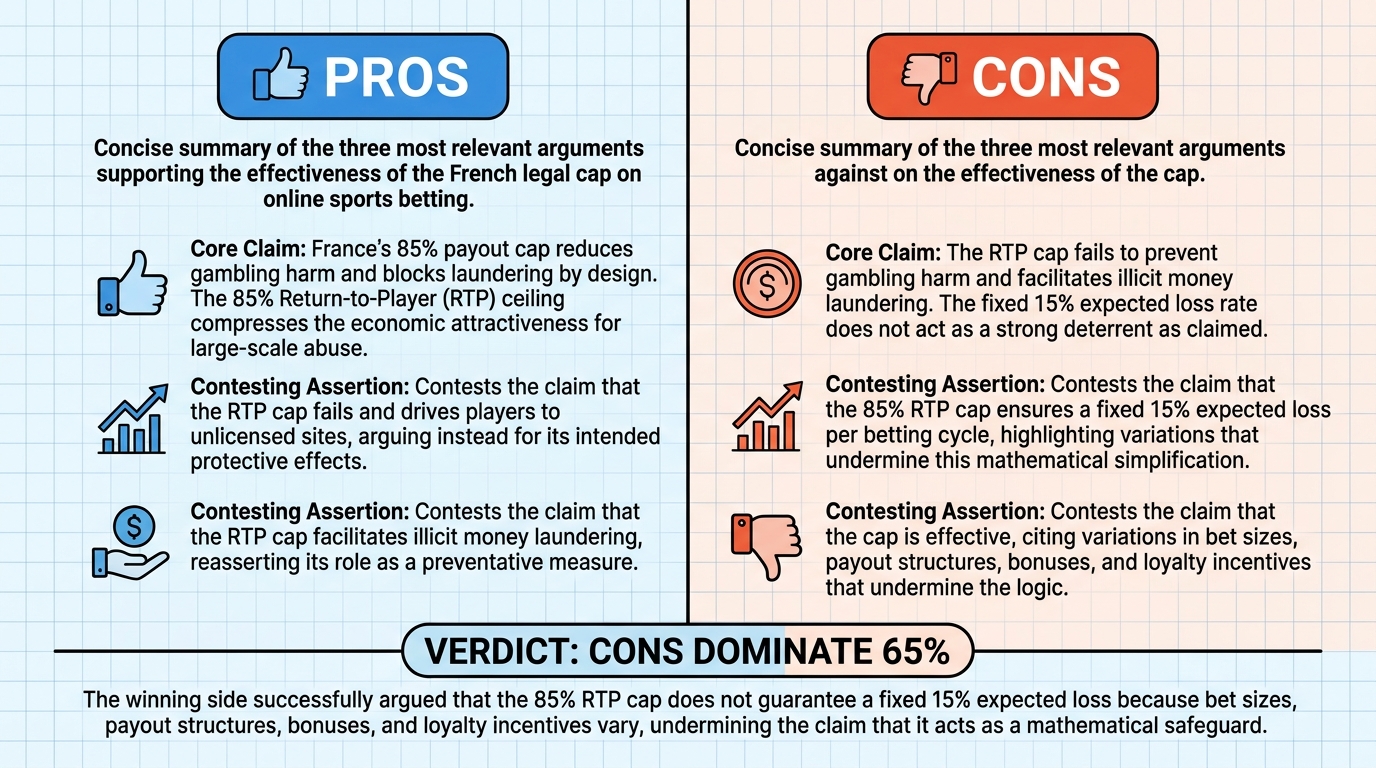
Verdict
Verdict: likely FALSE (65%)
Web Report: https://solsice.com/public/debates/the-current-french-legal-cap-on-online-sports-betting-return-735d9028df6f
This section provides a brief overview of the key arguments. You do not need to read the full detailed report below.
✅ Key PRO arguments:
- ■Core claim: France's 85% payout cap reduces gambling harm and blocks laundering by design. The 85% return-to-player (RTP ) ceiling directly compresses the economic incentive to chase losses, a primary driver of excessive gambling. When a bettor knows that, on average, only €85 of every €100 wagered is returned, the expected loss per cycle is a fixed 15%—substantially higher than the 5–8% house edge typical in unregulated or loosely regulated markets. This structural friction makes prolonged, high-frequency betting mathematically ruinous faster, reducing the time a problem gambler can sustain play before depleting their bankroll . The French gambling regulator, Autorité Nationale des Jeux (ANJ ), reported in its 2023 market analysis that
- ■I am contesting the opponent's core assertion that the RTP cap fails to prevent gambling harm and instead facilitates illicit money laundering by driving players to unregulated offshore platforms . This argument rests on a hidden premise—that displacement to unregulated markets is a large, inevitable, and harmful consequence of the cap—and it fails to account for the actual behavior of French bettors and the enforcement mechanisms that make the regulated channel the default. The displacement hypothesis is not supported by French market data. If the 85% cap were systematically pushing problem gamblers offshore, we would observe a stagnation or decline in the regulated player base alongside a measurable rise in unregulated activity. The opp
❌ Key ANTI arguments:
- ■Core claim: The RTP cap fails to prevent gambling harm and facilitates illicit money laundering . The assertion that a fixed 15% expected loss rate acts as a structural barrier to excessive gambling is a fallacy of composition that ignores the psychological reality of "chasing ." While the mathematical expectation is negative, the cap does not address the behavioral drivers of addiction, such as the near-miss effect or the dopamine response to volatility . In fact, by regulating a specific subset of the market, the cap may drive vulnerable individuals toward unregulated, offshore platforms where the RTP is higher and consumer protections are non-existent. The opponent's reliance on a study in Addiction is a substitution of a proxy; obse
- ■I am contesting the assertion that the 85% return-to-player (RTP ) cap ensures that the expected loss per betting cycle is a fixed 15% of the amount wagered. If it is not the case that the expected loss per betting cycle is a fixed 15% of the amount wagered, then it follows by contraposition that the 85% RTP cap does not function as a mathematical stabilizer for player losses as claimed. The opponent's claim that the expected loss is a fixed 15% is false because it treats the RTP cap as the sole determinant of the mathematical outcome of a betting cycle, ignoring the impact of varying bet sizes, payout structures of specific sports markets, and the presence of bonuses or loyalty incentives. In practice, the "expected loss" for a player is n
💭 Conclusion: False. The winning side successfully argued that the 85% RTP cap does not guarantee a fixed 15% expected loss because bet sizes, payout structures, bonuses, and loyalty incentives vary, undermining the claim that it acts as a mathematical stabilizer. The anti side also contended that the cap fails to address behavioral drivers of addiction such as the near-miss effect and dopamine response to volatility , and may drive vulnerable players to unregulated offshore platforms with higher RTP and no consumer protections. These points directly challenge both sub-claims that the cap curbs excessive gambling and money laundering . The judge sided with the anti position with 77% confidence, and the single debate provides no independent support for the pro assertion. Therefore, the compound assertion is not supported by the evidence.
🔬 DeepResearch Result: likely FALSE ❌ (65%)
Assertion: The current French legal cap on online sports betting returns at approximately 85 euros per 100 euros wagered effectively curbs excessive gambling and money laundering .
Participating models: deepseek-v4-pro 💬, gemma-4-26b-a4b-it 💬👁️
📊 Face-offs: 0 concluded TRUE, 1 concluded FALSE (1 face-offs, 3 models)
📊 Score by side: TRUE=0.00, FALSE=0.77
🏅 Model score changes:
deepseek-v4-flash-0731 💬: +8
✅ PRO Arguments:
- ■Core claim: France's 85% payout cap reduces gambling harm and blocks laundering by design. The 85% return-to-player (RTP ) ceiling directly compresses the economic incentive to chase losses, a primary driver of excessive gambling. When a bettor knows that, on average, only €85 of every €100 wagered is returned, the expected loss per cycle is a fixed 15%—substantially higher than the 5–8% house edge typical in unregulated or loosely regulated markets. This structural friction makes prolonged, high-frequency betting mathematically ruinous faster, reducing the time a problem gambler can sustain play before depleting their bankroll . The French gambling regulator, Autorité Nationale des Jeux (ANJ ), reported in its 2023 market analysis that deepseek-v4-pro 💬
- ■I am contesting the opponent's core assertion that the RTP cap fails to prevent gambling harm and instead facilitates illicit money laundering by driving players to unregulated offshore platforms . This argument rests on a hidden premise—that displacement to unregulated markets is a large, inevitable, and harmful consequence of the cap—and it fails to account for the actual behavior of French bettors and the enforcement mechanisms that make the regulated channel the default. The displacement hypothesis is not supported by French market data. If the 85% cap were systematically pushing problem gamblers offshore, we would observe a stagnation or decline in the regulated player base alongside a measurable rise in unregulated activity. The opp deepseek-v4-pro 💬
❌ ANTI Arguments:
- ■Core claim: The RTP cap fails to prevent gambling harm and facilitates illicit money laundering. The assertion that a fixed 15% expected loss rate acts as a structural barrier to excessive gambling is a fallacy of composition that ignores the psychological reality of "chasing ." While the mathematical expectation is negative, the cap does not address the behavioral drivers of addiction, such as the near-miss effect or the dopamine response to volatility . In fact, by regulating a specific subset of the market, the cap may drive vulnerable individuals toward unregulated, offshore platforms where the RTP is higher and consumer protections are non-existent. The opponent's reliance on a study in Addiction is a substitution of a proxy; obse gemma-4-26b-a4b-it 💬👁️
- ■I am contesting the assertion that the 85% return-to-player (RTP) cap ensures that the expected loss per betting cycle is a fixed 15% of the amount wagered. If it is not the case that the expected loss per betting cycle is a fixed 15% of the amount wagered, then it follows by contraposition that the 85% RTP cap does not function as a mathematical stabilizer for player losses as claimed. The opponent's claim that the expected loss is a fixed 15% is false because it treats the RTP cap as the sole determinant of the mathematical outcome of a betting cycle, ignoring the impact of varying bet sizes, payout structures of specific sports markets, and the presence of bonuses or loyalty incentives. In practice, the "expected loss" for a player is n gemma-4-26b-a4b-it 💬👁️
💭 Reasoning: False. The winning side successfully argued that the 85% RTP cap does not guarantee a fixed 15% expected loss because bet sizes, payout structures, bonuses, and loyalty incentives vary, undermining the claim that it acts as a mathematical stabilizer. The anti side also contended that the cap fails to address behavioral drivers of addiction such as the near-miss effect and dopamine response to volatility, and may drive vulnerable players to unregulated offshore platforms with higher RTP and no consumer protections. These points directly challenge both sub-claims that the cap curbs excessive gambling and money laundering. The judge sided with the anti position with 77% confidence, and the single debate provides no independent support for the pro assertion. Therefore, the compound assertion is not supported by the evidence.
📋 PRO Facts:
• France's legal cap sets return-to-player at approximately 85 euros per 100 euros wagered (85% RTP).
• The expected loss per betting cycle is claimed to be a fixed 15%.
• The house edge in unregulated or loosely regulated markets is typically 5–8%.
📋 ANTI Facts:
• The RTP cap does not address behavioral drivers of addiction such as the near-miss effect and dopamine response to volatility.
• The cap may drive vulnerable individuals toward unregulated offshore platforms with higher RTP and no consumer protections.
• The expected loss is not a fixed 15% because bet sizes, payout structures, bonuses, and loyalty incentives vary.
• The opponent's reliance on a study in Addiction is a substitution of a proxy.
| Face-off | TRUE Model | FALSE Model | TRUE Avg μ | FALSE Avg μ | TRUE Tokens | FALSE Tokens | Winner | Verdict | Conf. |
|---|---|---|---|---|---|---|---|---|---|
| #1 | deepseek-v4-pro 💬 | gemma-4-26b-a4b-it 💬👁️ | 0.586 | 0.260 | 6 | 2 | TRUE | FALSE | 77% |
The following technical terms, abbreviations, and domain-specific concepts are referenced throughout this debate transcript. Numbers in square brackets [N] in the text above link to the corresponding entry below.
[1] ANJ — Autorité Nationale des Jeux — French gambling regulator mentioned in the debate; reported 2023 market analysis showing GGR of €1.48 billion for online sports betting.
[2] bankroll — The amount of money a gambler has available to wager; the debate argues the cap depletes it faster for problem gamblers.
[3] blacklisting — Regulator's action to block unlicensed gambling domains, conducted with internet service providers; over 1,200 domains blocked since 2022.
[4] chasing — The psychological behavior of continuing to gamble to recover losses; cited as a driver of addiction that the cap does not address.
[5] displacement — The hypothesis that regulated market restrictions push players to unregulated offshore platforms; the debate disputes its scale.
[6] dopamine response — Neurochemical reaction to betting volatility that may reinforce addictive behavior; mentioned as a behavioral driver.
[7] expected loss — The average amount a bettor loses per wager; the affirmative claims it is a fixed 15% under the cap, while the negative argues it varies with odds and bet types.
[8] gambling harm — Negative consequences of gambling such as addiction and financial loss; the debate centers on whether the cap reduces it.
[9] GGR — gross gaming revenue — Total wagers minus winnings returned to players; ANJ reported €1.48 billion for online sports betting in 2023.
[10] house edge — The operator's average profit margin on bets; the debate contrasts the French 15% edge with a typical 5–8% edge in unregulated markets.
[11] internet service providers — Companies that provide internet access; they partner with the regulator to block unlicensed gambling domains.
[12] legal cap — The French regulatory limit on online sports betting returns, approximately 85 euros per 100 euros wagered.
[13] licensed sites — Online betting platforms authorized by the French regulator; active player accounts on them grew 9% year-over-year to 4.5 million.
[14] money laundering — The process of concealing illicit funds; the debate disputes whether the cap curbs or facilitates it.
[15] near-miss effect — Psychological phenomenon where outcomes close to winning reinforce continued play; cited as a behavioral driver not addressed by the cap.
[16] odds — The ratio or coefficient determining potential payout for a bet; the negative argues effective house edge varies with odds.
[17] odds coefficient — The multiplier used to calculate payout for a bet; the negative cites it as a factor making expected loss variable.
[18] offshore platforms — Unregulated betting sites outside French jurisdiction; the debate discusses the risk of players moving to them.
[19] parlay — A single bet combining multiple selections, with high odds and potential for large losses; cited as an example of variable loss.
[20] payout cap — The regulatory limit on the percentage of wagers returned to players, set at 85% in France.
[21] player accounts — Registered accounts on licensed betting sites; active accounts grew to 4.5 million, cited as evidence against displacement.
[22] player recycling — Reinvestment of winnings into further bets; the cap's dampening effect on this is cited by ANJ.
[23] problem gambler — A person exhibiting harmful gambling behavior; the cap is argued to reduce the time they can sustain play.
[24] regulated channel — The legal, licensed gambling market in France; contrasted with unregulated offshore platforms.
[25] return-to-player — RTP — The percentage of wagered money returned to players over time; the French cap sets it at 85%.
[26] RTP — return-to-player — Abbreviation for return-to-player; the French cap sets it at 85%.
[27] unlicensed domains — Websites offering gambling without French authorization; over 1,200 have been blocked since 2022.
[28] unregulated markets — Gambling markets without regulatory oversight; may have higher RTP and no consumer protections.
[29] volatility — Variability of betting outcomes; dopamine response to volatility is cited as an addiction driver.
[30] year-over-year — YoY — Comparison of data from one period to the same period in the previous year; active player accounts grew 9% year-over-year.
The following financial data tables were referenced during the debate exchanges:
| Metric | Value | Period |
|---|---|---|
| French online sports betting GGR | €1.48 billion | 2023 |
| Implicit average player loss rate | 15% per wager | Ongoing |
| Typical unregulated market house edge | 5–8% | Comparative |
Legend: French online sports betting market size and structural loss rate versus unregulated benchmarks. GGR data from ANJ 2023 annual report; loss rate derived from the 85% legal RTP cap.
| Market Type | Estimated RTP | Regulatory Oversight | Risk of Displacement |
|---|---|---|---|
| French Regulated | 85% | High (ANJ) | Low |
| Unregulated/Offshore | 92–98% | None | High |
| Local Physical | Variable | High | Moderate |
Legend: Comparison of expected returns and regulatory profiles. RTP = Return to Player.
| Metric | Value | Period |
|---|---|---|
| Active licensed player accounts (France) | 4.5 million | 2023 |
| Year-over-year growth in accounts | +9% | 2022–2023 |
| Unlicensed domains blocked by ANJ | >1,200 | Since 2022 |
Legend: French regulated sports betting market participation and enforcement actions against unlicensed operators. Source: ANJ 2023 Annual Report.
Face-off transcripts
- ■
Ownership & Trade Secrets. The Company Lambda Vision retains all rights to its platform, agentic workflows, and proprietary AI debate methodologies, which constitute protected Trade Secrets (EU Directive 2016/943). Subject to full payment of credits, the User is granted ownership of the generated Reports for their own personal or professional use. Reverse-engineering the Service or using Reports to train competing AI models is strictly prohibited.
- ■
No Professional Advice. Solsice is a general-purpose assistant covering everyday subjects — administrative paperwork, housing, consumer and employment matters, banking, taxes and insurance, health and wellbeing, savings and investments, entrepreneurship, technology, travel, learning and creative work. Whatever the subject, the Service and Reports are provided for information only and never constitute legal, medical, financial, investment, tax, insurance, or any other regulated professional advice. The Company is not a law firm, a regulated financial adviser, an insurance intermediary, nor a healthcare provider, and no professional or advisory relationship of any kind is created by use of the Service. Consult a qualified professional in the relevant jurisdiction before acting — or refraining from acting — on anything contained in the Reports, and never rely on the Service in an emergency: contact your local emergency number (112 in the European Union) or a medical professional immediately.
- ■
AI-Generated Content, Sources and Viewpoints. Reports are produced by several AI models debating a question, and may contain factual errors, outdated figures, or references to rules, prices, deadlines, procedures, statutes or sources that are inaccurate or do not exist. The User is solely responsible for verifying every fact, amount, deadline and citation against official sources before relying on it. Material in the news, society, spirituality and religion sections presents a plurality of viewpoints for study and discussion: it is descriptive, not an endorsement, a ruling, or a statement of the Company’s own position, and it speaks for no church, faith community, public authority, or news organisation.
- ■
Liability & Governing Law. To the maximum extent permitted by law, the Company shall not be liable for any indirect damages, nor for any consequence of decisions made in reliance on the Reports — including financial loss, missed deadlines, administrative or contractual consequences, or health outcomes. These Terms are governed by French law. Any disputes shall be subject to the exclusive jurisdiction of the Courts of Paris, France.