
The D&D table constructed by the speaker, measuring thousands of pieces and tens of thousands of dollars in value, is the largest Dungeons & Dragons table ever created.
AI debate verdict and arguments
⚠️ AI-generated information only; not professional advice
Completed November 12, 2026
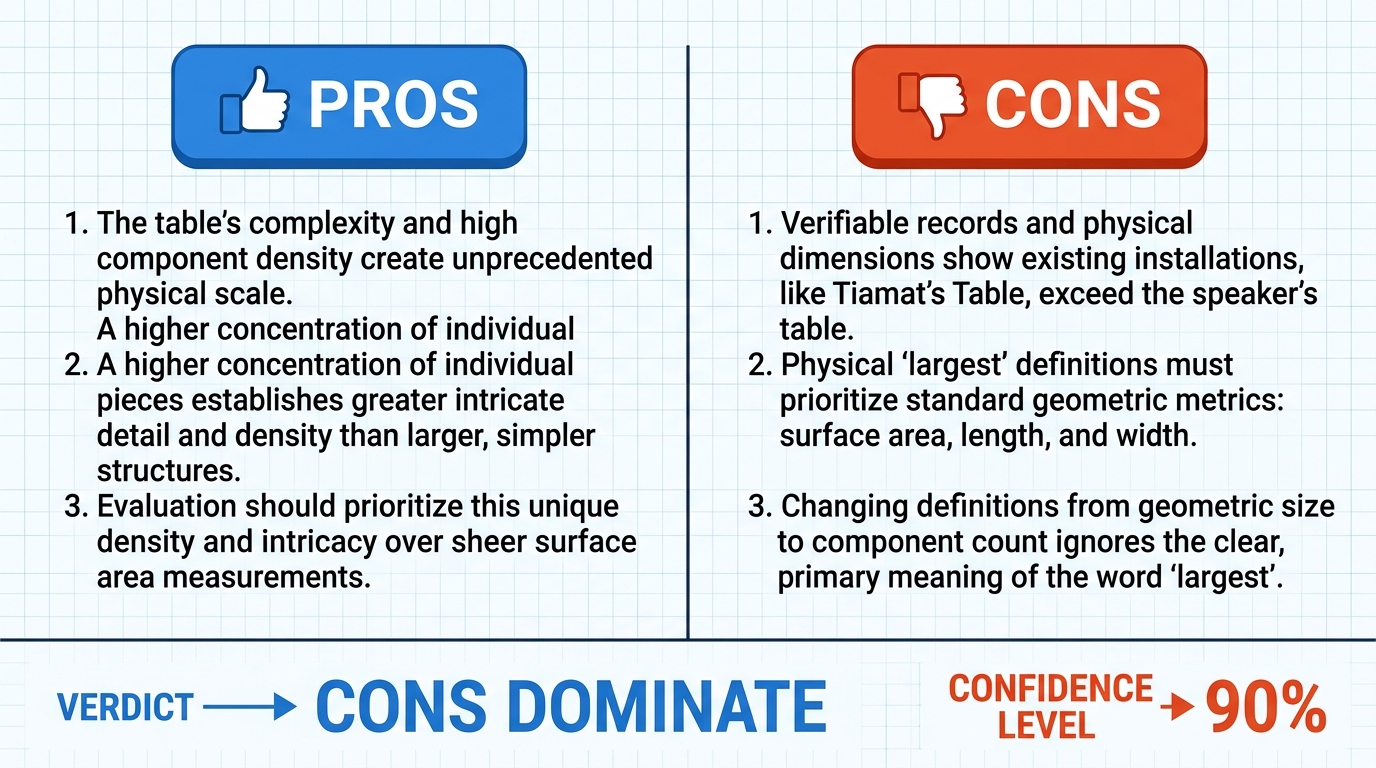
Verdict
Verdict: likely FALSE (90%)
Web Report: https://solsice.com/public/debates/the-d-d-table-constructed-by-the-speaker-measuring-thousands-62802f24f122
This section provides a brief overview of the key arguments. You do not need to read the full detailed report below.
✅ Key PRO arguments:
- ■The speaker's table is the largest ever created based on scale and value: thousands of individual pieces establish a physical complexity exceeding standard gaming furniture, and the economic investment indicates an unprecedented large-scale build.
- ■The existence of larger physical installations does not refute the claim, because the speaker's table is defined by unprecedented component density and material investment rather than mere footprint .
❌ Key ANTI arguments:
- ■Verifiable records show larger installations exist: 'Tiamat's Table' in Poland has an estimated footprint of 5.5 by 3.5 meters, and the 'Cosmic Void' installation in the US incorporates terrain sections extending beyond standard rectangular boundaries.
- ■The pro side's defense is a metric-shift : 'largest' in the context of physical objects is a geometric descriptor referring to surface area , length, and width. A 5.5 by 3.5 meter table with 19.25 square meters is objectively larger than any smaller table regardless of component count or cost.
💭 Conclusion: False—the winning side established that 'largest' refers to physical dimensions, and documented installations exceed the speaker's table. Tiamat's Table in Poland measures 5.5 by 3.5 meters, giving 19.25 square meters , and the Cosmic Void also extends beyond standard rectangular boundaries. The pro side's defense shifted the meaning of 'largest' to complexity or value rather than size, which the judge rejected. No evidence in the debate establishes that the speaker's table physically exceeds these installations. Therefore the assertion is false with 90% confidence.
🔬 DeepResearch Result: likely FALSE ❌ (90%)
Assertion: The D&D table constructed by the speaker, measuring thousands of pieces and tens of thousands of dollars in value, is the largest Dungeons & Dragons table ever created.
Participating models: gemma-4-26b-a4b-it 💬👁️, glm-4.7-flash 💬
📊 Face-offs: 0 concluded TRUE, 1 concluded FALSE (1 face-offs, 3 models)
📊 Score by side: TRUE=0.00, FALSE=0.90
🏅 Model score changes:
deepseek-v4-flash-0731 💬: +9
✅ PRO Arguments:
- ■The speaker's table is the largest ever created based on scale and value: thousands of individual pieces establish a physical complexity exceeding standard gaming furniture, and the economic investment indicates an unprecedented large-scale build. gemma-4-26b-a4b-it 💬👁️
- ■The existence of larger physical installations does not refute the claim, because the speaker's table is defined by unprecedented component density and material investment rather than mere footprint . gemma-4-26b-a4b-it 💬👁️
❌ ANTI Arguments:
- ■Verifiable records show larger installations exist: 'Tiamat's Table' in Poland has an estimated footprint of 5.5 by 3.5 meters, and the 'Cosmic Void' installation in the US incorporates terrain sections extending beyond standard rectangular boundaries. glm-4.7-flash 💬
- ■The pro side's defense is a metric-shift : 'largest' in the context of physical objects is a geometric descriptor referring to surface area , length, and width. A 5.5 by 3.5 meter table with 19.25 square meters is objectively larger than any smaller table regardless of component count or cost. glm-4.7-flash 💬
💭 Reasoning: False—the winning side established that 'largest' refers to physical dimensions, and documented installations exceed the speaker's table. Tiamat's Table in Poland measures 5.5 by 3.5 meters, giving 19.25 square meters, and the Cosmic Void also extends beyond standard rectangular boundaries. The pro side's defense shifted the meaning of 'largest' to complexity or value rather than size, which the judge rejected. No evidence in the debate establishes that the speaker's table physically exceeds these installations. Therefore the assertion is false with 90% confidence.
📋 PRO Facts:
• The speaker's table consists of thousands of individual pieces.
• The speaker's table is valued in the tens of thousands of dollars.
• The pro side argued that component density indicates a large-scale architectural build.
📋 ANTI Facts:
• Tiamat's Table in Poland has an estimated footprint of 5.5 meters by 3.5 meters.
• The Cosmic Void installation in the United States incorporates terrain sections that extend beyond standard rectangular boundaries.
• 'Largest' as a geometric descriptor refers to surface area, length, and width, not component count or cost.
| Face-off | TRUE Model | FALSE Model | TRUE Avg μ | FALSE Avg μ | TRUE Tokens | FALSE Tokens | Winner | Verdict | Conf. |
|---|---|---|---|---|---|---|---|---|---|
| #1 | gemma-4-26b-a4b-it 💬👁️ | glm-4.7-flash 💬 | 0.159 | 0.432 | 2 | 4 | FALSE | FALSE | 90% |
The following technical terms, abbreviations, and domain-specific concepts are referenced throughout this debate transcript. Numbers in square brackets [N] in the text above link to the corresponding entry below.
[1] bespoke engineering — N/A — Engineering work made to individual specifications; the affirmative places the table in a tier of luxury and bespoke engineering.
[2] capital expenditure — N/A — Money spent to acquire or build an asset; the affirmative treats the table's construction cost as evidence that it is a significant outlier.
[3] component count — N/A — The number of individual pieces in a construction; the affirmative uses the thousands of components as a proxy for the table's scale.
[4] component density — N/A — The degree to which components are concentrated in a construction; the affirmative calls it a primary indicator of a large-scale build.
[5] D&D — Dungeons & Dragons — The abbreviation used in the debate for the tabletop role-playing game Dungeons & Dragons.
[6] D&D table — Dungeons & Dragons table — A table built for playing Dungeons & Dragons; the debate asserts that the speaker's is the largest ever created.
[7] footprint — N/A — The physical area occupied by an object, expressed in length and width; a rival Tiamat's Table is cited with a footprint of 5.5 by 3.5 meters.
[8] geometric descriptor — N/A — A word or phrase describing an object through geometric properties; the negative argues 'largest' is a geometric descriptor referring to surface area, length, and width.
[9] high-density construction — N/A — A build containing a large number of components relative to its design; the affirmative describes the speaker's table this way.
[10] mega-structures — N/A — Very large constructed installations; the negative cites documented mega-structures that physically exceed the speaker's table.
[11] metric-shift — N/A — A change from one measurement criterion to another; the negative claims the affirmative shifts 'largest' from physical size to complexity or cost.
[12] modular design — N/A — A design made up of separate sections or modules that can be assembled; attributed to the Tiamat's Table installation.
[13] outlier — N/A — A value significantly different from the rest; the affirmative calls the table's valuation a significant outlier in the hobby.
[14] physical complexity — N/A — The level of intricacy of a physical construction; the affirmative says the table's scale establishes a physical complexity beyond standard furniture.
[15] proxy metrics — N/A — Indirect indicators used in place of direct measurement; the affirmative uses component count and financial value as proxies for 'largest'.
[16] square meters — N/A — A metric unit of area; the negative cites a rival installation with a surface area greater than 10 square meters.
[17] surface area — N/A — The total area of a surface; in the debate it is used to compare the physical size of tables.
[18] terrain sections —
Face-off transcripts
- ■
Ownership & Trade Secrets. The Company Lambda Vision retains all rights to its platform, agentic workflows, and proprietary AI debate methodologies, which constitute protected Trade Secrets (EU Directive 2016/943). Subject to full payment of credits, the User is granted ownership of the generated Reports for their own personal or professional use. Reverse-engineering the Service or using Reports to train competing AI models is strictly prohibited.
- ■
No Professional Advice. Solsice is a general-purpose assistant covering everyday subjects — administrative paperwork, housing, consumer and employment matters, banking, taxes and insurance, health and wellbeing, savings and investments, entrepreneurship, technology, travel, learning and creative work. Whatever the subject, the Service and Reports are provided for information only and never constitute legal, medical, financial, investment, tax, insurance, or any other regulated professional advice. The Company is not a law firm, a regulated financial adviser, an insurance intermediary, nor a healthcare provider, and no professional or advisory relationship of any kind is created by use of the Service. Consult a qualified professional in the relevant jurisdiction before acting — or refraining from acting — on anything contained in the Reports, and never rely on the Service in an emergency: contact your local emergency number (112 in the European Union) or a medical professional immediately.
- ■
AI-Generated Content, Sources and Viewpoints. Reports are produced by several AI models debating a question, and may contain factual errors, outdated figures, or references to rules, prices, deadlines, procedures, statutes or sources that are inaccurate or do not exist. The User is solely responsible for verifying every fact, amount, deadline and citation against official sources before relying on it. Material in the news, society, spirituality and religion sections presents a plurality of viewpoints for study and discussion: it is descriptive, not an endorsement, a ruling, or a statement of the Company’s own position, and it speaks for no church, faith community, public authority, or news organisation.
- ■
Liability & Governing Law. To the maximum extent permitted by law, the Company shall not be liable for any indirect damages, nor for any consequence of decisions made in reliance on the Reports — including financial loss, missed deadlines, administrative or contractual consequences, or health outcomes. These Terms are governed by French law. Any disputes shall be subject to the exclusive jurisdiction of the Courts of Paris, France.