
The 'Décarbon'Action' tool accurately quantifies the carbon footprint of each investment in a viticultural operation, providing a clear map for decision-making regarding carbon impact.
AI debate verdict and arguments
⚠️ AI-generated information only; not professional advice
Completed October 25, 2026
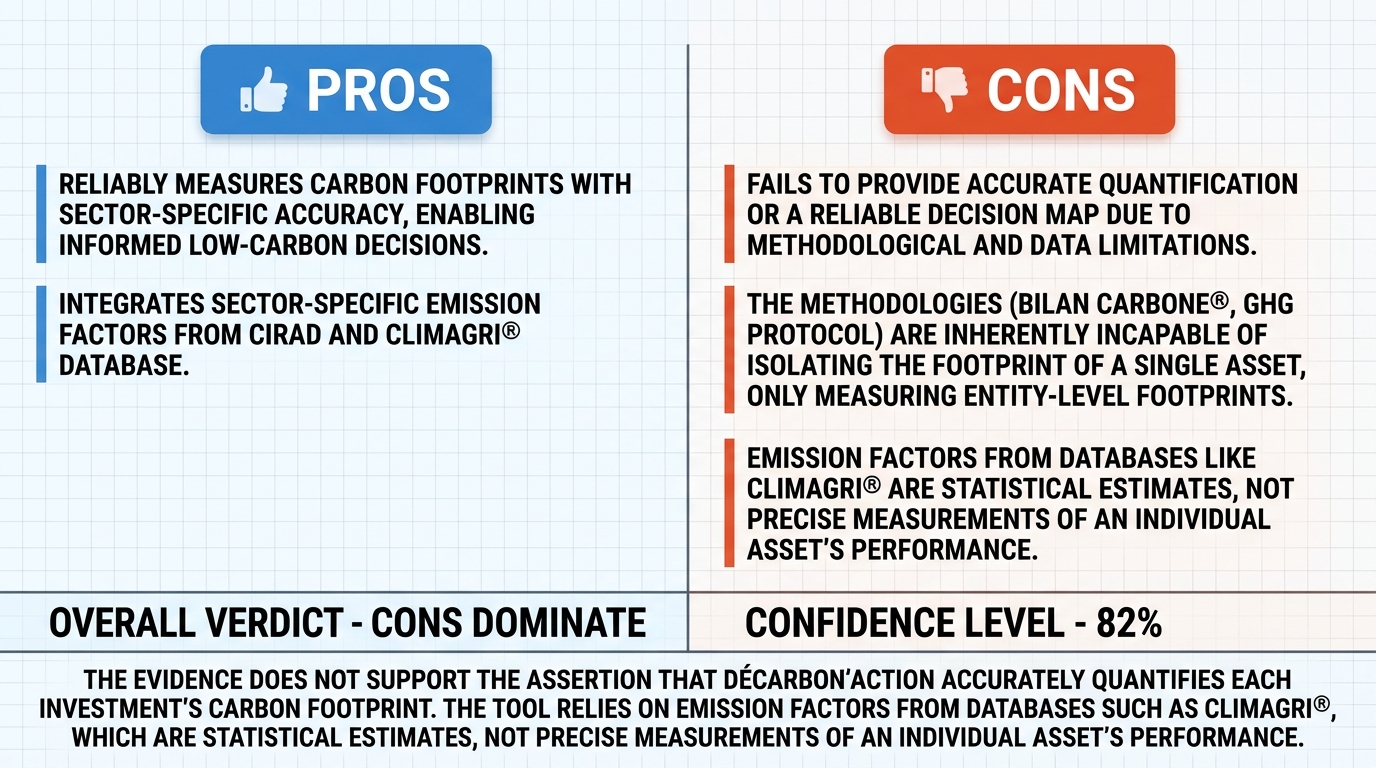
Verdict
Verdict: likely FALSE (82%)
Web Report: https://solsice.com/public/debates/the-decarbon-action-tool-accurately-quantifies-the-carbon-fo-785cbf76e6e2
This section provides a brief overview of the key arguments. You do not need to read the full detailed report below.
✅ Key PRO arguments:
- ■Core claim: Décarbon'Action reliably measures viticultural investment carbon footprints with sector-specific accuracy, enabling informed low-carbon decisions. The Décarbon'Action tool is built upon the rigorous Bilan Carbone® methodology, which itself aligns with the ISO 14064-1 standard and the GHG Protocol. This foundation provides a structured, five-step process for quantifying greenhouse gas emissions across all scopes —direct emissions from owned sources, indirect emissions from purchased energy , and other indirect emissions across the value chain . For a viticultural operation , this means an investment in, for example, a new diesel tractor is not assessed in isolation. The tool's boundary-setting protocols ensure that upstream em...
- ■The opposing argument contends that the Bilan Carbone® methodology and GHG Protocol are inherently incapable of isolating the footprint of a single asset, instead relying on industry-average data that creates an aggregation error . This claim misrepresents the methodological flexibility built into the standard's operationalization by the Décarbon'Action tool. The Bilan Carbone® method, as implemented by the Association pour la transition Bas Carbone (ABC), is not a monolithic, top-down reporting framework. Its core design includes a "bottom-up " physical flow approach precisely to avoid the aggregation error described. The methodological guide explicitly mandates that for capital goods —such as a specific tractor or a vineyard trellising sy...
❌ Key ANTI arguments:
- ■Core claim: The tool fails to provide accurate quantification or a reliable decision map due to methodological and data limitations. The assertion that Décarbon'Action provides "accurate quantification" is undermined by the inherent volatility and uncertainty of the emission factors it relies upon. While the tool utilizes databases like ClimAgri®, these factors are not static constants but are subject to significant variance based on localized environmental variables, soil composition, and management practices. Relying on these factors to quantify the footprint of a specific investment introduces a margin of error that can exceed the actual carbon impact of the investment itself. For instance, the nitrogen oxide (N2O ) emissions from fe...
- ■I am contesting the claim that the integration of sector-specific emission factors from CIRAD and the ClimAgri® database ensures "precise comparisons" for viticultural investments. The assertion that these factors enable precision is a fallacy of misplaced granularity. While the tool may use specific factors for N2O releases based on soil type or climate, the accuracy of the resulting "comparison" is fundamentally limited by the high degree of uncertainty inherent in those very factors. In environmental modeling , a factor is not a precise measurement but a statistical estimate . For instance, N2O emission factors are subject to massive fluctuations based on real-time soil moisture, temperature, and nitrogen availability—variables that are r...
💭 Conclusion: The evidence does not support the assertion that Décarbon'Action accurately quantifies each investment's carbon footprint . The tool relies on emission factors from databases such as ClimAgri®, which are statistical estimates, not precise measurements, and are subject to significant variance based on localized environmental variables, soil composition, and management practices. The uncertainty in these factors can mask investment benefits and fundamentally limits the accuracy of comparisons. Therefore, the claim of accurate quantification is not supported.
🔬 DeepResearch Result: likely FALSE ❌ (82%)
Assertion: The 'Décarbon'Action ' tool accurately quantifies the carbon footprint of each investment in a viticultural operation , providing a clear map for decision-making regarding carbon impact.
Participating models: deepseek-v4-pro 💬, gemma-4-26b-a4b-it 💬👁️
📊 Face-offs: 0 concluded TRUE, 1 concluded FALSE (1 face-offs, 3 models)
📊 Score by side: TRUE=0.00, FALSE=0.82
🏅 Model score changes:
deepseek-v4-flash-0731 💬: +8
✅ PRO Arguments:
- ■Core claim: Décarbon'Action reliably measures viticultural investment carbon footprints with sector-specific accuracy, enabling informed low-carbon decisions. The Décarbon'Action tool is built upon the rigorous Bilan Carbone® methodology, which itself aligns with the ISO 14064-1 standard and the GHG Protocol. This foundation provides a structured, five-step process for quantifying greenhouse gas emissions across all scopes —direct emissions from owned sources, indirect emissions from purchased energy , and other indirect emissions across the value chain . For a viticultural operation, this means an investment in, for example, a new diesel tractor is not assessed in isolation. The tool's boundary-setting protocols ensure that upstream em... deepseek-v4-pro 💬
- ■The opposing argument contends that the Bilan Carbone® methodology and GHG Protocol are inherently incapable of isolating the footprint of a single asset, instead relying on industry-average data that creates an aggregation error . This claim misrepresents the methodological flexibility built into the standard's operationalization by the Décarbon'Action tool. The Bilan Carbone® method, as implemented by the Association pour la transition Bas Carbone (ABC), is not a monolithic, top-down reporting framework. Its core design includes a "bottom-up " physical flow approach precisely to avoid the aggregation error described. The methodological guide explicitly mandates that for capital goods —such as a specific tractor or a vineyard trellising sy... deepseek-v4-pro 💬
❌ ANTI Arguments:
- ■Core claim: The tool fails to provide accurate quantification or a reliable decision map due to methodological and data limitations. The assertion that Décarbon'Action provides "accurate quantification" is undermined by the inherent volatility and uncertainty of the emission factors it relies upon. While the tool utilizes databases like ClimAgri®, these factors are not static constants but are subject to significant variance based on localized environmental variables, soil composition, and management practices. Relying on these factors to quantify the footprint of a specific investment introduces a margin of error that can exceed the actual carbon impact of the investment itself. For instance, the nitrogen oxide (N2O ) emissions from fe... gemma-4-26b-a4b-it 💬👁️
- ■I am contesting the claim that the integration of sector-specific emission factors from CIRAD and the ClimAgri® database ensures "precise comparisons" for viticultural investments. The assertion that these factors enable precision is a fallacy of misplaced granularity. While the tool may use specific factors for N2O releases based on soil type or climate, the accuracy of the resulting "comparison" is fundamentally limited by the high degree of uncertainty inherent in those very factors. In environmental modeling , a factor is not a precise measurement but a statistical estimate . For instance, N2O emission factors are subject to massive fluctuations based on real-time soil moisture, temperature, and nitrogen availability—variables that are r... gemma-4-26b-a4b-it 💬👁️
💭 Reasoning: The evidence does not support the assertion that Décarbon'Action accurately quantifies each investment's carbon footprint. The tool relies on emission factors from databases such as ClimAgri®, which are statistical estimates, not precise measurements, and are subject to significant variance based on localized environmental variables, soil composition, and management practices. The uncertainty in these factors can mask investment benefits and fundamentally limits the accuracy of comparisons. Therefore, the claim of accurate quantification is not supported.
📋 PRO Facts:
• Décarbon'Action is built upon the Bilan Carbone® methodology, aligned with ISO 14064-1 and the GHG Protocol.
• The tool uses a structured five-step process covering direct emissions, indirect emissions from purchased energy, and other indirect emissions across the value chain.
• The Bilan Carbone® method, as implemented by the Association pour la transition Bas Carbone (ABC), includes a bottom-up physical flow approach intended to avoid aggregation error.
• The tool's boundary-setting protocols are designed to assess investments such as a diesel tractor within the full operational context.
📋 ANTI Facts:
• The tool relies on emission factors from databases such as ClimAgri®, which are subject to variance based on localized environmental variables, soil composition, and management practices.
• Emission factors are statistical estimates rather than precise measurements.
• N2O emission factors are subject to high uncertainty and vary based on soil type or climate.
• Emission factor uncertainty can mask investment benefits and fundamentally limits the accuracy of comparisons.
| Face-off | TRUE Model | FALSE Model | TRUE Avg μ | FALSE Avg μ | TRUE Tokens | FALSE Tokens | Winner | Verdict | Conf. |
|---|---|---|---|---|---|---|---|---|---|
| #1 | deepseek-v4-pro 💬 | gemma-4-26b-a4b-it 💬👁️ | 0.460 | 0.314 | 6 | 2 | TRUE | FALSE | 82% |
The following technical terms, abbreviations, and domain-specific concepts are referenced throughout this debate transcript. Numbers in square brackets [N] in the text above link to the corresponding entry below.
[1] Aggregation error — An error that can arise when industry-average data is used to represent a specific asset; the affirmative argues the tool avoids it through a bottom-up physical flow approach.
[2] Bilan Carbone® — A French carbon accounting methodology described in the debate as rigorous, aligned with ISO 14064-1 and the GHG Protocol, and providing a five-step process for quantifying greenhouse gas emissions.
[3] Bottom-up — An approach that builds estimates from detailed physical data rather than aggregate averages; the affirmative says the Bilan Carbone® method uses this to avoid aggregation error.
[4] Boundary-setting protocols — Rules that define which emissions are included in the carbon accounting for an investment, ensuring upstream and downstream emissions are allocated.
[5] Capital goods — Long-lived assets such as tractors or vineyard trellising systems; the debate discusses how their carbon footprints are quantified.
[6] Carbon accounting — The process of quantifying greenhouse gas emissions for reporting or decision-making, as performed by the Décarbon'Action tool.
[7] Carbon footprint — The total greenhouse gas emissions associated with an investment or activity, which the tool aims to quantify.
[8] Carbon leakage — The shifting of emissions outside the accounting boundary; the tool's boundary-setting protocols aim to prevent it.
[9] Direct emissions — Emissions from sources owned or controlled by the operation, one of the scopes in the greenhouse gas accounting.
[10] Downstream emissions — Emissions occurring after an asset's use, such as those from eventual machinery disposal.
[11] Décarbon'Action — The tool under debate, designed to quantify the carbon footprint of investments in viticultural operations and provide a decision-making map.
[12] Emission factor — A statistical estimate used to convert activity data into greenhouse gas emissions; the debate highlights the uncertainty inherent in these factors.
[13] Environmental modeling — The use of statistical estimates and factors to represent environmental processes; the context for the negative's uncertainty argument.
[14] GHG — greenhouse gas — Abbreviation for greenhouse gas; used in the name GHG Protocol.
[15] GHG Protocol — A greenhouse gas accounting standard mentioned in the debate as a reference that the Bilan Carbone® methodology aligns with.
[16] Greenhouse gas emissions — Emissions quantified by the tool, categorized into scopes such as direct, indirect, and value-chain emissions.
[17] Indirect emissions — Emissions from purchased energy or other value-chain activities not directly owned by the operation.
[18] Industry-average data — Aggregated data representing typical operations; the negative argues it can cause aggregation error when applied to a specific asset.
[19] ISO 14064-1 — A standard mentioned in the debate as a reference that the Bilan Carbone® methodology aligns with.
[20] Margin of error — The amount of uncertainty in a measurement; the negative argues it may be larger than the projected carbon savings between investment options.
[21] Monetary ratio method — A fallback method for quantifying capital goods emissions based on monetary value, used only when physical data is unavailable.
[22] N2O — nitrogen oxide — A greenhouse gas emitted from fertilizers; the debate notes its emission factors are difficult to model precisely due to environmental variables.
[23] Physical flow analysis — A bottom-up method that disaggregates a product's material inputs, such as steel, rubber, and electronics, and applies emission factors to each material.
[24] Purchased energy — Energy bought from external suppliers; its indirect emissions are included in the accounting.
[25] Scopes — Categories of greenhouse gas emissions used in accounting: direct emissions, indirect emissions from purchased energy, and other indirect value-chain emissions.
[26] Spatial resolution — The level of geographic detail in data; the negative argues standard tools lack enough to capture local soil and climate variables.
[27] Statistical estimate — A value derived from data with inherent uncertainty, as opposed to a precise measurement; used for emission factors.
[28] Temporal resolution — The level of time detail in data; the negative argues standard tools lack enough to capture real-time variables such as soil moisture and temperature.
[29] Top-down — An approach that applies broad averages or high-level data; the affirmative says the Bilan Carbone® method is not a monolithic top-down framework.
[30] Trellising system — A vineyard structure used to support grapevines; mentioned as an example of a capital good in the debate.
[31] Uncertainty interval — The range within which an emission factor's true value is expected to lie; the negative argues it can exceed the carbon difference between investment options.
[32] Upstream emissions — Emissions occurring before an asset's use, such as fuel extraction, refining, and transport.
[33] Value chain — The full range of activities from raw material extraction to disposal that the tool's boundary-setting covers.
[34] Viticultural operation — An operation in the viticultural sector, the context for the tool's carbon assessments.
The following financial data tables were referenced during the debate exchanges:
| Factor Type | Primary Source | Uncertainty Level | Impact on Decision Accuracy |
|---|---|---|---|
| N2O Emissions | CIRAD / IFV | High | High (can mask investment benefits) |
| Soil Carbon Sequestration | INRAE Models | Very High | Extreme (long-term speculative risk) |
| Upstream/Downstream Scopes | Industry Averages | Moderate | Medium (dilutes investment specificity) |
Legend: Qualitative assessment of data reliability within the Décarbon'Action framework. Uncertainty levels reflect the difficulty in capturing localized viticultural variables.
Face-off transcripts
- ■
Ownership & Trade Secrets. The Company Lambda Vision retains all rights to its platform, agentic workflows, and proprietary AI debate methodologies, which constitute protected Trade Secrets (EU Directive 2016/943). Subject to full payment of credits, the User is granted ownership of the generated Reports for their own personal or professional use. Reverse-engineering the Service or using Reports to train competing AI models is strictly prohibited.
- ■
No Professional Advice. Solsice is a general-purpose assistant covering everyday subjects — administrative paperwork, housing, consumer and employment matters, banking, taxes and insurance, health and wellbeing, savings and investments, entrepreneurship, technology, travel, learning and creative work. Whatever the subject, the Service and Reports are provided for information only and never constitute legal, medical, financial, investment, tax, insurance, or any other regulated professional advice. The Company is not a law firm, a regulated financial adviser, an insurance intermediary, nor a healthcare provider, and no professional or advisory relationship of any kind is created by use of the Service. Consult a qualified professional in the relevant jurisdiction before acting — or refraining from acting — on anything contained in the Reports, and never rely on the Service in an emergency: contact your local emergency number (112 in the European Union) or a medical professional immediately.
- ■
AI-Generated Content, Sources and Viewpoints. Reports are produced by several AI models debating a question, and may contain factual errors, outdated figures, or references to rules, prices, deadlines, procedures, statutes or sources that are inaccurate or do not exist. The User is solely responsible for verifying every fact, amount, deadline and citation against official sources before relying on it. Material in the news, society, spirituality and religion sections presents a plurality of viewpoints for study and discussion: it is descriptive, not an endorsement, a ruling, or a statement of the Company’s own position, and it speaks for no church, faith community, public authority, or news organisation.
- ■
Liability & Governing Law. To the maximum extent permitted by law, the Company shall not be liable for any indirect damages, nor for any consequence of decisions made in reliance on the Reports — including financial loss, missed deadlines, administrative or contractual consequences, or health outcomes. These Terms are governed by French law. Any disputes shall be subject to the exclusive jurisdiction of the Courts of Paris, France.