
The dismantling of the 'corbeille' on July 14, 1987, and the subsequent loss of the stockbrokers' monopoly within French finance, was a direct and inevitable consequence of the processing of orders by computers.
AI debate verdict and arguments
⚠️ AI-generated information only; not professional advice
Completed October 17, 2026
Verdict
Verdict: likely FALSE (86%)
Web Report: https://solsice.com/public/debates/the-dismantling-of-the-corbeille-on-july-14-1987-and-the-sub-cf0a12493d72
This section provides a brief overview of the key arguments. You do not need to read the full detailed report below.
✅ Key PRO arguments:
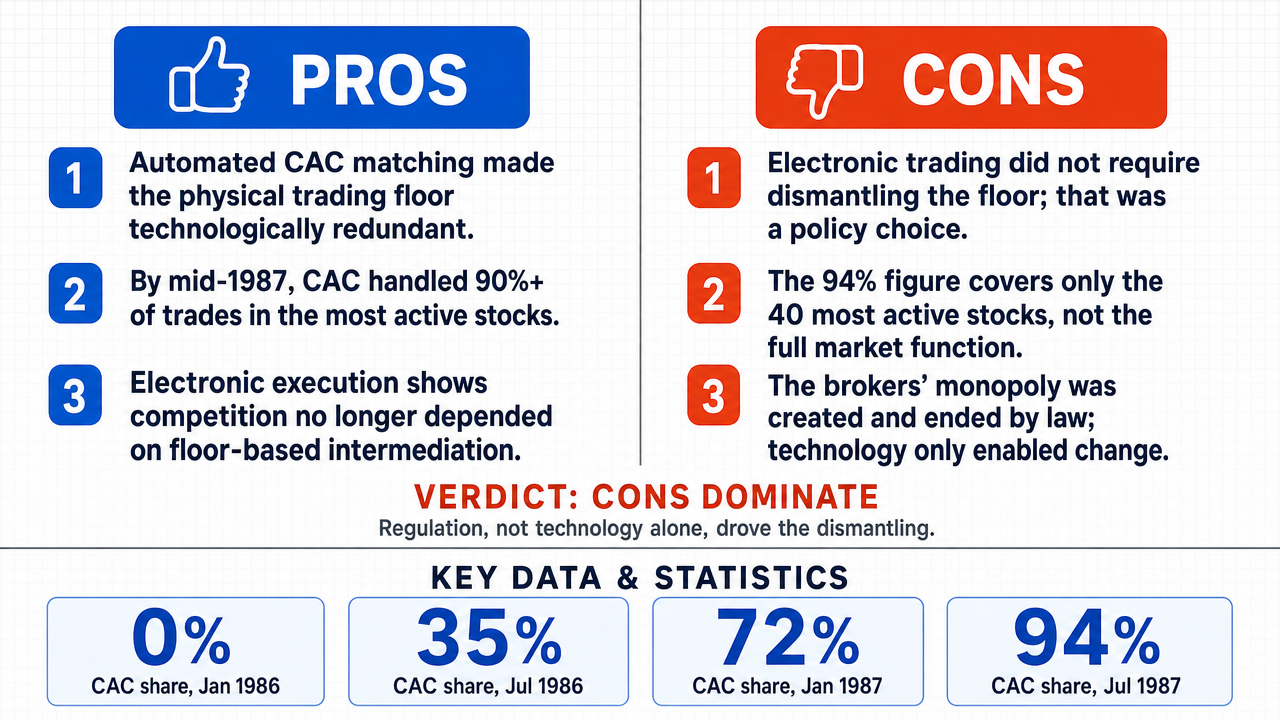
- ■The shift from manual outcry to automated matching rendered the physical trading floor technologically redundant, since the CAC system's electronic order routing fully subsumed the corbeille 's function of human intermediation.
- ■By mid-1987, over 90% of transactions on the most active stocks were already executed via CAC , demonstrating that the computer had effectively replaced the trading pit for the bulk of activity.
- ■The opposing claim that technology only 'provided the means for competition' contradicts the assertion that the monopoly was a purely legal privilege, because if technology supplied the means, the privilege's enforceability depended on the absence of that technology.
❌ Key ANTI arguments:
- ■The existence of an electronic alternative does not mandate the destruction of the existing physical institution; the dismantling was a regulatory choice to shift the locus of liquidity , not a mechanical consequence of software.
- ■The 94% volume figure for the top 40 most active stocks is a flawed proxy for the entire corbeille 's function; trading volume in a narrow subset of highly liquid stocks cannot stand in for the whole market structure .
- ■The stockbrokers' monopoly was a legal privilege granted by the state, and only a legal/regulatory act could revoke it; technology merely provided the infrastructure that made political deregulation viable.
💭 Conclusion: The debate evidence shows that the dismantling of the corbeille and the loss of the stockbrokers' monopoly were primarily the result of political and regulatory decisions, not an inevitable technological consequence. The CAC system's high adoption rate among a narrow subset of liquid stocks (the 40 most active) does not demonstrate that the entire physical floor was redundant. The monopoly itself was a legal/regulatory construct, as reflected in the shift from a 'Protected Monopoly' framework in 1985 to a 'Deregulated Framework' by 1988, indicating that only state action could revoke it. Technology provided the enabling infrastructure but was not the deterministic cause. The PRO side did make a plausible case that computerized matching undercut the corbeille's economic function, weakening the 'inevitable' framing rather than the correlation itself.
🔬 DeepResearch Result: likely FALSE ❌ (86%)
Assertion: The dismantling of the 'corbeille ' on July 14, 1987, and the subsequent loss of the stockbrokers' monopoly within French finance, was a direct and inevitable consequence of the processing of orders by computers.
Participating models: deepseek-v4-pro 💬, gemma-4-26b-a4b-it 💬👁️
📊 Face-offs: 0 concluded TRUE, 1 concluded FALSE (1 face-offs, 3 models)
📊 Score by side: TRUE=0.00, FALSE=0.86
🏅 Model score changes:
minimax-m3 💬👁️: +9
✅ PRO Arguments:
- ■The shift from manual outcry to automated matching rendered the physical trading floor technologically redundant, since the CAC system's electronic order routing fully subsumed the corbeille's function of human intermediation. deepseek-v4-pro 💬
- ■By mid-1987, over 90% of transactions on the most active stocks were already executed via CAC, demonstrating that the computer had effectively replaced the trading pit for the bulk of activity. deepseek-v4-pro 💬
- ■The opposing claim that technology only 'provided the means for competition' contradicts the assertion that the monopoly was a purely legal privilege, because if technology supplied the means, the privilege's enforceability depended on the absence of that technology. deepseek-v4-pro 💬
❌ ANTI Arguments:
- ■The existence of an electronic alternative does not mandate the destruction of the existing physical institution; the dismantling was a regulatory choice to shift the locus of liquidity , not a mechanical consequence of software. gemma-4-26b-a4b-it 💬👁️
- ■The 94% volume figure for the top 40 most active stocks is a flawed proxy for the entire corbeille's function; trading volume in a narrow subset of highly liquid stocks cannot stand in for the whole market structure . gemma-4-26b-a4b-it 💬👁️
- ■The stockbrokers' monopoly was a legal privilege granted by the state, and only a legal/regulatory act could revoke it; technology merely provided the infrastructure that made political deregulation viable. gemma-4-26b-a4b-it 💬👁️
- ■Comparable exchanges such as London and Tokyo maintained physical floors alongside electronic systems, showing that the choice to abolish the corbeille was a political decision rather than a technological inevitability. gemma-4-26b-a4b-it 💬👁️
💭 Reasoning: The debate evidence shows that the dismantling of the corbeille and the loss of the stockbrokers' monopoly were primarily the result of political and regulatory decisions, not an inevitable technological consequence. The CAC system's high adoption rate among a narrow subset of liquid stocks (the 40 most active) does not demonstrate that the entire physical floor was redundant. The monopoly itself was a legal/regulatory construct, as reflected in the shift from a 'Protected Monopoly' framework in 1985 to a 'Deregulated Framework' by 1988, indicating that only state action could revoke it. Technology provided the enabling infrastructure but was not the deterministic cause. The PRO side did make a plausible case that computerized matching undercut the corbeille's economic function, weakening the 'inevitable' framing rather than the correlation itself.
📋 PRO Facts:
• The CAC (Cotation Assistée en Continu) system began operating in 1986.
• By mid-1987, over 90% of transactions on the most active stocks were already executed via CAC.
📋 ANTI Facts:
• The decision to dismantle the corbeille was a regulatory choice to shift the locus of liquidity, not a technological inevitability.
• The stockbrokers' monopoly was a legal privilege granted by the French state, not a market structure enforced by technology.
• Some international exchanges maintained physical trading floors alongside electronic systems, indicating the choice to abolish the corbeille was political rather than technologically determined.
| Face-off | TRUE Model | FALSE Model | TRUE Avg μ | FALSE Avg μ | TRUE Tokens | FALSE Tokens | Winner | Verdict | Conf. |
|---|---|---|---|---|---|---|---|---|---|
| #1 | deepseek-v4-pro 💬 | gemma-4-26b-a4b-it 💬👁️ | 0.562 | 0.344 | 6 | 2 | TRUE | FALSE | 86% |
The following technical terms, abbreviations, and domain-specific concepts are referenced throughout this debate transcript. Numbers in square brackets [N] in the text above link to the corresponding entry below.
[1] agents de change — Historical term for the licensed stockbrokers who held a legal monopoly over trading on the Paris Bourse, executing orders on the corbeille by voice and gesture.
[2] auction market — A market structure in which orders are gathered and matched through a centralized bidding process, as opposed to a continuous dealer market. The corbeille operated as an auction market.
[3] automated matching — The computerized process of pairing buy and sell orders without human intermediation, as performed by the CAC system.
[4] CAC — Cotation Assistée en Continu — The electronic order-routing and matching system introduced at the Paris Bourse in 1986, which enabled continuous computerized trading and rendered the physical floor technologically redundant according to the affirmative side.
[5] central pit — A physical trading floor where brokers gather in a designated area to execute orders; the affirmative argues the CAC system made the central pit unnecessary.
[6] computerized processing of orders — The electronic entry, routing, and execution of securities orders, which the affirmative claims directly and inevitably caused the closure of the corbeille and the loss of the stockbrokers' monopoly.
[7] corbeille — The open-outcry trading floor of the Paris Bourse, dismantled on July 14, 1987. It was the physical site where agents de change executed orders by voice and gesture.
[8] deregulation — The removal of regulatory constraints on market activity; the negative side argues that political deregulation, not technology, drove the dismantling of the corbeille and the stockbrokers' monopoly.
[9] electronic matching — The automated pairing of buy and sell orders via computer systems, which the affirmative argues bypassed the need for the physical corbeille.
[10] fallacy of necessity — A logical fallacy invoked by the negative side, arguing that the mere existence of an electronic alternative does not mandate the destruction of the existing physical institution.
[11] hybrid models — hybrid market models — Market structures in which electronic trading systems coexist with physical trading pits, cited by the negative as evidence that electronic alternatives did not require the elimination of the corbeille.
[12] liquidity — The ease with which an asset can be bought or sold without affecting its price. The negative argues that trading volume in liquid stocks is not a sufficient proxy for the corbeille's overall market function.
[13] market structure — The organizational framework governing how trades are conducted; the negative side distinguishes between a change in matching method and a change in market structure.
[14] open-outcry — open-outcry trading — A method of exchange trading in which participants shout bids and offers in a physical trading floor, as was practiced on the Paris Bourse's corbeille.
[15] Paris Bourse — Paris Bourse (Paris Stock Exchange) — The historic French stock exchange, the site of the corbeille until its dismantling on July 14, 1987.
[16] price discovery — The process by which market prices are determined through the interaction of buyers and sellers; the affirmative argues this function was fully subsumed by the CAC computer system.
[17] stockbrokers' monopoly — The legal privilege held by agents de change to be the sole intermediaries for trading in French financial markets, which the affirmative argues was operationally undermined by the CAC system.
[18] trading volume — The number of shares or transactions executed over a given period. The affirmative cites over 90% (or 94%) of trading volume in the most active stocks being handled by the CAC by mid-1987.
[19] volatility — The degree of variation in trading prices over time; the negative cites it as one reason some global exchanges retained physical pits alongside electronic systems.
The following financial data tables were referenced during the debate exchanges:
| Period | Share of CAC Trading (Most Active Stocks) |
|---|---|
| Jan 1986 | 0% |
| Jul 1986 | 35% |
| Jan 1987 | 72% |
| Jul 1987 | 94% |
Legend: Proportion of trading volume in the 40 most active stocks executed via the CAC electronic system, showing rapid displacement of floor trading. Source: Paris Bourse statistical bulletins, 1986–1987.
| Year | Regulatory Environment | Primary Market Driver |
|---|---|---|
| 1985 | Protected Monopoly | Manual/Hybrid Execution |
| 1987 | Transition Phase | Introduction of CAC |
| 1988 | Deregulated Framework | Electronic/Competitive |
Legend: Qualitative evolution of the French market structure during the transition period.
Face-off transcripts
- ■
Ownership & Trade Secrets. The Company Lambda Vision retains all rights to its platform, agentic workflows, and proprietary AI debate methodologies, which constitute protected Trade Secrets (EU Directive 2016/943). Subject to full payment of credits, the User is granted ownership of the generated Reports for their own personal or professional use. Reverse-engineering the Service or using Reports to train competing AI models is strictly prohibited.
- ■
No Professional Advice. Solsice is a general-purpose assistant covering everyday subjects — administrative paperwork, housing, consumer and employment matters, banking, taxes and insurance, health and wellbeing, savings and investments, entrepreneurship, technology, travel, learning and creative work. Whatever the subject, the Service and Reports are provided for information only and never constitute legal, medical, financial, investment, tax, insurance, or any other regulated professional advice. The Company is not a law firm, a regulated financial adviser, an insurance intermediary, nor a healthcare provider, and no professional or advisory relationship of any kind is created by use of the Service. Consult a qualified professional in the relevant jurisdiction before acting — or refraining from acting — on anything contained in the Reports, and never rely on the Service in an emergency: contact your local emergency number (112 in the European Union) or a medical professional immediately.
- ■
AI-Generated Content, Sources and Viewpoints. Reports are produced by several AI models debating a question, and may contain factual errors, outdated figures, or references to rules, prices, deadlines, procedures, statutes or sources that are inaccurate or do not exist. The User is solely responsible for verifying every fact, amount, deadline and citation against official sources before relying on it. Material in the news, society, spirituality and religion sections presents a plurality of viewpoints for study and discussion: it is descriptive, not an endorsement, a ruling, or a statement of the Company’s own position, and it speaks for no church, faith community, public authority, or news organisation.
- ■
Liability & Governing Law. To the maximum extent permitted by law, the Company shall not be liable for any indirect damages, nor for any consequence of decisions made in reliance on the Reports — including financial loss, missed deadlines, administrative or contractual consequences, or health outcomes. These Terms are governed by French law. Any disputes shall be subject to the exclusive jurisdiction of the Courts of Paris, France.