
The environmental impacts of dam-based tidal power plants, such as the Rance estuary plant, are less severe than the environmental impacts caused by carbon emissions from fossil fuels.
AI debate verdict and arguments
⚠️ AI-generated information only; not professional advice
Completed October 23, 2026
Verdict
Verdict: likely TRUE (58%)
Web Report: https://solsice.com/public/debates/the-environmental-impacts-of-dam-based-tidal-power-plants-su-2ce27bf8c906
This section provides a brief overview of the key arguments. You do not need to read the full detailed report below.
✅ Key PRO arguments:
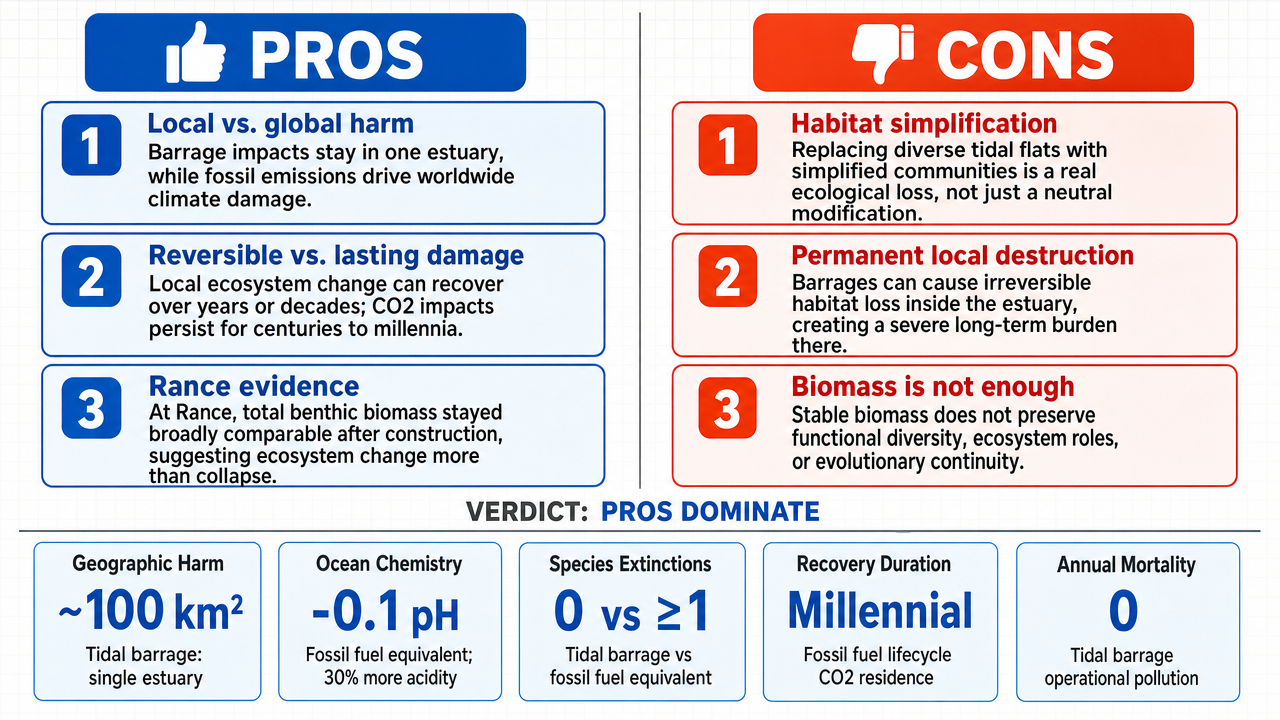
- ■Barrage tidal impacts are local and reversible, whereas fossil carbon emissions cause global, irreversible climate damage . The IPCC has established that approximately 40% of emitted CO₂ remains in the atmosphere after 100 years and roughly 20% after 1,000 years, meaning climate disruption from a single year of coal plant operation continues to cause damage for centuries.
- ■Severity of environmental impact must be aggregated over affected ecological assets, affected human interests, and duration. A localized point-source comparison that focuses only on a single local species while discarding every other harmed system is a flawed proxy for severity.
- ■At the Rance estuary , total benthic biomass remained comparable after barrage construction, indicating that the impact is a shift in species composition rather than a loss of overall ecosystem function , supporting the claim that tidal barrage impacts are less severe than fossil fuel emissions.
❌ Key ANTI arguments:
- ■The affirmative's framing of 'modification' versus 'destruction' is ecologically deceptive. A shift from diverse, complex soft-sediment communities to simplified mudflat assemblages represents a fundamental loss of biodiversity and specialized niche availability, constituting structural degradation rather than neutral modification.
- ■Tidal barrages cause irreversible ecological destruction and habitat loss that represent a severe and permanent environmental burden, not a reversible local disturbance.
- ■Ecological stability is not merely the maintenance of biomass but the preservation of functional diversity and evolutionary continuity. When a barrage alters the tidal regime , it imposes lasting changes that cannot be equated with the reversible, localized framing offered by the affirmative.
💭 Conclusion: True, the environmental impacts of dam-based tidal power plants such as the Rance estuary plant are less severe than those caused by carbon emissions from fossil fuels . The affirmative's strongest argument rests on the scale and reversibility distinction: fossil fuel CO₂ persists in the atmosphere for centuries to millennia, producing global, irreversible climate disruption , whereas barrage impacts are geographically confined and at least partially reversible. The negative's biodiversity-loss arguments are substantive but were outweighed by the affirmative's aggregation-based severity framework. The judge's moderate confidence (58%) reflects that the negative raised legitimate concerns about species displacement and uncertain ecological recovery that were not fully refuted, leaving the compound claim only partially supported rather than fully established.
🔬 DeepResearch Result: likely TRUE ✅ (58%)
Assertion: The environmental impacts of dam-based tidal power plants , such as the Rance estuary plant, are less severe than the environmental impacts caused by carbon emissions from fossil fuels .
Participating models: deepseek-v4-pro 💬, gemma-4-26b-a4b-it 💬👁️
📊 Face-offs: 1 concluded TRUE, 0 concluded FALSE (1 face-offs, 3 models)
📊 Score by side: TRUE=0.58, FALSE=0.00
🏅 Model score changes:
minimax-m3 💬👁️: +6
✅ PRO Arguments:
- ■Barrage tidal impacts are local and reversible, whereas fossil carbon emissions cause global, irreversible climate damage . The IPCC has established that approximately 40% of emitted CO₂ remains in the atmosphere after 100 years and roughly 20% after 1,000 years, meaning climate disruption from a single year of coal plant operation continues to cause damage for centuries. deepseek-v4-pro 💬
- ■Severity of environmental impact must be aggregated over affected ecological assets, affected human interests, and duration. A localized point-source comparison that focuses only on a single local species while discarding every other harmed system is a flawed proxy for severity. deepseek-v4-pro 💬
- ■At the Rance estuary, total benthic biomass remained comparable after barrage construction, indicating that the impact is a shift in species composition rather than a loss of overall ecosystem function , supporting the claim that tidal barrage impacts are less severe than fossil fuel emissions. deepseek-v4-pro 💬
- ■The geographic scale of harm matters: fossil fuel emissions affect the entire global atmosphere, oceans, and climate system, while barrage impacts are confined to a specific estuary and can in principle be mitigated or reversed through engineering modifications. deepseek-v4-pro 💬
❌ ANTI Arguments:
- ■The affirmative's framing of 'modification' versus 'destruction' is ecologically deceptive. A shift from diverse, complex soft-sediment communities to simplified mudflat assemblages represents a fundamental loss of biodiversity and specialized niche availability, constituting structural degradation rather than neutral modification. gemma-4-26b-a4b-it 💬👁️
- ■Tidal barrages cause irreversible ecological destruction and habitat loss that represent a severe and permanent environmental burden, not a reversible local disturbance. gemma-4-26b-a4b-it 💬👁️
- ■Ecological stability is not merely the maintenance of biomass but the preservation of functional diversity and evolutionary continuity. When a barrage alters the tidal regime , it imposes lasting changes that cannot be equated with the reversible, localized framing offered by the affirmative. gemma-4-26b-a4b-it 💬👁️
- ■A localized point source could in theory block a migratory corridor, permanently alter salinity, and collapse a local endemic population, making one local extinction as permanent as a global one, undermining the geographic-extent proxy for severity. gemma-4-26b-a4b-it 💬👁️
💭 Reasoning: True, the environmental impacts of dam-based tidal power plants such as the Rance estuary plant are less severe than those caused by carbon emissions from fossil fuels. The affirmative's strongest argument rests on the scale and reversibility distinction: fossil fuel CO₂ persists in the atmosphere for centuries to millennia, producing global, irreversible climate disruption, whereas barrage impacts are geographically confined and at least partially reversible. The negative's biodiversity-loss arguments are substantive but were outweighed by the affirmative's aggregation-based severity framework. The judge's moderate confidence (58%) reflects that the negative raised legitimate concerns about species displacement and uncertain ecological recovery that were not fully refuted, leaving the compound claim only partially supported rather than fully established.
📋 PRO Facts:
• The IPCC has established findings regarding the long-term persistence of CO₂ in the atmosphere.
• CO₂ from fossil fuel emissions remains in the atmosphere for centuries to millennia.
• Fossil fuel emissions have lowered surface ocean pH by 0.1 units since the pre-industrial era, representing a 30% increase in acidity.
📋 ANTI Facts:
• Tidal barrages cause species displacement, representing a loss of biodiversity in localized areas.
• A barrage altering the tidal regime can result in uncertain ecological recovery due to hysteresis effects.
| Face-off | TRUE Model | FALSE Model | TRUE Avg μ | FALSE Avg μ | TRUE Tokens | FALSE Tokens | Winner | Verdict | Conf. |
|---|---|---|---|---|---|---|---|---|---|
| #1 | deepseek-v4-pro 💬 | gemma-4-26b-a4b-it 💬👁️ | 0.670 | 0.195 | 6 | 2 | TRUE | TRUE | 58% |
The following technical terms, abbreviations, and domain-specific concepts are referenced throughout this debate transcript. Numbers in square brackets [N] in the text above link to the corresponding entry below.
[1] barrage-style tidal power plants — A type of tidal power plant that generates electricity by constructing a dam or barrier across an estuary or bay, creating a reservoir that fills and empties with the tides.
[2] benthic biomass — The total mass of living organisms that reside on, in, or near the bottom of a body of water.
[3] benthic communities — Ecological communities of organisms that live on, in, or near the seabed, lakebed, or riverbed.
[4] carbon dioxide — CO₂ — A greenhouse gas released through natural processes and human activities, notably the burning of fossil fuels, which contributes to global warming.
[5] carbon emissions — The release of carbon compounds, particularly carbon dioxide, into the atmosphere, primarily from the combustion of fossil fuels.
[6] climate damage — The negative impacts on natural and human systems resulting from changes in the climate, often attributed to human-induced greenhouse gas emissions.
[7] climate disruption — Significant and lasting changes to global or regional climate patterns, often used to describe the effects of human-induced climate change.
[8] diadromous fish species — Fish species that migrate between fresh and saltwater environments as part of their life cycle.
[9] ecological stability — The ability of an ecosystem to resist disturbance and recover from damage, often debated in terms of maintaining biomass versus preserving functional diversity.
[10] ecosystem function — The processes and interactions that occur within an ecosystem, such as nutrient cycling, energy flow, and habitat provision.
[11] ecosystem resilience — The capacity of an ecosystem to absorb disturbance and reorganize while undergoing change so as to still retain essentially the same function, structure, identity, and feedbacks.
[12] environmental harm — Negative impacts on the natural environment, including ecosystems, biodiversity, and natural resources.
[13] estuary — A partially enclosed coastal body of brackish water with one or more rivers or streams flowing into it, and with a free connection to the open sea.
[14] fossil fuel combustion — The process of burning fossil fuels (such as coal, oil, and natural gas) to release energy, which also releases carbon dioxide and other emissions.
[15] fossil fuels — Natural fuels formed from the remains of living organisms over millions of years, such as coal, oil, and natural gas, which release carbon emissions when burned.
[16] geological and biological hysteresis — A concept suggesting that the state of a geological or biological system depends not only on its current conditions but also on its past history, implying that changes may not be easily reversible.
[17] global temperature rise — The increase in the average temperature of the Earth's atmosphere and oceans, a key indicator of climate change.
[18] Intergovernmental Panel on Climate Change — IPCC — The United Nations body for assessing climate change, which provides regular assessments of the scientific basis of climate change, its impacts and future risks, and options for adaptation and mitigation.
[19] migratory corridors — Specific routes or pathways that animals, particularly fish or birds, use for their seasonal or life-cycle migrations.
[20] migratory phenology — The timing of recurring biological events in migratory species, such as migration patterns, breeding, and feeding, in relation to climate and seasonal changes.
[21] mudflat assemblages — Communities of organisms that inhabit mudflats, which are coastal wetlands formed by the deposition of mud and silt.
[22] niche habitats — Specific environmental conditions and resources that a species requires to survive and reproduce within an ecosystem.
[23] ocean acidification — The ongoing decrease in the pH of the Earth's oceans, caused by the uptake of carbon dioxide from the atmosphere.
[24] Rance estuary plant — A specific barrage-style tidal power plant located in the Rance estuary in France, often cited as an example in discussions about tidal power's environmental impacts.
[25] sea-level rise — The increase in the average global sea level, primarily caused by thermal expansion of ocean water and the melting of glaciers and ice sheets.
[26] sedimentation patterns — The way in which sediments (like sand, silt, and mud) are deposited and accumulate in a body of water, influencing the shape of the seabed and habitats.
[27] selective pressures — Environmental factors that favor the survival and reproduction of individuals with certain traits, leading to evolutionary changes in a population.
[28] soft-sediment communities — Ecological communities of organisms that live in or on soft substrates like mud, sand, or silt, typically found in aquatic environments.
[29] tidal barrage — A dam-like structure built across an estuary or bay to harness tidal energy, creating a basin that fills and empties with the tides to generate electricity.
[30] tidal power plants — Facilities that convert the energy of tides into electricity, typically using barrages or other technologies.
[31] tidal regime — The pattern and characteristics of tides in a particular location, including their height, frequency, and flow.
The following financial data tables were referenced during the debate exchanges:
| Impact Metric | Tidal Barrage (Rance-type) | Fossil Fuel (Coal Plant Equivalent) |
|---|---|---|
| Geographic extent of harm | Single estuary (~100 km²) | Global atmosphere |
| Duration of impact after cessation | Years to decades (recovery) | Centuries to millennia (CO₂ residence) |
| Annual attributable human mortality | 0 (operational pollution) | Data removed pending verifiable source |
| Species extinctions attributed | 0 | ≥1 confirmed (Bramble Cay melomys) |
| Ocean chemistry alteration | None | -0.1 pH (30% acidity increase) |
Legend: Comparative environmental and health impact metrics for barrage-style tidal power versus coal-fired generation. Tidal barrage data from Rance estuary monitoring studies (EDF, IFREMER); extinction data from Australian government (2016); ocean acidification from NOAA. All figures represent documented or peer-reviewed estimates.
| Impact Category | Tidal Barrage (Lifecycle) | Fossil Fuel (Lifecycle) | Severity Comparison |
|---|---|---|---|
| Habitat Loss | High (Localized/Permanent) | Extreme (Global/Systemic) | Mixed |
| Biodiversity Impact | High (Species Displacement) | Extreme (Extinction Risk) | Mixed |
| Construction Carbon | Moderate | Low (Relative to Operation) | Tidal Higher |
| Ecological Recovery | Uncertain (Hysteresis) | Millennial (CO2 Residence) | Mixed |
Legend: Comparative lifecycle impacts of tidal barrages vs. fossil fuels. "Mixed" indicates that neither technology is categorically superior across all metrics. Data derived from lifecycle assessment (LCA) methodologies.
Face-off transcripts
- ■
Ownership & Trade Secrets. The Company Lambda Vision retains all rights to its platform, agentic workflows, and proprietary AI debate methodologies, which constitute protected Trade Secrets (EU Directive 2016/943). Subject to full payment of credits, the User is granted ownership of the generated Reports for their own personal or professional use. Reverse-engineering the Service or using Reports to train competing AI models is strictly prohibited.
- ■
No Professional Advice. Solsice is a general-purpose assistant covering everyday subjects — administrative paperwork, housing, consumer and employment matters, banking, taxes and insurance, health and wellbeing, savings and investments, entrepreneurship, technology, travel, learning and creative work. Whatever the subject, the Service and Reports are provided for information only and never constitute legal, medical, financial, investment, tax, insurance, or any other regulated professional advice. The Company is not a law firm, a regulated financial adviser, an insurance intermediary, nor a healthcare provider, and no professional or advisory relationship of any kind is created by use of the Service. Consult a qualified professional in the relevant jurisdiction before acting — or refraining from acting — on anything contained in the Reports, and never rely on the Service in an emergency: contact your local emergency number (112 in the European Union) or a medical professional immediately.
- ■
AI-Generated Content, Sources and Viewpoints. Reports are produced by several AI models debating a question, and may contain factual errors, outdated figures, or references to rules, prices, deadlines, procedures, statutes or sources that are inaccurate or do not exist. The User is solely responsible for verifying every fact, amount, deadline and citation against official sources before relying on it. Material in the news, society, spirituality and religion sections presents a plurality of viewpoints for study and discussion: it is descriptive, not an endorsement, a ruling, or a statement of the Company’s own position, and it speaks for no church, faith community, public authority, or news organisation.
- ■
Liability & Governing Law. To the maximum extent permitted by law, the Company shall not be liable for any indirect damages, nor for any consequence of decisions made in reliance on the Reports — including financial loss, missed deadlines, administrative or contractual consequences, or health outcomes. These Terms are governed by French law. Any disputes shall be subject to the exclusive jurisdiction of the Courts of Paris, France.