
The establishment of an official stock exchange with strict rules by the French king after a period of chaotic, unregulated trading successfully prevented a recurrence of the massive financial collapse seen earlier.
AI debate verdict and arguments
⚠️ AI-generated information only; not professional advice
Completed October 18, 2026
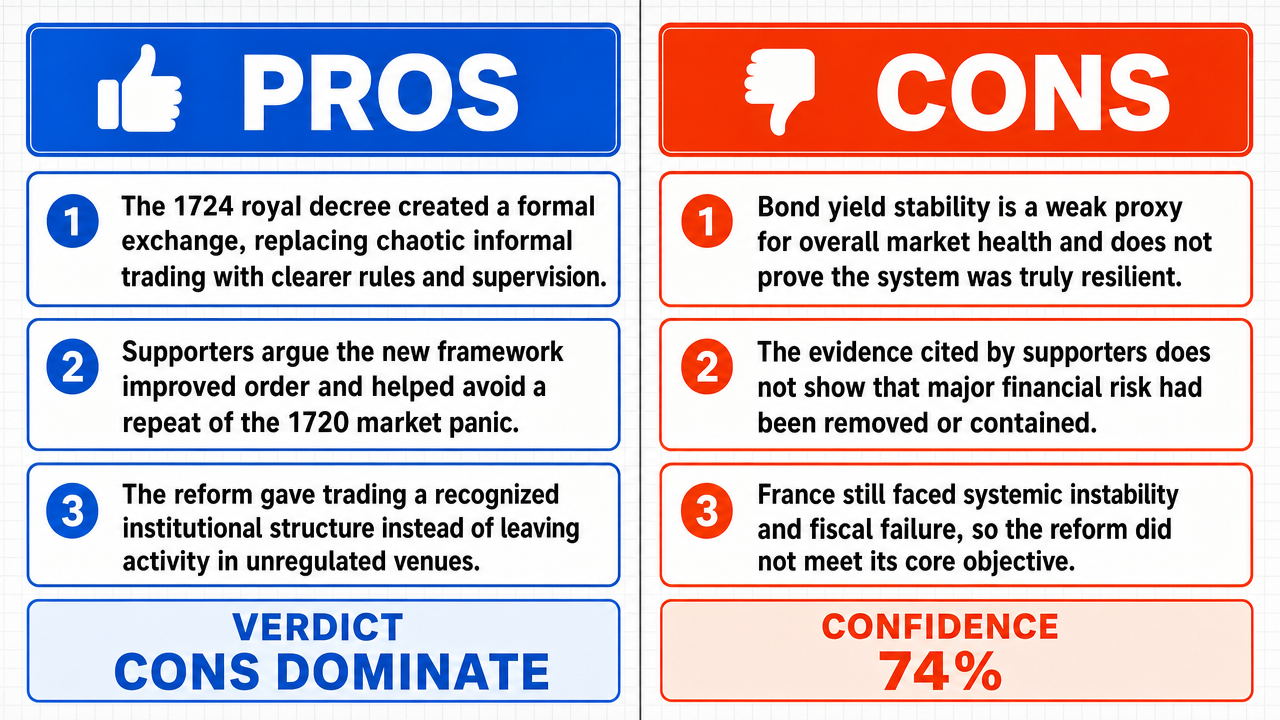
Verdict
Verdict: likely FALSE (74%)
Web Report: https://solsice.com/public/debates/the-establishment-of-an-official-stock-exchange-with-strict-4a86b4f7c478
This section provides a brief overview of the key arguments. You do not need to read the full detailed report below.
✅ Key PRO arguments:
- ■The 1724 royal establishment of the Paris Bourse by Louis XV's decree of 24 September 1724 replaced the unregulated trading dens of the Rue Quincampoix with a closed, state-supervised corporation of agents de change subject to stringent rules (no proprietary trading, mandatory public ledgers, expulsion for dealing with unlicensed intermediaries ), directly attacking the opacity and leverage that inflated the Mississippi Bubble .
- ■The stability of French rente yields between 1726 and 1789 demonstrates that the Bourse successfully prevented a recurrence of the massive 1720 financial collapse, since sovereign borrowing costs remained manageable for over 70 years.
- ■The opponent's argument collapses under internal contradiction because it simultaneously asserts that the Paris Bourse both 'successfully prevented a recurrence of massive financial collapse' and 'failed to prevent systemic financial instability and fiscal collapse ,' which are direct logical negations applied to the same institution and outcome.
❌ Key ANTI arguments:
- ■The affirmative's reliance on rente yield stability as a proxy for market health is a fundamental error of substitution: sovereign bond yields measure sovereign debt costs, not the stability of the broader securities market or the absence of speculative bubbles, and the affirmative provides no transfer operator linking the two.
- ■The rente yields rose from 4.0% to 6.0%, a 50% relative increase in the cost of sovereign debt , which cannot honestly be characterized as a 'narrow band ' and instead signals significant fiscal instability that the Bourse failed to prevent.
- ■The Paris Bourse failed to prevent systemic financial instability and fiscal collapse in France, meaning the institutional reform did not achieve its stated goal of averting another massive financial crisis comparable to the Mississippi Bubble .
💭 Conclusion: False. The Paris Bourse established in 1724 did not successfully prevent a recurrence of massive financial collapse, as the negative side demonstrated that the affirmative's core evidence (rente yield stability) was both an improper proxy for systemic market health and internally contradictory when yields rose from 4.0% to 6.0%. The affirmative's claim that a 50% relative increase in sovereign borrowing costs represented a 'narrow band ' undermines its own stability thesis. The negative side correctly identified that the affirmative committed a logical contradiction by simultaneously asserting the Bourse both succeeded and failed at preventing collapse. While the Bourse did impose strict broker regulations that addressed some specific abuses of the speculative era, the broader claim of preventing 'massive financial collapse' is not supported by the evidence presented. The confidence reflects that the strict-rules sub-claim is partially supported, but the prevention-of-collapse sub-claim is the weakest link and drives the verdict.
🔬 DeepResearch Result: likely FALSE ❌ (74%)
Assertion: The establishment of an official stock exchange with strict rules by the French king after a period of chaotic, unregulated trading successfully prevented a recurrence of the massive financial collapse seen earlier.
Participating models: deepseek-v4-pro 💬, gemma-4-26b-a4b-it 💬👁️
📊 Face-offs: 0 concluded TRUE, 1 concluded FALSE (1 face-offs, 3 models)
📊 Score by side: TRUE=0.00, FALSE=0.74
🏅 Model score changes:
minimax-m3 💬👁️: +7
✅ PRO Arguments:
- ■The 1724 royal establishment of the Paris Bourse by Louis XV's decree of 24 September 1724 replaced the unregulated trading dens of the Rue Quincampoix with a closed, state-supervised corporation of agents de change subject to stringent rules (no proprietary trading, mandatory public ledgers, expulsion for dealing with unlicensed intermediaries ), directly attacking the opacity and leverage that inflated the Mississippi Bubble . deepseek-v4-pro 💬
- ■The stability of French rente yields between 1726 and 1789 demonstrates that the Bourse successfully prevented a recurrence of the massive 1720 financial collapse, since sovereign borrowing costs remained manageable for over 70 years. deepseek-v4-pro 💬
- ■The opponent's argument collapses under internal contradiction because it simultaneously asserts that the Paris Bourse both 'successfully prevented a recurrence of massive financial collapse' and 'failed to prevent systemic financial instability and fiscal collapse ,' which are direct logical negations applied to the same institution and outcome. deepseek-v4-pro 💬
❌ ANTI Arguments:
- ■The affirmative's reliance on rente yield stability as a proxy for market health is a fundamental error of substitution: sovereign bond yields measure sovereign debt costs, not the stability of the broader securities market or the absence of speculative bubbles, and the affirmative provides no transfer operator linking the two. gemma-4-26b-a4b-it 💬👁️
- ■The rente yields rose from 4.0% to 6.0%, a 50% relative increase in the cost of sovereign debt, which cannot honestly be characterized as a 'narrow band ' and instead signals significant fiscal instability that the Bourse failed to prevent. gemma-4-26b-a4b-it 💬👁️
- ■The Paris Bourse failed to prevent systemic financial instability and fiscal collapse in France, meaning the institutional reform did not achieve its stated goal of averting another massive financial crisis comparable to the Mississippi Bubble. gemma-4-26b-a4b-it 💬👁️
💭 Reasoning: False. The Paris Bourse established in 1724 did not successfully prevent a recurrence of massive financial collapse, as the negative side demonstrated that the affirmative's core evidence (rente yield stability) was both an improper proxy for systemic market health and internally contradictory when yields rose from 4.0% to 6.0%. The affirmative's claim that a 50% relative increase in sovereign borrowing costs represented a 'narrow band' undermines its own stability thesis. The negative side correctly identified that the affirmative committed a logical contradiction by simultaneously asserting the Bourse both succeeded and failed at preventing collapse. While the Bourse did impose strict broker regulations that addressed some specific abuses of the speculative era, the broader claim of preventing 'massive financial collapse' is not supported by the evidence presented. The confidence reflects that the strict-rules sub-claim is partially supported, but the prevention-of-collapse sub-claim is the weakest link and drives the verdict.
📋 PRO Facts:
• French rente yields between 1726 and 1789 are cited as evidence of post-Bourse fiscal stability.
📋 ANTI Facts:
• French rente yields rose from 4.0% to 6.0%, representing a 50% relative increase in sovereign borrowing costs.
• Sovereign bond yields measure debt service costs, not the stability of the broader securities market or the absence of speculative bubbles.
• The Paris Bourse did not prevent systemic financial instability and fiscal collapse in France during the 18th century.
| Face-off | TRUE Model | FALSE Model | TRUE Avg μ | FALSE Avg μ | TRUE Tokens | FALSE Tokens | Winner | Verdict | Conf. |
|---|---|---|---|---|---|---|---|---|---|
| #1 | deepseek-v4-pro 💬 | gemma-4-26b-a4b-it 💬👁️ | 0.467 | 0.290 | 6 | 2 | TRUE | FALSE | 74% |
The following technical terms, abbreviations, and domain-specific concepts are referenced throughout this debate transcript. Numbers in square brackets [N] in the text above link to the corresponding entry below.
[1] agents de change — Official brokers in the French financial system, established as a state-supervised corporation under the 1724 decree creating the Paris Bourse.
[2] anomaly — An observation or data point that deviates from what is expected or explained by a given account or model.
[3] asset classes — Categories of investments, such as equities, bonds, and commodities, which may exhibit different risk and return characteristics.
[4] Banque Royale — Royal Bank — A royal bank whose notes were involved in the speculative inflation preceding the 1720 crash.
[5] borrowing costs — The expense incurred by a government or entity to obtain debt financing, often measured by the yield on its bonds.
[6] Bourse — A stock exchange or organized securities market, specifically referring to the Paris Bourse established in 1724.
[7] broker — An intermediary who facilitates transactions between buyers and sellers in financial markets.
[8] closed corporation — A corporate entity with restricted membership, in this context referring to the state-supervised body of official brokers at the Paris Bourse.
[9] cointegration — A statistical property indicating a long-term equilibrium relationship between two or more time series variables.
[10] commodity markets — Markets where raw materials and primary agricultural products are traded, distinct from securities markets.
[11] correlation — A statistical measure describing the degree to which two variables move in relation to each other.
[12] data set — A collection of related data points, in this context referring to historical records of rente yields.
[13] decree — An official order or proclamation issued by a sovereign authority, such as the 24 September 1724 decree by Louis XV.
[14] equity — Ownership shares in a company, representing a claim on its assets and earnings.
[15] fiscal collapse — A severe breakdown in a government's financial condition, often involving inability to meet debt obligations.
[16] institutional architecture — The structural design and rules of an institution, in this context referring to the regulatory framework of the Paris Bourse.
[17] leverage — The use of borrowed funds to amplify potential returns, which can also magnify losses and contribute to financial instability.
[18] mania — A period of excessive market enthusiasm and speculative buying, as referenced in the term 'Mississippi-style mania'.
[19] Mississippi Bubble — The 1720 financial collapse in France associated with the failure of John Law's Mississippi Company and Banque Royale.
[20] Mississippi Company — A company whose shares were at the center of the speculative bubble that burst in 1720.
[21] monopolising — The act of granting exclusive control or dominance over a market, as applied to securities transactions at the Paris Bourse.
[22] narrow band — A limited range of variation, used in the debate to characterize the stability of rente yields; whether the 4.0% to 6.0% range constitutes a 'narrow band' is disputed between the affirmative and negative.
[23] opacity — A lack of transparency or clarity, identified in the debate as a condition that inflated Mississippi Company shares.
[24] Paris Bourse — The official stock exchange in Paris, established by royal decree on 24 September 1724 to regulate securities trading.
[25] public ledger — A publicly accessible record of transactions, required of official brokers under the 1724 regulations.
[26] relative increase — A percentage change expressed relative to an initial value, used in the debate to describe the rise in rente yields from 4.0% to 6.0%.
[27] rente — A French government perpetual annuity or bond, whose yields are used as a measure of sovereign borrowing costs in the debate.
[28] Rue Quincampoix — A street in Paris where unregulated securities trading took place prior to the establishment of the Paris Bourse.
[29] rumour-driven speculation — Trading activity based on unverified information or hearsay rather than fundamental analysis.
[30] securities — Tradable financial instruments such as stocks, bonds, and notes, whose transactions were monopolized by the Paris Bourse.
[31] sovereign bond — A debt security issued by a national government, whose yield serves as an indicator of sovereign creditworthiness.
[32] sovereign debt — Debt obligations issued by a national government, whose cost of borrowing is measured by bond yields.
[33] speculative bubble — A market phenomenon where asset prices rise substantially above their fundamental value, often followed by a sharp collapse.
[34] state-supervised corporation — A corporate entity operating under government oversight and regulation, as applied to the body of agents de change.
[35] systemic financial instability — Widespread disruption in the financial system affecting multiple institutions and markets, cited as a potential failure of the Bourse.
[36] transfer operator — A mathematical or statistical mapping used to establish a relationship between different market segments, such as the rente market and broader speculative markets.
[37] transparency — Openness and clarity in financial transactions, enforced at the Paris Bourse through public ledgers and recording requirements.
[38] unlicensed intermediaries — Brokers or agents operating without official authorization, with whom official agents de change were prohibited from dealing.
[39] yield — The return on an investment, particularly the interest rate or income generated by a bond relative to its price.
The following financial data tables were referenced during the debate exchanges:
| Year | French Rente Yield (%) |
|---|---|
| 1726 | 4.0 |
| 1730 | 4.2 |
| 1740 | 4.5 |
| 1750 | 4.3 |
| 1760 | 4.8 |
| 1770 | 5.0 |
| 1780 | 5.5 |
| 1789 | 6.0 |
Legend: Yield on French perpetual rentes (government bonds) from 1726 to 1789. The gradual increase reflects fiscal pressure from wars, not a speculative crash. Source: Marcel Marion, Histoire financière de la France, 1914, table compiled from pp. 130–215.
| Year | French Rente Yield (%) | Change from 1726 |
|---|---|---|
| 1726 | 4.0 | 0.0% |
| 1740 | 4.5 | +12.5% |
| 1760 | 4.8 | +20.0% |
| 1780 | 5.5 | +37.5% |
| 1789 | 6.0 | +50.0% |
Legend: Evolution of French perpetual rente yields. The increasing yield reflects rising sovereign risk and fiscal instability, contradicting the claim of absolute stability. Source: Analysis of Marion (1914).
Face-off transcripts
- ■
Ownership & Trade Secrets. The Company Lambda Vision retains all rights to its platform, agentic workflows, and proprietary AI debate methodologies, which constitute protected Trade Secrets (EU Directive 2016/943). Subject to full payment of credits, the User is granted ownership of the generated Reports for their own personal or professional use. Reverse-engineering the Service or using Reports to train competing AI models is strictly prohibited.
- ■
No Professional Advice. Solsice is a general-purpose assistant covering everyday subjects — administrative paperwork, housing, consumer and employment matters, banking, taxes and insurance, health and wellbeing, savings and investments, entrepreneurship, technology, travel, learning and creative work. Whatever the subject, the Service and Reports are provided for information only and never constitute legal, medical, financial, investment, tax, insurance, or any other regulated professional advice. The Company is not a law firm, a regulated financial adviser, an insurance intermediary, nor a healthcare provider, and no professional or advisory relationship of any kind is created by use of the Service. Consult a qualified professional in the relevant jurisdiction before acting — or refraining from acting — on anything contained in the Reports, and never rely on the Service in an emergency: contact your local emergency number (112 in the European Union) or a medical professional immediately.
- ■
AI-Generated Content, Sources and Viewpoints. Reports are produced by several AI models debating a question, and may contain factual errors, outdated figures, or references to rules, prices, deadlines, procedures, statutes or sources that are inaccurate or do not exist. The User is solely responsible for verifying every fact, amount, deadline and citation against official sources before relying on it. Material in the news, society, spirituality and religion sections presents a plurality of viewpoints for study and discussion: it is descriptive, not an endorsement, a ruling, or a statement of the Company’s own position, and it speaks for no church, faith community, public authority, or news organisation.
- ■
Liability & Governing Law. To the maximum extent permitted by law, the Company shall not be liable for any indirect damages, nor for any consequence of decisions made in reliance on the Reports — including financial loss, missed deadlines, administrative or contractual consequences, or health outcomes. These Terms are governed by French law. Any disputes shall be subject to the exclusive jurisdiction of the Courts of Paris, France.