
The expanded 12-team playoff format in college football will diminish the consequence of regular-season losses for top-tier teams.
AI debate verdict and arguments
⚠️ AI-generated information only; not professional advice
Completed October 22, 2026
Verdict
Verdict: likely FALSE (68%)
Web Report: https://solsice.com/public/debates/the-expanded-12-team-playoff-format-in-college-football-will-ae50bce81469
This section provides a brief overview of the key arguments. You do not need to read the full detailed report below.
✅ Key PRO arguments:
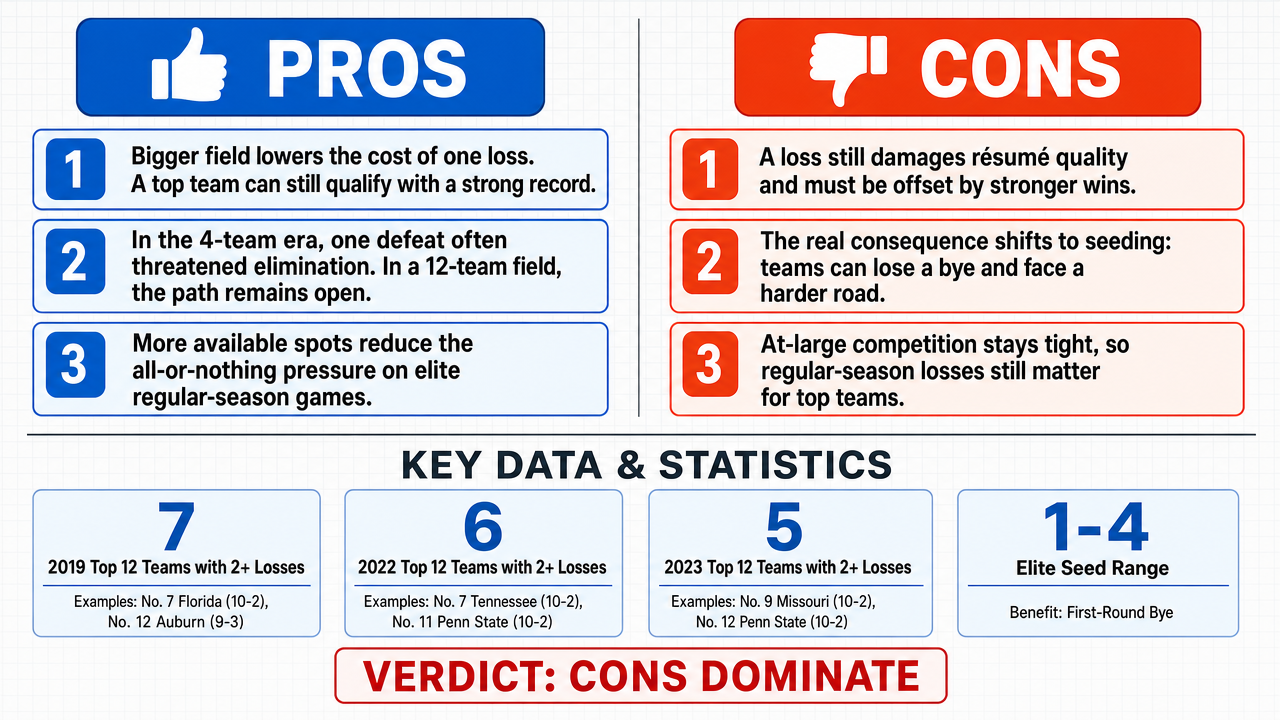
- ■The structural mathematics of qualification fundamentally alter the stakes of a regular-season defeat. Under the four-team model, a single loss for a top-tier program often functioned as a de facto elimination event , as the selection committee historically excluded one-loss Power Five teams when multiple undefeated or one-loss conference champions were present. The 12-team format dismantles this binary threshold by granting automatic bids to the five highest-ranked conference champions and reserving seven at-large spots, expanding the pool of viable contenders.
- ■The negative's argument deploys the term 'consequence' in two irreconcilable senses across its reasoning. When describing the four-team era, 'consequence' denotes a binary outcome (playoff access or exclusion), but when shifting to the 12-team format, 'consequence' is silently redefined to mean 'seeding position' or 'difficulty of path.' This equivocation undermines the negative's claim that losses carry greater consequence under the expanded format.
❌ Key ANTI arguments:
- ■The affirmative commits a fundamental logical error of substitution of proxy . They claim that because certain teams historically had two losses and still ranked in the top 12, the consequence of a loss is diminished. However, they are measuring the historical composition of the top 12 to draw a conclusion about the future consequence of a loss under a new ruleset. There is no established transfer operator —no correlation or causal link —between the historical presence of two-loss teams in the rankings and the actual impact of a loss on a team's playoff probability under the new format.
- ■A loss, regardless of the opponent's quality, is a negative data point that must be offset by an even greater accumulation of positive data points to maintain the same level of value in the eyes of a selection committee . While a loss to a 'blue-blood ' program may prevent a total collapse in strength-of-schedule metrics, it does not 'enhance' a résumé ; it merely mitigates the damage. To claim enhancement is to suggest a loss provides a net benefit , which contradicts the fundamental mathematical reality of the selection process.
- ■Expanded playoffs increase the stakes of regular-season losses by intensifying competition for limited at-large bids . With only seven at-large spots available and a hyper-competitive pool of Power Five and Group of Five contenders, the margin for error shrinks rather than expands, making each loss more consequential for teams competing for those finite slots.
💭 Conclusion: False. The expanded 12-team playoff format does not diminish the consequence of regular-season losses for top-tier teams. The negative side successfully identified a critical logical flaw in the affirmative's reasoning: the substitution of proxy error, where historical data about two-loss teams appearing in top-12 rankings was used to project future consequences under an entirely new ruleset without establishing any causal transfer operator . Furthermore, the negative correctly argued that a loss remains a negative data point that must be offset by positive data points, regardless of opponent quality, meaning losses cannot truly 'enhance' a résumé . The affirmative's attempt to reframe 'consequence' from binary elimination to seeding difficulty was effectively countered as equivocation . The judge's confidence reflects moderate certainty, acknowledging that while the structural argument for diminished stakes has intuitive appeal, the negative's logical rigor in identifying the proxy substitution error and the mathematical reality of the selection process proved more persuasive.
🔬 DeepResearch Result: likely FALSE ❌ (68%)
Assertion: The expanded 12-team playoff format in college football will diminish the consequence of regular-season losses for top-tier teams.
Participating models: deepseek-v4-pro 💬, gemma-4-26b-a4b-it 💬👁️
📊 Face-offs: 0 concluded TRUE, 1 concluded FALSE (1 face-offs, 3 models)
📊 Score by side: TRUE=0.00, FALSE=0.68
🏅 Model score changes:
minimax-m3 💬👁️: +7
✅ PRO Arguments:
- ■The structural mathematics of qualification fundamentally alter the stakes of a regular-season defeat. Under the four-team model, a single loss for a top-tier program often functioned as a de facto elimination event , as the selection committee historically excluded one-loss Power Five teams when multiple undefeated or one-loss conference champions were present. The 12-team format dismantles this binary threshold by granting automatic bids to the five highest-ranked conference champions and reserving seven at-large spots, expanding the pool of viable contenders. deepseek-v4-pro 💬
- ■The negative's argument deploys the term 'consequence' in two irreconcilable senses across its reasoning. When describing the four-team era, 'consequence' denotes a binary outcome (playoff access or exclusion), but when shifting to the 12-team format, 'consequence' is silently redefined to mean 'seeding position' or 'difficulty of path.' This equivocation undermines the negative's claim that losses carry greater consequence under the expanded format. deepseek-v4-pro 💬
❌ ANTI Arguments:
- ■The affirmative commits a fundamental logical error of substitution of proxy . They claim that because certain teams historically had two losses and still ranked in the top 12, the consequence of a loss is diminished. However, they are measuring the historical composition of the top 12 to draw a conclusion about the future consequence of a loss under a new ruleset. There is no established transfer operator —no correlation or causal link —between the historical presence of two-loss teams in the rankings and the actual impact of a loss on a team's playoff probability under the new format. gemma-4-26b-a4b-it 💬👁️
- ■A loss, regardless of the opponent's quality, is a negative data point that must be offset by an even greater accumulation of positive data points to maintain the same level of value in the eyes of a selection committee. While a loss to a 'blue-blood ' program may prevent a total collapse in strength-of-schedule metrics, it does not 'enhance' a résumé ; it merely mitigates the damage. To claim enhancement is to suggest a loss provides a net benefit , which contradicts the fundamental mathematical reality of the selection process. gemma-4-26b-a4b-it 💬👁️
- ■Expanded playoffs increase the stakes of regular-season losses by intensifying competition for limited at-large bids . With only seven at-large spots available and a hyper-competitive pool of Power Five and Group of Five contenders, the margin for error shrinks rather than expands, making each loss more consequential for teams competing for those finite slots. gemma-4-26b-a4b-it 💬👁️
💭 Reasoning: False. The expanded 12-team playoff format does not diminish the consequence of regular-season losses for top-tier teams. The negative side successfully identified a critical logical flaw in the affirmative's reasoning: the substitution of proxy error, where historical data about two-loss teams appearing in top-12 rankings was used to project future consequences under an entirely new ruleset without establishing any causal transfer operator. Furthermore, the negative correctly argued that a loss remains a negative data point that must be offset by positive data points, regardless of opponent quality, meaning losses cannot truly 'enhance' a résumé. The affirmative's attempt to reframe 'consequence' from binary elimination to seeding difficulty was effectively countered as equivocation. The judge's confidence reflects moderate certainty, acknowledging that while the structural argument for diminished stakes has intuitive appeal, the negative's logical rigor in identifying the proxy substitution error and the mathematical reality of the selection process proved more persuasive.
📋 PRO Facts:
• Under the four-team playoff model, a single loss for a top-tier program often functioned as a de facto elimination event.
• The 12-team format grants automatic bids to conference champions and reserves at-large spots for other contenders.
• Historically, the selection committee excluded one-loss Power Five teams when multiple undefeated or one-loss conference champions were present.
📋 ANTI Facts:
• The affirmative's argument relies on measuring historical composition of the top 12 to draw conclusions about future consequence under a new ruleset, constituting a substitution of proxy error.
• A loss is a negative data point that must be offset by an even greater accumulation of positive data points to maintain the same value in the eyes of a selection committee.
• The 12-team format creates a hyper-competitive at-large bottleneck with limited at-large spots available among Power Five and Group of Five contenders.
| Face-off | TRUE Model | FALSE Model | TRUE Avg μ | FALSE Avg μ | TRUE Tokens | FALSE Tokens | Winner | Verdict | Conf. |
|---|---|---|---|---|---|---|---|---|---|
| #1 | deepseek-v4-pro 💬 | gemma-4-26b-a4b-it 💬👁️ | 0.468 | 0.309 | 6 | 2 | TRUE | FALSE | 68% |
The following technical terms, abbreviations, and domain-specific concepts are referenced throughout this debate transcript. Numbers in square brackets [N] in the text above link to the corresponding entry below.
[1] at-large bids — at-large spots — Playoff berths not tied to winning a conference championship; awarded by the selection committee based on overall merit, creating a competitive bottleneck in the 12-team format.
[2] automatic bids — automatic qualification — Guaranteed playoff spots reserved for the five highest-ranked conference champions in the 12-team College Football Playoff format, bypassing the selection committee.
[3] bait-and-switch — bait-and-switch fallacy — A rhetorical tactic in which a term's meaning is silently redefined mid-argument to support a different conclusion than the original premise allowed.
[4] binary threshold — binary outcome threshold — A decision point with only two possible outcomes—in this context, the four-team playoff's structure where a loss could mean either inclusion or total exclusion from championship contention.
[5] blue-blood — blue-blood program — A college football term for historically dominant, prestigious programs (e.g., Alabama, Ohio State, Notre Dame) with sustained national success and large fanbases.
[6] bottleneck — competitive bottleneck — A point in a process where limited capacity creates intense competition; in the 12-team format, the seven at-large spots form a bottleneck for non-conference-champion contenders.
[7] causal link — A demonstrated cause-and-effect relationship between two variables, as opposed to mere correlation; the negative argues no causal link exists between historical top-12 rankings and current loss consequences.
[8] CFP — College Football Playoff — The postseason playoff system for NCAA Division I FBS college football, expanded from four to twelve teams, governed by a selection committee that ranks teams and awards at-large bids.
[9] championship contention — The state of being a viable competitor for the national title; the affirmative argues the 12-team format keeps more teams in contention after a loss.
[10] conference champions — Teams that win their respective athletic conference's championship game, qualifying them for automatic bids in the expanded playoff format.
[11] correlation — statistical correlation — A statistical measure of how two variables move together, distinguished from causation; the negative argues the affirmative conflates correlation with causation regarding loss consequences.
[12] data point — An individual piece of information used in evaluation; in this context, a loss is treated as a negative data point that must be offset by positive results.
[13] elimination event — de facto elimination event — A game whose loss effectively removes a team from realistic championship contention, as occurred under the four-team format when one loss could exclude top-tier teams.
[14] equivocation — equivocation fallacy — A logical fallacy in which a key term is used in different senses within the same argument, creating an illusion of consistency; the affirmative accuses the negative of shifting the meaning of 'consequence.'
[15] hyper-competitive — Describing an environment of unusually intense competition; the negative characterizes the at-large bid market under the 12-team format as hyper-competitive.
[16] logical inversion — A reasoning error in which a claim is reversed to assert its opposite; the negative argues that claiming a loss 'enhances' a résumé inverts the reality that losses reduce ranking value.
[17] margin for error — The tolerance a team has for mistakes before facing negative consequences; the negative argues the 12-team format actually reduces this margin due to at-large bid competition.
[18] marquee game — A high-profile, nationally televised matchup between prominent programs, often carrying significant strength-of-schedule weight in selection committee evaluations.
[19] must-win-out — must-win-out scenario — A situation in which a team must win all remaining games to preserve its postseason hopes; the affirmative argues the 12-team format reduces the frequency of such scenarios.
[20] net benefit — The overall positive effect after accounting for negatives; the negative argues a loss cannot provide a net benefit to a playoff résumé, only mitigate damage.
[21] Power Five — Power Five conferences — The five major athletic conferences in FBS college football (ACC, Big Ten, Big 12, Pac-12, SEC), historically considered the elite tier of college athletics.
[22] road game — A game played at the opponent's home stadium; the negative argues that dropping from a No. 4 to No. 5 seed forces a first-round road game, intensifying loss consequences.
[23] résumé — playoff résumé — A team's cumulative body of work—including wins, losses, strength of schedule, and conference championship results—used by the selection committee to evaluate playoff worthiness.
[24] seeding — playoff seeding — The numerical ranking assigned to playoff teams that determines bracket position and home-field advantage; the negative argues losses affect seeding even when they don't eliminate teams.
[25] selection committee — College Football Playoff selection committee — The body of administrators and former coaches responsible for ranking teams and awarding at-large bids in the College Football Playoff.
[26] strength-of-schedule — strength-of-schedule (SOS) — A metric evaluating the difficulty of a team's opponents based on their collective records and rankings; a key factor in selection committee deliberations.
[27] substitution of proxy — substitution of proxy fallacy — A logical error in which a stand-in measurement is used in place of the actual variable being studied; the negative accuses the affirmative of using historical top-12 composition as a proxy for current loss consequences.
[28] top-12 finish — A final ranking within the twelve positions that qualify a team for the expanded playoff, the threshold the affirmative argues is more achievable after a loss than the old top-four threshold.
[29] top-four ranking — A position among the four highest-ranked teams, which under the four-team format granted direct playoff entry and a first-round bye; under the 12-team format, top-four seeds receive byes.
[30] transfer operator — A mathematical or logical mechanism that maps findings from one context to another; the negative argues no such operator links historical top-12 data to current loss consequences.
The following financial data tables were referenced during the debate exchanges:
| Season | Teams in Top 12 with 2+ Losses | Example (Rank, Record) |
|---|---|---|
| 2022 | 6 | No. 7 Tennessee (10-2), No. 11 Penn State (10-2) |
| 2023 | 5 | No. 9 Missouri (10-2), No. 12 Penn State (10-2) |
| 2019 | 7 | No. 7 Florida (10-2), No. 12 Auburn (9-3) |
Legend: Count of teams ranked in the final CFP Top 12 with two or more losses (2019, 2022, 2023 seasons). Source: College Football Playoff final rankings archives.
| Playoff Tier | Seed Range | Benefit | Risk of Loss |
|---|---|---|---|
| Elite | 1–4 | First-round Bye | Minimal (Seeding only) |
| Contender | 5–12 | At-large/Auto-bid | High (Must play road game) |
Legend: Comparison of structural consequences under the 12-team format. The "Risk of Loss" refers to the impact on the path to the championship.
Face-off transcripts
- ■
Ownership & Trade Secrets. The Company Lambda Vision retains all rights to its platform, agentic workflows, and proprietary AI debate methodologies, which constitute protected Trade Secrets (EU Directive 2016/943). Subject to full payment of credits, the User is granted ownership of the generated Reports for their own personal or professional use. Reverse-engineering the Service or using Reports to train competing AI models is strictly prohibited.
- ■
No Professional Advice. Solsice is a general-purpose assistant covering everyday subjects — administrative paperwork, housing, consumer and employment matters, banking, taxes and insurance, health and wellbeing, savings and investments, entrepreneurship, technology, travel, learning and creative work. Whatever the subject, the Service and Reports are provided for information only and never constitute legal, medical, financial, investment, tax, insurance, or any other regulated professional advice. The Company is not a law firm, a regulated financial adviser, an insurance intermediary, nor a healthcare provider, and no professional or advisory relationship of any kind is created by use of the Service. Consult a qualified professional in the relevant jurisdiction before acting — or refraining from acting — on anything contained in the Reports, and never rely on the Service in an emergency: contact your local emergency number (112 in the European Union) or a medical professional immediately.
- ■
AI-Generated Content, Sources and Viewpoints. Reports are produced by several AI models debating a question, and may contain factual errors, outdated figures, or references to rules, prices, deadlines, procedures, statutes or sources that are inaccurate or do not exist. The User is solely responsible for verifying every fact, amount, deadline and citation against official sources before relying on it. Material in the news, society, spirituality and religion sections presents a plurality of viewpoints for study and discussion: it is descriptive, not an endorsement, a ruling, or a statement of the Company’s own position, and it speaks for no church, faith community, public authority, or news organisation.
- ■
Liability & Governing Law. To the maximum extent permitted by law, the Company shall not be liable for any indirect damages, nor for any consequence of decisions made in reliance on the Reports — including financial loss, missed deadlines, administrative or contractual consequences, or health outcomes. These Terms are governed by French law. Any disputes shall be subject to the exclusive jurisdiction of the Courts of Paris, France.