
The Federal Reserve's actions, specifically raising interest rates, are likely to lead to a recession in the US economy.
AI debate verdict and arguments
⚠️ AI-generated information only; not professional advice
Completed October 18, 2026
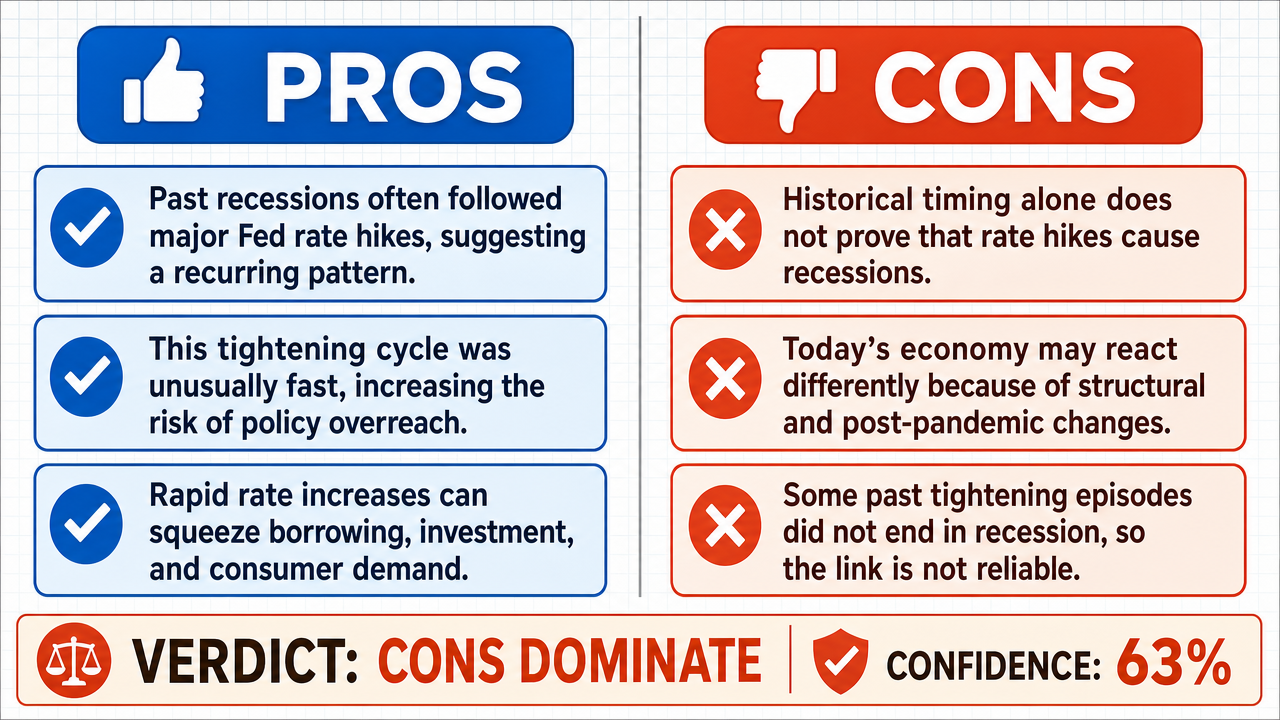
Verdict
Verdict: likely FALSE (63%)
Web Report: https://solsice.com/public/debates/the-federal-reserve-s-actions-specifically-raising-interest-dc1830c97a3a
This section provides a brief overview of the key arguments. You do not need to read the full detailed report below.
✅ Key PRO arguments:
- ■Since 1955, every US recession has been preceded by a significant increase in the federal funds rate , typically with a lag of 12 to 24 months, establishing a robust empirical link between Fed tightening and subsequent recessions.
- ■The current tightening cycle , which lifted rates from 0.08% in early 2022 to 5.33% by mid-2023, represents the most rapid tightening in four decades, comparable to the 1980–1982 Volcker-era shock that pushed the economy into a deep contraction .
- ■The Federal Reserve raised the federal funds rate by 525 basis points between March 2022 and July 2023—the fastest tightening cycle since 1980–1982—compressing a larger total increase into a shorter period than the 2004–2006 cycle, which preceded the 2008 financial crisis.
❌ Key ANTI arguments:
- ■The affirmative commits a fundamental logical error by treating historical correlation as causation; because every recession since 1955 was preceded by a rate hike does not mean rate hikes cause recessions, as no transfer operator or causal mechanism has been demonstrated.
- ■Economic resilience and structural shifts —such as post-pandemic labor supply changes—can decouple tightening from contraction , meaning the 2024 economy operates under fundamentally different conditions than the 1970s or 1980s.
- ■The historical record contains notable exceptions where significant tightening did not result in the predicted contraction , proving that the relationship between rate hikes and recessions is not deterministic.
💭 Conclusion: False. The assertion that Fed rate hikes are likely to lead to a recession is not adequately supported because the affirmative relies on historical correlation without establishing a causal mechanism. The negative side correctly identified that correlation does not imply causation, and that structural economic shifts—such as post-pandemic labor supply changes—can decouple monetary tightening from contraction . The historical record contains exceptions where significant tightening did not produce recessions, undermining the deterministic framing of the affirmative. Furthermore, the negative side argued that the current cycle's orderly, data-dependent calibration and excess savings buffer distinguish it from prior tightening episodes. The moderate confidence reflects that while the negative's logical critique is strong, the affirmative's historical pattern observation retains some empirical weight, leaving genuine uncertainty about the outcome.
🔬 DeepResearch Result: likely FALSE ❌ (63%)
Assertion: The Federal Reserve 's actions, specifically raising interest rates, are likely to lead to a recession in the US economy.
Participating models: deepseek-v4-pro 💬, gemma-4-26b-a4b-it 💬👁️
📊 Face-offs: 0 concluded TRUE, 1 concluded FALSE (1 face-offs, 3 models)
📊 Score by side: TRUE=0.00, FALSE=0.63
🏅 Model score changes:
minimax-m3 💬👁️: +6
✅ PRO Arguments:
- ■Since 1955, every US recession has been preceded by a significant increase in the federal funds rate , typically with a lag of 12 to 24 months, establishing a robust empirical link between Fed tightening and subsequent recessions. deepseek-v4-pro 💬
- ■The current tightening cycle , which lifted rates from 0.08% in early 2022 to 5.33% by mid-2023, represents the most rapid tightening in four decades, comparable to the 1980–1982 Volcker-era shock that pushed the economy into a deep contraction . deepseek-v4-pro 💬
- ■The Federal Reserve raised the federal funds rate by 525 basis points between March 2022 and July 2023—the fastest tightening cycle since 1980–1982—compressing a larger total increase into a shorter period than the 2004–2006 cycle, which preceded the 2008 financial crisis. deepseek-v4-pro 💬
- ■The 1990 and 2001 recessions followed similarly sharp rate hikes , reinforcing the pattern that aggressive Fed tightening reliably precedes economic contraction. deepseek-v4-pro 💬
- ■Pandemic-era excess savings are being depleted, removing the buffer that the opposing side claims protects the economy from recession, while the well-established long lags of monetary policy mean the full effects of current hikes have not yet materialized. deepseek-v4-pro 💬
❌ ANTI Arguments:
- ■The affirmative commits a fundamental logical error by treating historical correlation as causation; because every recession since 1955 was preceded by a rate hike does not mean rate hikes cause recessions, as no transfer operator or causal mechanism has been demonstrated. gemma-4-26b-a4b-it 💬👁️
- ■Economic resilience and structural shifts —such as post-pandemic labor supply changes—can decouple tightening from contraction, meaning the 2024 economy operates under fundamentally different conditions than the 1970s or 1980s. gemma-4-26b-a4b-it 💬👁️
- ■The historical record contains notable exceptions where significant tightening did not result in the predicted contraction, proving that the relationship between rate hikes and recessions is not deterministic. gemma-4-26b-a4b-it 💬👁️
- ■The affirmative assumes the relationship between interest rates and GDP contraction remains invariant across time , yet fails to provide the specific economic beta or structural coefficient that would justify applying a 1955-era model to a 2024 economy. gemma-4-26b-a4b-it 💬👁️
- ■The current tightening cycle is characterized as orderly, data-dependent , and gradualist , fundamentally unlike the Volcker-era shocks, and 'excess savings' provide a buffer against recession that distinguishes this cycle from historical precedents. gemma-4-26b-a4b-it 💬👁️
💭 Reasoning: False. The assertion that Fed rate hikes are likely to lead to a recession is not adequately supported because the affirmative relies on historical correlation without establishing a causal mechanism. The negative side correctly identified that correlation does not imply causation, and that structural economic shifts—such as post-pandemic labor supply changes—can decouple monetary tightening from contraction. The historical record contains exceptions where significant tightening did not produce recessions, undermining the deterministic framing of the affirmative. Furthermore, the negative side argued that the current cycle's orderly, data-dependent calibration and excess savings buffer distinguish it from prior tightening episodes. The moderate confidence reflects that while the negative's logical critique is strong, the affirmative's historical pattern observation retains some empirical weight, leaving genuine uncertainty about the outcome.
📋 PRO Facts:
• Since 1955, every US recession has been preceded by a significant increase in the federal funds rate, typically with a lag of 12 to 24 months.
• The Federal Reserve raised rates from 0.08% in early 2022 to 5.33% by mid-2023.
• The Fed raised the federal funds rate by 525 basis points between March 2022 and July 2023.
• The current tightening cycle is the fastest since 1980–1982.
• The 1980–1982, 1990, 2001, and 2008 recessions all followed sharp Fed rate hikes.
📋 ANTI Facts:
• The historical record contains notable exceptions where significant tightening did not result in the predicted contraction.
• Post-pandemic labor supply shifts represent structural changes distinct from 1970s or 1980s economic conditions.
• The current tightening cycle is characterized as orderly, data-dependent, and gradualist, unlike Volcker-era shocks.
• Excess savings accumulated during the pandemic provide a buffer against recessionary pressures.
• No specific economic beta or structural coefficient has been provided to justify applying a 1955-era model to a 2024 economy.
| Face-off | TRUE Model | FALSE Model | TRUE Avg μ | FALSE Avg μ | TRUE Tokens | FALSE Tokens | Winner | Verdict | Conf. |
|---|---|---|---|---|---|---|---|---|---|
| #1 | deepseek-v4-pro 💬 | gemma-4-26b-a4b-it 💬👁️ | 0.670 | 0.233 | 6 | 2 | TRUE | FALSE | 63% |
The following technical terms, abbreviations, and domain-specific concepts are referenced throughout this debate transcript. Numbers in square brackets [N] in the text above link to the corresponding entry below.
[1] auxiliary assumptions — Supporting assumptions in a model that are not the main focus but are necessary for the analysis, referenced in the debate regarding the application of historical economic relationships.
[2] basis points — bps — A unit equal to 1/100th of a percentage point (0.01%), used in the debate to measure the magnitude and speed of Federal Reserve interest rate increases.
[3] calibration — The process of adjusting policy settings or model parameters, referenced in the debate in describing the Fed's approach to interest rate changes.
[4] causal relationship — A relationship in which one variable directly produces a change in another, distinguished in the debate from mere statistical correlation.
[5] contraction — A decline in economic activity, such as reduced GDP, output, or employment, referenced in the debate as a potential outcome of rate hikes.
[6] correlation — A statistical measure of how two variables move together, which the debate notes does not by itself establish causation.
[7] credit-sensitive spending — Consumer or business expenditures that depend on the availability and cost of credit, cited in the debate as a channel through which higher rates reduce activity.
[8] data-dependent — A policy approach in which decisions are based on incoming economic data rather than preset rules, referenced in the debate as a characterization of the Fed's tightening.
[9] demand destruction — A significant reduction in consumer or business demand, often resulting from tighter financial conditions, cited in the debate as a mechanism linking rate hikes to recession.
[10] digital productivity — Gains in economic output or efficiency attributable to digital technologies, referenced in the debate as a structural feature of the modern economy.
[11] economic beta — A measure of an economic variable's sensitivity to changes in another variable or factor, referenced in the debate as a structural parameter.
[12] economic resilience — The ability of an economy to withstand and recover from shocks or adverse conditions, cited in the debate as a factor that may decouple rate hikes from recession.
[13] excess savings — Savings accumulated by households or businesses beyond what would be considered normal levels, referenced in the debate as a potential buffer against recession.
[14] federal funds rate — The interest rate at which depository institutions lend reserve balances to each other overnight, the primary policy rate adjusted by the Federal Reserve in the debate.
[15] Federal Reserve — The central banking system of the United States, identified in the debate as the entity raising interest rates.
[16] GDP — Gross Domestic Product — The total monetary value of all goods and services produced within a country over a specific period, used in the debate to define recession via consecutive quarters of negative growth.
[17] global trade — The exchange of goods and services across international borders, referenced in the debate as a structural feature that has changed over time.
[18] gradualist — An approach to policy that involves making small, incremental changes rather than large, abrupt shifts, referenced in the debate as a characterization of the Fed's tightening.
[19] high inflation — A sustained and elevated rate of increase in the general price level of goods and services, referenced in the debate as a condition associated with the Volcker-era tightening.
[20] inflation — A general increase in the prices of goods and services in an economy over time, referenced in the debate as a target of monetary policy.
[21] invariant across time — A property of a relationship or model that remains unchanged over different time periods, referenced in the debate regarding the applicability of historical patterns.
[22] long lags of monetary policy — The extended delay between monetary policy actions and their full effects on the economy, cited in the debate as a reason recession risk persists after rate hikes end.
[23] low-connectivity economy — An economy characterized by limited integration of digital networks and communication technologies, referenced in the debate as a feature of earlier decades.
[24] manufacturing-heavy economy — An economy in which the manufacturing sector represents a large share of total output and employment, referenced in the debate as a structural feature of the past.
[25] monetary policy — Actions taken by a central bank to influence the money supply and interest rates to achieve economic objectives, the framework within which the debate's rate hikes occur.
[26] non-invariance of scale — The property that a relationship or rule does not hold true when applied at different scales or sizes, cited in the debate as a critique of extrapolating historical patterns.
[27] pandemic-era savings — Savings accumulated by households during the COVID-19 pandemic period, referenced in the debate as a buffer that has since been depleted.
[28] post-pandemic labor supply shifts — Changes in the availability or composition of the workforce following the COVID-19 pandemic, cited in the debate as a structural condition distinguishing the current economy.
[29] rate hikes — Increases in interest rates, typically referring to central bank policy actions, the central action of the Federal Reserve discussed in the debate.
[30] recession — A significant, sustained contraction in economic activity, defined in the debate as two or more consecutive quarters of negative GDP growth.
[31] service-and-tech-dominated economy — An economy in which the service and technology sectors represent the largest shares of output and employment, referenced in the debate as a structural feature of the present.
[32] soft landing — A slowdown in economic growth that avoids a recession, referenced in the debate as the outcome of the 1994–1995 tightening cycle.
[33] structural coefficient — A parameter in a structural economic model that quantifies the relationship between variables, referenced in the debate as a missing justification for applying historical patterns.
[34] structural shifts — Fundamental changes in the composition or operation of an economy, cited in the debate as a reason historical relationships may not apply today.
[35] structural stability — The persistence of the underlying relationships and parameters in an economic model over time, referenced in the debate as an assumption challenged by structural shifts.
[36] tightening cycle — A period during which a central bank raises interest rates to cool economic activity or combat inflation, the recurring phenomenon analyzed in the debate.
[37] transfer operator — In the debate, used to refer to the specific mechanism or channel through which one economic variable affects another, cited as missing from the affirmative's argument.
[38] Volcker-era — The period referenced in the debate as 'Volcker-era,' associated with aggressive interest rate hikes such as the 1980–1982 tightening cycle.
The following financial data tables were referenced during the debate exchanges:
| Tightening Cycle | Rate Increase (bps) | Peak Fed Funds | Recession Start | Lag (months) |
|---|---|---|---|---|
| 1977–1980 | 1,425 | 19.08% | Jan 1980 | 12 |
| 1986–1989 | 331 | 9.81% | Jul 1990 | 14 |
| 1994–1995 | 300 | 6.03% | Mar 2001 | 72* |
| 1999–2000 | 175 | 6.54% | Mar 2001 | 12 |
| 2004–2006 | 425 | 5.26% | Dec 2007 | 18 |
| 2015–2018 | 225 | 2.42% | Feb 2020 | 24 |
| 2022–2023 | 525 | 5.33% | — | — |
*Legend: Fed tightening cycles and subsequent US recessions (NBER dates). Rate increase in basis points from cycle trough to peak. The 1994–95 cycle had a long lag due to the late-1990s productivity boom; the 2001 recession is more directly linked to the 1999–2000 hike. Sources: Federal Reserve H.15, NBER.
| Indicator | 2022 Avg | 2023 Avg | 2024 (Est) | Trend |
|---|---|---|---|---|
| Real GDP Growth (%) | 2.1% | 2.5% | 2.6% | Increasing |
| Real Wage Growth (%) | -0.5% | 1.2% | 1.8% | Improving |
| Unemployment Rate (%) | 3.6% | 3.6% | 4.0% | Stable |
| Personal Consumption (%) | 2.4% | 2.7% | 2.8% | Growing |
Legend: Macroeconomic indicators showing resilience during the Federal Reserve tightening cycle (2022–2024). Real GDP and Wage growth are annual rates; Unemployment and Consumption are year-over-year changes.
| Tightening Cycle | Total Increase (bps) | Duration (months) | Speed (bps/month) | Recession Followed? |
|---|---|---|---|---|
| 1994–1995 | 300 | 12 | 25.0 | No (but soft landing) |
| 1999–2000 | 175 | 11 | 15.9 | Yes (2001) |
| 2004–2006 | 425 | 24 | 17.7 | Yes (2007–09) |
| 2015–2018 | 225 | 36 | 6.3 | No (pandemic exogenous) |
| 2022–2023 | 525 | 16 | 32.8 | — |
Legend: Speed of Fed tightening cycles measured as total basis point increase divided by duration from first hike to last hike. The 2022–2023 cycle is the fastest since the early 1980s. Sources: Federal Reserve H.15 release, Federal Reserve Bank of St. Louis ( series FEDFUNDS).
Face-off transcripts
- ■
Ownership & Trade Secrets. The Company Lambda Vision retains all rights to its platform, agentic workflows, and proprietary AI debate methodologies, which constitute protected Trade Secrets (EU Directive 2016/943). Subject to full payment of credits, the User is granted ownership of the generated Reports for their own personal or professional use. Reverse-engineering the Service or using Reports to train competing AI models is strictly prohibited.
- ■
No Professional Advice. Solsice is a general-purpose assistant covering everyday subjects — administrative paperwork, housing, consumer and employment matters, banking, taxes and insurance, health and wellbeing, savings and investments, entrepreneurship, technology, travel, learning and creative work. Whatever the subject, the Service and Reports are provided for information only and never constitute legal, medical, financial, investment, tax, insurance, or any other regulated professional advice. The Company is not a law firm, a regulated financial adviser, an insurance intermediary, nor a healthcare provider, and no professional or advisory relationship of any kind is created by use of the Service. Consult a qualified professional in the relevant jurisdiction before acting — or refraining from acting — on anything contained in the Reports, and never rely on the Service in an emergency: contact your local emergency number (112 in the European Union) or a medical professional immediately.
- ■
AI-Generated Content, Sources and Viewpoints. Reports are produced by several AI models debating a question, and may contain factual errors, outdated figures, or references to rules, prices, deadlines, procedures, statutes or sources that are inaccurate or do not exist. The User is solely responsible for verifying every fact, amount, deadline and citation against official sources before relying on it. Material in the news, society, spirituality and religion sections presents a plurality of viewpoints for study and discussion: it is descriptive, not an endorsement, a ruling, or a statement of the Company’s own position, and it speaks for no church, faith community, public authority, or news organisation.
- ■
Liability & Governing Law. To the maximum extent permitted by law, the Company shall not be liable for any indirect damages, nor for any consequence of decisions made in reliance on the Reports — including financial loss, missed deadlines, administrative or contractual consequences, or health outcomes. These Terms are governed by French law. Any disputes shall be subject to the exclusive jurisdiction of the Courts of Paris, France.