
The first two chapters of *The Fires of December* are sufficient for a potential reader to understand the book's appeal and decide whether to continue.
AI debate verdict and arguments
⚠️ AI-generated information only; not professional advice
Completed October 18, 2026
Verdict
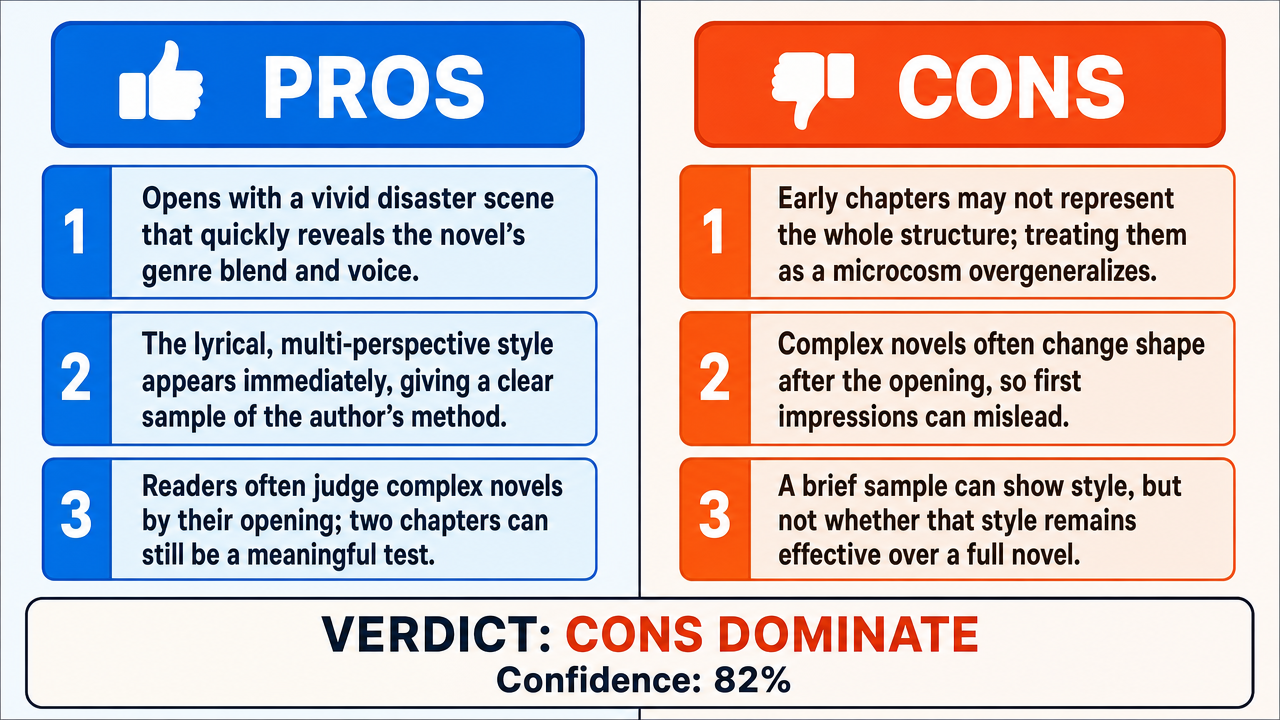
Verdict: likely FALSE (82%)
Web Report: https://solsice.com/public/debates/the-first-two-chapters-of-the-fires-of-december-are-sufficie-306599b960e5
This section provides a brief overview of the key arguments. You do not need to read the full detailed report below.
✅ Key PRO arguments:
- ■The first two chapters immediately establish the novel's unique genre blend and narrative voice through a vivid, sensory-rich description of a catastrophic wildfire bearing down on a Hawaiian island, thrusting the reader directly into the central high-stakes conflict .
- ■The dense, lyrical prose weaving together multiple character perspectives in a single sweeping paragraph showcases the author's distinctive, almost stream-of-consciousness style, which is a hallmark of the author's work and a key factor in the book's appeal.
- ■If two chapters provided insufficient data to judge a complex novel, then no complex novel could ever be adequately sampled by its opening—a conclusion contradicted by the established practice of literary criticism and the publishing industry itself.
❌ Key ANTI arguments:
- ■The claim that the first two chapters serve as a 'microcosm ' of the novel's formal design commits a logical fallacy of composition : assuming that the structural rhythm established in the first 5% of the text is invariant across the remaining 95%.
- ■In complex literary works, particularly multi-generational sagas, the narrative architecture often shifts from introductory vignettes to sustained character arcs or divergent subplots , meaning early impressions cannot reliably predict long-term engagement.
- ■An initial encounter with dense, lyrical prose may establish a stylistic impression, but it cannot establish the utility or sustainability of that style over a full reading; a 'showcase' of stylistic elements is not a guarantee of sustained reader engagement.
💭 Conclusion: False: the first two chapters of the novel are not sufficient for a potential reader to fully understand the book's appeal and decide whether to continue. The negative side's strongest argument is that assuming the opening chapters are a microcosm of the whole novel commits a fallacy of composition , since the structural rhythm established in the first portion of the text does not necessarily predict the rhythm of the remaining pages. The affirmative's position that the opening chapters can serve as a reliable preview is undermined by the logical gap between an initial sample and the full work. Therefore, the verdict aligns with the FALSE position, as the structural and thematic complexity of the novel cannot be adequately assessed from only its first two chapters.
🔬 DeepResearch Result: likely FALSE ❌ (82%)
Assertion: The first two chapters of The Fires of December are sufficient for a potential reader to understand the book's appeal and decide whether to continue.
Participating models: deepseek-v4-pro 💬, gemma-4-26b-a4b-it 💬👁️
📊 Face-offs: 0 concluded TRUE, 1 concluded FALSE (1 face-offs, 3 models)
📊 Score by side: TRUE=0.00, FALSE=0.82
🏅 Model score changes:
minimax-m3 💬👁️: +8
✅ PRO Arguments:
- ■The first two chapters immediately establish the novel's unique genre blend and narrative voice through a vivid, sensory-rich description of a catastrophic wildfire bearing down on a Hawaiian island, thrusting the reader directly into the central high-stakes conflict . deepseek-v4-pro 💬
- ■The dense, lyrical prose weaving together multiple character perspectives in a single sweeping paragraph showcases the author's distinctive, almost stream-of-consciousness style, which is a hallmark of the author's work and a key factor in the book's appeal. deepseek-v4-pro 💬
- ■If two chapters provided insufficient data to judge a complex novel, then no complex novel could ever be adequately sampled by its opening—a conclusion contradicted by the established practice of literary criticism and the publishing industry itself. deepseek-v4-pro 💬
❌ ANTI Arguments:
- ■The claim that the first two chapters serve as a 'microcosm ' of the novel's formal design commits a logical fallacy of composition : assuming that the structural rhythm established in the first 5% of the text is invariant across the remaining 95%. gemma-4-26b-a4b-it 💬👁️
- ■In complex literary works, particularly multi-generational sagas, the narrative architecture often shifts from introductory vignettes to sustained character arcs or divergent subplots , meaning early impressions cannot reliably predict long-term engagement. gemma-4-26b-a4b-it 💬👁️
- ■An initial encounter with dense, lyrical prose may establish a stylistic impression, but it cannot establish the utility or sustainability of that style over a full reading; a 'showcase' of stylistic elements is not a guarantee of sustained reader engagement. gemma-4-26b-a4b-it 💬👁️
- ■Two chapters provide insufficient structural and thematic data to judge a complex novel because the opening sections are designed to introduce rather than sustain, and the reader's decision to continue depends on long-arc developments that only emerge later. gemma-4-26b-a4b-it 💬👁️
💭 Reasoning: False: the first two chapters of the novel are not sufficient for a potential reader to fully understand the book's appeal and decide whether to continue. The negative side's strongest argument is that assuming the opening chapters are a microcosm of the whole novel commits a fallacy of composition, since the structural rhythm established in the first portion of the text does not necessarily predict the rhythm of the remaining pages. The affirmative's position that the opening chapters can serve as a reliable preview is undermined by the logical gap between an initial sample and the full work. Therefore, the verdict aligns with the FALSE position, as the structural and thematic complexity of the novel cannot be adequately assessed from only its first two chapters.
📋 PRO Facts:
• The novel employs a rotating cast and mosaic structure from the outset.
📋 ANTI Facts:
• The first two chapters represent approximately the first 5% of the novel's text.
• The novel is approximately 300 pages in length.
| Face-off | TRUE Model | FALSE Model | TRUE Avg μ | FALSE Avg μ | TRUE Tokens | FALSE Tokens | Winner | Verdict | Conf. |
|---|---|---|---|---|---|---|---|---|---|
| #1 | deepseek-v4-pro 💬 | gemma-4-26b-a4b-it 💬👁️ | 0.301 | 0.234 | 6 | 2 | TRUE | FALSE | 82% |
The following technical terms, abbreviations, and domain-specific concepts are referenced throughout this debate transcript. Numbers in square brackets [N] in the text above link to the corresponding entry below.
[1] character arcs — The developmental trajectories of fictional characters over the course of a narrative, encompassing their growth, decline, or transformation.
[2] consequent — In a conditional logical statement ('if P, then Q'), the consequent is the second part (Q) that follows from the antecedent (P).
[3] contraposition — In logic, a form of immediate inference in which a categorical proposition is transformed by negating both its subject and predicate and swapping them, often used in reductio ad absurdum arguments.
[4] disaster narrative — A literary genre or narrative framework centered on a catastrophic event as the primary plot driver, often exploring human responses to large-scale crisis.
[5] divergent subplots — Secondary storylines within a novel that branch away from the main plot, often following different characters or thematic threads.
[6] expository — Relating to writing that aims to explain, inform, or describe rather than to narrate or dramatize; in this debate, contrasted with action-driven openings.
[7] fallacy of composition — A logical fallacy in which one infers that something is true of the whole from the fact that it is true of some part or parts of the whole.
[8] genre blend — The deliberate combination of elements from two or more literary genres within a single work, creating hybrid narrative categories.
[9] hidden premise — An unstated assumption underlying an argument that must be accepted for the argument's conclusion to follow logically.
[10] high-stakes conflict — A narrative confrontation in which the characters face consequences of significant magnitude, such as survival, loss, or large-scale catastrophe.
[11] incantatory prose — A highly rhythmic, repetitive, and hypnotic style of writing intended to produce an almost spellbinding effect on the reader.
[12] introductory vignettes — Brief, evocative scenes or sketches used at the opening of a work to introduce characters, settings, or themes before the main narrative develops.
[13] lyrical prose — A style of prose writing characterized by musicality, poetic rhythm, vivid imagery, and emotional intensity.
[14] microcosm — In this debate, used to mean a small portion of a work that allegedly reflects the character or structure of the whole.
[15] mosaic structure — A narrative architecture in which discrete episodes, perspectives, or fragments are assembled into a larger unified whole, rather than following a single continuous storyline.
[16] mutually exclusive branches — In logic, a dichotomy in which the listed possibilities cannot all be true simultaneously; accepting one excludes the others.
[17] narrative architecture — The overarching structural design of a literary work, including how its parts are organized, sequenced, and related to one another.
[18] narrative voice — The distinctive style, tone, and perspective through which a story is told, including the personality and values conveyed by the narrator.
[19] pacing — The speed and rhythm at which a narrative unfolds, including the rate of plot advancement and the distribution of action versus reflection.
[20] polyphonic — Literary term for a narrative that gives independent, simultaneous voice to multiple characters or perspectives, rather than centering a single consciousness.
[21] prologue — A preliminary section of a literary work that precedes the main narrative, often providing background information or a distinct introductory episode.
[22] rotating-perspective structure — A narrative technique in which the point of view shifts among several characters, often by chapter or section, rather than remaining with a single narrator.
[23] stream-of-consciousness — A narrative mode that attempts to render the continuous flow of a character's thoughts, sensations, and associations in an unstructured, interior manner.
[24] structural rhythm — The recurring pattern of narrative pacing, scene length, and structural choices that gives a work its characteristic tempo and shape.
[25] stylistic fatigue — Reader weariness or diminishing engagement caused by the sustained repetition of a particular prose style or narrative technique over the length of a work.
[26] unproven conjecture — A claim or conclusion put forward without sufficient supporting evidence, relying on speculation rather than demonstration.
Face-off transcripts
- ■
Ownership & Trade Secrets. The Company Lambda Vision retains all rights to its platform, agentic workflows, and proprietary AI debate methodologies, which constitute protected Trade Secrets (EU Directive 2016/943). Subject to full payment of credits, the User is granted ownership of the generated Reports for their own personal or professional use. Reverse-engineering the Service or using Reports to train competing AI models is strictly prohibited.
- ■
No Professional Advice. Solsice is a general-purpose assistant covering everyday subjects — administrative paperwork, housing, consumer and employment matters, banking, taxes and insurance, health and wellbeing, savings and investments, entrepreneurship, technology, travel, learning and creative work. Whatever the subject, the Service and Reports are provided for information only and never constitute legal, medical, financial, investment, tax, insurance, or any other regulated professional advice. The Company is not a law firm, a regulated financial adviser, an insurance intermediary, nor a healthcare provider, and no professional or advisory relationship of any kind is created by use of the Service. Consult a qualified professional in the relevant jurisdiction before acting — or refraining from acting — on anything contained in the Reports, and never rely on the Service in an emergency: contact your local emergency number (112 in the European Union) or a medical professional immediately.
- ■
AI-Generated Content, Sources and Viewpoints. Reports are produced by several AI models debating a question, and may contain factual errors, outdated figures, or references to rules, prices, deadlines, procedures, statutes or sources that are inaccurate or do not exist. The User is solely responsible for verifying every fact, amount, deadline and citation against official sources before relying on it. Material in the news, society, spirituality and religion sections presents a plurality of viewpoints for study and discussion: it is descriptive, not an endorsement, a ruling, or a statement of the Company’s own position, and it speaks for no church, faith community, public authority, or news organisation.
- ■
Liability & Governing Law. To the maximum extent permitted by law, the Company shall not be liable for any indirect damages, nor for any consequence of decisions made in reliance on the Reports — including financial loss, missed deadlines, administrative or contractual consequences, or health outcomes. These Terms are governed by French law. Any disputes shall be subject to the exclusive jurisdiction of the Courts of Paris, France.