
The human mind's capacity to envision worst-case scenarios implies an equal capacity to envision positive outcomes, and actively imagining favorable results can physiologically reduce anxiety.
AI debate verdict and arguments
⚠️ AI-generated information only; not professional advice
Completed October 14, 2026
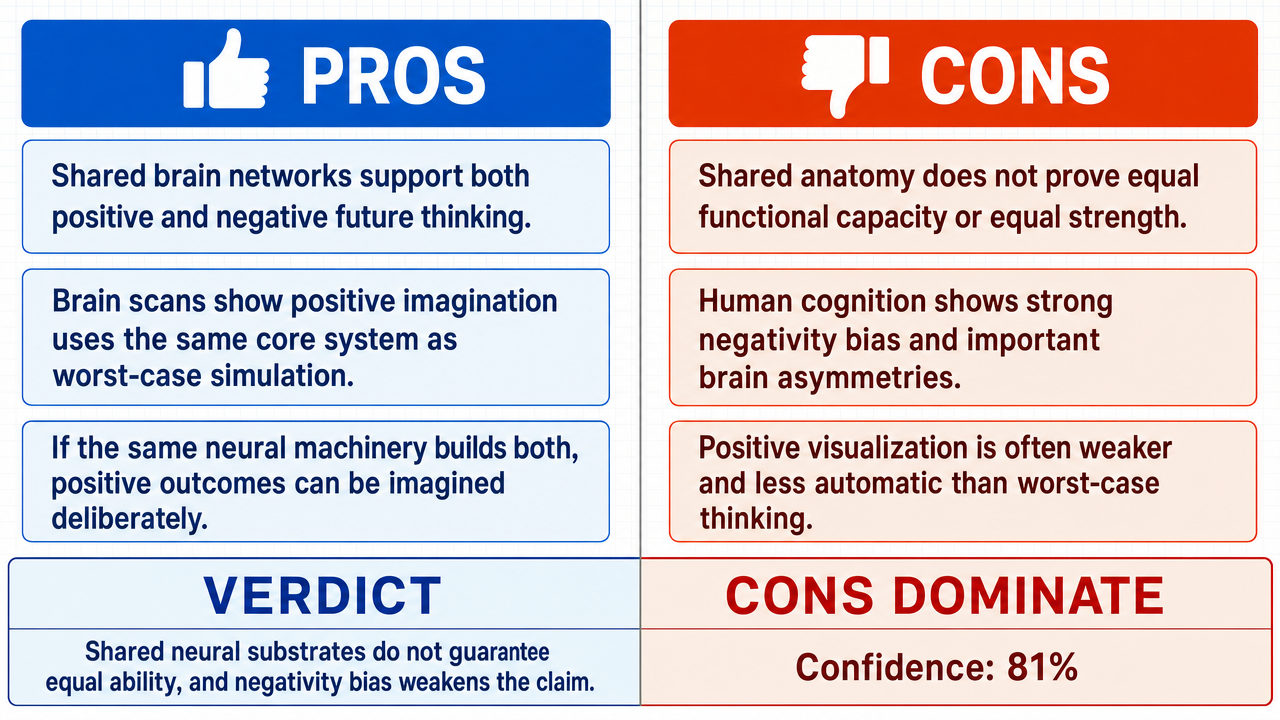
Verdict
Verdict: likely FALSE (81%)
Web Report: https://solsice.com/public/debates/the-human-mind-s-capacity-to-envision-worst-case-scenarios-i-52e4e01700ea
This section provides a brief overview of the key arguments. You do not need to read the full detailed report below.
✅ Key PRO arguments:
- ■Neuroanatomical evidence shows that the brain regions responsible for generating negative future scenarios (the default mode network and medial prefrontal cortex ) are equally capable of producing positive ones, as these regions are central to self-referential thought and prospection irrespective of valence .
- ■Functional MRI studies demonstrate that tasks requiring positive future thinking activate the same core network as negative future thinking, with only emotional valence subsystems showing differential engagement, indicating the underlying cognitive machinery is shared and not valence-specific.
- ■The claim that shared neural networks do not imply equal functional capacity rests on a false dichotomy : either the shared anatomical substrate produces equal functional output for positive and negative prospection (which falsifies the negativity bias claim) or it produces inherently unequal output (which requires separate evidence not provided).
❌ Key ANTI arguments:
- ■The affirmative's reliance on neuroimaging is a substitution of proxy that fails to bridge the gap between shared networks and functional capacity ; shared anatomical real estate does not guarantee equal software capability, as the brain exhibits a profound negativity bias with neural pathways for threat detection and worst-case simulation being more developed.
- ■The brain is not a symmetric system but is characterized by profound functional asymmetry , meaning that the presence of a shared anatomical substrate does not necessitate equal functional capacity for positive versus negative prospection .
- ■Cognitive asymmetry and physiological limitations ensure that positive visualization does not equal negative envisioning, undermining the assertion that worst-case scenario capacity implies an equal capacity for positive outcomes.
💭 Conclusion: False. The FALSE side won because it successfully argued that shared neural substrates do not imply equal functional capacity , drawing on the well-documented negativity bias in human cognition. The affirmative's reliance on neuroimaging showing overlapping activation patterns was rebutted as a substitution of proxy —measuring anatomical engagement does not establish equivalent functional output. The brain's asymmetry, particularly in threat detection and worst-case simulation pathways, supports the conclusion that capacity for negative envisioning does not imply an equal capacity for positive envisioning. Additionally, the physiological claim about anxiety reduction through positive visualization was not independently substantiated with strong evidence in the debate. The compound nature of the assertion, combining both the capacity-equivalence claim and the physiological anxiety-reduction claim, means the verdict reflects the weakest supported sub-claim.
🔬 DeepResearch Result: likely FALSE ❌ (81%)
Assertion: The human mind's capacity to envision worst-case scenarios implies an equal capacity to envision positive outcomes, and actively imagining favorable results can physiologically reduce anxiety.
Participating models: deepseek-v3.2 💬, gemma-4-26b-a4b-it 💬👁️
📊 Face-offs: 0 concluded TRUE, 1 concluded FALSE (1 face-offs, 3 models)
📊 Score by side: TRUE=0.00, FALSE=0.81
🏅 Model score changes:
minimax-m3 💬👁️: +8
✅ PRO Arguments:
- ■Neuroanatomical evidence shows that the brain regions responsible for generating negative future scenarios (the default mode network and medial prefrontal cortex ) are equally capable of producing positive ones, as these regions are central to self-referential thought and prospection irrespective of valence . deepseek-v3.2 💬
- ■Functional MRI studies demonstrate that tasks requiring positive future thinking activate the same core network as negative future thinking, with only emotional valence subsystems showing differential engagement, indicating the underlying cognitive machinery is shared and not valence-specific. deepseek-v3.2 💬
- ■The claim that shared neural networks do not imply equal functional capacity rests on a false dichotomy : either the shared anatomical substrate produces equal functional output for positive and negative prospection (which falsifies the negativity bias claim) or it produces inherently unequal output (which requires separate evidence not provided). deepseek-v3.2 💬
❌ ANTI Arguments:
- ■The affirmative's reliance on neuroimaging is a substitution of proxy that fails to bridge the gap between shared networks and functional capacity; shared anatomical real estate does not guarantee equal software capability, as the brain exhibits a profound negativity bias with neural pathways for threat detection and worst-case simulation being more developed. gemma-4-26b-a4b-it 💬👁️
- ■The brain is not a symmetric system but is characterized by profound functional asymmetry , meaning that the presence of a shared anatomical substrate does not necessitate equal functional capacity for positive versus negative prospection. gemma-4-26b-a4b-it 💬👁️
- ■Cognitive asymmetry and physiological limitations ensure that positive visualization does not equal negative envisioning, undermining the assertion that worst-case scenario capacity implies an equal capacity for positive outcomes. gemma-4-26b-a4b-it 💬👁️
💭 Reasoning: False. The FALSE side won because it successfully argued that shared neural substrates do not imply equal functional capacity, drawing on the well-documented negativity bias in human cognition. The affirmative's reliance on neuroimaging showing overlapping activation patterns was rebutted as a substitution of proxy—measuring anatomical engagement does not establish equivalent functional output. The brain's asymmetry, particularly in threat detection and worst-case simulation pathways, supports the conclusion that capacity for negative envisioning does not imply an equal capacity for positive envisioning. Additionally, the physiological claim about anxiety reduction through positive visualization was not independently substantiated with strong evidence in the debate. The compound nature of the assertion, combining both the capacity-equivalence claim and the physiological anxiety-reduction claim, means the verdict reflects the weakest supported sub-claim.
📋 PRO Facts:
• The default mode network (DMN) and medial prefrontal cortex are central to self-referential thought and prospection.
• Functional MRI studies show that positive future thinking activates the same core network as negative future thinking.
• Only emotional valence subsystems show differential engagement between positive and negative prospection tasks.
📋 ANTI Facts:
• The brain exhibits a profound negativity bias in cognitive processing.
• Neural pathways for threat detection and worst-case simulation are more developed than those for positive prospection.
• Shared anatomical substrates do not guarantee equal functional capacity, as the brain is characterized by functional asymmetry.
| Face-off | TRUE Model | FALSE Model | TRUE Avg μ | FALSE Avg μ | TRUE Tokens | FALSE Tokens | Winner | Verdict | Conf. |
|---|---|---|---|---|---|---|---|---|---|
| #1 | deepseek-v3.2 💬 | gemma-4-26b-a4b-it 💬👁️ | 0.587 | 0.277 | 8 | 2 | TRUE | FALSE | 81% |
The following technical terms, abbreviations, and domain-specific concepts are referenced throughout this debate transcript. Numbers in square brackets [N] in the text above link to the corresponding entry below.
[1] activation ratio — A comparative measure of neural engagement between conditions, referenced in the debate as a potential metric to determine whether positive imagery reaches equivalent intensity as negative imagery in brain regions.
[2] anatomical substrate — The underlying physical brain structures (hardware) that support a given cognitive function; in the debate, used to argue whether shared anatomy implies shared functional output.
[3] clinical psychology — The branch of psychology concerned with the assessment and treatment of mental health conditions; cited in the affirmative as a source of evidence for visualization-based anxiety reduction.
[4] cognitive asymmetry — The notion that the brain does not process positive and negative information with equal weight or efficiency; the negative side argues this asymmetry undermines equal imaginative capacity.
[5] cognitive machinery — A metaphor used in the debate for the underlying neural systems that generate mental representations, which the affirmative argues are shared across valences.
[6] correlation coefficient — A statistical measure of the strength of a relationship between two variables; cited by the negative as an example of a 'transfer operator' that would be needed to link shared networks to equal functional output.
[7] Default Mode Network (DMN) — Default Mode Network — A network of brain regions active during self-referential thought and prospection; both sides agree it is engaged during both positive and negative future thinking.
[8] emotional valence subsystems — Brain components that differentially encode the positive or negative quality (valence) of mental content; the affirmative notes these are the only subsystems showing differential engagement between positive and negative prospection.
[9] false dichotomy — A logical fallacy in which two options are presented as exhaustive when they are not; the affirmative accuses the negative of constructing one around equal versus unequal functional output.
[10] functional asymmetry — The principle that shared anatomical structures can support unequal processing; invoked by the negative to argue that the brain is not a symmetric system.
[11] functional capacity — The actual processing output a neural system can produce, distinguished in the debate from mere anatomical presence (the 'software' versus the 'hardware').
[12] functional MRI (fMRI) — functional Magnetic Resonance Imaging — A neuroimaging technique that measures brain activity by detecting changes associated with blood flow; cited as evidence that positive and negative future thinking activate overlapping core networks.
[13] guided imagery — A clinical technique in which a person deliberately conjures sensory-rich mental scenes; cited by the affirmative as an intervention that lowers physiological markers of anxiety.
[14] medial prefrontal cortex — A brain region central to self-referential thought and prospection; both sides agree it is engaged during both positive and negative future thinking.
[15] negativity bias — The tendency for the brain to process negative information more robustly, rapidly, and deeply than positive information; the negative argues this makes worst-case simulation structurally privileged.
[16] neural activation — The engagement of neurons or brain regions during a task; the affirmative cites studies measuring activation magnitude to argue positive and negative prospection are equivalent.
[17] neural architecture — The structural organization of neural circuits; used metaphorically as 'hardware' in the debate to contrast with functional output ('software').
[18] neural pathways — The routes through which neural signals travel; the negative argues pathways for threat detection and worst-case simulation are more deeply ingrained than those for positive visualization.
[19] neuroanatomical — Pertaining to the anatomy of the nervous system; the affirmative cites neuroanatomical evidence that regions generating negative scenarios are equally capable of producing positive ones.
[20] neurobiological — Pertaining to the biology of the nervous system; the negative uses the term to describe how shared networks are modulated differently for threat versus positive content.
[21] neuroimaging — Techniques used to visualize the structure or activity of the brain; the negative argues that neuroimaging evidence of shared networks is a 'substitution of proxy' for functional capacity.
[22] physiological markers — Measurable bodily indicators (e.g., heart rate, cortisol, skin conductance) used to assess anxiety; the affirmative claims structured positive visualization lowers these markers.
[23] prospection — The mental simulation of future events; both sides discuss positive and negative prospection as the cognitive activity at issue in the debate.
[24] self-referential thought — Cognition directed toward oneself; the default mode network and medial prefrontal cortex are described as central to this kind of thinking.
[25] statistically significant — A threshold in statistical testing indicating that an observed effect is unlikely to be due to chance; the affirmative cites studies showing no statistically significant difference in vividness or activation between positive and negative prospection.
[26] substitution of proxy — A rhetorical or logical move in which one measure is offered in place of another that is actually required; the negative accuses the affirmative of substituting neuroimaging evidence for evidence of functional capacity.
[27] systematic desensitization — A behavioral therapy technique that pairs relaxation with graduated exposure to anxiety-provoking stimuli; cited by the affirmative as a clinical intervention relevant to visualization and anxiety reduction.
[28] threat detection — Neural processes specialized for identifying potential dangers; the negative argues these processes are more robust and rapidly activated than those supporting positive visualization.
[29] transfer operator — A conceptual link in the debate that would translate evidence of shared neural architecture into evidence of equal functional output; the negative argues such an operator is missing.
[30] valence — The positive or negative quality of an emotional stimulus; the affirmative argues that the underlying cognitive machinery for prospection is not valence-specific.
[31] vividness ratings — Subjective scores indicating how vividly a person can mentally imagine a scenario; the affirmative cites studies pairing these ratings with fMRI to argue positive and negative prospection are equivalent.
Face-off transcripts
- ■
Ownership & Trade Secrets. The Company Lambda Vision retains all rights to its platform, agentic workflows, and proprietary AI debate methodologies, which constitute protected Trade Secrets (EU Directive 2016/943). Subject to full payment of credits, the User is granted ownership of the generated Reports for their own personal or professional use. Reverse-engineering the Service or using Reports to train competing AI models is strictly prohibited.
- ■
No Professional Advice. Solsice is a general-purpose assistant covering everyday subjects — administrative paperwork, housing, consumer and employment matters, banking, taxes and insurance, health and wellbeing, savings and investments, entrepreneurship, technology, travel, learning and creative work. Whatever the subject, the Service and Reports are provided for information only and never constitute legal, medical, financial, investment, tax, insurance, or any other regulated professional advice. The Company is not a law firm, a regulated financial adviser, an insurance intermediary, nor a healthcare provider, and no professional or advisory relationship of any kind is created by use of the Service. Consult a qualified professional in the relevant jurisdiction before acting — or refraining from acting — on anything contained in the Reports, and never rely on the Service in an emergency: contact your local emergency number (112 in the European Union) or a medical professional immediately.
- ■
AI-Generated Content, Sources and Viewpoints. Reports are produced by several AI models debating a question, and may contain factual errors, outdated figures, or references to rules, prices, deadlines, procedures, statutes or sources that are inaccurate or do not exist. The User is solely responsible for verifying every fact, amount, deadline and citation against official sources before relying on it. Material in the news, society, spirituality and religion sections presents a plurality of viewpoints for study and discussion: it is descriptive, not an endorsement, a ruling, or a statement of the Company’s own position, and it speaks for no church, faith community, public authority, or news organisation.
- ■
Liability & Governing Law. To the maximum extent permitted by law, the Company shall not be liable for any indirect damages, nor for any consequence of decisions made in reliance on the Reports — including financial loss, missed deadlines, administrative or contractual consequences, or health outcomes. These Terms are governed by French law. Any disputes shall be subject to the exclusive jurisdiction of the Courts of Paris, France.