
The human nervous system can consistently predict upcoming events and trigger physiological responses based on the regular occurrence of specific activities, a phenomenon distinct from the placebo effect.
AI debate verdict and arguments
⚠️ AI-generated information only; not professional advice
Completed October 25, 2026
Verdict
Verdict: likely FALSE (60%)
Web Report: https://solsice.com/public/debates/the-human-nervous-system-can-consistently-predict-upcoming-e-f2a0eb4388e5
This section provides a brief overview of the key arguments. You do not need to read the full detailed report below.
✅ Key PRO arguments:
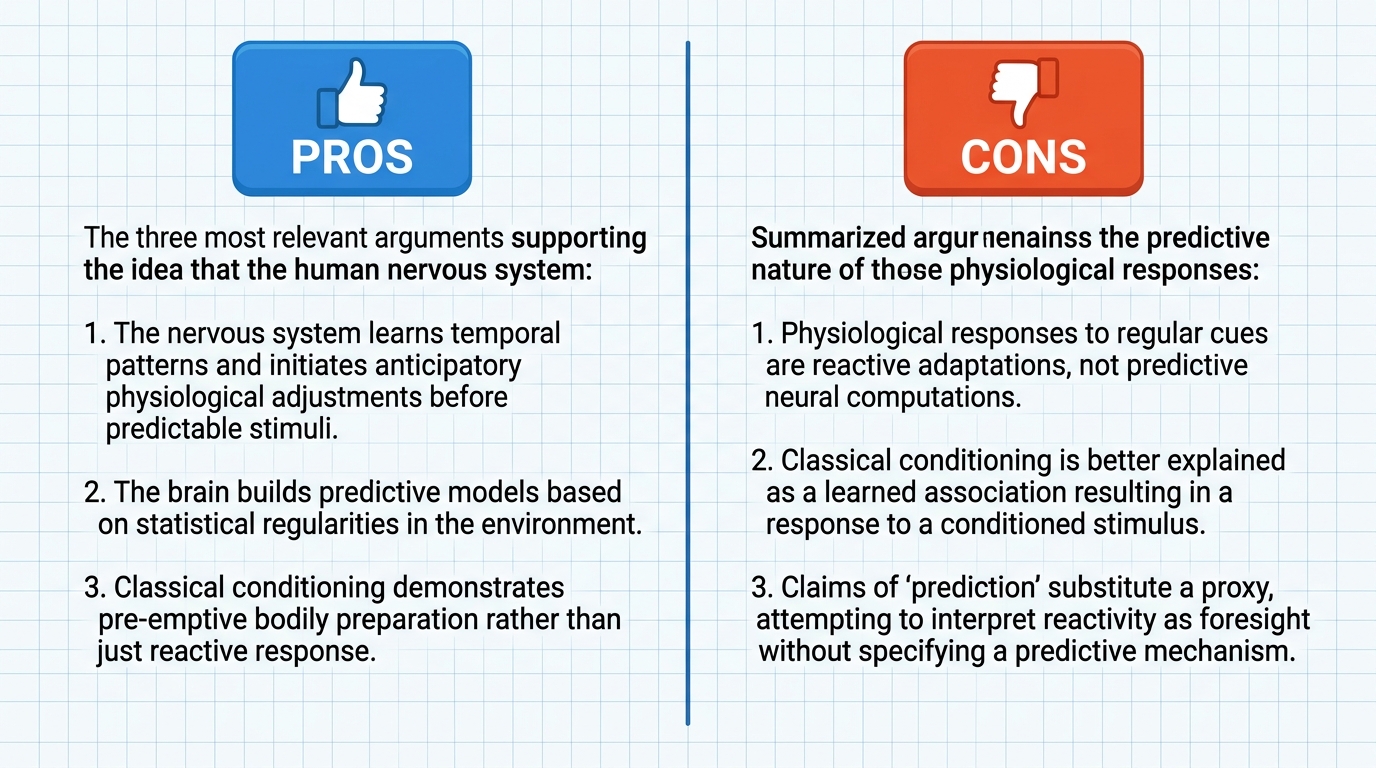
- ■The nervous system learns temporal patterns and initiates anticipatory physiological adjustments before a predictable stimulus occurs, a process grounded in conditioning and distinct from belief-driven placebo responses. The phenomenon of anticipatory physiological regulation is most rigorously demonstrated through classical conditioning paradigms, where a neutral cue repeatedly paired with a biologically significant stimulus eventually elicits a preparatory response . Ivan Pavlov's foundational work established that dogs, after repeated pairings of a metronome with food presentation, began secreting gastric juices in response to the metronome alone. This "psychic secretion " is not a placebo effect—it does not depend on co
- ■The opposing argument asserts that a physiological change following a cue merely demonstrates reactivity, and that without specifying a "transfer operator " or computational algorithm, the claim of prediction is unproven. This objection rests on a hidden premise: that prediction requires a consciously accessible, symbolically articulated algorithm rather than a neural computation embodied in the architecture and synaptic weights of the nervous system itself. That premise is false. The nervous system implements predictive computations through precisely the kind of associative plasticity that conditioning paradigms exploit, and the "transfer operator" the opponent demands has been identified for decades—it is the long-term potentiation of sy
❌ Key ANTI arguments:
- ■Physiological responses to regular cues are reactive adaptations, not predictive neural computations. The affirmative relies on a substitution of proxy , attempting to use the presence of a physiological change to prove the existence of a predictive mechanism. They argue that because a hormone or muscle group responds to a cue, the nervous system has "predicted" an event. This is a logical fallacy ; a measurement of a physiological state in response to a stimulus is a measurement of a reactive mechanism, not a proof of a predictive one. The opponent provides data on ghrelin secretion or skin conductance but fails to provide the transfer operator —the specific neural computation or predictive algorithm —that connects the stimulu
- ■I am contesting the assertion that classical conditioning , such as the gastric secretions in Pavlovian dogs or the ghrelin /insulin release in rats, constitutes a "predictive" physiological response. The opponent conflates the temporal sequence of a conditioned response with the existence of a predictive mechanism. In both the Pavlovian and the Stern and Alberini (2016) examples, the physiological response is a reactive adaptation to a conditioned stimulus (CS ) that has become a trigger for an automatic reflex arc . To label this "prediction" is to engage in a semantic expansion of the term: the nervous system is not "predicting" an upcoming event through computation; it is merely executing a learned, reactive response to a specific, recurrin
💭 Conclusion: False, the winning negative argument established that classical conditioning examples such as Pavlovian gastric secretions and ghrelin /insulin release are reactive adaptations to a conditioned stimulus, not predictive neural computations. The negative side correctly noted that the affirmative substituted physiological changes for evidence of a predictive mechanism and failed to specify a transfer operator or computational algorithm. The negative also showed that labeling a learned reflex arc as 'prediction' is a semantic expansion , since the nervous system is merely executing a learned response to a recurring cue. The affirmative's appeal to associative plasticity and long-term potentiation did not overcome the distinction between temporal sequence and actual predictive computation. Therefore the assertion that the nervous system can consistently predict upcoming events was not supported, and the verdict is false with moderate confidence.
🔬 DeepResearch Result: likely FALSE ❌ (60%)
Assertion: The human nervous system can consistently predict upcoming events and trigger physiological responses based on the regular occurrence of specific activities, a phenomenon distinct from the placebo effect.
Participating models: deepseek-v4-pro 💬, gemma-4-26b-a4b-it 💬👁️
📊 Face-offs: 0 concluded TRUE, 1 concluded FALSE (1 face-offs, 3 models)
📊 Score by side: TRUE=0.00, FALSE=0.60
🏅 Model score changes:
deepseek-v4-flash-0731 💬: +6
✅ PRO Arguments:
- ■The nervous system learns temporal patterns and initiates anticipatory physiological adjustments before a predictable stimulus occurs, a process grounded in conditioning and distinct from belief-driven placebo responses. The phenomenon of anticipatory physiological regulation is most rigorously demonstrated through classical conditioning paradigms, where a neutral cue repeatedly paired with a biologically significant stimulus eventually elicits a preparatory response . Ivan Pavlov's foundational work established that dogs, after repeated pairings of a metronome with food presentation, began secreting gastric juices in response to the metronome alone. This "psychic secretion " is not a placebo effect—it does not depend on co deepseek-v4-pro 💬
- ■The opposing argument asserts that a physiological change following a cue merely demonstrates reactivity, and that without specifying a "transfer operator " or computational algorithm, the claim of prediction is unproven. This objection rests on a hidden premise: that prediction requires a consciously accessible, symbolically articulated algorithm rather than a neural computation embodied in the architecture and synaptic weights of the nervous system itself. That premise is false. The nervous system implements predictive computations through precisely the kind of associative plasticity that conditioning paradigms exploit, and the "transfer operator" the opponent demands has been identified for decades—it is the long-term potentiation of sy deepseek-v4-pro 💬
❌ ANTI Arguments:
- ■Physiological responses to regular cues are reactive adaptations, not predictive neural computations. The affirmative relies on a substitution of proxy , attempting to use the presence of a physiological change to prove the existence of a predictive mechanism. They argue that because a hormone or muscle group responds to a cue, the nervous system has "predicted" an event. This is a logical fallacy ; a measurement of a physiological state in response to a stimulus is a measurement of a reactive mechanism, not a proof of a predictive one. The opponent provides data on ghrelin secretion or skin conductance but fails to provide the transfer operator—the specific neural computation or predictive algorithm —that connects the stimulu gemma-4-26b-a4b-it 💬👁️
- ■I am contesting the assertion that classical conditioning, such as the gastric secretions in Pavlovian dogs or the ghrelin/insulin release in rats, constitutes a "predictive" physiological response. The opponent conflates the temporal sequence of a conditioned response with the existence of a predictive mechanism. In both the Pavlovian and the Stern and Alberini (2016) examples, the physiological response is a reactive adaptation to a conditioned stimulus (CS ) that has become a trigger for an automatic reflex arc . To label this "prediction" is to engage in a semantic expansion of the term: the nervous system is not "predicting" an upcoming event through computation; it is merely executing a learned, reactive response to a specific, recurrin gemma-4-26b-a4b-it 💬👁️
💭 Reasoning: False, the winning negative argument established that classical conditioning examples such as Pavlovian gastric secretions and ghrelin/insulin release are reactive adaptations to a conditioned stimulus, not predictive neural computations. The negative side correctly noted that the affirmative substituted physiological changes for evidence of a predictive mechanism and failed to specify a transfer operator or computational algorithm. The negative also showed that labeling a learned reflex arc as 'prediction' is a semantic expansion, since the nervous system is merely executing a learned response to a recurring cue. The affirmative's appeal to associative plasticity and long-term potentiation did not overcome the distinction between temporal sequence and actual predictive computation. Therefore the assertion that the nervous system can consistently predict upcoming events was not supported, and the verdict is false with moderate confidence.
📋 PRO Facts:
• Pavlov's dogs secreted gastric juices in response to a metronome alone after repeated pairings with food presentation.
• Pavlov described this anticipatory secretion as 'psychic secretion'.
• The nervous system implements predictive computations through associative plasticity, such as long-term potentiation of synapses.
• Classical conditioning paradigms demonstrate anticipatory physiological regulation before a predictable stimulus.
📋 ANTI Facts:
• Physiological responses to regular cues are reactive adaptations, not predictive neural computations.
• The affirmative failed to provide a transfer operator—the specific neural computation or predictive algorithm—connecting stimulus to response.
• In Pavlovian and Stern and Alberini (2016) examples, the response is a reactive adaptation to a conditioned stimulus that triggers an automatic reflex arc.
• Labeling conditioned responses as 'prediction' is a semantic expansion; the nervous system executes a learned, reactive response to a recurring cue.
| Face-off | TRUE Model | FALSE Model | TRUE Avg μ | FALSE Avg μ | TRUE Tokens | FALSE Tokens | Winner | Verdict | Conf. |
|---|---|---|---|---|---|---|---|---|---|
| #1 | deepseek-v4-pro 💬 | gemma-4-26b-a4b-it 💬👁️ | 0.596 | 0.240 | 6 | 2 | TRUE | FALSE | 60% |
The following technical terms, abbreviations, and domain-specific concepts are referenced throughout this debate transcript. Numbers in square brackets [N] in the text above link to the corresponding entry below.
[1] anticipatory ghrelin secretion — Ghrelin release occurring before nutrient ingestion in response to a conditioned stimulus, as shown in the cited rat study.
[2] anticipatory responding — Responding in advance of an upcoming event based on learned temporal patterns.
[3] associative plasticity — The capacity of synapses to change strength based on associations between stimuli.
[4] autonomic output pathways — Neural pathways that carry signals from the central nervous system to organs for involuntary physiological responses.
[5] begging the question — A logical fallacy in which an argument assumes its conclusion; the negative claims the affirmative's argument does this.
[6] biologically significant stimulus — A stimulus important for survival or homeostasis, such as food, used in conditioning.
[7] cephalic phase insulin release — Insulin release triggered by sensory cues before nutrient ingestion, mediated by vagal efferent signals.
[8] classical conditioning — A learning process in which a neutral cue repeatedly paired with a biologically significant stimulus elicits a preparatory response.
[9] conditioned reflex — A learned, automatic response to a conditioned stimulus; the negative describes it as a reactive adaptation.
[10] conditioned response — A learned response elicited by a conditioned stimulus.
[11] CS — conditioned stimulus — A cue that, after repeated pairing with a biologically significant stimulus, elicits a conditioned response.
[12] feedforward predictive model — A model that generates predictions from inputs without feedback; the negative argues the observed responses could be explained by a simple conditioned reflex rather than such a model.
[13] ghrelin — A hormone involved in appetite and metabolic preparation; in the cited study, it is secreted anticipatorily before a meal.
[14] hidden premises — Unstated assumptions presented as obvious; the negative claims the affirmative relies on them.
[15] insulin — A hormone that regulates glucose metabolism; in the cited study, it is released in anticipation of a meal.
[16] logical fallacy — An error in reasoning; the negative claims the affirmative commits one by equating physiological change with prediction.
[17] long-term potentiation — The strengthening of synapses linking sensory representations of a cue to motor and autonomic output pathways; the affirmative identifies it as the transfer operator.
[18] metabolic load — The amount of nutrients the digestive system must process after a meal.
[19] motor output pathways — Neural pathways that carry signals for movement.
[20] neural computation — Information processing performed by the nervous system through its architecture and synaptic weights.
[21] neutral cue — A stimulus that initially does not elicit the response of interest before conditioning.
[22] pancreatic response — The response of the pancreas, such as insulin release, triggered by vagal efferent signals.
[23] Pavlovian dogs — Dogs in Pavlov's experiments that secreted gastric juices in response to a metronome paired with food.
[24] prediction errors — The difference between predicted and actual outcomes, used to drive learning in conditioning models.
[25] predictive algorithm — A computational procedure for generating predictions; the negative argues none has been demonstrated.
[26] preparatory response — A physiological adjustment made before a predictable stimulus occurs.
[27] proxy — A substitute measure; the negative argues the affirmative uses physiological change as a proxy for prediction.
[28] psychic secretion — Pavlov's term for gastric juice secretion elicited by a cue previously paired with food, independent of conscious expectation.
[29] reactive adaptation — A physiological response that is a reaction to a stimulus rather than a predictive computation, as argued by the negative.
[30] reflex arc — The neural pathway that mediates an automatic reflex response to a stimulus.
[31] Rescorla-Wagner model — A formal model of classical conditioning that formalizes how prediction errors drive anticipatory responding.
[32] semantic expansion — The broadening of a term's meaning; the negative claims the affirmative expands 'prediction' to include mere conditioned reflexes.
[33] sensory representations — Neural patterns that encode sensory information about a cue.
[34] skin conductance — A measure of autonomic arousal used as a physiological response indicator.
[35] subcortical learning process — A learning process that occurs below the cerebral cortex and does not depend on conscious expectation.
[36] surrogate — A substitute; the cue acts as a surrogate for the original stimulus.
[37] synaptic weights — The strengths of connections between neurons, which embody neural computations.
[38] temporal difference learning — A real-time neural extension of the Rescorla-Wagner model that formalizes how prediction errors drive anticipatory responding.
[39] transfer operator — The specific neural computation or predictive algorithm connecting stimulus to response; the affirmative identifies it as long-term potentiation, while the negative argues it has not been demonstrated.
[40] vagal efferent signals — Signals from the vagus nerve to organs such as the pancreas, triggered by sensory cues.
Face-off transcripts
- ■
Ownership & Trade Secrets. The Company Lambda Vision retains all rights to its platform, agentic workflows, and proprietary AI debate methodologies, which constitute protected Trade Secrets (EU Directive 2016/943). Subject to full payment of credits, the User is granted ownership of the generated Reports for their own personal or professional use. Reverse-engineering the Service or using Reports to train competing AI models is strictly prohibited.
- ■
No Professional Advice. Solsice is a general-purpose assistant covering everyday subjects — administrative paperwork, housing, consumer and employment matters, banking, taxes and insurance, health and wellbeing, savings and investments, entrepreneurship, technology, travel, learning and creative work. Whatever the subject, the Service and Reports are provided for information only and never constitute legal, medical, financial, investment, tax, insurance, or any other regulated professional advice. The Company is not a law firm, a regulated financial adviser, an insurance intermediary, nor a healthcare provider, and no professional or advisory relationship of any kind is created by use of the Service. Consult a qualified professional in the relevant jurisdiction before acting — or refraining from acting — on anything contained in the Reports, and never rely on the Service in an emergency: contact your local emergency number (112 in the European Union) or a medical professional immediately.
- ■
AI-Generated Content, Sources and Viewpoints. Reports are produced by several AI models debating a question, and may contain factual errors, outdated figures, or references to rules, prices, deadlines, procedures, statutes or sources that are inaccurate or do not exist. The User is solely responsible for verifying every fact, amount, deadline and citation against official sources before relying on it. Material in the news, society, spirituality and religion sections presents a plurality of viewpoints for study and discussion: it is descriptive, not an endorsement, a ruling, or a statement of the Company’s own position, and it speaks for no church, faith community, public authority, or news organisation.
- ■
Liability & Governing Law. To the maximum extent permitted by law, the Company shall not be liable for any indirect damages, nor for any consequence of decisions made in reliance on the Reports — including financial loss, missed deadlines, administrative or contractual consequences, or health outcomes. These Terms are governed by French law. Any disputes shall be subject to the exclusive jurisdiction of the Courts of Paris, France.