
The idea of a single Arab state was not initially unrealistic before the rise of specific national interests and institutions.
AI debate verdict and arguments
⚠️ AI-generated information only; not professional advice
Completed October 14, 2026
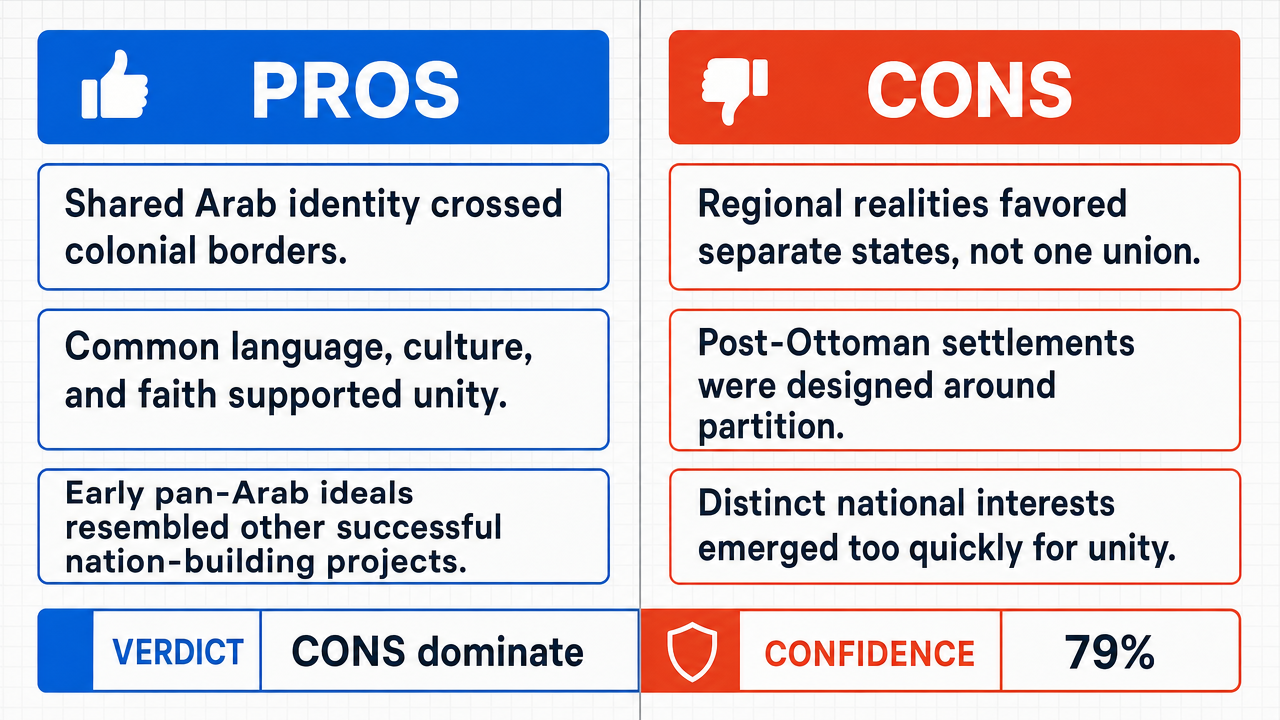
Verdict
Verdict: likely FALSE (79%)
Web Report: https://solsice.com/public/debates/the-idea-of-a-single-arab-state-was-not-initially-unrealisti-0c167abf9f6c
This section provides a brief overview of the key arguments. You do not need to read the full detailed report below.
✅ Key PRO arguments:
- ■The initial momentum for Arab unity was rooted in a shared cultural, linguistic, and religious heritage that transcended the colonial-era borders imposed by the Sykes-Picot Agreement . The Arab Revolt (1916-1918) and the pronouncements of Sharif Hussein of Mecca envisioned a single Arab kingdom from Aleppo to Aden, a vision that garnered significant popular support.
- ■Pan-Arabism 's core premise—that shared language, culture, and history could form a viable basis for statehood—is the same premise that successfully underpinned the unification of Germany and Italy in the 19th century, demonstrating the concept's validity. Historical texts such as the Damascus Protocol support this.
❌ Key ANTI arguments:
- ■Pan-Arabism was a conceptually flawed ideal, structurally incompatible with regional realities. The Arab Revolt sought autonomy from Ottoman rule, but the resulting political landscape was defined by intense competition between local elites rather than a cohesive movement for a single state. The claim that pan-Arab sentiment was the 'dominant political force' ignores the profound sectarian, tribal, and regional divisions that existed long before colonial mandates .
- ■The defining geopolitical settlements of the era—specifically the Sykes-Picot Agreement (1916) and the Balfour Declaration (1917)—were predicated on the partition of Arab-inhabited territories and the establishment of separate, conflicting political mandates , demonstrating that the structural conditions for a single Arab state never coherently existed.
💭 Conclusion: False. The idea of a single Arab state was unrealistic even in its earliest formulations because the structural preconditions for unity were absent from the outset. The anti side demonstrated that the post-Ottoman political landscape was defined by intense competition among local elites and deep sectarian, tribal, and regional divisions that long predated colonial mandates , undermining the affirmative's claim that pan-Arab sentiment was the dominant political force. The foundational geopolitical documents of the era—the Sykes-Picot Agreement (1916) and the Balfour Declaration (1917)—explicitly partitioned Arab-inhabited territories into separate, conflicting mandates, showing that the international order never aligned with a unified Arab polity. While the affirmative correctly noted that pan-Arab cultural identity existed, the anti side effectively argued that cultural affinity alone does not constitute political viability when structural, institutional, and elite-level fragmentation was already entrenched. Therefore, the assertion that the idea was 'not initially unrealistic' fails because the conceptual and structural flaws were present from the beginning, not merely products of later national-interest crystallization.
🔬 DeepResearch Result: likely FALSE ❌ (79%)
Assertion: The idea of a single Arab state was not initially unrealistic before the rise of specific national interests and institutions.
Participating models: deepseek-v3.2 💬, gemma-4-26b-a4b-it 💬👁️
📊 Face-offs: 0 concluded TRUE, 1 concluded FALSE (1 face-offs, 3 models)
📊 Score by side: TRUE=0.00, FALSE=0.79
🏅 Model score changes:
minimax-m3 💬👁️: +8
✅ PRO Arguments:
- ■The initial momentum for Arab unity was rooted in a shared cultural, linguistic, and religious heritage that transcended the colonial-era borders imposed by the Sykes-Picot Agreement . The Arab Revolt (1916-1918) and the pronouncements of Sharif Hussein of Mecca envisioned a single Arab kingdom from Aleppo to Aden, a vision that garnered significant popular support. deepseek-v3.2 💬
- ■Pan-Arabism 's core premise—that shared language, culture, and history could form a viable basis for statehood—is the same premise that successfully underpinned the unification of Germany and Italy in the 19th century, demonstrating the concept's validity. Historical texts such as the Damascus Protocol support this. deepseek-v3.2 💬
❌ ANTI Arguments:
- ■Pan-Arabism was a conceptually flawed ideal, structurally incompatible with regional realities. The Arab Revolt sought autonomy from Ottoman rule, but the resulting political landscape was defined by intense competition between local elites rather than a cohesive movement for a single state. The claim that pan-Arab sentiment was the 'dominant political force' ignores the profound sectarian, tribal, and regional divisions that existed long before colonial mandates . gemma-4-26b-a4b-it 💬👁️
- ■The defining geopolitical settlements of the era—specifically the Sykes-Picot Agreement (1916) and the Balfour Declaration (1917)—were predicated on the partition of Arab-inhabited territories and the establishment of separate, conflicting political mandates , demonstrating that the structural conditions for a single Arab state never coherently existed. gemma-4-26b-a4b-it 💬👁️
💭 Reasoning: False. The idea of a single Arab state was unrealistic even in its earliest formulations because the structural preconditions for unity were absent from the outset. The anti side demonstrated that the post-Ottoman political landscape was defined by intense competition among local elites and deep sectarian, tribal, and regional divisions that long predated colonial mandates, undermining the affirmative's claim that pan-Arab sentiment was the dominant political force. The foundational geopolitical documents of the era—the Sykes-Picot Agreement (1916) and the Balfour Declaration (1917)—explicitly partitioned Arab-inhabited territories into separate, conflicting mandates, showing that the international order never aligned with a unified Arab polity. While the affirmative correctly noted that pan-Arab cultural identity existed, the anti side effectively argued that cultural affinity alone does not constitute political viability when structural, institutional, and elite-level fragmentation was already entrenched. Therefore, the assertion that the idea was 'not initially unrealistic' fails because the conceptual and structural flaws were present from the beginning, not merely products of later national-interest crystallization.
📋 PRO Facts:
• The Arab Revolt occurred between 1916 and 1918 against Ottoman rule.
• Sharif Hussein of Mecca envisioned a single Arab kingdom spanning from Aleppo to Aden.
• The Damascus Protocol was a historical document from the period articulating Arab unity aspirations.
• Germany and Italy unified in the 19th century on the basis of shared language, culture, and history.
📋 ANTI Facts:
• The Sykes-Picot Agreement was concluded in 1916 and partitioned Arab-inhabited territories into separate spheres of influence.
• The Balfour Declaration of 1917 established the basis for a separate Jewish homeland in Palestine, contradicting any unified Arab state vision.
• Sectarian, tribal, and regional divisions among Arab populations long predated the colonial mandate period.
• The post-Ottoman political landscape was characterized by competition between local elites rather than a cohesive pan-Arab movement.
| Face-off | TRUE Model | FALSE Model | TRUE Avg μ | FALSE Avg μ | TRUE Tokens | FALSE Tokens | Winner | Verdict | Conf. |
|---|---|---|---|---|---|---|---|---|---|
| #1 | deepseek-v3.2 💬 | gemma-4-26b-a4b-it 💬👁️ | 0.486 | 0.313 | 8 | 2 | TRUE | FALSE | 79% |
The following technical terms, abbreviations, and domain-specific concepts are referenced throughout this debate transcript. Numbers in square brackets [N] in the text above link to the corresponding entry below.
[1] Arab Revolt — The 1916-1918 uprising against Ottoman rule referenced in the debate as a political movement whose pronouncements envisioned a single Arab kingdom.
[2] Balfour Declaration — A 1917 declaration cited in the debate as one of the defining political acts of the post-Ottoman period, predicated on the partition of Arab-inhabited territories and the establishment of separate, conflicting political mandates.
[3] British Foreign Office — The British government department whose records are cited in the debate as documenting post-war political conditions and pan-Arab sentiment.
[4] colonial mandates — The system of colonial administration referenced in the debate, under which sovereignty was assigned to external colonial powers following the Ottoman collapse.
[5] colonial partition — The division of Arab-inhabited territories among colonial powers, exemplified in the debate by the Sykes-Picot Agreement.
[6] contingent factors — External or accidental circumstances (as opposed to inherent or necessary ones) that the affirmative argues caused the early failure of Pan-Arabism.
[7] Damascus Protocol — A 1915 document cited in the debate as evidence of a coherent, widely understood political program for a constitutional, independent Arab state.
[8] economic markets — Shared commercial and trade systems, which the negative argues were lacking as institutional scaffolding for a unified Arab state.
[9] geopolitical settlements — The political arrangements and agreements (such as the Sykes-Picot Agreement and Balfour Declaration) that shaped the post-Ottoman political landscape.
[10] institutional crystallization — The process by which distinct state institutions and bureaucracies became established, which the affirmative argues made unified Arab statehood less realistic over time.
[11] legal frameworks — Systems of laws and legal institutions, which the negative argues were absent and thus made a single unified state functionally unrealistic.
[12] national interests — The distinct political, economic, and security priorities of individual states, which the debate identifies as emerging among Arab countries and undermining unity.
[13] non sequitur — A logical fallacy in which a conclusion does not follow from the premises; used in the debate to critique the affirmative's reasoning about state institutions.
[14] Ottoman Empire — The historical empire that administered the Arab provinces prior to its collapse, identified in the debate as the starting point for considering Arab unity.
[15] pan-Arab sentiment — The popular political force favoring Arab unity, which the affirmative argues was the dominant political force immediately following the Ottoman collapse.
[16] Pan-Arabism — The political ideology promoting unity among Arab peoples and states, examined in the debate as either conceptually sound or structurally flawed.
[17] political mandates — The governing arrangements established by colonial powers, referenced in the debate as the actual governing reality of the post-Ottoman period.
[18] regional divisions — Divisions based on geographic or regional affiliations among Arab populations, which the negative argues existed long before colonial mandates.
[19] sectarian divisions — Religious or denominational divisions among Arab populations, which the negative argues existed long before colonial mandates.
[20] Sharif Hussein of Mecca — The historical figure whose pronouncements envisioned a single Arab kingdom from Aleppo to Aden.
[21] sovereignty — Supreme political authority over a territory, discussed in the debate in the context of colonial mandates and the emergence of distinct Arab states.
[22] state institutions — The administrative, bureaucratic, and political structures necessary for governing a state, which the debate argues were largely absent or embryonic in the early 20th century Arab provinces.
[23] state sovereignty — The condition of having supreme authority over a defined territory, discussed in the debate as emerging with the formation of distinct Arab states.
[24] structural capacity — The institutional and organizational ability to govern, which the negative argues was lacking for a unified Arab state despite pan-Arab political intent.
[25] Sykes-Picot Agreement — A 1916 agreement cited in the debate as one of the defining political acts of the era, predicated on the partition of Arab-inhabited territories.
[26] T.E. Lawrence — The historical figure whose correspondence is cited in the debate as documenting post-war political conditions and pan-Arab sentiment.
[27] tribal divisions — Divisions based on tribal affiliations, which the negative argues existed long before colonial mandates and undermined pan-Arab cohesion.
[28] unified Arab state — The concept of a single political entity encompassing all Arab territories, examined in the debate as either a realistic starting point or an unrealistic ideal.
[29] vilayets — Ottoman administrative divisions or provinces, referenced in the debate as the form of administration for Arab provinces under Ottoman rule.
Face-off transcripts
- ■
Ownership & Trade Secrets. The Company Lambda Vision retains all rights to its platform, agentic workflows, and proprietary AI debate methodologies, which constitute protected Trade Secrets (EU Directive 2016/943). Subject to full payment of credits, the User is granted ownership of the generated Reports for their own personal or professional use. Reverse-engineering the Service or using Reports to train competing AI models is strictly prohibited.
- ■
No Professional Advice. Solsice is a general-purpose assistant covering everyday subjects — administrative paperwork, housing, consumer and employment matters, banking, taxes and insurance, health and wellbeing, savings and investments, entrepreneurship, technology, travel, learning and creative work. Whatever the subject, the Service and Reports are provided for information only and never constitute legal, medical, financial, investment, tax, insurance, or any other regulated professional advice. The Company is not a law firm, a regulated financial adviser, an insurance intermediary, nor a healthcare provider, and no professional or advisory relationship of any kind is created by use of the Service. Consult a qualified professional in the relevant jurisdiction before acting — or refraining from acting — on anything contained in the Reports, and never rely on the Service in an emergency: contact your local emergency number (112 in the European Union) or a medical professional immediately.
- ■
AI-Generated Content, Sources and Viewpoints. Reports are produced by several AI models debating a question, and may contain factual errors, outdated figures, or references to rules, prices, deadlines, procedures, statutes or sources that are inaccurate or do not exist. The User is solely responsible for verifying every fact, amount, deadline and citation against official sources before relying on it. Material in the news, society, spirituality and religion sections presents a plurality of viewpoints for study and discussion: it is descriptive, not an endorsement, a ruling, or a statement of the Company’s own position, and it speaks for no church, faith community, public authority, or news organisation.
- ■
Liability & Governing Law. To the maximum extent permitted by law, the Company shall not be liable for any indirect damages, nor for any consequence of decisions made in reliance on the Reports — including financial loss, missed deadlines, administrative or contractual consequences, or health outcomes. These Terms are governed by French law. Any disputes shall be subject to the exclusive jurisdiction of the Courts of Paris, France.