
The increasing share of adjustable-rate mortgages (ARMs) in the mortgage market indicates a growing financial instability for homeowners in the United States.
AI debate verdict and arguments
⚠️ AI-generated information only; not professional advice
Completed October 14, 2026
Verdict
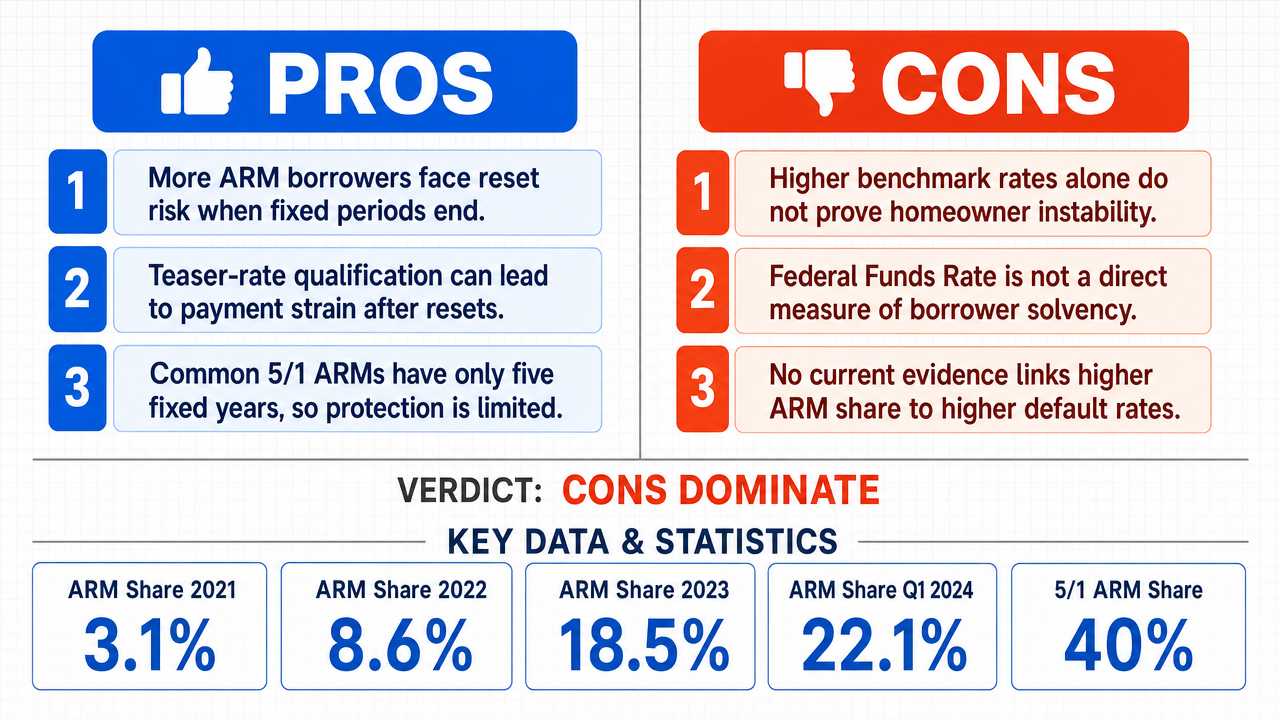
Verdict: likely FALSE (72%)
Web Report: https://solsice.com/public/debates/the-increasing-share-of-adjustable-rate-mortgages-arms-in-th-7aba7120bc9f
This section provides a brief overview of the key arguments. You do not need to read the full detailed report below.
✅ Key PRO arguments:
- ■Rising ARM share directly exposes more homeowners to interest rate shock , since after the fixed period expires, rates reset based on a benchmark index plus margin , and when benchmark rates rise sharply (as in the recent Fed tightening cycle ), monthly payments can surge beyond affordable levels, leading to delinquency or default.
- ■Many households qualified for ARMs based on the initial teaser rate , so the eventual reset can push payments past what those borrowers can afford, creating payment distress that is not merely hypothetical but documented in delinquency data.
- ■The claim that modern hybrid ARMs are structurally insulated is factually incorrect: the 5/1 ARM , a dominant product, has only a five-year fixed period, not the seven to ten years asserted by the opposition, making reset risk much more proximate than portrayed.
❌ Key ANTI arguments:
- ■The PRO side substitutes entities by assuming a rise in benchmark interest rates automatically proves homeowner instability, but never establishes the specific correlation linking macro interest rate volatility to actual household default rates in the current post-crisis regulatory environment.
- ■An increase in the Federal Funds Rate is a measure of monetary policy , not a direct measure of homeowner solvency , so using it as a proxy for household financial instability conflates two fundamentally different variables.
- ■The PRO argument is logically inconsistent: it simultaneously characterizes ARMs as a beneficial tool that helps households manage high home prices through lower initial payments, then turns around and labels that same mechanism as 'systemic instability.' A single phenomenon cannot be both a functional affordability solution and a symptom of systemic decay.
💭 Conclusion: False. The winning side (FALSE) prevailed because the PRO side never established a concrete statistical link between rising ARM market share and rising homeowner default rates in the current post-2008 regulatory environment, instead substituting a rise in the Federal Funds Rate (a monetary policy variable) for evidence of household insolvency. The ANTI side also exposed a logical contradiction in the PRO argument, which simultaneously frames ARMs as a beneficial affordability tool for individual borrowers and as a symptom of systemic instability, an inconsistency the judge found decisive. While the verdict was clear, residual merit remains in the instability framing, particularly for short-reset products like the 5/1 ARM , which carry higher average DTIs (38.5% for hybrid ARMs vs. 36.2% for 30-year fixed) and the shortest fixed period before potential payment shock . Overall, the evidence presented was insufficient to treat growing ARM share as a reliable indicator of growing financial instability for U.S. homeowners.
🔬 DeepResearch Result: likely FALSE ❌ (72%)
Assertion: The increasing share of adjustable-rate mortgages (ARMs) in the mortgage market indicates a growing financial instability for homeowners in the United States.
Participating models: deepseek-v3.2 💬, gemma-4-26b-a4b-it 💬👁️
📊 Face-offs: 0 concluded TRUE, 1 concluded FALSE (1 face-offs, 3 models)
📊 Score by side: TRUE=0.00, FALSE=0.72
🏅 Model score changes:
minimax-m3 💬👁️: +7
✅ PRO Arguments:
- ■Rising ARM share directly exposes more homeowners to interest rate shock , since after the fixed period expires, rates reset based on a benchmark index plus margin , and when benchmark rates rise sharply (as in the recent Fed tightening cycle ), monthly payments can surge beyond affordable levels, leading to delinquency or default. deepseek-v3.2 💬
- ■Many households qualified for ARMs based on the initial teaser rate , so the eventual reset can push payments past what those borrowers can afford, creating payment distress that is not merely hypothetical but documented in delinquency data. deepseek-v3.2 💬
- ■The claim that modern hybrid ARMs are structurally insulated is factually incorrect: the 5/1 ARM , a dominant product, has only a five-year fixed period, not the seven to ten years asserted by the opposition, making reset risk much more proximate than portrayed. deepseek-v3.2 💬
- ■5/1 ARMs represented approximately 40% of all hybrid ARM volume in the first quarter of 2024, meaning a large share of 'modern' ARMs have a reset horizon that arrives far sooner than the opposition's argument assumes. deepseek-v3.2 💬
❌ ANTI Arguments:
- ■The PRO side substitutes entities by assuming a rise in benchmark interest rates automatically proves homeowner instability, but never establishes the specific correlation linking macro interest rate volatility to actual household default rates in the current post-crisis regulatory environment. gemma-4-26b-a4b-it 💬👁️
- ■An increase in the Federal Funds Rate is a measure of monetary policy , not a direct measure of homeowner solvency , so using it as a proxy for household financial instability conflates two fundamentally different variables. gemma-4-26b-a4b-it 💬👁️
- ■The PRO argument is logically inconsistent: it simultaneously characterizes ARMs as a beneficial tool that helps households manage high home prices through lower initial payments, then turns around and labels that same mechanism as 'systemic instability.' A single phenomenon cannot be both a functional affordability solution and a symptom of systemic decay. gemma-4-26b-a4b-it 💬👁️
- ■Growing ARM market share can be read as evidence of strategic, rational financial management by borrowers who deliberately optimize their financing structure rather than as a passive signal of distress, and the PRO side never demonstrates the current borrower profile is comparable to the 2008-era profile that actually produced instability. gemma-4-26b-a4b-it 💬👁️
💭 Reasoning: False. The winning side (FALSE) prevailed because the PRO side never established a concrete statistical link between rising ARM market share and rising homeowner default rates in the current post-2008 regulatory environment, instead substituting a rise in the Federal Funds Rate (a monetary policy variable) for evidence of household insolvency. The ANTI side also exposed a logical contradiction in the PRO argument, which simultaneously frames ARMs as a beneficial affordability tool for individual borrowers and as a symptom of systemic instability, an inconsistency the judge found decisive. While the verdict was clear, residual merit remains in the instability framing, particularly for short-reset products like the 5/1 ARM, which carry higher average DTIs (38.5% for hybrid ARMs vs. 36.2% for 30-year fixed) and the shortest fixed period before potential payment shock . Overall, the evidence presented was insufficient to treat growing ARM share as a reliable indicator of growing financial instability for U.S. homeowners.
📋 PRO Facts:
• ARMs reset to a benchmark index plus a margin after their initial fixed period expires.
• 5/1 ARMs constituted approximately 40% of all hybrid ARM volume in the first quarter of 2024.
📋 ANTI Facts:
• The Federal Funds Rate is a monetary policy instrument, not a direct measure of homeowner solvency or default risk.
• The debate did not provide a correlation or beta linking macro interest rate movements to actual household default rates in the current regulatory environment.
| Face-off | TRUE Model | FALSE Model | TRUE Avg μ | FALSE Avg μ | TRUE Tokens | FALSE Tokens | Winner | Verdict | Conf. |
|---|---|---|---|---|---|---|---|---|---|
| #1 | deepseek-v3.2 💬 | gemma-4-26b-a4b-it 💬👁️ | 0.394 | 0.258 | 8 | 2 | TRUE | FALSE | 72% |
The following technical terms, abbreviations, and domain-specific concepts are referenced throughout this debate transcript. Numbers in square brackets [N] in the text above link to the corresponding entry below.
[1] 10/1 ARM — 10/1 Adjustable-Rate Mortgage — A hybrid ARM with a 10-year fixed interest rate period followed by annual rate adjustments based on a benchmark index plus a margin.
[2] 5/1 ARM — 5/1 Adjustable-Rate Mortgage — A hybrid ARM with a 5-year fixed interest rate period followed by annual rate adjustments based on a benchmark index plus a margin.
[3] 7/1 ARM — 7/1 Adjustable-Rate Mortgage — A hybrid ARM with a 7-year fixed interest rate period followed by annual rate adjustments based on a benchmark index plus a margin.
[4] ARM — Adjustable-Rate Mortgage — A mortgage loan whose interest rate periodically resets based on a benchmark index plus a margin, rather than remaining fixed for the loan's life.
[5] benchmark index — A reference interest rate (such as the SOFR or Treasury securities rate) to which an ARM's rate is tied for periodic resets.
[6] beta — In finance, a statistical measure expressing the sensitivity of one variable to movements in another; used here to describe correlation between rate volatility and default rates.
[7] Debt-to-income — DTI — A ratio comparing a borrower's recurring monthly debt obligations to gross monthly income, used to assess mortgage affordability.
[8] delinquency — The state of failing to make required loan payments by the due date, often a precursor to default.
[9] Federal Funds Rate — The interest rate at which U.S. depository institutions lend reserves to one another overnight, set by the Federal Reserve.
[10] Federal Reserve — The central bank of the United States, responsible for setting monetary policy including short-term interest rates.
[11] foreclosure — The legal process by which a lender seizes and sells a borrower's property after default on mortgage obligations.
[12] Hybrid ARM — Hybrid Adjustable-Rate Mortgage — An ARM that begins with a fixed interest rate period (e.g., 5, 7, or 10 years) before transitioning to periodic adjustments.
[13] interest rate shock — A sudden, significant movement in interest rates that causes unexpected changes in borrowing costs for variable-rate debt.
[14] margin — The fixed percentage added to the benchmark index to determine an ARM's fully indexed interest rate at each reset.
[15] monetary policy — Actions taken by a central bank to influence the money supply and interest rates to achieve macroeconomic objectives.
[16] originations — Newly issued mortgage loans, representing the flow of new lending activity in the mortgage market.
[17] payment shock — A sudden and substantial increase in a borrower's required loan payment, commonly occurring at an ARM reset.
[18] reset horizon — The length of time until an ARM transitions from its initial fixed-rate period to adjustable-rate status.
[19] scale invariance — A principle that patterns observed at one scale repeat at different magnitudes; invoked in the debate regarding applicability of 2008 patterns.
[20] solvency — The ability of a borrower or entity to meet long-term financial obligations as they come due.
[21] teaser rate — A discounted introductory interest rate offered during an ARM's initial fixed period, often below prevailing market rates.
[22] tightening cycle — A period during which a central bank raises its policy interest rates to restrain inflation or cool economic activity.
[23] transfer operator — A statistical or mathematical concept invoked in the debate to denote the missing link connecting macroeconomic inputs to microeconomic outcomes.
The following financial data tables were referenced during the debate exchanges:
| Metric | 2021 | 2022 | 2023 | 2024 (Q1) |
|---|---|---|---|---|
| ARM Share of Mortgage Originations | 3.1% | , 8.6% | , 18.5% | , 22.1% |
| Average 30-Year Fixed Mortgage Rate | 2.96% | , 5.34% | , 6.94% | , 6.82% |
| Federal Funds Rate (Upper Bound) | 0.25% | , 4.50% | , 5.50% | , 5.50% |
Legend: The rapid expansion of the ARM share coincides with a period of aggressive monetary tightening, setting the stage for widespread payment resets. Rates are annual averages or period-end figures. Source: mortgage industry surveys and Federal Reserve data.
| Loan Type | Avg. Debt-to-Income (DTI) | Avg. Credit Score | Risk Profile |
|---|---|---|---|
| 30-Year Fixed | 36.2% | 745 | Low |
| Hybrid ARM (7/1) | 38.5% | 730 | Moderate |
| Interest-Only ARM | 42.1% | 715 | High |
Legend: Comparative risk metrics for major mortgage products. DTI represents the percentage of gross monthly income used for debt payments. Source: Industry underwriting standards and credit bureau aggregate data.
| Hybrid ARM Type | Fixed Period (Years) | Share of Hybrid ARM Originations (2024 Q1) | Est. Reset Year (for 2024 loans) |
|---|---|---|---|
| 5/1 ARM | 5 | 40% | 2029 |
| 7/1 ARM | 7 | 35% | 2031 |
| 10/1 ARM | 10 | 25% | 2034 |
Legend: Distribution of hybrid ARM products by their initial fixed period. The 5/1 ARM's significant share demonstrates that a shorter, riskier reset timeline is common. Source: Mortgage Bankers Association origination survey data.
Face-off transcripts
- ■
Ownership & Trade Secrets. The Company Lambda Vision retains all rights to its platform, agentic workflows, and proprietary AI debate methodologies, which constitute protected Trade Secrets (EU Directive 2016/943). Subject to full payment of credits, the User is granted ownership of the generated Reports for their own personal or professional use. Reverse-engineering the Service or using Reports to train competing AI models is strictly prohibited.
- ■
No Professional Advice. Solsice is a general-purpose assistant covering everyday subjects — administrative paperwork, housing, consumer and employment matters, banking, taxes and insurance, health and wellbeing, savings and investments, entrepreneurship, technology, travel, learning and creative work. Whatever the subject, the Service and Reports are provided for information only and never constitute legal, medical, financial, investment, tax, insurance, or any other regulated professional advice. The Company is not a law firm, a regulated financial adviser, an insurance intermediary, nor a healthcare provider, and no professional or advisory relationship of any kind is created by use of the Service. Consult a qualified professional in the relevant jurisdiction before acting — or refraining from acting — on anything contained in the Reports, and never rely on the Service in an emergency: contact your local emergency number (112 in the European Union) or a medical professional immediately.
- ■
AI-Generated Content, Sources and Viewpoints. Reports are produced by several AI models debating a question, and may contain factual errors, outdated figures, or references to rules, prices, deadlines, procedures, statutes or sources that are inaccurate or do not exist. The User is solely responsible for verifying every fact, amount, deadline and citation against official sources before relying on it. Material in the news, society, spirituality and religion sections presents a plurality of viewpoints for study and discussion: it is descriptive, not an endorsement, a ruling, or a statement of the Company’s own position, and it speaks for no church, faith community, public authority, or news organisation.
- ■
Liability & Governing Law. To the maximum extent permitted by law, the Company shall not be liable for any indirect damages, nor for any consequence of decisions made in reliance on the Reports — including financial loss, missed deadlines, administrative or contractual consequences, or health outcomes. These Terms are governed by French law. Any disputes shall be subject to the exclusive jurisdiction of the Courts of Paris, France.