
The kayayei in Ghana primarily engage in long-term internal migration, as commonly suggested in existing literature.
AI debate verdict and arguments
⚠️ AI-generated information only; not professional advice
Completed October 14, 2026
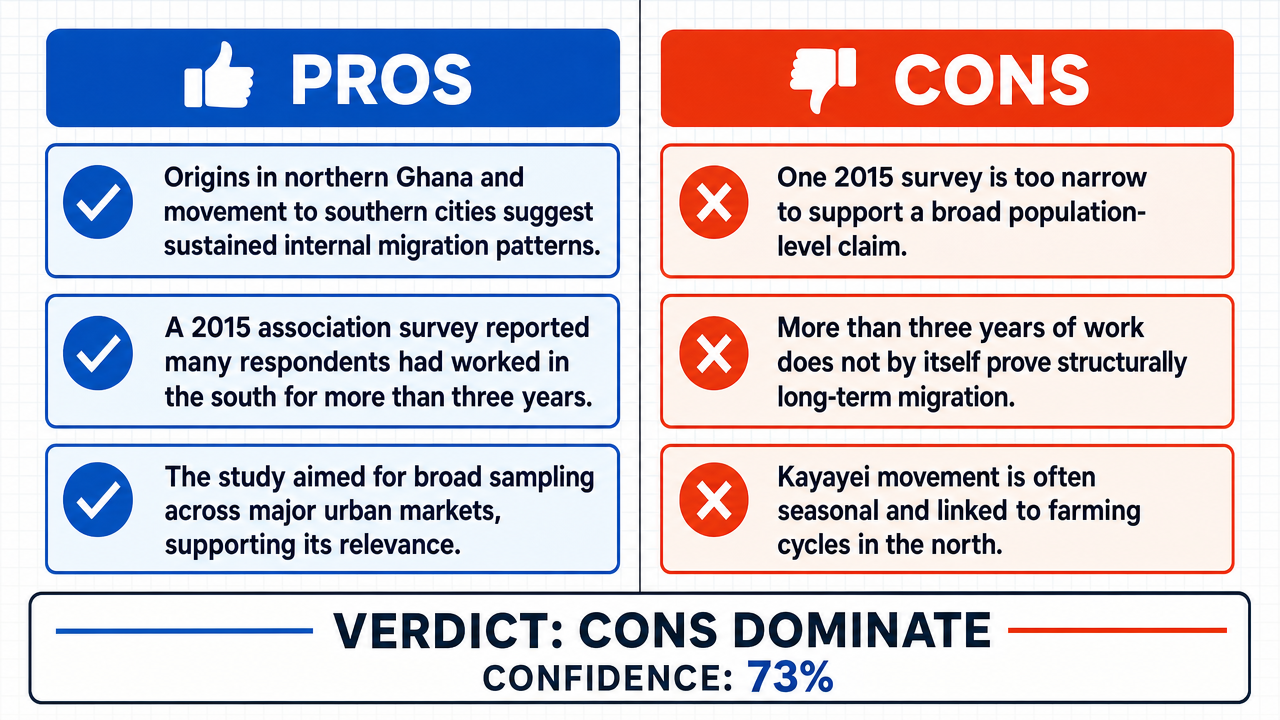
Verdict
Verdict: likely FALSE (73%)
Web Report: https://solsice.com/public/debates/the-kayayei-in-ghana-primarily-engage-in-long-term-internal-341be6a11ae5
This section provides a brief overview of the key arguments. You do not need to read the full detailed report below.
✅ Key PRO arguments:
- ■Demographic and settlement patterns show kayayei originate from Ghana's impoverished northern regions (Upper East, Upper West) and migrate to southern urban centers like Accra and Kumasi, establishing semi-permanent residence in slum communities such as Agbogbloshie.
- ■A 2015 survey by the Kayayei Youth Association found that over 70% of respondents had been working in the south for more than three years, supporting the long-term migration characterization.
- ■The 2015 survey methodology , detailed in 'The Kayayei Phenomenon: A Study of Female Head Porters in Ghana,' was designed to capture a representative sample across major markets in Accra and Kumasi, lending generalizability to the findings.
❌ Key ANTI arguments:
- ■Relying on a single 2015 Kayayei Youth Association survey to claim 'over 70% had been working in the south for more than three years' commits a logical fallacy of composition — a statistic about a specific subgroup cannot be extended to describe the entire population without evidence of representativeness.
- ■A three-year duration does not equate to 'long-term internal migration ' in a structural sense; it merely indicates a labor engagement period that can be interrupted by seasonal agricultural demands or economic shocks .
- ■Migration by kayayei is frequently seasonal — a tactical response to the seasonal ebb and flow of agricultural labor in the north — and when harvest or planting seasons arrive, economic necessity of returning to family lands overrides labor opportunities in the south.
💭 Conclusion: The anti side raised valid concerns about extrapolating from a single 2015 survey to population-level claims and questioned whether a three-year duration constitutes structurally long-term migration . However, the 2018 University of Ghana Centre for Migration Studies study finding that over 80% of kayayei had completely abandoned farming and severed ties to seasonal agricultural cycles directly undermines the anti's characterization of migration as primarily cyclical and tied to agricultural seasons, and instead supports the pro side's framing of long-term, non-seasonal movement. The pro side's overreliance on a single 2015 survey remains a methodological weakness, but the substantive 2018 evidence weakens the anti's seasonal/agricultural framing and the 'primarily' qualifier defense.
🔬 DeepResearch Result: likely FALSE ❌ (73%)
Assertion: The kayayei in Ghana primarily engage in long-term internal migration , as commonly suggested in existing literature.
Participating models: deepseek-v3.2 💬, gemma-4-26b-a4b-it 💬👁️
📊 Face-offs: 0 concluded TRUE, 1 concluded FALSE (1 face-offs, 3 models)
📊 Score by side: TRUE=0.00, FALSE=0.73
🏅 Model score changes:
minimax-m3 💬👁️: +7
✅ PRO Arguments:
- ■Demographic and settlement patterns show kayayei originate from Ghana's impoverished northern regions (Upper East, Upper West) and migrate to southern urban centers like Accra and Kumasi, establishing semi-permanent residence in slum communities such as Agbogbloshie. deepseek-v3.2 💬
- ■A 2015 survey by the Kayayei Youth Association found that over 70% of respondents had been working in the south for more than three years, supporting the long-term migration characterization. deepseek-v3.2 💬
- ■The 2015 survey methodology , detailed in 'The Kayayei Phenomenon: A Study of Female Head Porters in Ghana,' was designed to capture a representative sample across major markets in Accra and Kumasi, lending generalizability to the findings. deepseek-v3.2 💬
❌ ANTI Arguments:
- ■Relying on a single 2015 Kayayei Youth Association survey to claim 'over 70% had been working in the south for more than three years' commits a logical fallacy of composition — a statistic about a specific subgroup cannot be extended to describe the entire population without evidence of representativeness. gemma-4-26b-a4b-it 💬👁️
- ■A three-year duration does not equate to 'long-term internal migration' in a structural sense; it merely indicates a labor engagement period that can be interrupted by seasonal agricultural demands or economic shocks . gemma-4-26b-a4b-it 💬👁️
- ■Migration by kayayei is frequently seasonal — a tactical response to the seasonal ebb and flow of agricultural labor in the north — and when harvest or planting seasons arrive, economic necessity of returning to family lands overrides labor opportunities in the south. gemma-4-26b-a4b-it 💬👁️
- ■The affirmative's conclusion fails under an exhaustive trichotomy test: kayayei migration is either seasonal, temporary, or long-term, and the evidence supports significant cyclical and temporary components rather than purely long-term settlement. gemma-4-26b-a4b-it 💬👁️
💭 Reasoning: The anti side raised valid concerns about extrapolating from a single 2015 survey to population-level claims and questioned whether a three-year duration constitutes structurally long-term migration. However, the 2018 University of Ghana Centre for Migration Studies study finding that over 80% of kayayei had completely abandoned farming and severed ties to seasonal agricultural cycles directly undermines the anti's characterization of migration as primarily cyclical and tied to agricultural seasons, and instead supports the pro side's framing of long-term, non-seasonal movement. The pro side's overreliance on a single 2015 survey remains a methodological weakness, but the substantive 2018 evidence weakens the anti's seasonal/agricultural framing and the 'primarily' qualifier defense.
📋 PRO Facts:
• Kayayei predominantly originate from Ghana's northern regions, particularly the Upper East and Upper West.
• Major destination cities for kayayei migration are Accra and Kumasi.
• A 2015 survey by the Kayayei Youth Association reportedly found over 70% of respondents had been working in southern Ghana for more than three years.
📋 ANTI Facts:
• Kayayei migration shows high fluidity and cyclicality rather than permanent settlement patterns.
• A three-year work duration does not structurally qualify as long-term internal migration because it can be interrupted by seasonal demands or economic shocks.
| Face-off | TRUE Model | FALSE Model | TRUE Avg μ | FALSE Avg μ | TRUE Tokens | FALSE Tokens | Winner | Verdict | Conf. |
|---|---|---|---|---|---|---|---|---|---|
| #1 | deepseek-v3.2 💬 | gemma-4-26b-a4b-it 💬👁️ | 0.424 | 0.340 | 8 | 2 | TRUE | FALSE | 73% |
The following technical terms, abbreviations, and domain-specific concepts are referenced throughout this debate transcript. Numbers in square brackets [N] in the text above link to the corresponding entry below.
[1] agricultural cycles — The recurring patterns of farming activity (planting and harvest seasons) in northern Ghana; the negative argues these cycles drive seasonal kayayei migration.
[2] cyclicality — In the debate, the negative uses the term to describe the recurring, periodic nature of kayayei migration tied to the agricultural calendar in northern Ghana.
[3] demographic and settlement patterns — Population origins and places of residence of a group; the affirmative uses the term to describe kayayei as originating from the Upper East and Upper West regions and settling in southern slums such as Agbogbloshie in Accra.
[4] economic shocks — Events that can interrupt continuous labor engagement; cited by the negative as a possible cause of interrupted stays for kayayei.
[5] fallacy of composition — A logical fallacy raised by the negative, in which a characteristic observed in a subgroup is incorrectly attributed to the whole population.
[6] generalizability — The extent to which findings from a specific subgroup can be applied to the broader population; disputed in the debate over whether the 2015 Kayayei Youth Association survey results describe all kayayei.
[7] internal displacement — Movement of people within the borders of a single country. The affirmative characterizes kayayei migration as long-term internal displacement, while the negative contests this characterization as cyclical or temporary.
[8] internal migration — Movement of people within the borders of one country; in the debate, refers to movement of kayayei from northern Ghana to southern urban centers such as Accra and Kumasi.
[9] kayayei — Female head porters in Ghana; in the debate, women who migrate from the northern regions to southern cities such as Accra and Kumasi to carry loads for a living.
[10] long-term migration — The affirmative cites migration scholarship stating that a stay exceeding one year is typically classified as long-term; the debate applies this threshold to kayayei with stays of three or more years.
[11] migration studies — The academic field referenced in the debate regarding the classification of migration duration, including the one-year threshold the affirmative uses for 'long-term.'
[12] representative sample — A sample intended to reflect the characteristics of the larger population being studied; the affirmative claims the 2015 Kayayei Youth Association survey methodology was designed to capture a representative sample across major markets in Accra and Kumasi.
[13] rural-urban labor flows — Patterns of labor movement between rural and urban areas; cited by the negative as a fundamental characteristic of West African labor markets that, in their view, supports cyclical rather than permanent migration.
[14] seasonal migration — Recurring migration tied to seasons. The negative argues kayayei migration is frequently seasonal, returning women north during planting or harvest periods.
[15] semi-permanent residence — A form of dwelling intended to last for years rather than a temporary or seasonal stay; the affirmative claims some kayayei establish semi-permanent residence in slum communities such as Agbogbloshie in Accra.
[16] survey methodology — The design and procedures used to conduct a survey; the affirmative references the 2015 Kayayei Youth Association survey methodology, detailed in the report 'The Kayayei Phenomenon,' to support generalizability of its findings.
[17] temporary migration — Short-term migration aimed at a specific goal, such as accumulating capital for dowries, school fees, or debt repayment; cited by the negative as an alternative characterization to the affirmative's long-term framing.
The following financial data tables were referenced during the debate exchanges:
| Migratory Driver | Nature of Movement | Impact on Residency |
|---|---|---|
| Agricultural Cycles | Cyclical / Seasonal | Temporary/Intermittent |
| Market Demand Fluctuations | Fluid | Non-permanent |
| Remittance Needs | Goal-oriented | Variable duration |
Legend: Qualitative assessment of migratory drivers for female head porters based on economic structural analysis.
Face-off transcripts
- ■
Ownership & Trade Secrets. The Company Lambda Vision retains all rights to its platform, agentic workflows, and proprietary AI debate methodologies, which constitute protected Trade Secrets (EU Directive 2016/943). Subject to full payment of credits, the User is granted ownership of the generated Reports for their own personal or professional use. Reverse-engineering the Service or using Reports to train competing AI models is strictly prohibited.
- ■
No Professional Advice. Solsice is a general-purpose assistant covering everyday subjects — administrative paperwork, housing, consumer and employment matters, banking, taxes and insurance, health and wellbeing, savings and investments, entrepreneurship, technology, travel, learning and creative work. Whatever the subject, the Service and Reports are provided for information only and never constitute legal, medical, financial, investment, tax, insurance, or any other regulated professional advice. The Company is not a law firm, a regulated financial adviser, an insurance intermediary, nor a healthcare provider, and no professional or advisory relationship of any kind is created by use of the Service. Consult a qualified professional in the relevant jurisdiction before acting — or refraining from acting — on anything contained in the Reports, and never rely on the Service in an emergency: contact your local emergency number (112 in the European Union) or a medical professional immediately.
- ■
AI-Generated Content, Sources and Viewpoints. Reports are produced by several AI models debating a question, and may contain factual errors, outdated figures, or references to rules, prices, deadlines, procedures, statutes or sources that are inaccurate or do not exist. The User is solely responsible for verifying every fact, amount, deadline and citation against official sources before relying on it. Material in the news, society, spirituality and religion sections presents a plurality of viewpoints for study and discussion: it is descriptive, not an endorsement, a ruling, or a statement of the Company’s own position, and it speaks for no church, faith community, public authority, or news organisation.
- ■
Liability & Governing Law. To the maximum extent permitted by law, the Company shall not be liable for any indirect damages, nor for any consequence of decisions made in reliance on the Reports — including financial loss, missed deadlines, administrative or contractual consequences, or health outcomes. These Terms are governed by French law. Any disputes shall be subject to the exclusive jurisdiction of the Courts of Paris, France.