
The Matron of Ravens' decision to make the gods mortal and leave fragments of themselves behind will ultimately starve Predathos and save the pantheon.
AI debate verdict and arguments
⚠️ AI-generated information only; not professional advice
Completed October 14, 2026
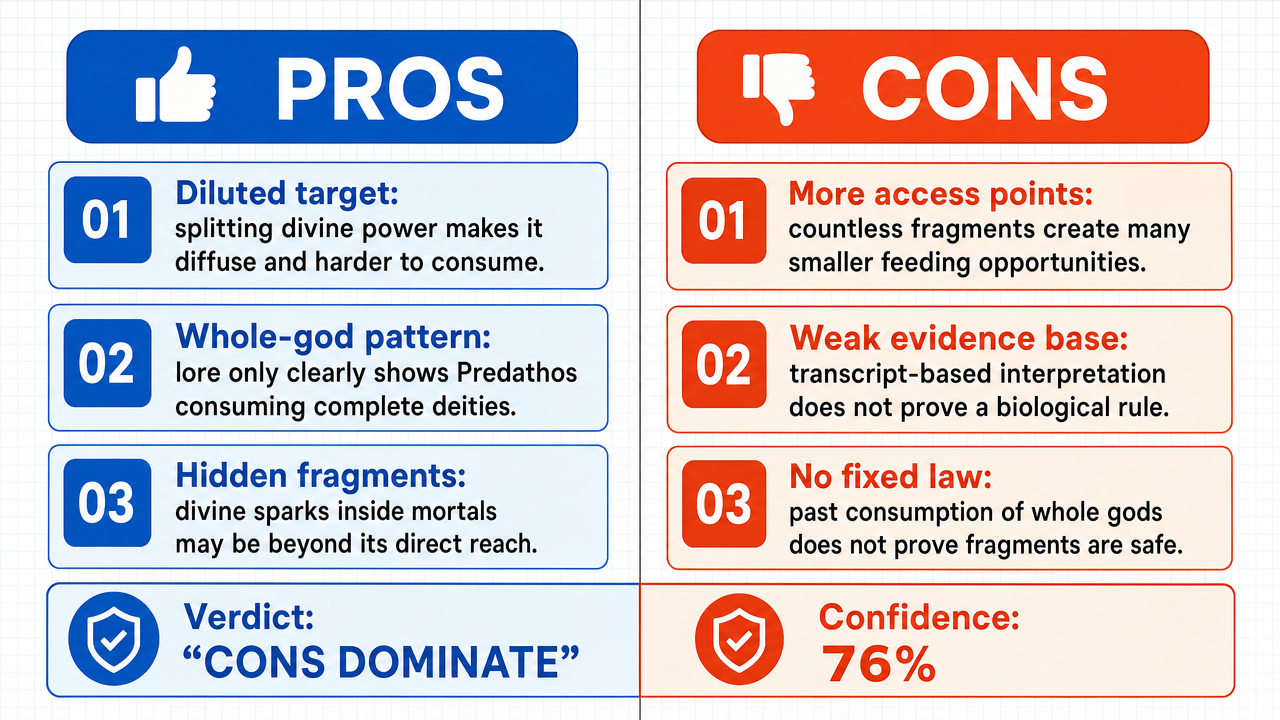
Verdict
Verdict: likely FALSE (76%)
Web Report: https://solsice.com/public/debates/the-matron-of-ravens-decision-to-make-the-gods-mortal-and-le-8f5104ad145d
This section provides a brief overview of the key arguments. You do not need to read the full detailed report below.
✅ Key PRO arguments:
- ■Fragmenting the gods transforms a concentrated, potent food source into a diffuse, inaccessible one, analogous to starving a predator by hiding and diluting its prey, since Predathos 's hunger is for whole gods as evidenced by its historical consumption of two deities.
- ■The canonical title 'God-Eater ' and the historical record of Predathos consuming the Dawnfather and the Everlight as whole entities implies it cannot metabolize fragmented divine essence as efficiently as complete gods.
- ■Fragmentary divine sparks embedded in mortal hosts would be inaccessible to Predathos , effectively removing the gods from its reach while preserving their essence in a form it cannot consume.
❌ Key ANTI arguments:
- ■Fragmentation increases Predathos 's accessibility by creating infinite, manageable feeding opportunities, since dispersed divine fragments across countless mortals give the entity more targets than a small number of whole gods.
- ■The affirmative's reliance on campaign transcripts as a source for Predathos 's fundamental biological requirements is a failure of source genus , since tabletop game transcripts are records of improvised narrative rather than codified ontological law.
- ■The claim that Predathos requires whole gods is not established as a fundamental law of divine biology; treating the historical consumption of two deities as a definitive metabolic constraint is a narrow, restrictive reading unsupported by canonical evidence.
💭 Conclusion: False. The Matron's plan will not starve Predathos and save the pantheon , as the negative successfully undermined the affirmative's evidentiary foundation. The affirmative relied heavily on campaign transcripts and interpretive lore to claim Predathos can only consume whole gods, but the negative correctly identified this as a failure of source genus , since improvised tabletop narratives cannot establish structural laws of divine biology. The negative's stronger argument—that fragmentation actually increases Predathos's accessibility by creating countless manageable feeding opportunities across mortal hosts—remained unrefuted and represents a plausible counter-model. Because the claim is compound (starving Predathos AND saving the pantheon), and the debate only partially addressed the 'save the pantheon' sub-claim, confidence is capped at the judge's 76% level rather than reported as higher.
🔬 DeepResearch Result: likely FALSE ❌ (76%)
Assertion: The Matron of Ravens ' decision to make the gods mortal and leave fragments of themselves behind will ultimately starve Predathos and save the pantheon .
Participating models: deepseek-v3.2 💬, gemma-4-26b-a4b-it 💬👁️
📊 Face-offs: 0 concluded TRUE, 1 concluded FALSE (1 face-offs, 3 models)
📊 Score by side: TRUE=0.00, FALSE=0.76
🏅 Model score changes:
minimax-m3 💬👁️: +8
✅ PRO Arguments:
- ■Fragmenting the gods transforms a concentrated, potent food source into a diffuse, inaccessible one, analogous to starving a predator by hiding and diluting its prey, since Predathos's hunger is for whole gods as evidenced by its historical consumption of two deities. deepseek-v3.2 💬
- ■The canonical title 'God-Eater ' and the historical record of Predathos consuming the Dawnfather and the Everlight as whole entities implies it cannot metabolize fragmented divine essence as efficiently as complete gods. deepseek-v3.2 💬
- ■Fragmentary divine sparks embedded in mortal hosts would be inaccessible to Predathos, effectively removing the gods from its reach while preserving their essence in a form it cannot consume. deepseek-v3.2 💬
❌ ANTI Arguments:
- ■Fragmentation increases Predathos's accessibility by creating infinite, manageable feeding opportunities, since dispersed divine fragments across countless mortals give the entity more targets than a small number of whole gods. gemma-4-26b-a4b-it 💬👁️
- ■The affirmative's reliance on campaign transcripts as a source for Predathos's fundamental biological requirements is a failure of source genus , since tabletop game transcripts are records of improvised narrative rather than codified ontological law. gemma-4-26b-a4b-it 💬👁️
- ■The claim that Predathos requires whole gods is not established as a fundamental law of divine biology; treating the historical consumption of two deities as a definitive metabolic constraint is a narrow, restrictive reading unsupported by canonical evidence. gemma-4-26b-a4b-it 💬👁️
- ■Without a stable canonical source defining the specific caloric requirements of Predathos, the assertion that it cannot feed on fragments is speculative rather than structurally grounded in the multiverse 's rules. gemma-4-26b-a4b-it 💬👁️
💭 Reasoning: False. The Matron's plan will not starve Predathos and save the pantheon, as the negative successfully undermined the affirmative's evidentiary foundation. The affirmative relied heavily on campaign transcripts and interpretive lore to claim Predathos can only consume whole gods, but the negative correctly identified this as a failure of source genus, since improvised tabletop narratives cannot establish structural laws of divine biology. The negative's stronger argument—that fragmentation actually increases Predathos's accessibility by creating countless manageable feeding opportunities across mortal hosts—remained unrefuted and represents a plausible counter-model. Because the claim is compound (starving Predathos AND saving the pantheon), and the debate only partially addressed the 'save the pantheon' sub-claim, confidence is capped at the judge's 76% level rather than reported as higher.
📋 PRO Facts:
• Predathos is described as the 'God-Eater' in the Explorer's Guide to Wildemount .
• Predathos historically consumed two whole gods: the Dawnfather and the Everlight.
• Fragmentary divine sparks exist within mortal hosts in the lore.
📋 ANTI Facts:
• Tabletop campaign transcripts are records of player interaction and improvised narrative, not formal ontological treatises.
• No canonical source defines the specific caloric or metabolic requirements of Predathos.
• The historical consumption of two deities does not constitute a codified metabolic constraint on Predathos.
| Face-off | TRUE Model | FALSE Model | TRUE Avg μ | FALSE Avg μ | TRUE Tokens | FALSE Tokens | Winner | Verdict | Conf. |
|---|---|---|---|---|---|---|---|---|---|
| #1 | deepseek-v3.2 💬 | gemma-4-26b-a4b-it 💬👁️ | 0.421 | 0.315 | 8 | 2 | TRUE | FALSE | 76% |
The following technical terms, abbreviations, and domain-specific concepts are referenced throughout this debate transcript. Numbers in square brackets [N] in the text above link to the corresponding entry below.
[1] attenuation — Severe reduction or weakening of a deity's power or presence. Mentioned in the debate as a state through which gods can persist despite fragmentation.
[2] campaign transcripts — Written records of tabletop role-playing game sessions, capturing player dialogue and improvised narrative. The negative side argues these are transient, subjective sources unsuitable for establishing canonical laws of the setting.
[3] canonical source — An authoritative reference work recognized as definitive for the lore of a setting. The debate turns on whether certain sources qualify as canonical regarding Predathos's feeding requirements.
[4] codified rulebook — A formally published set of rules or systems that govern a game's mechanics or a fictional universe. Contrasted in the debate with improvised narrative sources.
[5] Dawnfather — A specific deity referenced in the debate as one of two whole gods historically consumed by Predathos.
[6] divine essence — The fundamental substance or power constituting a deity, cited as the type of 'food' Predathos consumes. The debate disputes whether this essence in fragmentary form can sustain the entity.
[7] divine predator — A classification for Predathos in the debate: an entity whose nature is defined by the consumption of divine beings.
[8] divine sparks — Small fragmentary pieces of divine essence, associated in the debate with mortal champions and relics. The affirmative argues these fragments are insufficient as Predathos's sustenance.
[9] Everlight — A specific deity referenced in the debate as the second of two whole gods historically consumed by Predathos.
[10] Explorer's Guide to Wildemount — A published sourcebook cited as canonical evidence in the debate for describing Predathos as the 'God-Eater' and its consumption of whole deities.
[11] fragmentation — The process of breaking whole divine beings into smaller pieces or fragments. The central mechanism of the Matron's plan and the focal point of the affirmative/negative disagreement.
[12] God-Eater — An epithet used in the canonical source for Predathos, referenced in the debate to imply a diet of complete divine entities rather than fragments.
[13] Matron of Ravens — The character attributed in the debate assertion with the decision to make the gods mortal and disperse their essence into fragments.
[14] metabolic flexibility — The capacity of a biological or analogous entity to process varying forms or concentrations of sustenance. The affirmative argues this is absent in Predathos; the negative disputes this claim.
[15] metabolic requirements — The specific nutritional or sustenance conditions an entity needs to function. The parties disagree over whether Predathos's requirements are limited to whole gods or extend to fragments.
[16] mortal champions — Mortal beings imbued with fragmentary divine essence, cited as one form into which the dispersed divine sparks are cast.
[17] multiverse — The broader cosmological setting of the debate, referenced when characterizing what constitutes a 'structural law' of divine biology.
[18] ontological treatise — A formal philosophical or systematic work on the nature of being and existence, invoked in the debate as the type of source proper to establish cosmic laws.
[19] pantheon — the collective gods — The collective body of deities whose survival is at stake in the debate.
[20] portion control — A concept introduced by the negative side to characterize the argument that Predathos could consume divine essence in many smaller doses rather than whole deities at once.
[21] Predathos — The 'God-Eater,' a divine predator entity whose feeding mechanism and dietary requirements are the central disputed concept of the debate.
[22] relics — Physical objects that contain or carry fragments of divine essence, cited as one of the diffuse forms the shattered divine takes after fragmentation.
[23] source genus — The category or class of a cited source. The negative argues that invoking 'campaign transcripts' as the source for Predathos's biology is a 'failure of source genus'—using an inappropriate category of reference.
[24] structural law — A foundational, stable rule of a fictional cosmology, contrasted with player-driven or improvised observations. The debate disputes whether any claim about Predathos's diet rises to this level.
[25] sustenance model — A framework describing how Predathos obtains and uses nourishment. The affirmative proposes a model in which Predathos requires concentrated whole-god essence, which fragmentation dismantles.
Face-off transcripts
- ■
Ownership & Trade Secrets. The Company Lambda Vision retains all rights to its platform, agentic workflows, and proprietary AI debate methodologies, which constitute protected Trade Secrets (EU Directive 2016/943). Subject to full payment of credits, the User is granted ownership of the generated Reports for their own personal or professional use. Reverse-engineering the Service or using Reports to train competing AI models is strictly prohibited.
- ■
No Professional Advice. Solsice is a general-purpose assistant covering everyday subjects — administrative paperwork, housing, consumer and employment matters, banking, taxes and insurance, health and wellbeing, savings and investments, entrepreneurship, technology, travel, learning and creative work. Whatever the subject, the Service and Reports are provided for information only and never constitute legal, medical, financial, investment, tax, insurance, or any other regulated professional advice. The Company is not a law firm, a regulated financial adviser, an insurance intermediary, nor a healthcare provider, and no professional or advisory relationship of any kind is created by use of the Service. Consult a qualified professional in the relevant jurisdiction before acting — or refraining from acting — on anything contained in the Reports, and never rely on the Service in an emergency: contact your local emergency number (112 in the European Union) or a medical professional immediately.
- ■
AI-Generated Content, Sources and Viewpoints. Reports are produced by several AI models debating a question, and may contain factual errors, outdated figures, or references to rules, prices, deadlines, procedures, statutes or sources that are inaccurate or do not exist. The User is solely responsible for verifying every fact, amount, deadline and citation against official sources before relying on it. Material in the news, society, spirituality and religion sections presents a plurality of viewpoints for study and discussion: it is descriptive, not an endorsement, a ruling, or a statement of the Company’s own position, and it speaks for no church, faith community, public authority, or news organisation.
- ■
Liability & Governing Law. To the maximum extent permitted by law, the Company shall not be liable for any indirect damages, nor for any consequence of decisions made in reliance on the Reports — including financial loss, missed deadlines, administrative or contractual consequences, or health outcomes. These Terms are governed by French law. Any disputes shall be subject to the exclusive jurisdiction of the Courts of Paris, France.