
The memory impairments observed in animal models due to high sugar or junk food consumption are fully reversible solely by switching to a healthy diet.
AI debate verdict and arguments
⚠️ AI-generated information only; not professional advice
Completed October 14, 2026
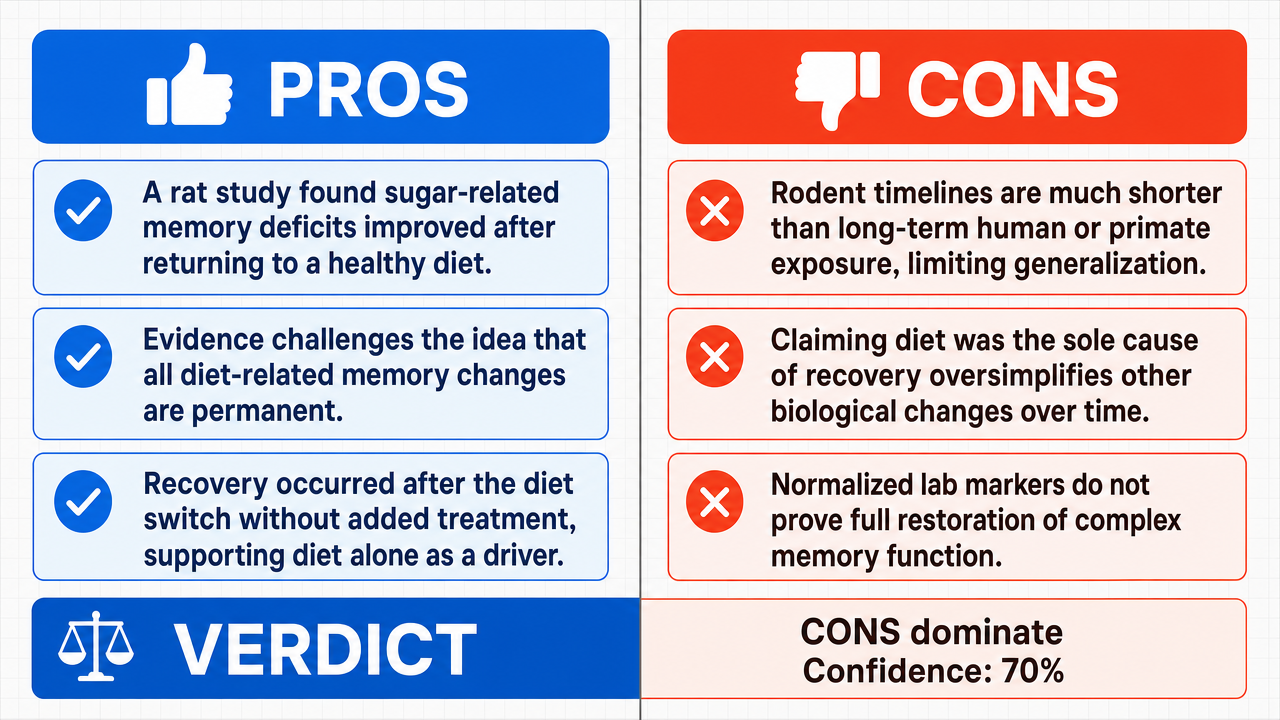
Verdict
Verdict: likely FALSE (70%)
Web Report: https://solsice.com/public/debates/the-memory-impairments-observed-in-animal-models-due-to-high-3b995a4f2534
This section provides a brief overview of the key arguments. You do not need to read the full detailed report below.
✅ Key PRO arguments:
- ■A 2017 study in Scientific Reports demonstrated that rats fed a high-sugar diet for six weeks exhibited impaired hippocampal-dependent spatial memory and reduced BDNF ; after switching to a standard chow diet for four weeks, BDNF levels normalized and memory performance in the Morris water maze returned to control levels without any pharmacological intervention .
- ■The opponent's claim that structural damage is permanent collapses in every logically possible scenario: if impairments are fully reversible—as evidence shows—then the claim of permanent structural damage is false; if partially reversible, the 'full reversal' claim is simply qualified but not refuted by partial evidence.
- ■The dietary switch was isolated as the sole variable in the recovery, with no other interventions, showing that diet change alone was sufficient to reverse the biochemical and functional impairments.
❌ Key ANTI arguments:
- ■There is a fundamental scale mismatch between rodent models and higher organisms: dietary insult in rodents is measured in weeks, whereas in primates and humans the cumulative impact of high-sugar diets spans years or decades, and the metabolic and neuroinflammatory cascades trigger structural changes such as loss of synaptic density that a simple diet switch cannot fully undo.
- ■The claim that the dietary switch is the 'sole' variable responsible for recovery relies on a logical contradiction: the affirmative simultaneously argues the study isolated diet as the sole variable and that the diet change 'alone' was sufficient, yet failed to account for other potential drivers of neuroplasticity such as changes in animal handling, social interaction density, or spontaneous behavior.
- ■While a switch to standard chow may normalize biochemical markers like BDNF in a controlled laboratory environment, these biochemical normalizations do not necessarily equate to full reversal of structural and neuroinflammatory damage, which can persist even after biochemical markers recover.
💭 Conclusion: False. The assertion that memory impairments from high sugar or junk food consumption in animal models are fully reversible solely by switching to a healthy diet is not adequately supported by the available evidence. The strongest argument against the assertion is the scale-mismatch objection: rodent studies measuring dietary insult over weeks cannot be straightforwardly generalized to the chronic, long-term neuroinflammatory and structural changes that accumulate over years of exposure. Additionally, the 'solely by diet' qualifier is undermined by the difficulty of truly isolating dietary change as the only variable in neuroplasticity recovery, since animal handling, social interaction, and other uncontrolled factors can independently drive recovery. While the pro-side's cited Scientific Reports study did show BDNF normalization and Morris water maze recovery after a diet switch, this evidence does not establish that such recovery is universally complete across all junk-food/high-sugar paradigms or that it eliminates all structural damage. The compound claim therefore fails on both its 'fully reversible' and 'solely by diet' components, with the weakest sub-claim being the exclusivity of diet as the causal mechanism of recovery.
🔬 DeepResearch Result: likely FALSE ❌ (70%)
Assertion: The memory impairments observed in animal models due to high sugar or junk food consumption are fully reversible solely by switching to a healthy diet.
Participating models: deepseek-v3.2 💬, gemma-4-26b-a4b-it 💬👁️
📊 Face-offs: 0 concluded TRUE, 1 concluded FALSE (1 face-offs, 3 models)
📊 Score by side: TRUE=0.00, FALSE=0.90
🏅 Model score changes:
minimax-m3 💬👁️: +9
✅ PRO Arguments:
- ■A 2017 study in Scientific Reports demonstrated that rats fed a high-sugar diet for six weeks exhibited impaired hippocampal-dependent spatial memory and reduced BDNF ; after switching to a standard chow diet for four weeks, BDNF levels normalized and memory performance in the Morris water maze returned to control levels without any pharmacological intervention . deepseek-v3.2 💬
- ■The opponent's claim that structural damage is permanent collapses in every logically possible scenario: if impairments are fully reversible—as evidence shows—then the claim of permanent structural damage is false; if partially reversible, the 'full reversal' claim is simply qualified but not refuted by partial evidence. deepseek-v3.2 💬
- ■The dietary switch was isolated as the sole variable in the recovery, with no other interventions, showing that diet change alone was sufficient to reverse the biochemical and functional impairments. deepseek-v3.2 💬
❌ ANTI Arguments:
- ■There is a fundamental scale mismatch between rodent models and higher organisms: dietary insult in rodents is measured in weeks, whereas in primates and humans the cumulative impact of high-sugar diets spans years or decades, and the metabolic and neuroinflammatory cascades trigger structural changes such as loss of synaptic density that a simple diet switch cannot fully undo. gemma-4-26b-a4b-it 💬👁️
- ■The claim that the dietary switch is the 'sole' variable responsible for recovery relies on a logical contradiction: the affirmative simultaneously argues the study isolated diet as the sole variable and that the diet change 'alone' was sufficient, yet failed to account for other potential drivers of neuroplasticity such as changes in animal handling, social interaction density, or spontaneous behavior. gemma-4-26b-a4b-it 💬👁️
- ■While a switch to standard chow may normalize biochemical markers like BDNF in a controlled laboratory environment, these biochemical normalizations do not necessarily equate to full reversal of structural and neuroinflammatory damage, which can persist even after biochemical markers recover. gemma-4-26b-a4b-it 💬👁️
💭 Reasoning: False. The assertion that memory impairments from high sugar or junk food consumption in animal models are fully reversible solely by switching to a healthy diet is not adequately supported by the available evidence. The strongest argument against the assertion is the scale-mismatch objection: rodent studies measuring dietary insult over weeks cannot be straightforwardly generalized to the chronic, long-term neuroinflammatory and structural changes that accumulate over years of exposure. Additionally, the 'solely by diet' qualifier is undermined by the difficulty of truly isolating dietary change as the only variable in neuroplasticity recovery, since animal handling, social interaction, and other uncontrolled factors can independently drive recovery. While the pro-side's cited Scientific Reports study did show BDNF normalization and Morris water maze recovery after a diet switch, this evidence does not establish that such recovery is universally complete across all junk-food/high-sugar paradigms or that it eliminates all structural damage. The compound claim therefore fails on both its 'fully reversible' and 'solely by diet' components, with the weakest sub-claim being the exclusivity of diet as the causal mechanism of recovery.
📋 PRO Facts:
• A 2017 study in Scientific Reports showed rats fed a high-sugar diet for six weeks exhibited impaired hippocampal-dependent spatial memory and reduced BDNF.
• After switching to a standard chow diet for four weeks, BDNF levels normalized and Morris water maze performance returned to control levels without pharmacological intervention.
📋 ANTI Facts:
• Rodent dietary insult studies typically measure exposure over much shorter durations (weeks) compared to primate or human chronic exposure (years to decades).
• Chronic high-sugar consumption induces structural changes including loss of synaptic density that may persist beyond biochemical marker normalization.
• Neuroinflammatory cascades triggered by chronic sugar consumption can produce damage that is not fully reversed by simple dietary restoration alone.
| Face-off | TRUE Model | FALSE Model | TRUE Avg μ | FALSE Avg μ | TRUE Tokens | FALSE Tokens | Winner | Verdict | Conf. |
|---|---|---|---|---|---|---|---|---|---|
| #1 | deepseek-v3.2 💬 | gemma-4-26b-a4b-it 💬👁️ | 0.482 | 0.406 | 8 | 2 | TRUE | FALSE | 90% |
The following technical terms, abbreviations, and domain-specific concepts are referenced throughout this debate transcript. Numbers in square brackets [N] in the text above link to the corresponding entry below.
[1] BDNF — brain-derived neurotrophic factor — A protein of the neurotrophin family that supports neuronal survival, growth, and synaptic plasticity and is critical for memory function.
[2] confounding factors — Variables other than the one being studied that may independently influence an experimental outcome and therefore must be controlled for.
[3] dendritic spines — Small protrusions on neuronal dendrites that receive synaptic input and are involved in synaptic transmission and plasticity.
[4] electron microscopy — A high-resolution imaging technique that uses electron beams to visualize cellular and subcellular structures, including synapses and dendritic spines.
[5] high-fat, high-sugar diet — An experimental diet combining elevated fat and sugar content, used in animal research to model obesogenic or Western-style dietary patterns.
[6] hippocampal neurogenesis — The process of generating new neurons in the hippocampus, a brain region involved in learning and memory.
[7] hippocampal-dependent spatial memory — Memory for spatial locations and navigation that depends on the functional integrity of the hippocampus.
[8] hippocampus — A medial temporal lobe brain structure critical for spatial navigation and the consolidation of declarative memories.
[9] junk food models — Animal research paradigms that use diets rich in processed, palatable foods (high in sugar, fat, and salt) to study physiological and behavioral effects.
[10] metabolic cascade — A chain of related biochemical or physiological events in metabolism in which one triggering event initiates a sequence of subsequent events.
[11] Morris water maze — A behavioral neuroscience test in which rodents learn to locate a hidden platform in a pool of water, used to assess hippocampal-dependent spatial memory.
[12] neural architecture — The physical structural organization of neurons, synapses, and circuits that make up the nervous system.
[13] neuroinflammatory — Pertaining to inflammation within the nervous system, typically involving activation of glial cells and release of inflammatory mediators.
[14] neuroplasticity — The capacity of the nervous system to reorganize synaptic connections and neural circuits in response to experience, learning, or injury.
[15] pharmacological intervention — The use of drugs or bioactive compounds to modify a physiological, biochemical, or behavioral process.
[16] rodent models — Animal models using rats or mice to investigate biological mechanisms or disease processes relevant to mammalian physiology.
[17] spatial memory — The cognitive function responsible for encoding, storing, and retrieving information about environments and spatial orientation.
[18] spine density — The number of dendritic spines per unit length or area on a neuron, commonly used as an index of synaptic connectivity.
[19] standard chow diet — A nutritionally complete, standardized pellet diet fed to laboratory rodents, typically used as a control condition in dietary intervention studies.
[20] structural atrophy — The physical loss or reduction of tissue mass, cellular components, or structural elements within an organ or anatomical region.
[21] synaptic density — The number or concentration of synapses within a defined neural region, reflecting the degree of connectivity between neurons.
[22] synaptic plasticity — The ability of synapses to strengthen or weaken over time in response to activity, a cellular mechanism underlying learning and memory.
[23] transfer operator — In this debate, a methodological term referring to the rigorous experimental control or exclusion of all environmental variables other than the one being tested, in order to attribute an outcome to that variable alone.
Face-off transcripts
- ■
Ownership & Trade Secrets. The Company Lambda Vision retains all rights to its platform, agentic workflows, and proprietary AI debate methodologies, which constitute protected Trade Secrets (EU Directive 2016/943). Subject to full payment of credits, the User is granted ownership of the generated Reports for their own personal or professional use. Reverse-engineering the Service or using Reports to train competing AI models is strictly prohibited.
- ■
No Professional Advice. Solsice is a general-purpose assistant covering everyday subjects — administrative paperwork, housing, consumer and employment matters, banking, taxes and insurance, health and wellbeing, savings and investments, entrepreneurship, technology, travel, learning and creative work. Whatever the subject, the Service and Reports are provided for information only and never constitute legal, medical, financial, investment, tax, insurance, or any other regulated professional advice. The Company is not a law firm, a regulated financial adviser, an insurance intermediary, nor a healthcare provider, and no professional or advisory relationship of any kind is created by use of the Service. Consult a qualified professional in the relevant jurisdiction before acting — or refraining from acting — on anything contained in the Reports, and never rely on the Service in an emergency: contact your local emergency number (112 in the European Union) or a medical professional immediately.
- ■
AI-Generated Content, Sources and Viewpoints. Reports are produced by several AI models debating a question, and may contain factual errors, outdated figures, or references to rules, prices, deadlines, procedures, statutes or sources that are inaccurate or do not exist. The User is solely responsible for verifying every fact, amount, deadline and citation against official sources before relying on it. Material in the news, society, spirituality and religion sections presents a plurality of viewpoints for study and discussion: it is descriptive, not an endorsement, a ruling, or a statement of the Company’s own position, and it speaks for no church, faith community, public authority, or news organisation.
- ■
Liability & Governing Law. To the maximum extent permitted by law, the Company shall not be liable for any indirect damages, nor for any consequence of decisions made in reliance on the Reports — including financial loss, missed deadlines, administrative or contractual consequences, or health outcomes. These Terms are governed by French law. Any disputes shall be subject to the exclusive jurisdiction of the Courts of Paris, France.