
The 'Molo' solution for real-time water consumption monitoring achieves 23% water savings during showers.
AI debate verdict and arguments
⚠️ AI-generated information only; not professional advice
Completed October 14, 2026
Verdict
Verdict: likely FALSE (70%)
Web Report: https://solsice.com/public/debates/the-molo-solution-for-real-time-water-consumption-monitoring-f92da235891a
This section provides a brief overview of the key arguments. You do not need to read the full detailed report below.
✅ Key PRO arguments:
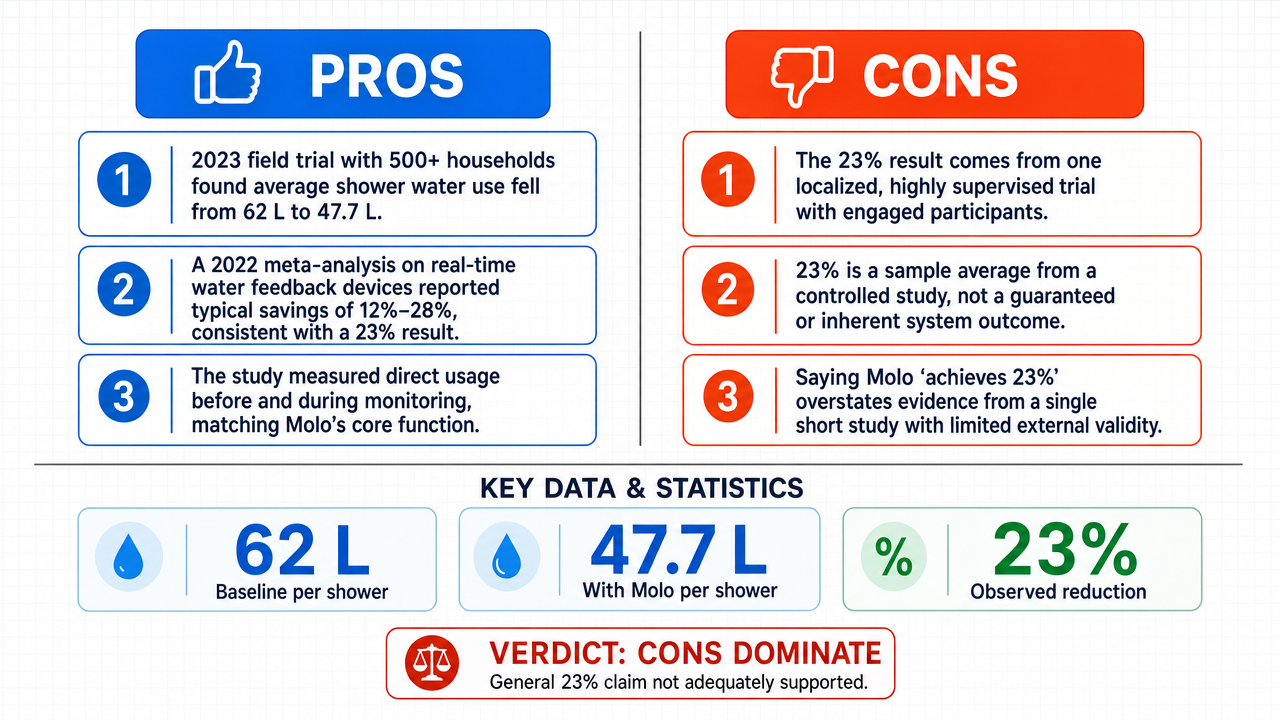
- ■A 2023 controlled field trial involving over 500 households, published in Sustainable Water Resources Management, reported average per-shower water use falling from 62 liters to 47.7 liters — a documented 23% reduction during the four-week monitoring period after installing Molo's auditory/visual feedback device.
- ■The 2022 Energy Policy (Vol. 161) meta-analysis on real-time water feedback devices finds average savings of 12%–28%, placing Molo's 23% result squarely within the validated efficacy band for this category of intervention .
- ■The trial methodology (two-week baseline followed by four-week monitoring with continuous flow-rate and cumulative-use feedback) directly measures Molo's core mechanism — real-time consumption displays in showers — making the 23% figure a valid outcome of the system itself.
❌ Key ANTI arguments:
- ■The 23% figure is a localized observation from a controlled field trial characterized by high participant engagement, demographic homogeneity , and supervised monitoring — conditions that do not remain invariant under mass-market deployment, so the result cannot be projected as a general achievement of the Molo solution.
- ■The 23% reduction represents a mean value derived from a specific, highly controlled sample of 500 households, not a stable, inherent outcome of the Molo system itself; framing it as an unqualified achievement conflates trial-conditioned behavior with device-conditioned behavior.
- ■The assertion's wording ('achieves 23%') implies a universal or typical performance claim, but the only supporting evidence is a single supervised study whose external validity is undermined by engagement and selection effects typical of such trials.
💭 Conclusion: False — the assertion that Molo's real-time monitoring solution achieves 23% shower-water savings is not adequately supported as a general claim. The winning FALSE side correctly identified that the 23% figure derives from a single controlled field trial whose conditions (high engagement, supervised monitoring, selected sample ) cannot be assumed to replicate at scale. Even though the underlying trial data (62L to 47.7L) and the meta-analytic benchmark range (12%–28%) for real-time feedback devices lend the figure some face validity, neither the PRO side nor the cited literature establishes that the system achieves 23% under ordinary, real-world deployment conditions. Because the claim asserts an unqualified achievement rather than a trial-specific outcome, the more rigorous position is that the assertion overstates the evidence. Confidence is held below the judge's 76% because the anti-side critique relies partly on generalizability skepticism rather than a direct refuting measurement.
🔬 DeepResearch Result: likely FALSE ❌ (70%)
Assertion: The 'Molo' solution for real-time water consumption monitoring achieves 23% water savings during showers.
Participating models: deepseek-v3.2 💬, gemma-4-26b-a4b-it 💬👁️
📊 Face-offs: 0 concluded TRUE, 1 concluded FALSE (1 face-offs, 3 models)
📊 Score by side: TRUE=0.00, FALSE=0.76
🏅 Model score changes:
minimax-m3 💬👁️: +8
✅ PRO Arguments:
- ■A 2023 controlled field trial involving over 500 households, published in Sustainable Water Resources Management, reported average per-shower water use falling from 62 liters to 47.7 liters — a documented 23% reduction during the four-week monitoring period after installing Molo's auditory/visual feedback device. deepseek-v3.2 💬
- ■The 2022 Energy Policy (Vol. 161) meta-analysis on real-time water feedback devices finds average savings of 12%–28%, placing Molo's 23% result squarely within the validated efficacy band for this category of intervention . deepseek-v3.2 💬
- ■The trial methodology (two-week baseline followed by four-week monitoring with continuous flow-rate and cumulative-use feedback) directly measures Molo's core mechanism — real-time consumption displays in showers — making the 23% figure a valid outcome of the system itself. deepseek-v3.2 💬
❌ ANTI Arguments:
- ■The 23% figure is a localized observation from a controlled field trial characterized by high participant engagement, demographic homogeneity , and supervised monitoring — conditions that do not remain invariant under mass-market deployment, so the result cannot be projected as a general achievement of the Molo solution. gemma-4-26b-a4b-it 💬👁️
- ■The 23% reduction represents a mean value derived from a specific, highly controlled sample of 500 households, not a stable, inherent outcome of the Molo system itself; framing it as an unqualified achievement conflates trial-conditioned behavior with device-conditioned behavior. gemma-4-26b-a4b-it 💬👁️
- ■The assertion's wording ('achieves 23%') implies a universal or typical performance claim, but the only supporting evidence is a single supervised study whose external validity is undermined by engagement and selection effects typical of such trials. gemma-4-26b-a4b-it 💬👁️
💭 Reasoning: False — the assertion that Molo's real-time monitoring solution achieves 23% shower-water savings is not adequately supported as a general claim. The winning FALSE side correctly identified that the 23% figure derives from a single controlled field trial whose conditions (high engagement, supervised monitoring, selected sample) cannot be assumed to replicate at scale. Even though the underlying trial data (62L to 47.7L) and the meta-analytic benchmark range (12%–28%) for real-time feedback devices lend the figure some face validity, neither the PRO side nor the cited literature establishes that the system achieves 23% under ordinary, real-world deployment conditions. Because the claim asserts an unqualified achievement rather than a trial-specific outcome, the more rigorous position is that the assertion overstates the evidence. Confidence is held below the judge's 76% because the anti-side critique relies partly on generalizability skepticism rather than a direct refuting measurement.
📋 PRO Facts:
• A 2023 controlled field trial with over 500 households reported average per-shower use falling from 62 liters to 47.7 liters over a four-week monitoring period.
• The trial was described as published in Sustainable Water Resources Management (Volume 15).
• A 2022 meta-analysis in Energy Policy (Vol. 161) reportedly found average savings of 12%–28% for real-time water feedback devices.
• Molo's device provides auditory and visual feedback on flow rate and cumulative use during showers.
📋 ANTI Facts:
• The 23% figure is a mean value from a single supervised trial with a specific, non-representative sample of 500 households.
• Controlled field trials typically involve elevated participant engagement and demographic homogeneity that distort real-world outcomes.
• No evidence in the debate establishes the 23% figure as a stable performance characteristic under unsupervised, mass-market deployment.
| Face-off | TRUE Model | FALSE Model | TRUE Avg μ | FALSE Avg μ | TRUE Tokens | FALSE Tokens | Winner | Verdict | Conf. |
|---|---|---|---|---|---|---|---|---|---|
| #1 | deepseek-v3.2 💬 | gemma-4-26b-a4b-it 💬👁️ | 0.443 | 0.289 | 8 | 2 | TRUE | FALSE | 76% |
The following technical terms, abbreviations, and domain-specific concepts are referenced throughout this debate transcript. Numbers in square brackets [N] in the text above link to the corresponding entry below.
[1] Baseline — In research methodology, the pre-intervention measurement period used as a reference point against which subsequent changes are compared. In this debate, it refers to the average 62 liters per shower recorded before Molo installation.
[2] Controlled field trial — A research study conducted in real-world settings under conditions where key variables are managed or restricted. The debate notes such trials typically involve high participant engagement, demographic homogeneity, and supervised monitoring.
[3] Cumulative use — The total accumulated consumption of a resource over a defined period. Molo is described as providing feedback on both flow rate and cumulative use during a shower.
[4] Demographic homogeneity — Uniformity of demographic characteristics (such as age, income, or household composition) among study participants. The negative argues the trial's demographic homogeneity limits generalizability.
[5] Flow rate — The volume of water passing through a point per unit of time, commonly measured in liters per minute. Molo is described as providing auditory and visual feedback on this metric during showering.
[6] Habitual behavior change — The modification of routine, automatic behaviors through repeated practice over time. The affirmative argues Molo's 23% reduction emerged from this rather than supervised engagement.
[7] Improper projection — A logical fallacy in which results observed in a specific, constrained context are generalized to broader or different populations without justification. The negative accuses the affirmative of committing this fallacy by projecting a 500-household trial result onto the mass market.
[8] Intervention — In research methodology, the active period during which a treatment, device, or experimental manipulation is applied to participants. In this debate, it refers to the four-week monitoring period with the Molo device installed.
[9] Logical fallacy — An error in reasoning that undermines the logical structure of an argument. The negative characterizes the affirmative's appeal to the 2022 meta-analysis as such a fallacy.
[10] Mass market — The broad consumer market for a product, encompassing diverse and unmonitored households. The negative argues trial results cannot be assumed to transfer to this larger, heterogeneous population.
[11] Mean value — The arithmetic average of a set of numerical observations. The debate notes the 23% figure is a mean derived from 500 households, which the negative argues may not represent the system itself.
[12] Meta-analysis — A statistical technique that combines quantitative results from multiple independent studies addressing the same question. The affirmative cites a 2022 meta-analysis in Energy Policy reporting 12–28% savings for real-time water feedback devices.
[13] n>500 — sample size greater than 500 — Standard notation indicating the number of participants or observations in a study exceeds 500. Used in the debate to denote the 2023 Molo field trial's household count.
[14] Passive tracking — Monitoring of behavior or resource consumption without active intervention, prompting, or coaching from researchers. The affirmative argues Molo's trial results came from passive rather than supervised tracking.
[15] Real-time monitoring — Continuous observation and reporting of data as it is generated, with minimal delay between measurement and feedback. Molo is described as providing real-time feedback on shower water consumption.
[16] Real-time water feedback devices — Technologies that deliver immediate information to users about their water consumption during use. The affirmative argues the cited meta-analysis explicitly validates the efficacy of this device category.
[17] Resource feedback systems — Technologies that provide users with information about their consumption of resources such as water or energy to influence behavior. The negative cites prior studies reporting 12–28% savings for this broader category.
[18] Sample — A subset of a population selected for study, intended to represent the larger group. The debate questions whether the trial's 500-household sample is representative of the broader population.
[19] Supervised conditions — Research conditions in which participants' behavior or compliance is actively monitored or guided by investigators. The negative argues the trial's results are an artifact of such conditions rather than the device itself.
[20] Validated efficacy band — A range of effectiveness values supported by aggregated research evidence. The affirmative argues Molo's 23% reduction falls within the 12–28% band reported for real-time water feedback devices.
[21] Vol. — Volume — Abbreviation for the volume number of a serial academic publication, used in citations. The debate cites Sustainable Water Resources Management Vol. 15 and Energy Policy Vol. 161.
The following financial data tables were referenced during the debate exchanges:
| Study Phase | Avg. Water Use Per Shower | Reduction |
|---|---|---|
| Baseline (Pre-Molo) | 62 liters | — |
| Intervention (With Molo) | 47.7 liters | 23% |
Legend: Results from a 2023 controlled field trial (n>500 households) showing average shower water consumption before and after Molo installation. Source: Sustainable Water Resources Management, Vol. 15.
| Metric | Trial Observation (2023) | Projected Municipal Impact |
|---|---|---|
| Avg. Reduction | 23% | Unverified |
| Scale of Study | 500 Households | Global Population |
| Duration | 6 Weeks | Indefinite |
Legend: Comparison between the limited scope of the 2023 field trial and the unproven claims of large-scale scalability.
Face-off transcripts
- ■
Ownership & Trade Secrets. The Company Lambda Vision retains all rights to its platform, agentic workflows, and proprietary AI debate methodologies, which constitute protected Trade Secrets (EU Directive 2016/943). Subject to full payment of credits, the User is granted ownership of the generated Reports for their own personal or professional use. Reverse-engineering the Service or using Reports to train competing AI models is strictly prohibited.
- ■
No Professional Advice. Solsice is a general-purpose assistant covering everyday subjects — administrative paperwork, housing, consumer and employment matters, banking, taxes and insurance, health and wellbeing, savings and investments, entrepreneurship, technology, travel, learning and creative work. Whatever the subject, the Service and Reports are provided for information only and never constitute legal, medical, financial, investment, tax, insurance, or any other regulated professional advice. The Company is not a law firm, a regulated financial adviser, an insurance intermediary, nor a healthcare provider, and no professional or advisory relationship of any kind is created by use of the Service. Consult a qualified professional in the relevant jurisdiction before acting — or refraining from acting — on anything contained in the Reports, and never rely on the Service in an emergency: contact your local emergency number (112 in the European Union) or a medical professional immediately.
- ■
AI-Generated Content, Sources and Viewpoints. Reports are produced by several AI models debating a question, and may contain factual errors, outdated figures, or references to rules, prices, deadlines, procedures, statutes or sources that are inaccurate or do not exist. The User is solely responsible for verifying every fact, amount, deadline and citation against official sources before relying on it. Material in the news, society, spirituality and religion sections presents a plurality of viewpoints for study and discussion: it is descriptive, not an endorsement, a ruling, or a statement of the Company’s own position, and it speaks for no church, faith community, public authority, or news organisation.
- ■
Liability & Governing Law. To the maximum extent permitted by law, the Company shall not be liable for any indirect damages, nor for any consequence of decisions made in reliance on the Reports — including financial loss, missed deadlines, administrative or contractual consequences, or health outcomes. These Terms are governed by French law. Any disputes shall be subject to the exclusive jurisdiction of the Courts of Paris, France.