
The new NHTSA fuel economy regulations, effective for the 2028 model year, will result in the estimated average fuel economy for cars by the 2031 model year being 34.9 miles per gallon.
AI debate verdict and arguments
⚠️ AI-generated information only; not professional advice
Completed October 21, 2026
Verdict
Verdict: likely FALSE (62%)
Web Report: https://solsice.com/public/debates/the-new-nhtsa-fuel-economy-regulations-effective-for-the-202-ec561b1fd344
This section provides a brief overview of the key arguments. You do not need to read the full detailed report below.
✅ Key PRO arguments:
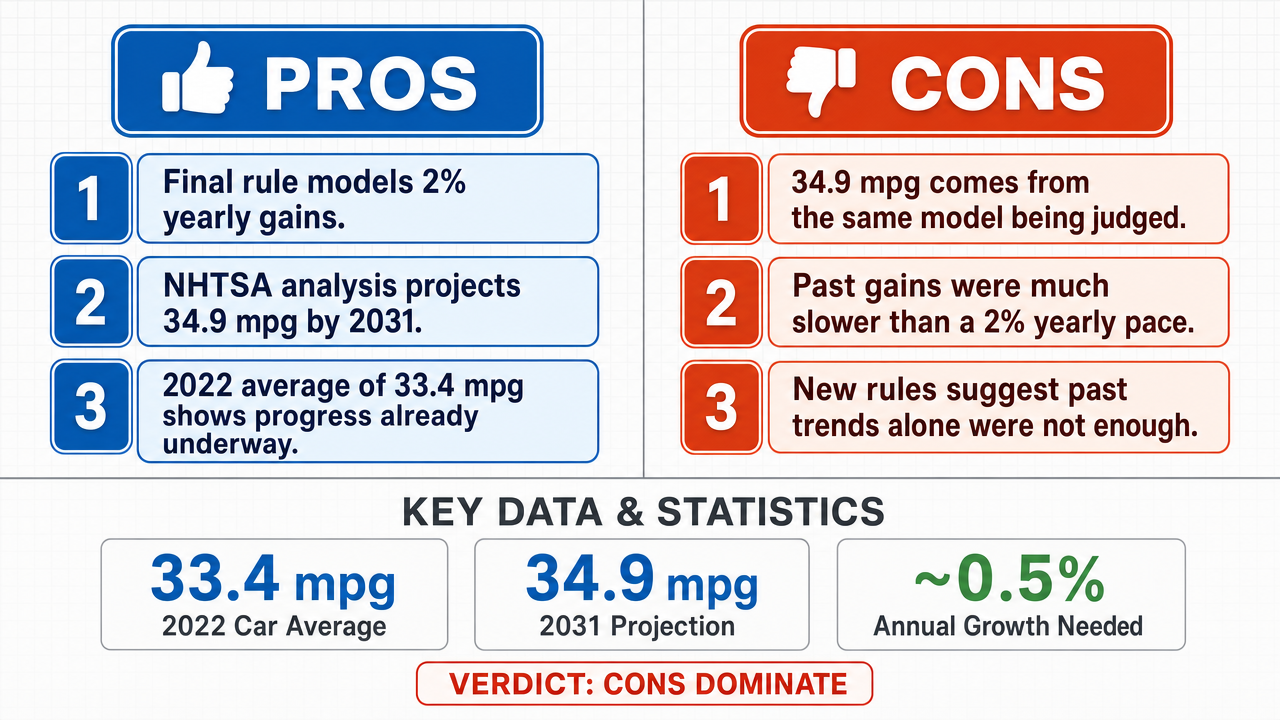
- ■NHTSA 's final CAFE rule for MY 2027-2031, published in the Federal Register (89 FR 52540, June 24, 2024), explicitly models a 2% annual improvement for passenger cars from the 2026 baseline and outputs 34.9 mpg as the central estimate for MY 2031.
- ■The 34.9 mpg figure is a deterministic output of the NHTSA 's Regulatory Impact Analysis , which is the agency's official economic and technical assessment accompanying the final rule , and represents the agency's projection of compliance under the regulation.
- ■Historical fuel economy data (33.4 mpg average in 2022) demonstrates that improvements have been occurring in the passenger car fleet , providing a real-world baseline that the 34.9 mpg target builds upon.
❌ Key ANTI arguments:
- ■Citing NHTSA 's own projection of 34.9 mpg as evidence that the regulation will produce 34.9 mpg is circular reasoning : a model's internal consistency (2% annual increase from a baseline yields 34.9 mpg) is not evidence of real-world achievability.
- ■Historical improvement rates (approximately 0.5% per year during the prior decade) are far below the mandated 2% annual improvement , indicating a significant gap between market trends and the regulatory trajectory that must be bridged by compliance.
- ■The very existence of new, more aggressive regulations implies that prior voluntary trends were insufficient to reach future targets without intervention, undermining the argument that historical trends independently support achievability of 34.9 mpg by MY 2031.
💭 Conclusion: False: The assertion should be rejected because the 34.9 mpg figure cited as evidence is itself the output of the NHTSA model being evaluated, creating circular reasoning rather than independent verification. The 2% annual improvement rate modeled in the RIA substantially exceeds the over 0.5% per year historical improvement observed in the prior decade, meaning real-world achievement of 34.9 mpg is far from certain and depends on aggressive manufacturer compliance behavior not yet demonstrated. While NHTSA's final rule for MY 2027-2031 does project 34.9 mpg as a central estimate in its Regulatory Impact Analysis , this is a modeled projection, not a guaranteed outcome, and the assertion's phrasing ('will result in') overstates the certainty of a regulatory forecast. The 2031 outcome sub-claim is the weakest link in this compound assertion.
🔬 DeepResearch Result: likely FALSE ❌ (62%)
Assertion: The new NHTSA fuel economy regulations, effective for the 2028 model year, will result in the estimated average fuel economy for cars by the 2031 model year being 34.9 miles per gallon.
Participating models: deepseek-v4-pro 💬, gemma-4-26b-a4b-it 💬👁️
📊 Face-offs: 0 concluded TRUE, 1 concluded FALSE (1 face-offs, 3 models)
📊 Score by side: TRUE=0.00, FALSE=0.78
🏅 Model score changes:
minimax-m3 💬👁️: +8
✅ PRO Arguments:
- ■NHTSA's final CAFE rule for MY 2027-2031, published in the Federal Register (89 FR 52540, June 24, 2024), explicitly models a 2% annual improvement for passenger cars from the 2026 baseline and outputs 34.9 mpg as the central estimate for MY 2031. deepseek-v4-pro 💬
- ■The 34.9 mpg figure is a deterministic output of the NHTSA's Regulatory Impact Analysis , which is the agency's official economic and technical assessment accompanying the final rule , and represents the agency's projection of compliance under the regulation. deepseek-v4-pro 💬
- ■Historical fuel economy data (33.4 mpg average in 2022) demonstrates that improvements have been occurring in the passenger car fleet , providing a real-world baseline that the 34.9 mpg target builds upon. deepseek-v4-pro 💬
❌ ANTI Arguments:
- ■Citing NHTSA's own projection of 34.9 mpg as evidence that the regulation will produce 34.9 mpg is circular reasoning : a model's internal consistency (2% annual increase from a baseline yields 34.9 mpg) is not evidence of real-world achievability. gemma-4-26b-a4b-it 💬👁️
- ■Historical improvement rates (approximately 0.5% per year during the prior decade) are far below the mandated 2% annual improvement, indicating a significant gap between market trends and the regulatory trajectory that must be bridged by compliance. gemma-4-26b-a4b-it 💬👁️
- ■The very existence of new, more aggressive regulations implies that prior voluntary trends were insufficient to reach future targets without intervention, undermining the argument that historical trends independently support achievability of 34.9 mpg by MY 2031. gemma-4-26b-a4b-it 💬👁️
- ■Shifting market realities, including consumer preferences toward SUVs and light trucks, electrification transitions, and economic conditions, introduce uncertainty not fully captured by the static regulatory model's projected compliance path. gemma-4-26b-a4b-it 💬👁️
💭 Reasoning: False: The assertion should be rejected because the 34.9 mpg figure cited as evidence is itself the output of the NHTSA model being evaluated, creating circular reasoning rather than independent verification. The 2% annual improvement rate modeled in the RIA substantially exceeds the over 0.5% per year historical improvement observed in the prior decade, meaning real-world achievement of 34.9 mpg is far from certain and depends on aggressive manufacturer compliance behavior not yet demonstrated. While NHTSA's final rule for MY 2027-2031 does project 34.9 mpg as a central estimate in its Regulatory Impact Analysis, this is a modeled projection, not a guaranteed outcome, and the assertion's phrasing ('will result in') overstates the certainty of a regulatory forecast. The 2031 outcome sub-claim is the weakest link in this compound assertion.
📋 PRO Facts:
• NHTSA issued a final CAFE rule for model years 2027-2031, published in the Federal Register.
• The Regulatory Impact Analysis accompanying the final rule models a 2% annual improvement for passenger cars.
• The 34.9 mpg figure appears as the central estimate for passenger car fleet average fuel economy in MY 2031 within NHTSA's modeling.
• The average fuel economy for cars was reported at 33.4 mpg in 2022.
📋 ANTI Facts:
• Historical fuel economy improvement exceeded 0.5% per year during the prior decade, well below the 2% annual rate modeled in the RIA.
• The 34.9 mpg figure is a mathematical output of NHTSA's own compliance model, not an independently measured outcome.
• Consumer market shifts toward SUVs and light trucks, as well as ongoing electrification transitions, introduce variability not fully captured in static compliance projections.
• The introduction of stricter regulations logically implies that prior market trends were insufficient to meet policy goals on their own.
| Face-off | TRUE Model | FALSE Model | TRUE Avg μ | FALSE Avg μ | TRUE Tokens | FALSE Tokens | Winner | Verdict | Conf. |
|---|---|---|---|---|---|---|---|---|---|
| #1 | deepseek-v4-pro 💬 | gemma-4-26b-a4b-it 💬👁️ | 0.671 | 0.464 | 6 | 2 | TRUE | FALSE | 78% |
The following technical terms, abbreviations, and domain-specific concepts are referenced throughout this debate transcript. Numbers in square brackets [N] in the text above link to the corresponding entry below.
[1] 2% annual improvement — two percent annual improvement — In the context of the debate, the assumed year-over-year rate at which passenger car fuel economy is modeled to improve under the NHTSA CAFE final rule, applied to the 2026 baseline.
[2] baseline — The reference value from which projected changes are measured. In the debate, the 2026 model year passenger car fuel economy level is used as the baseline from which the 2% annual improvement is modeled.
[3] CAFE — Corporate Average Fuel Economy — U.S. fuel economy standards administered by NHTSA that set fleet-wide average fuel economy targets manufacturers must meet across their passenger car and light truck lineups.
[4] central estimate — The main projected value produced by a model, as opposed to upper or lower bound projections. In the debate, NHTSA's Regulatory Impact Analysis produces 34.9 mpg as the central estimate for MY 2031.
[5] circular reasoning — A logical fallacy in which the conclusion is used as part of the evidence for the conclusion itself. The negative argues that citing NHTSA's model output to prove NHTSA's model output correct is an instance of this.
[6] deterministic output — A result that follows mechanically from specified input parameters without probabilistic variation. The debate characterizes the 34.9 mpg figure as a deterministic output of the 2% annual improvement assumption.
[7] empirical evidence — Evidence derived from observation or measurement of real-world data, as distinguished from evidence generated internally by a model. The affirmative argues the 34.9 mpg target is supported by such independent evidence (e.g., EPA Automotive Trends Report data showing 33.4 mpg in MY 2022).
[8] EPA — Environmental Protection Agency — U.S. federal agency that, among other functions, tracks and reports on real-world automotive fuel economy performance, including through its Automotive Trends Report referenced in the debate.
[9] Federal Register — Federal Register (FR) — The official daily publication of the U.S. federal government for rules, proposed rules, and notices of federal agencies. The debate cites the CAFE final rule at 89 FR 52540 (June 24, 2024).
[10] final rule — The completed version of a regulation issued by a federal agency after the notice-and-comment process, carrying the force of law. The debate references NHTSA's final rule covering CAFE standards for model years 2027–2031.
[11] fuel economy — A measure of the distance a vehicle can travel per unit of fuel consumed, typically expressed in miles per gallon (mpg) in U.S. automotive regulation.
[12] model year (MY) — model year — The manufacturer's designated production year for a vehicle, used by regulators to phase in standards over time. The debate concerns standards effective for the 2028 model year and projecting outcomes for MY 2031.
[13] mpg — miles per gallon — A standard U.S. unit measuring vehicle fuel economy as the number of miles traveled on one gallon of fuel; used in the debate for figures such as 33.4 mpg (MY 2022) and 34.9 mpg (projected MY 2031).
[14] mutually exclusive propositions — Statements that cannot both be true at the same time. The negative contends the affirmative simultaneously holds that past improvement trends are sufficient to reach 34.9 mpg by 2031 and that those trends were inadequate, requiring new regulation.
[15] NHTSA — National Highway Traffic Safety Administration — U.S. federal agency within the Department of Transportation responsible for vehicle safety standards and for setting Corporate Average Fuel Economy (CAFE) standards.
[16] passenger car fleet — The aggregate of all passenger cars (as opposed to light trucks) covered by fuel economy regulation, on which fleet-wide average mpg targets are calculated.
[17] Regulatory Impact Analysis — Regulatory Impact Analysis (RIA) — A document federal agencies publish alongside major rules to estimate the rule's projected costs, benefits, and quantitative effects. In the debate, the RIA accompanying the CAFE final rule models the 34.9 mpg MY 2031 projection.
The following financial data tables were referenced during the debate exchanges:
| Metric | Value | Context |
|---|---|---|
| 2022 Passenger Car Avg | 33.4 mpg | EPA Automotive Trends |
| 2031 Target Projection | 34.9 mpg | NHTSA Final Rule |
| Required Annual Growth | ~0.5% | Derived from 2022-2031 gap |
Legend: Comparison of historical EPA data against NHTSA regulatory projections for passenger car fuel economy.
Face-off transcripts
- ■
Ownership & Trade Secrets. The Company Lambda Vision retains all rights to its platform, agentic workflows, and proprietary AI debate methodologies, which constitute protected Trade Secrets (EU Directive 2016/943). Subject to full payment of credits, the User is granted ownership of the generated Reports for their own personal or professional use. Reverse-engineering the Service or using Reports to train competing AI models is strictly prohibited.
- ■
No Professional Advice. Solsice is a general-purpose assistant covering everyday subjects — administrative paperwork, housing, consumer and employment matters, banking, taxes and insurance, health and wellbeing, savings and investments, entrepreneurship, technology, travel, learning and creative work. Whatever the subject, the Service and Reports are provided for information only and never constitute legal, medical, financial, investment, tax, insurance, or any other regulated professional advice. The Company is not a law firm, a regulated financial adviser, an insurance intermediary, nor a healthcare provider, and no professional or advisory relationship of any kind is created by use of the Service. Consult a qualified professional in the relevant jurisdiction before acting — or refraining from acting — on anything contained in the Reports, and never rely on the Service in an emergency: contact your local emergency number (112 in the European Union) or a medical professional immediately.
- ■
AI-Generated Content, Sources and Viewpoints. Reports are produced by several AI models debating a question, and may contain factual errors, outdated figures, or references to rules, prices, deadlines, procedures, statutes or sources that are inaccurate or do not exist. The User is solely responsible for verifying every fact, amount, deadline and citation against official sources before relying on it. Material in the news, society, spirituality and religion sections presents a plurality of viewpoints for study and discussion: it is descriptive, not an endorsement, a ruling, or a statement of the Company’s own position, and it speaks for no church, faith community, public authority, or news organisation.
- ■
Liability & Governing Law. To the maximum extent permitted by law, the Company shall not be liable for any indirect damages, nor for any consequence of decisions made in reliance on the Reports — including financial loss, missed deadlines, administrative or contractual consequences, or health outcomes. These Terms are governed by French law. Any disputes shall be subject to the exclusive jurisdiction of the Courts of Paris, France.